Copyright owners sometimes are faced with an infringement matter that requires action. These situations raise an important question: “Can you sue for copyright infringement without registration?” In the United States, copyright protection is automatic. It exists as soon as an original work is created and fixed in a tangible medium of expression. However, U.S. copyright law generally requires a registration before the copyright owner can file an infringement lawsuit in federal court. In practice, this means you must register your copyright to sue for copyright infringement. This article breaks down the rules under U.S. copyright law, the role of the U.S. Copyright Office, and why timely registration is crucial for obtaining remedies like statutory damages and attorney’s fees in an infringement suit.
Under U.S. law, you automatically own the copyright in any original work of authorship once it is fixed in a tangible medium of expression (e.g., writing an article, saving a digital photo, or recording a song). You do not have to file anything to have copyright protection, the copyright exists from the moment the work is created. Copyright covers a wide range of creative works both published and unpublished, including various forms such as:
The copyright owner immediately enjoys certain exclusive rights granted by copyright law. For example, the rights to reproduce the work, distribute it, create derivative works from it, and to perform or display the work publicly. These rights give the owner control over how the copyrighted work is used.
Copyright infringement occurs when someone exercises one of the copyright owner’s exclusive rights without permission (i.e. without a license or authorization). In legal terms, 17 U.S.C. § 501(a) provides that “anyone who violates any of the exclusive rights of the copyright owner… is an infringer”. Those exclusive rights include the right to reproduce the work, to distribute copies, to prepare derivative works, and to perform or display the work publicly. Any unauthorized use of these rights (e.g., copying your article or photo and posting it online without your permission) will constitute an act of infringement, giving rise to a civil copyright infringement claim by the copyright holder. In other words, if someone uses your creative work without a license or consent, that person is infringing your copyright. The copyright owner would then have the right to take legal action by filing a copyright infringement suit to enforce their exclusive rights.
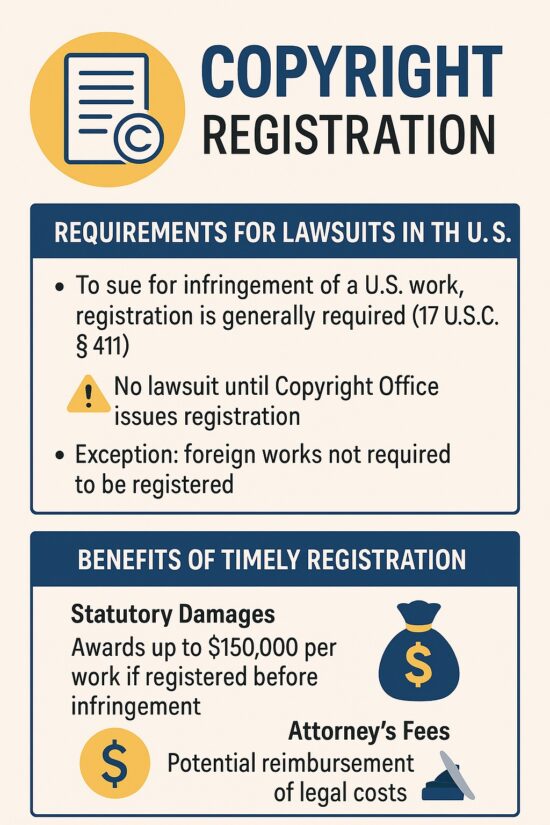
While your work is protected by copyright automatically, U.S. copyright law makes copyright registration a prerequisite to filing a lawsuit for infringement of any United States work. In fact, the Copyright Act says “no civil action for infringement of the copyright in any United States work shall be instituted until registration of the copyright claim has been made”. This means that if your work is considered a U.S. work (e.g. first published in the U.S.), you cannot sue the infringer in federal court until you have a Certificate of Registration from the U.S. Copyright Office. U.S. federal courts have exclusive jurisdiction over copyright claims, so registration is essentially your entry ticket to court for U.S. works.
The Supreme Court underscored this rule in Fourth Estate Pub. Benefit Corp. v. Wall-Street.com, 139 S.Ct. 881 (2019), unanimously holding that copyright owners must wait until the Copyright Office actually issues a registration before filing an infringement lawsuit. Simply submitting a registration application is not enough. The registration has to be granted by the Copyright Office for the suit to proceed. If you file a lawsuit before registration, the court will dismiss the case for failure to meet this statutory requirement.
The law provides only a few narrow exceptions where a suit can proceed without registration. For example, claims under the Visual Artists Rights Act, which protects certain moral rights of attribution/integrity for visual art, and certain cases involving works fixed during live broadcasts under 17 U.S.C. §411(c). These are uncommon scenarios. For nearly all typical infringement cases (e.g. unauthorized use of your business’s marketing materials, software, photos, etc.), registration is required before you can bring a civil infringement action.
The registration prerequisite applies only to “United States works.” If your work is a non-U.S., foreign work, U.S. law does not require registration to sue. This distinction exists because of international treaty obligations under the Berne Convention, which prohibit member countries from imposing formalities like registration on foreign works as a condition of protection. In other countries, generally you can sue for copyright infringement without registration, as most countries do not have a registration requirement for enforcement. For example, a UK or Canadian copyright owner can usually go straight to court since their copyright laws recognize copyright automatically upon creation.
However, if you are a foreign copyright owner suing in a U.S. court, you should explicitly plead and prove the foreign status of your work to be exempt from the registration rule. Courts have dismissed lawsuits by foreign plaintiffs who failed to allege that their works were not “United States works.” In practice, it’s wise even for foreign authors to consider U.S. registration, not only to avoid any confusion about eligibility to sue, but also to access the full range of remedies, such as statutory damages. And while registration is typically optional abroad, some countries have voluntary copyright registries that can serve as public record or evidence of ownership.
Registering your copyright not only allows you to sue, but also unlocks important legal remedies. Perhaps the biggest advantages of timely registration are the ability to seek statutory damages and attorney’s fees from the infringer in a successful lawsuit. Statutory damages are pre-set monetary awards defined by the Copyright Act, ranging from $750 to $30,000 per work infringed, and up to $150,000 per work for willful infringement. These damages can be awarded without needing to prove your actual monetary loss. By contrast, if you haven’t preserved the right to statutory damages, you are limited to actual damages, which may be your lost profits or the infringer’s profits attributable to the infringement, which you must prove with evidence. Proving actual damages can be difficult and may result in lower recovery, especially if the actual funds lost from the infringement are small or hard to quantify.
Attorney’s fees can also be awarded to the prevailing party at the court’s discretion under 17 U.S.C. §505. However, to be eligible for an award of attorney’s fees and statutory damages, the copyright must have been registered timely. “Timely” generally means before the infringement occurs, or if the work was published, within three months of its first publication, as provided under 17 U.S.C. §412. If you do not register before infringement begins, the law bars you from recovering statutory damages or attorney’s fees for that infringement. In a practical sense, this can make a huge difference. For example, a business whose work was infringed but not registered may only recover perhaps a few thousand dollars of actual damages or in some cases $0 if actual loss can’t be proven, and would have to pay its own lawyers. Such a scenario may make litigation not worth the cost. Conversely, a business with a registered work can threaten statutory damages up to $150,000 plus attorney’s fees for willful infringement, creating a strong incentive for an infringer to settle or for the court to fully compensate the copyright owner.
Failing to register in time means you cannot “seek statutory damages” or reimbursement of attorneys’ fees in court for past infringement. You would be limited to proving and obtaining actual damages and stopping further infringement via injunction. These actual losses are often lower than statutory awards and successful litigation may not even be economically feasible without the prospect of statutory damages and fee-shifting. Timely registration ensures you retain the right to these powerful remedies, which can be critical in an infringement action.
It is important to understand that even if you missed registering before an infringement, you can still register and then file a copyright infringement lawsuit, but your remedies will be limited as noted above. Once you do obtain a registration, you can sue to stop the unauthorized use and claim any provable actual damages and infringer’s profits from the misuse of your work. The infringer does not get a “free pass” simply because you hadn’t registered at the time of infringement. The infringer may still be found liable and be ordered to pay for the damage done to you. However, any infringement that occurred before the effective date of your registration will not qualify for statutory damages or attorney’s fees under the Copyright Act. Only infringements that commence after your registration or after timely copyright registration within the publication grace period can potentially yield those enhanced remedies. This is why many copyright owners choose to register early, even if no infringement is yet known. It is an investment in being able to fully enforce your rights should infringement occur.
Additionally, registering your work provides an evidentiary benefit in court. Specifically, if you register before an infringement or within five years of first publication, your certificate of registration is treated as prima facie evidence of the validity of your copyright and of the facts in the certificate, including your ownership. In an infringement lawsuit, the copyright owner must prove ownership of a valid copyright and prove infringement by the defendant. A timely copyright registration creates several benefits, including a presumption that your copyright is valid, which can make it easier to prove the first element of infringement in court. The burden would shift to the defendant to rebut your ownership or the copyright’s validity. Without registration, you may need to provide additional proof of your ownership and the work’s originality/creation date. Thus, registration can strengthen your position in litigation beyond just the damages. It helps establish your case from the outset, contributing to more successful litigation outcomes.
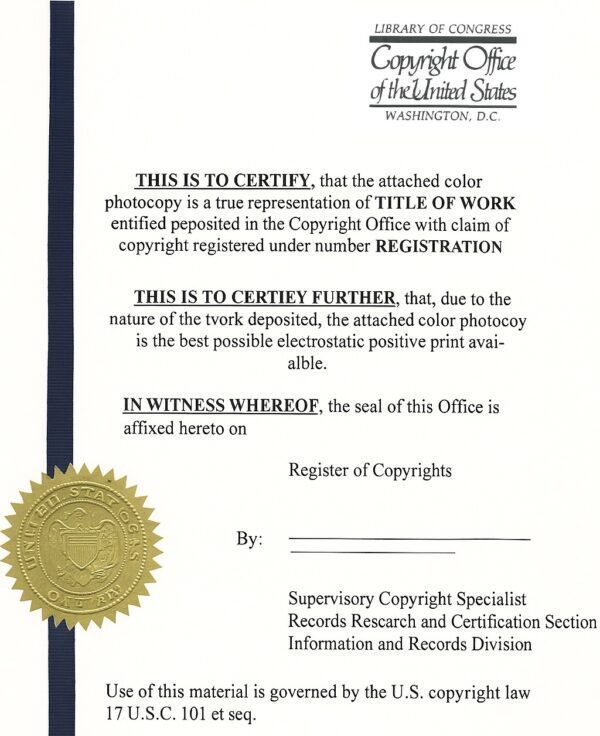
Registering a copyright with the U.S. Copyright Office is a relatively straightforward process. It involves filing a copyright application, commonly done online via the Electronic Copyright Office portal, paying a filing fee, and submitting copies of the work referred to as a “deposit” to the Copyright Office. Once the Office examines and approves the claim, it will issue a Certificate of Registration under its seal, and that certificate will list details like the title, author, owner, and effective date of registration. The effective date is important. It is the date the Copyright Office received your complete application and fee, not the date they finally issue the certificate.
In recent years, standard copyright registrations can take anywhere from a few weeks to several months for the Copyright Office to process, depending on the complexity of the work and backlog. The average processing time is often around 4–6 months, and it could be longer if the examiner raises issues that must be addressed before registration. If you anticipate an infringement lawsuit or need a registration quickly, the Copyright Office offers an expedited service called “special handling.” For an additional fee, you can request special handling to have your application processed on an urgent basis if there is pending or prospective litigation. An application under special handling may be processed in a few days to a few weeks. Many copyright owners use this option when they discover infringement and need to sue immediately, essentially paying extra to get the registration issued so they can proceed to court.
It’s best practice to register your work as early as possible, ideally within three months of first publication, so that you qualify for the full range of remedies if an infringement occurs. If you register within that 3-month window after publication, any infringement that happens in those first months after publication is still eligible for statutory damages and attorney’s fees. The law treats the registration as if it were in place at the time of infringement. If you wait longer than three months after publishing to register and someone infringes in the interim, you have potentially lost the chance to recover those enhanced damages for that period. Therefore, timely registration is crucial for valuable works.
Aside from enabling lawsuits and damages, certificate of registration also creates a public record of your claim to copyright. The details of your registration go into the Copyright Office’s database (e.g., listing the copyright holder, dates, etc.), which puts the world on notice that you claim ownership. This can deter potential infringers and helps others who may seek to license or get permission to find the owner easily, since the registration can include contact info for licensing requests. In sum, registering your works promptly will protect your ability to enforce your rights and maximize your legal remedies if infringement arises.
In the U.S., for works of U.S. origin, you must register your copyright before you can file an infringement lawsuit. Copyright protection may be automatic, but enforcing your rights is another matter. Registration is a critical step that empowers the copyright owner to bring a civil action in federal court and to claim powerful remedies like statutory damages and attorney’s fees. If you skip registration or delay it, you risk losing out on those remedies and weakening your position against an alleged infringer. On the other hand, timely copyright registration sets you up for successful litigation if needed, establishing a public record, providing legal presumptions of ownership, and allowing recovery of statutory damages and attorney's fees if infringement occurs. With the proper registration and legal guidance, you can confidently sue for copyright infringement when necessary and seek the full remedies that copyright law provides to the copyright holder.
The takeaway is clear: register your copyrights in your important creative works early. The cost and effort of registration are small compared to the protection and advantages it provides. If you have concerns related to unregistered copyrights or discover an infringement, contact our office to consult with an experienced intellectual property attorney.
© 2025 Sierra IP Law, PC. The information provided herein does not constitute legal advice, but merely conveys general information that may be beneficial to the public, and should not be viewed as a substitute for legal consultation in a particular case.

"Mark and William are stellar in the capabilities, work ethic, character, knowledge, responsiveness, and quality of work. Hubby and I are incredibly grateful for them as they've done a phenomenal job working tirelessly over a time span of at least five years on a series of patents for hubby. Grateful that Fresno has such amazing patent attorneys! They're second to none and they never disappoint. Thank you, Mark, William, and your entire team!!"
Linda Guzman


Sierra IP Law, PC - Patents, Trademarks & Copyrights
FRESNO
7030 N. Fruit Ave.
Suite 110
Fresno, CA 93711
(559) 436-3800 | phone
BAKERSFIELD
1925 G. Street
Bakersfield, CA 93301
(661) 200-7724 | phone
SAN LUIS OBISPO
956 Walnut Street, 2nd Floor
San Luis Obispo, CA 93401
(805) 275-0943 | phone

SACRAMENTO
180 Promenade Circle, Suite 300
Sacramento, CA 95834
(916) 209-8525 | phone
MODESTO
1300 10th St., Suite F.
Modesto, CA 95345
(209) 286-0069 | phone
SANTA BARBARA
414 Olive Street
Santa Barbara, CA 93101
(805) 275-0943 | phone
SAN MATEO
1650 Borel Place, Suite 216
San Mateo, CA, CA 94402
(650) 398-1644. | phone
STOCKTON
110 N. San Joaquin St., 2nd Floor
Stockton, CA 95202
(209) 286-0069 | phone
PORTLAND
425 NW 10th Ave., Suite 200
Portland, OR 97209
(503) 343-9983 | phone
TACOMA
1201 Pacific Avenue, Suite 600
Tacoma, WA 98402
(253) 345-1545 | phone
KENNEWICK
1030 N Center Pkwy Suite N196
Kennewick, WA 99336
(509) 255-3442 | phone
2023 Sierra IP Law, PC - Patents, Trademarks & Copyrights - All Rights Reserved - Sitemap Privacy Lawyer Fresno, CA - Trademark Lawyer Modesto CA - Patent Lawyer Bakersfield, CA - Trademark Lawyer Bakersfield, CA - Patent Lawyer San Luis Obispo, CA - Trademark Lawyer San Luis Obispo, CA - Trademark Infringement Lawyer Tacoma WA - Internet Lawyer Bakersfield, CA - Trademark Lawyer Sacramento, CA - Patent Lawyer Sacramento, CA - Trademark Infringement Lawyer Sacrament CA - Patent Lawyer Tacoma WA - Intellectual Property Lawyer Tacoma WA - Trademark lawyer Tacoma WA - Portland Patent Attorney - Santa Barbara Patent Attorney - Santa Barbara Trademark Attorney
