Understanding Trademark Symbols
Trademarks are a form of intellectual property that identify a source of goods or services: names, logos, slogans, and other brand elements that distinguish a business’s goods or services. In the United States, business owners commonly use two symbols with their trademarks: TM (™) and ® (R in a circle). Understanding the difference between TM and R is important for anyone looking to safeguard their brand. The trademark symbols you use signal the legal status of your mark and carry important implications for trademark protection and enforcement. We explain here the meaning of these two symbols, when to use each, and the legal consequences of their use or misuse under U.S. law.
Key Takeaways
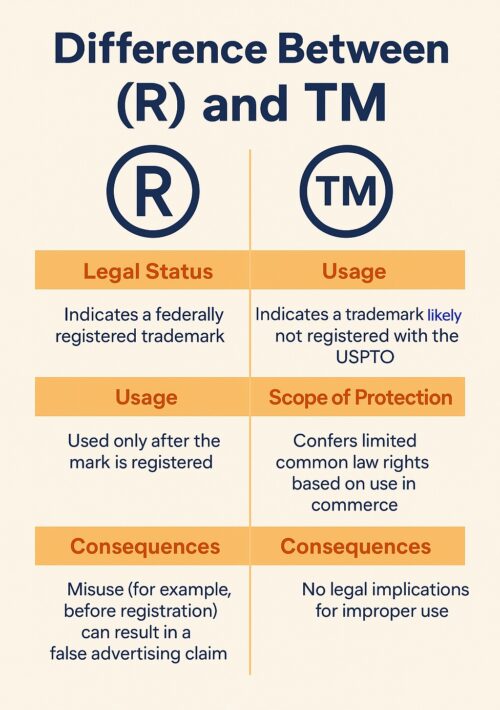
- TM Symbol (™) – The “TM” symbol stands for “trademark” and is used to claim rights in a word, logo, or phrase as a trademark even if it is not registered. It can be used by any business or individual to put the public and potential infringers on notice that a particular mark is claimed as a trademark. Using the TM symbol establishes your intent to assert unregistered, common law rights in the mark, but it does not carry the legal presumption of nationwide validity that federal registration provides.
- ® Symbol (R in a circle) – The “®” symbol indicates a mark that has been officially registered with the U.S. Patent and Trademark Office (USPTO). It signifies that the owner has exclusive rights to that mark for the registered goods/services and that the mark is legally protected under federal law. The ® symbol should only be used after trademark registration is granted. Registration provides the strongest protection for your brand and conveys a legal presumption of your nationwide ownership and rights.
- Unregistered vs. Registered Rights – In the U.S., you can have a valid trademark without registration (under common law), but unregistered trademarks are generally limited to the geographic area or market where you operate. Federal trademark registration expands your rights nationwide and gives you several procedural advantages. A registered mark comes with presumptions of validity and ownership, making enforcement against infringers easier, whereas an unregistered mark places a higher burden on the owner to prove ownership and scope of rights if a dispute arises.
- Legal Protection and Enforcement – Both registered and unregistered trademarks can be protected under U.S. law. Unregistered, common law marks are protected by state law and Section 43(a) of the Lanham Act (15 U.S.C. § 1125(a)) against infringement (false designation of origin). However, a federal registration gives additional benefits in enforcement: the owner can sue for infringement under 15 U.S.C. § 1114 with the benefit of presumptive ownership, can obtain statutory damages or attorneys’ fees in certain cases, and gains “constructive notice” to prevent others from claiming innocent use.
- Use of Symbols and Consequences – Use the appropriate symbol for your situation: TM (or SM for services) for unregistered marks, and ® only for registered marks. Misusing the ® symbol (using it without a registration) is unlawful and considered a form of false advertising, and possibly fraud. In fact, U.S. courts have noted that falsely claiming a mark is registered (for example, by affixing “Registered U.S. Patent Office” or ® to an unregistered mark) creates a prima facie case of fraud against the public. Conversely, failing to use the ® on a registered mark can limit your legal remedies. Under U.S. law, if you fail to use the ® symbol with your mark, you cannot recover profits or damages from an infringer unless the infringer had actual notice of your registered trademark rights.
TM Symbol: Claiming an Unregistered Trademark
The TM symbol (™) is a notification to the world that you consider a mark (such as a name, logo, or slogan) to be your trademark. Importantly, no registration is required to use the TM symbol. Any company or individual can add "TM" to their brand name or logo to stake a claim to trademark rights. Using TM with your brand signifies your intent to claim trademark rights, even though those rights are based on use (so-called common law trademark rights) rather than a government registration.
When you use the TM symbol, you are asserting that you own that mark within your market and are putting others on notice of your claim. This can deter competitors from adopting a confusingly similar name or logo, as it serves as a warning that you will defend your brand. However, the legal protection for a TM-designated mark is limited compared to a registered mark. Common law rights arise automatically when you create and use a mark in commerce, but they extend only to the geographic area or scope of market where the mark is actually used and known by consumers. For example, if your small business uses a business or brand name locally and has not registered it, you can use the “Name™” format and gain rights in your region. However, another company in a different state might use the same name without violating your trademark rights, if they are outside your established market.
It’s worth noting that service marks (marks for services rather than goods) are often also denoted by TM in practice. Technically, the SM symbol (℠) is available to indicate a “service mark” used for services like consulting or banking. In the same way as TM, SM notifies others of an unregistered service mark. For example, a law firm could use “XYZ Legal℠” for legal services. Both TM and SM have the same legal effect. They do not carry any government imprimatur, but they tell the public that the brand is claimed as a trademark. The Lanham Act and state laws protect unregistered marks against confusing uses by others, but as the trademark owner you will need to prove the validity and priority of your mark in any enforcement action, since you lack the automatic presumption that comes with registration.
® Symbol: Signifying a Registered Trademark
The ® symbol is reserved for registered trademarks. In the United States, this means the mark has been officially registered with the federal USPTO. Using ® gives immediate visual notice that the mark is federally registered and enjoys the full legal protection of a U.S. registered mark. Many businesses pursue federal registration for important brands because registration provides the strongest protection available under U.S. law.
Legally, a federally registered trademark carries significant benefits. A registration on the Principal Register gives the owner a legal presumption that the mark is valid, that the registrant is the rightful owner, and that the registrant has the exclusive rights to use the mark nationwide for the goods or services listed in the registration. In other words, the burden shifts to others to try to challenge those facts. By contrast, without a registration, an owner has to prove those elements from scratch in court. Additionally, registration confers constructive notice to the public of the claim of ownership, meaning no later user can defend an infringement by claiming they didn’t know the mark was in use. See 15 U.S.C. § 1072. However, in order to recover monetary damages without actual notice, you must use the ® symbol next to your mark. The registered mark can also become “incontestable” after five years of continuous use post-registration, which even further strengthens its protection by cutting off certain defenses. See 15 U.S.C. § 1065. All of these advantages make ® a powerful symbol for a trademark owner.
From a practical standpoint, the ® tells consumers and competitors that your brand name or logo is not just a marketing claim but a legally protected asset. You will often see ® on established brand names (e.g., Coca-Cola®, Microsoft®) as well as on logos and even taglines. Using the ® symbol may also discourage potential infringers. Seeing the ® can make others think twice before using a similar name, for fear of legal action. As one law firm put it, the ® symbol “shows people that your trademark is safe and trusted by the law” and “scares off others who might try to copy it”.
You cannot legally use the ® symbol until your mark is actually registered with the USPTO. U.S. federal law forbids false or misleading claims about trademark registration. Using ® without a registration has been deemed a deceptive act, constituting fraud on the public. So, while consistent use of TM is encouraged for unregistered marks, using ® too soon (or on a mark that never was registered) can lead to serious legal problems, as discussed below.
The Trademark Registration Process (From TM to ®)
How does a trademark go from TM to ®? The trademark registration process in the U.S. involves filing an application with the USPTO, examining and approving the mark, and ultimately issuing a registration certificate. Here’s a brief overview:
- Application – The owner (individual or company) files a trademark application with the USPTO, specifying the word, logo, or phrase to protect, the goods/services with which it is used, and other details. The application can be a current use in commerce application (under § 1A) or an intent to use application (under § 1B) based on a bona fide intent to use the mark in commerce.
- Examination – An attorney at the USPTO (the trademark office) reviews the application under the Lanham Act’s rules. They check for any conflicts with earlier marks and whether the mark meets formal requirements (e.g. not descriptive or generic). An office action may be issued if there a likelihood of confusion issue with a prior-filed similar mark or formal deficiencies, which the applicant must overcome.
- Publication – If the application clears examination, the mark is published for opposition, a period where others can challenge the registration if they believe it would conflict with their rights.
- Registration – If no opposition is filed (or any opposition is resolved in the applicant’s favor), the USPTO issues a registration certificate. For intent-to-use applications, the applicant must also submit proof of use prior to registration. Once the certificate is issued, the owner may legally use the ® symbol next to the mark. The mark is now a registered trademark on the Principal Register.
- Post-Registration – The owner must meet maintenance requirements, including filing renewals and proof of continued use at regular intervals to keep the registration active. After five years, the owner can file for incontestability status, which further solidifies the rights.
During this registration process, the trademark owner typically uses the TM symbol until the registration is granted. For example, a startup might brand its product as SuperCo™ after launch and throughout the application process. Once the registration is approved and issued, the company would update the marking to SuperCo® on its branding and materials to reflect the new registered status. This registration process can take anywhere from 9 months to 18 months (or more) depending on any legal hurdles, but it is a worthwhile process for many businesses because of the significant benefits of owning a federal registration.
Benefits of Federal Trademark Registration
Registering a trademark with the USPTO enables use of the ® symbol, and also grants concrete legal advantages that can be critical for protecting your intellectual property rights. Key benefits of a U.S. federal trademark registration include:
- Nationwide Exclusive Rights: A federal registration gives you rights to use the mark nationwide, regardless of the geographic area where you have actually used it. Common law rights, by contrast, are limited to your local marketplace or region of use where consumers are familiar with your mark. This is especially important in an era where e-commerce and the internet allow even small businesses to reach consumers across the country.
- Legal Presumptions: Under the Lanham Act, a registration on the Principal Register is prima facie evidence of your mark’s validity, your ownership of the mark, and your exclusive right to use the mark in connection with the listed goods/services. In any legal dispute, this puts you in a stronger position. The court will presume your mark is a valid trademark and that you’re the rightful owner, unless the other side can prove otherwise. This shifts the burden of proof to anyone challenging your mark.
- Federal Court Jurisdiction: With a registered mark, you can sue an infringer in federal court under §32 of the Lanham Act (15 U.S.C. § 1114). While unregistered marks can be protected under §43(a) (15 U.S.C. § 1125), a registration simplifies the process of getting into federal court and often brings more powerful remedies.
- Enhanced Remedies: Federal registration can unlock additional legal remedies. For example, if someone counterfeits your registered mark, you may be eligible for statutory damages and attorney’s fees under certain conditions. You also gain the ability to have U.S. Customs and Border Protection bar importation of counterfeit or infringing goods using your mark. Furthermore, as noted earlier, using the ® symbol provides notice to infringers. If you use the (R) symbol (or another indication, such as "Reg. US Pat. & Tm. Off.") next to your mark on your goods, an infringer will be liable for profits, damages, and costs from the date of infringement without any need to prove they knew of your rights. See 15 U.S.C. §1111. Registration + marking = monetary damages without the need for actual notice. Without registration or if you fail to mark, you might only get an injunction and would have to show the infringer willfully infringed your mark in order to get monetary relief.
- Incontestability: After five years of continuous use following registration, your mark can achieve “incontestable” status by filing a Section 15 affidavit. See 15 U.S.C. § 1065. An incontestable mark is immune from certain challenges. For instance, others cannot invalidate your mark based on a theory that the mark is merely descriptive or lacks secondary meaning. This status solidifies your rights and makes enforcement less vulnerable to counterclaims, aside from a few exceptions (e.g., an assertion that the mark is generic).
- Use as an Asset: A registered trademark is a piece of property that can be licensed, sold, or used as collateral. It often has more business value than an unregistered mark because of the clarity and nationwide scope of rights. Investors and buyers tend to look more favorably on companies with registered IP assets.
In short, a registered trademark carries a bundle of rights and legal protections that far exceed what you get under common law alone. This is why trademark attorneys urge business owners to register their key brand names and logos. It provides a much stronger legal foundation for building and defending a brand.
Proper Use of Trademark Symbols (™, ℠, ®)
Knowing when and how to use trademark symbols is an important practical skill for anyone managing a brand. Here are some guidelines on appropriate symbol usage:
- Use “TM” or “SM” immediately upon using a new trademark or service mark in commerce. There’s no filing or approval needed to use these symbols. Placing "TM" (for trademarks on products) or "SM" (for service marks) next to your brand name, logo, or tagline can be a beneficial practice from day one. It serves as notice to others and helps stake your claim. For example, if you launch a company called AlphaTech providing software services, you might brand as AlphaTech℠ during the startup phase to indicate it’s your service mark. If AlphaTech later starts selling physical gadgets, it could use AlphaTech™ on those product names. Many U.S. companies simply use ™ for both products and services, which is generally acceptable since the law treats trademarks and service marks similarly. The key is consistent use: use the symbol in your marketing, packaging, website, etc., especially in prominent or first usages of the mark, so that people see the claim of rights. This consistent use can help establish your rights in that particular mark over time.
- Use the ® symbol only after the USPTO issues a registration for your mark. Once you have your official registration certificate, you should start using ® with the trademark when used on the goods/services covered by the registration. For instance, if you registered “CoolCo” for clothing, label your clothing tags or product descriptions with CoolCo®. This puts the world on notice that the mark is federally registered. You should not use ® for uses of the mark outside the scope of your registered goods/services. Using it too broadly could be considered misleading. Also, you cannot use ® while your application is pending or if your registration lapses/expires. The rule is clear: if it’s not registered, don’t use ®.
- Placement of Symbols: Typically, you place the symbol immediately after the trademark, often in superscript. For example, BrandName™ or Logo®. It can be placed at the upper right, lower right, or really anywhere as long as it’s obvious. Common practice is to use the symbol at least on the first and most prominent appearance of the mark in a document or graphic. You do not need to use the symbol every single time the mark appears in a lengthy text. Using it on the first mention or in headers is usually sufficient to convey notice. On products and packaging, it’s wise to use the symbol where practical (e.g., on the product label or next to the logo).
- Use of © (Copyright) Symbol – Don’t Mix Them Up: The © symbol is the copyright symbol, which is unrelated to trademarks. It designates creative works (like text, artwork, software code) as being under copyright. Do not use © in place of TM or ® on your brand name or logo. Doing so does not protect the name as a trademark and will cause confusion.
By following these practices, you maximize your legal protection and avoid miscommunication. The goal of using TM, SM, or ® is to clearly signal your rights in a brand. In fact, using the proper symbol can strengthen your position if you ever need to enforce your trademark, by showing you took care to notify others. As one guide explains, marking your trademark (especially with ® once registered) can even be a prerequisite for recovering damages in litigation.
Consequences of Misusing Trademark Symbols
Using the wrong symbol, or using the right symbol in the wrong way, can have legal repercussions. Business owners should be aware of these pitfalls:
- Using ® Without Registration: As mentioned, it is illegal to use the ® symbol on an unregistered mark. It can be considered a form of false advertising or unfair competition under Lanham Act § 43(a) or possibly fraud, if intentional. Moreover, presenting an unregistered mark as registered might be used against you if you ever try to register that mark later. The USPTO could view it as evidence of bad faith, and an opponent in an opposition or cancellation proceeding might argue that you come with “unclean hands”, as a defense. In court, if you sued someone for infringement of that mark, they could raise your improper use of ® as a defense, arguing that you misled consumers or that your trademark claim is undermined by your own false marking. In short, the risk far outweighs any perceived benefit. Never use ® with a mark that is not registered. Stick with "TM" or "SM" while unregistered.
- Failure to Use ® on a Registered Mark: Surprisingly to some, not using ® can also hurt you. U.S. law (15 U.S.C. § 1111) encourages proper marking by limiting remedies if you don’t mark. Specifically, if you have a registered trademark but fail to give notice of that registration, either by using ® or otherwise informing the infringer, you cannot recover damages or profits in a trademark infringement lawsuit unless the infringer had actual knowledge of the registration. For example, if someone unknowingly infringes your mark in good faith in another state, and you never used ® so they truly had no reason to know you were registered, a court might deny you money relief for past infringement. You would still be able to seek injunction to stop the infringing use. This rule incentivizes trademark owners to use ® and thereby put the world on constructive notice. The takeaway: once your mark is registered, use the ® symbol consistently. It preserves your rights to full remedies if you need to enforce your mark.
- Improper Use of TM/SM: There’s generally no legal penalty for using TM or SM, even if you technically don’t have any rights in the mark. You could put "TM" on the name XYZ even if you just coined it today and haven’t sold a product yet. TM simply indicates you think it is a trademark. However, be mindful that using TM or SM doesn’t make a term a trademark if it is not. For instance, putting ™ after a generic term (like “Table™” for a table product) won’t give you ownership of “table.” The mark still has to be legally protectable (distinctive) and actually used as a source identifier. Using TM on a clearly descriptive or generic term won’t stop others from using that term. In fact, overuse of TM on everything can look amateurish. It’s best reserved for names, logos, or slogans you genuinely claim as unique brand identifiers. Additionally, using TM or SM does not excuse you from infringing a third party mark. If you put TM on a name that another company already owns, you could still be liable for trademark infringement. In summary, TM/SM misuse is not a direct legal violation, but use them truthfully and wisely to represent your legitimate claims.
- False Claims of “Registered Trademark” in text: Apart from symbols, avoid saying “Brand X is a Registered Trademark” unless it truly is federally registered. This statement in marketing or packaging, if untrue, could be used as evidence of intent to deceive. It’s essentially the text form of the ® issue.
International Considerations
These guidelines and legal rules are specific to U.S. law. If your business operates internationally or sells products abroad, be aware that the treatment of trademark symbols can vary in other countries. Some countries recognize the ® and TM symbols similarly, while others have different practices or laws:
- ® Abroad: In many countries, just like in the U.S., it is unlawful or improper to use ® unless the mark is registered in that country. For example, if you sell a product in the UK or India and your mark is not registered there, you should not label it with ® in those markets. Doing so could violate local consumer protection or fair trading laws. One practical solution companies use is creating country-specific packaging or inserts, or using "TM" instead of ® in jurisdictions where they do not have a registration.
- TM Usage: TM is generally more loosely used worldwide. Even in countries that do not formally use TM, it is often understood as a claim of rights. It usually doesn’t carry legal penalties if used by anyone, since it is not an official designation. It is more of an informative notice.
- No Symbol Norms: Some jurisdictions do not commonly use symbols at all. For instance, in Europe it is less common to see ™ or ® on every product, even if marks are registered. Companies sometimes rely on the fact that registration is on record. Trademark marking is treated differently across jurisdictions, so international brands should adapt to local norms and laws. When in doubt, consult local trademark counsel in each country to ensure you’re using symbols correctly and not inadvertently violating any local regulations.
One universal principle across countries is the concept of giving notice. While the mechanics differ, it is always beneficial to clearly signal to competitors and the public that you claim international trademark rights in your brand. It helps avoid confusion and can strengthen your position if legal enforcement becomes necessary. Just remember that what works in the U.S. might not be acceptable elsewhere unless you hold a local registration in that jurisdiction.
Conclusion
In summary, “TM” is for claiming a trademark that is not registered, and “®” is for a trademark that is federally registered. The two symbols reflect different levels of legal protection: TM (and SM) symbols signal common law or unregistered rights, which are valid but limited, while the ® symbol signals the broader rights and legal presumptions that come with a federal trademark registration. Using these symbols properly can help protect your brand and put others on notice, whereas misuse can lead to legal troubles or weakened rights.
With the right strategy, your brand can safely grow from a local ™ to a nationally recognized ®, reaping the benefits of the U.S. trademark system along the way. If you need assistance with registering your trademark or other trademark matters, contact our office to schedule a consultation.
© 2025 Sierra IP Law, PC. The information provided herein does not constitute legal advice, but merely conveys general information that may be beneficial to the public, and should not be viewed as a substitute for legal consultation in a particular case.