
An invention disclosure is often the first step in protecting an invention and transforming it into a commercial asset. It is a document drafted to capture the invention for review by the company employing the inventor(s), patent counsel, or other parties that will consider the merits of the invention. The invention disclosure can be used for various purposes, including notifying a company of the internal development of a new invention, to inform a patent attorney of what is to be covered in a patent application, or to inform potential investors of the invention and its potential market value. The discovery of a new innovation or invention is valuable development and opportunity. Prompt action should be taken to document the essential features and embodiments of the invention.
An invention disclosure is a confidential internal disclosure that serves two equally important purposes. First, it creates a formal record of an invention, preserving the innovation by documenting when it was created, who the inventors are, and how the invention arose from a specific project, research, or development effort. This record is critical for establishing ownership, complying with organizational practices, and meeting obligations tied to funding sources, including government funding under the Bayh-Dole Act (35 U.S.C. §§ 200–212).
Second, an invention disclosure is an explanation to others, such as an internal IP office, licensing officer, or outside patent counsel, of what the invention actually is. The disclosure must clearly describe the technology, the underlying idea, and how it works as a system, method, or product. This explanation allows the invention to be evaluated for patentability, commercial potential, and suitability for commercialization or licensing.
Most organizations require inventors to complete an invention disclosure form, often through an online portal or inventor portal. While formats vary, strong disclosures typically include several key sections. These include a summary of the invention; a detailed description with technical details sufficient to be enabling; identification of all inventors; relevant data, drawings, or prototypes; and a discussion of alternative embodiments. The form also commonly asks inventors to identify any public disclosures, such as publications, presentations, or conferences, as well as any confidentiality agreement or other agreements governing the work.
Submitting an invention disclosure is crucial because it creates an internal recordkeeping system that allows a company or organization to control how, when, and whether an invention is disclosed to third parties. Most companies, universities, and research organizations maintain formal trade secret and intellectual property control policies that require inventors to submit an invention disclosure before discussing the invention externally. These policies help ensure that disclosures to customers, partners, investors, or vendors occur only under appropriate confidentiality agreements and consistent internal practices.
From a legal standpoint, uncontrolled public disclosures, including presentations, conferences, publications, offers for sale, or other external communications, can jeopardize patent rights if a patent application is not filed within the statutory one-year grace period under U.S. law. See 35 U.S.C. § 102(b). An invention disclosure allows the organization to manage this risk by routing all external communications through a centralized process and IP management personnel.
Equally important, the disclosure preserves the invention concept itself. The disclosure establishes a dated record of the idea as it exists at a particular stage of development, capturing the core innovation before it evolves further. As the invention is refined, additional details, data, embodiments, and improvements can be added, creating a living record that supports future protection, commercialization decisions, and ongoing development of the technology over time.
The invention disclosure form is a structured document designed to capture all information needed to evaluate, protect, and develop an invention. Each section serves a specific purpose within the overall process of intellectual property management and commercialization.
Most forms begin with a summary section. This high-level overview explains the core idea, the problem it solves, and why the invention is different from existing solutions. The summary allows reviewers to quickly understand the technology and its potential relevance.
The detailed description section is the most critical. Here, inventors must fully describe how the invention works, including technical details, components, steps, or architecture of the system or method. This section should be sufficiently enabling so that a person skilled in the field could understand the invention. Supporting data, drawings, figures, or prototypes are often included to strengthen this explanation.
Another key section identifies all inventors, contributors, and the circumstances under which the invention was created, including related research, project information, and employment or agreements. This ensures proper ownership and assignment.
The form also typically includes sections addressing public disclosures (such as publications, presentations, or conferences), funding sources, and any applicable confidentiality agreement. These sections help assess legal risks and compliance obligations.
Finally, many forms ask about commercial potential, possible companies or markets of interest, and anticipated development paths, supporting informed decisions about patent applications and commercialization strategies.
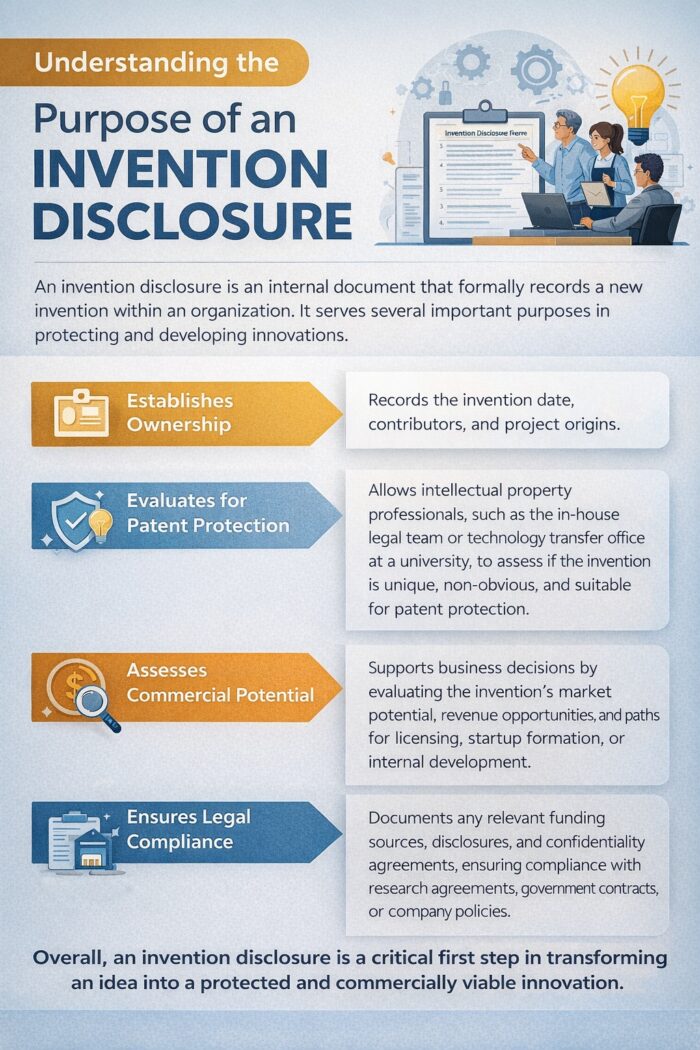
Submitting an invention disclosure typically involves coordination with the internal group responsible for intellectual property protection. In corporate settings, disclosures are commonly handled by in-house legal departments, intellectual property groups, or dedicated innovation or R&D offices that manage invention records and control external disclosures. At a university, invention disclosures are usually submitted to a technology transfer or commercialization office that supports faculty, researchers, and staff in evaluating and developing inventions. In some cases, outside law firms assist with intake, review, and preparation of disclosures for patent and licensing purposes.
The submission format varies by organization. Some entities still accept paper or PDF form submissions, while others rely on centralized online portals or inventor portals that guide inventors through the process step by step. These systems may require uploading technical descriptions, drawings, and data, as well as confirming inventor information and funding details. Regardless of format, timely submission is critical to ensure prompt review, coordinated patent strategy, and effective control over future disclosures.
After an invention disclosure is submitted, the organization evaluates the invention’s commercial potential to determine the most effective path forward. This assessment is typically conducted by a licensing or technology commercialization team and considers whether the invention is best suited for licensing to existing companies, forming a startup, or pursuing internal development. Factors often include the maturity of the technology, market size, competitive landscape, regulatory considerations, and the availability of funding or investor interest.
The quality of the invention disclosure plays a central role in this evaluation. A clear description, supporting data, and well-articulated use cases make it easier to identify interested partners and align the invention with real-world needs. Licensing officers may contact potential commercial partners, industry organizations, or investors to gauge interest and validate market assumptions.
Strong disclosures can accelerate the commercialization process, support successful licensing negotiations, and generate ongoing revenue. That revenue, in turn, often helps support future research, product refinement, and continued innovation within the organization.
University and corporate practices around invention disclosure are designed to ensure consistent protection, clear ownership, and compliance with legal and contractual obligations. At universities, invention disclosures are typically required from faculty, researchers, students, and staff who create inventions in the course of sponsored research or institutional activities. These disclosures are submitted to a technology transfer or commercialization office, which evaluates the invention for patentability, commercialization, and compliance with funding requirements, including federal grant obligations.
In corporate environments, invention disclosure obligations are usually established through employment agreements, invention assignment clauses, and internal IP policies. Employees are required to disclose inventions developed during their employment so the company can assess ownership, control disclosures, and determine whether to pursue patent applications or maintain the invention as a trade secret. These structured disclosure requirements help organizations maintain centralized records, manage risk, and ensure that intellectual property rights are consistently identified, secured, and enforced across teams and business units.
Maintaining accurate and complete invention disclosure records is a critical part of effective intellectual property management. Well-maintained disclosure records also support internal reviews, compliance audits, and due diligence activities related to funding obligations, government reporting, or corporate transactions. By clearly linking inventions to specific funding sources, contributors, and agreements, organizations can more easily demonstrate ownership and compliance with applicable policies and laws.
In addition, disclosure records create a foundation that can be built upon over time. As new embodiments, data, improvements, or use cases emerge, the original disclosure can be updated or supplemented, preserving institutional knowledge and strengthening future patent applications, licensing efforts, and enforcement strategies.
Controlling disclosures to third parties is critical because both an inventor’s own disclosure and derivative disclosures by others can qualify as prior art under U.S. patent law. Under 35 U.S.C. § 102(a), an invention is not patentable if it was publicly disclosed, on sale, or otherwise made available to the public before a patent application is filed. This includes situations where the inventor or company itself discloses the invention through presentations, publications, demonstrations, or unrestricted discussions. Importantly, disclosures by third parties who learned of the invention from the inventor or company can also become prior art if those disclosures are made publicly.
Using a confidentiality agreement or non-disclosure agreement (NDA) before sharing an invention serves several important purposes. First, it provides contractual remedies if the third party improperly discloses or uses the invention. Second, it can create a documented record of what was disclosed, when it was disclosed, and to whom. This record can be critical in demonstrating that a third party’s later disclosure, or even an allegedly infringing product, was derived from the inventor’s original disclosure rather than independently developed. Such evidence can be highly relevant in derivation proceedings and infringement disputes.
The risks of uncontrolled disclosure were highlighted long ago in Egbert v. Lippmann, 104 U.S. 333 (1881), where even limited, non-commercial use of an invention without confidentiality restrictions was deemed a public use that invalidated patent rights. The case underscores that secrecy and control, not the size of the audience, are what matter. Proper use of NDAs, combined with internal invention disclosure procedures, helps preserve patent rights while enabling necessary business and development discussions.
When an invention is developed using federal funding, additional legal obligations apply that make accurate disclosure especially important. Under the Bayh-Dole Act (35 U.S.C. §§ 200–212), organizations such as universities, nonprofit institutions, and certain companies receiving federal research support must disclose each subject invention to the appropriate funding agency within a prescribed time period after the invention is identified. This obligation is typically triggered through the organization’s internal invention disclosure process.
The invention disclosure must accurately identify all funding sources, grants, or contracts that supported the research or project leading to the invention. Federal agencies rely on this information to track rights, confirm compliance, and determine whether the organization may elect to retain title. Failure to timely disclose, elect title, or comply with reporting requirements can give the government so-called “march-in rights” or allow the agency to take ownership of the invention.
Accurate and complete funding disclosure also supports downstream patent applications, licensing, and commercialization, ensuring that ownership, reporting, and revenue-sharing obligations are properly managed from the outset.
An invention disclosure is more than paperwork. It is the gateway to securing patent rights, and it enables commercialization. Invention disclosures should be prepared and submitted in a timely manner in order to preserve the innovation and initiate evaluation and commercialization. By promptly completing the invention disclosure form, inventors and companies can secure their discoveries, avoid costly mistakes, and lead their innovations toward successful commercialization.
If you need assistance with developing an invention disclosure form or other intellectual property matters, please contact our office for a consultation.
© 2026 Sierra IP Law, PC. The information provided herein does not constitute legal advice, but merely conveys general information that may be beneficial to the public, and should not be viewed as a substitute for legal consultation in a particular case.

"Mark and William are stellar in the capabilities, work ethic, character, knowledge, responsiveness, and quality of work. Hubby and I are incredibly grateful for them as they've done a phenomenal job working tirelessly over a time span of at least five years on a series of patents for hubby. Grateful that Fresno has such amazing patent attorneys! They're second to none and they never disappoint. Thank you, Mark, William, and your entire team!!"
Linda Guzman


Sierra IP Law, PC - Patents, Trademarks & Copyrights
FRESNO
7030 N. Fruit Ave.
Suite 110
Fresno, CA 93711
(559) 436-3800 | phone
BAKERSFIELD
1925 G. Street
Bakersfield, CA 93301
(661) 200-7724 | phone
SAN LUIS OBISPO
956 Walnut Street, 2nd Floor
San Luis Obispo, CA 93401
(805) 275-0943 | phone

SACRAMENTO
180 Promenade Circle, Suite 300
Sacramento, CA 95834
(916) 209-8525 | phone
MODESTO
1300 10th St., Suite F.
Modesto, CA 95345
(209) 286-0069 | phone
SANTA BARBARA
414 Olive Street
Santa Barbara, CA 93101
(805) 275-0943 | phone
SAN MATEO
1650 Borel Place, Suite 216
San Mateo, CA, CA 94402
(650) 398-1644. | phone
STOCKTON
110 N. San Joaquin St., 2nd Floor
Stockton, CA 95202
(209) 286-0069 | phone
PORTLAND
425 NW 10th Ave., Suite 200
Portland, OR 97209
(503) 343-9983 | phone
TACOMA
1201 Pacific Avenue, Suite 600
Tacoma, WA 98402
(253) 345-1545 | phone
KENNEWICK
1030 N Center Pkwy Suite N196
Kennewick, WA 99336
(509) 255-3442 | phone
2023 Sierra IP Law, PC - Patents, Trademarks & Copyrights - All Rights Reserved - Sitemap Privacy Lawyer Fresno, CA - Trademark Lawyer Modesto CA - Patent Lawyer Bakersfield, CA - Trademark Lawyer Bakersfield, CA - Patent Lawyer San Luis Obispo, CA - Trademark Lawyer San Luis Obispo, CA - Trademark Infringement Lawyer Tacoma WA - Internet Lawyer Bakersfield, CA - Trademark Lawyer Sacramento, CA - Patent Lawyer Sacramento, CA - Trademark Infringement Lawyer Sacrament CA - Patent Lawyer Tacoma WA - Intellectual Property Lawyer Tacoma WA - Trademark lawyer Tacoma WA - Portland Patent Attorney - Santa Barbara Patent Attorney - Santa Barbara Trademark Attorney
