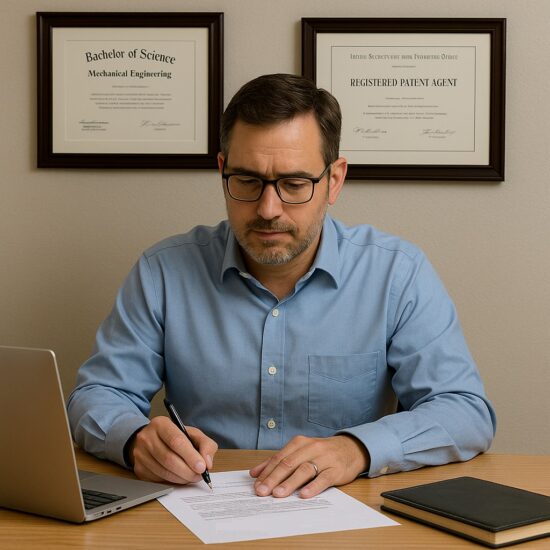
Patent agents are federally-licensed professionals who help inventors and companies secure patents. They are not attorneys, but they are licensed to prepare and prosecute patent applications before the United States Patent and Trademark Office (USPTO). We explain here what patent agents are, their qualifications, how they differ from patent attorneys, and the role they play in intellectual property services.
A patent agent is a person authorized to represent inventors and businesses before the USPTO in patent matters. Patent agents are not attorneys, but they are licensed by the USPTO after passing a special registration examination (the patent bar exam). Once registered, their name is added to the USPTO’s official roster of patent practitioners, which entitles them to practice before the USPTO only in patent matters. In practice, this means a patent agent can file patent applications and prosecute them, i.e., work through the patent application process with patent examiners. The USPTO’s regulations define “practice before the Office” in patent cases to include tasks like preparing, filing, and prosecuting patent applications, consulting with or giving advice to clients in contemplation of filing a patent application, and communicating with USPTO patent office examiners on patent application process issues.
Patent agents often have extensive technical training in science or engineering. In fact, a strong scientific background is required. Many patent agents hold at least a bachelor’s degree (many have advanced degrees) in fields like engineering, computer science, or hard sciences, like physics and chemistry. This technical expertise enables them to understand complex inventions and draft patent documents that accurately describe and claim the invention. For example, a patent agent with a degree in organic chemistry might work on pharmaceutical or chemical patent applications, leveraging their scientific knowledge to draft the patent and communicate with the USPTO examiner about technical details.
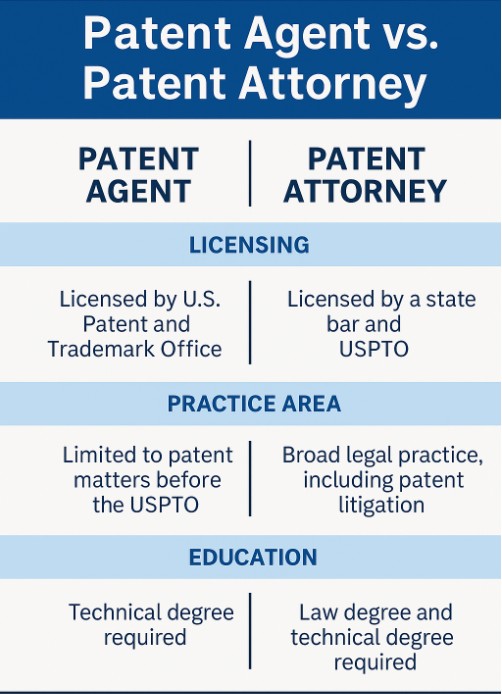
It’s important to distinguish patent agents from patent lawyers or attorneys. Both patent agents and patent attorneys must pass the USPTO’s patent bar exam and are collectively referred to as registered patent practitioners. The key difference is that a patent attorney has also attended law school, obtained a Juris Doctor (J.D.), and passed a state bar exam to become a licensed attorney at law. A patent lawyer is licensed to practice in any field of law, and can draft contracts, file lawsuits, and advise clients in any area of the law. A patent agent, by contrast, is not an attorney and is not a member of a state bar.
Despite these differences, both patent agents and patent attorneys can represent patent applicants before the USPTO. From the USPTO’s perspective, a patent agent can do anything a patent attorney can do in the patent application process: drafting the application, responding to USPTO actions, negotiating with examiners, and filing appeals within the Office. Law firms often employ patent agents for patent filings when they specifically need patent prosecution expertise and do not need broader legal services.
To become a patent agent, one must satisfy strict qualifications set by the USPTO. Generally, the requirements to sit for the USPTO’s registration examination include:
Only after meeting these requirements and passing the exam does an individual become a registered practitioner authorized to represent clients before the USPTO. The law specifically empowers the USPTO to register persons who are possessed of good moral character and the necessary qualifications to render applicants valuable service, advice, and assistance in the presentation or prosecution of their applications. This means patent agents must have both the technical expertise and integrity to provide valuable service in patent matters.
Patent agents play a critical role in helping inventors navigate the patent application process from start to finish. This process (often called patent prosecution) involves several steps where a patent agent’s expertise is invaluable:
Patent agents have complete practice authority before the USPTO to prosecute and negotiate patent applications, this includes applications for utility patents, design patents, and plant patents. They are also permitted to represent inventors in appeals and other post-examination proceedings before the Office, since these are part of the administrative patent process. However, patent attorneys typically handle these proceedings because there are areas of law, including rules of evidence, expert witness testimony, and oral argument, that come into play. These are areas of knowledge and skill that are within the skill sets of attorneys, but are not areas in which patent agents are typically trained.
Throughout this process, patent agents provide guidance strictly focused on patents. They advise clients on patent strategy, such as whether to pursue multiple applications, or how to claim the invention, and provide compliance with USPTO rules and regulations. However, they do not provide advice or services for intellectual property protection generally. Their work is limited to USPTO patent matters. Patent agents do not get involved in broader legal or business advice. They often work alongside attorneys that handle the broader business matters, taking on the work of capturing inventions patent applications to pursue strong patents that can be assets for the client's business. However, there are independent patent agents that can be hired for patent prosecution. Their services are typically sought out by solo inventors and small businesses.
Under U.S. law, patent agents’ ability to practice is grounded in federal statute and regulations. Congress has explicitly authorized the USPTO to regulate who may act as a patent practitioner. 35 U.S.C. § 2(b)(2)(D) empowers the USPTO to “govern the recognition and conduct of agents, attorneys, or other persons representing applicants” before the Office, and to require that practitioners be of good moral character and have the necessary qualifications to assist inventors in patent cases. In other words, federal law allows non-attorneys with the proper qualifications to practice patent law before the USPTO. Pursuant to this authority, the USPTO admits qualified individuals to practice via the patent bar exam and maintains the register of patent agents and attorneys.
There is important case law confirming a patent agent’s right to practice. In the landmark case Sperry v. Florida ex rel. Florida Bar, 373 U.S. 379 (1963), the U.S. Supreme Court held that Florida could not bar a registered patent agent from performing tasks “incident to the preparation and prosecution of patent applications” within the state. The Court acknowledged that drafting and prosecuting patent applications for others is considered the practice of law under state definitions. However, because a federal statute expressly permitted the U.S. Patent Office to authorize patent practice by nonlawyers, the Supremacy Clause of the US Constitution meant Florida could not treat that federally-authorized work as the unauthorized practice of law.
In short, a registered patent agent is federally licensed to practice patent law before the USPTO, and states must allow this limited practice even though the patent agent is not a member of the state bar. The Sperry case affirmed the legality of patent agent practice nationwide and confirmed that patent agents provide legal services in the patent field under the authority of federal law.
More recently, courts have also recognized that communications with patent agents in the scope of patent prosecution are confidential and may be covered by a form of attorney-client privilege. For example, the Federal Circuit in 2016 acknowledged a “patent-agent privilege” protecting client communications with patent agents when acting within their authorized role of obtaining patents, just as communications with attorneys would be. In re Queen’s University at Kingston, 820 F.3d 1287 (Fed. Cir. 2016). Likewise, in In re Silver, 540 S.W.3d 530 (Tex. 2018), the Texas Supreme Court ruled that registered patent agents are considered lawyers for purposes of privilege when they are doing USPTO patent work, because they are authorized to practice law within the limited scope of patent matters. These developments reinforce that patent agents, though not attorneys, occupy a legally recognized role in providing patent legal services under U.S. law.
While patent agents can handle patent applications, there are clear limits on what they can do. By law, patent agents’ practice is restricted to patent matters before the USPTO. Here are some important limitations to understand:
Despite these limitations, within the domain of obtaining patents, patent agents are fully qualified professionals. They adhere to the USPTO’s professional conduct rules and are subject to discipline by the USPTO’s Office of Enrollment and Discipline (OED) if they violate regulations or ethical standards.
Patent agents work in various professional settings and can handle a wide range of patent matters for different clients. Many patent agents are employed at law firms that specialize in patents or general intellectual property. In a law firm, patent agents often draft patent applications and manage prosecution for the firm’s clients under the supervision of the firm’s patent attorneys. This allows the firm to serve more clients efficiently. The agents handle the technical patent drafting while the attorneys handle legal strategy, opinion work (like infringement or validity opinions), and patent litigation. Clients of the firm benefit because the combination of attorneys and agents can cover all aspects of patent practice and process.
The presence of patent agents in a firm can also reduce cost for clients, as some work can be billed at the agent’s lower hourly rate. They typically charge professional fees for drafting and prosecution that are lower than those of patent attorneys, while still providing good value. They are not trained or licensed in all areas of patent law, but can be very effective when working with a patent attorney.
Also, many large corporations with substantial research and development activities hire patent agents in-house. These agents work alongside patent attorneys in the company’s IP department. For example, a big technology company might have patent agents to prepare and file dozens of patent applications on new inventions coming out of their R&D teams. The patent agents coordinate with engineers and scientists internally, draft the applications, and correspond with the USPTO. Meanwhile, the company’s patent attorneys might focus on portfolio management, licensing deals, or patent disputes. In this environment, patent agents help scale the patent filing process for the company and ensure high-quality patents by virtue of their technical focus.
Importantly, patent agents and patent attorneys are part of the same ecosystem governed by the USPTO. Both must adhere to the USPTO’s regulations and ethical rules in 37 C.F.R. § 11, and both are subject to disciplinary action for misconduct. Under 35 U.S.C. § 32, the USPTO can suspend or exclude practitioners for cause. Clients can verify a patent agent’s credentials by checking the USPTO’s public register of registered patent attorneys and agents. Whether you engage a patent agent or attorney, you should expect professional conduct, confidentiality, and competence in handling your patent work.
Most people do not fully understand what a patent agent is. Hopefully this article has explained that a patent agent is a USPTO-registered practitioner who can provide a valuable service by helping inventors and businesses obtain patents. Overall, patent agents serve as key partners in innovation, combining technical expertise with knowledge of patent law to turn new ideas into patented assets.
Whether you work with a patent agent or a patent attorney (or both), the goal is the same: effective intellectual property protection for your inventions within the framework of U.S. patent law. With their unique qualifications and federal license, patent agents can be a useful resource for anyone looking to secure a United States patent.
If you need assistance with pursuing a patent or some other patent matter, contact our office for a free consultation with one of our patent professionals.
© 2025 Sierra IP Law, PC. The information provided herein does not constitute legal advice, but merely conveys general information that may be beneficial to the public, and should not be viewed as a substitute for legal consultation in a particular case.

"Mark and William are stellar in the capabilities, work ethic, character, knowledge, responsiveness, and quality of work. Hubby and I are incredibly grateful for them as they've done a phenomenal job working tirelessly over a time span of at least five years on a series of patents for hubby. Grateful that Fresno has such amazing patent attorneys! They're second to none and they never disappoint. Thank you, Mark, William, and your entire team!!"
Linda Guzman


Sierra IP Law, PC - Patents, Trademarks & Copyrights
FRESNO
7030 N. Fruit Ave.
Suite 110
Fresno, CA 93711
(559) 436-3800 | phone
BAKERSFIELD
1925 G. Street
Bakersfield, CA 93301
(661) 200-7724 | phone
SAN LUIS OBISPO
956 Walnut Street, 2nd Floor
San Luis Obispo, CA 93401
(805) 275-0943 | phone

SACRAMENTO
180 Promenade Circle, Suite 300
Sacramento, CA 95834
(916) 209-8525 | phone
MODESTO
1300 10th St., Suite F.
Modesto, CA 95345
(209) 286-0069 | phone
SANTA BARBARA
414 Olive Street
Santa Barbara, CA 93101
(805) 275-0943 | phone
SAN MATEO
1650 Borel Place, Suite 216
San Mateo, CA, CA 94402
(650) 398-1644. | phone
STOCKTON
110 N. San Joaquin St., 2nd Floor
Stockton, CA 95202
(209) 286-0069 | phone
PORTLAND
425 NW 10th Ave., Suite 200
Portland, OR 97209
(503) 343-9983 | phone
TACOMA
1201 Pacific Avenue, Suite 600
Tacoma, WA 98402
(253) 345-1545 | phone
KENNEWICK
1030 N Center Pkwy Suite N196
Kennewick, WA 99336
(509) 255-3442 | phone
2023 Sierra IP Law, PC - Patents, Trademarks & Copyrights - All Rights Reserved - Sitemap Privacy Lawyer Fresno, CA - Trademark Lawyer Modesto CA - Patent Lawyer Bakersfield, CA - Trademark Lawyer Bakersfield, CA - Patent Lawyer San Luis Obispo, CA - Trademark Lawyer San Luis Obispo, CA - Trademark Infringement Lawyer Tacoma WA - Internet Lawyer Bakersfield, CA - Trademark Lawyer Sacramento, CA - Patent Lawyer Sacramento, CA - Trademark Infringement Lawyer Sacrament CA - Patent Lawyer Tacoma WA - Intellectual Property Lawyer Tacoma WA - Trademark lawyer Tacoma WA - Portland Patent Attorney - Santa Barbara Patent Attorney - Santa Barbara Trademark Attorney
