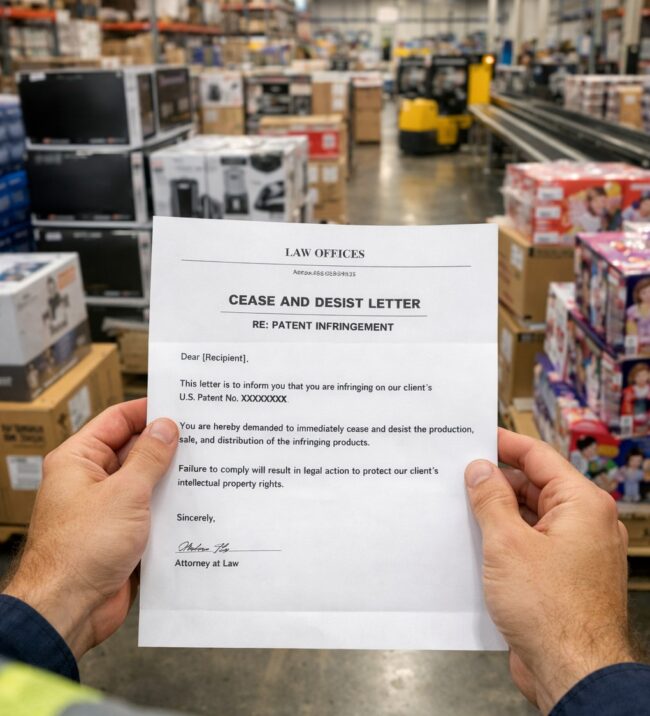
Patents provide exclusive intellectual property rights over inventions. Under U.S. federal law, a granted United States patent confers the patent owner “the right to exclude others from making, using, offering for sale, selling, or importing” the patented invention in the U.S. If anyone other than the patent holder engages in these exclusive patent rights without permission, the patent holder may sue for patent infringement. Patent enforcement is the process by which a patent holder (also called a patent owner) asserts their legal rights against an infringing party. This article provides a general overview of U.S. patent enforcement, explaining how patent infringement lawsuits generally work, what remedies are available, and key considerations in protecting a patented invention.
A U.S. patent grants its owner a time-limited monopoly over the invention’s use. This means others cannot make, use, sell, or import the patented product or process without the patent owner’s consent. For example, if your company holds a patent on a new gadget, and a competitor starts manufacturing or selling a similar gadget covered by your patent claims without a license, that is an infringing product and you have the right to take action. U.S. patent law broadly defines infringement as any unauthorized making, using, selling, offering for sale, or importing of the patented invention during the patent term. 35 U.S.C. § 271. Both the patent holder and any accused infringer should note that a patent is enforceable only after it is granted by the U.S. Patent and Trademark Office (USPTO); patent pending applications cannot be enforced in court. Once a patent issues, the patent owner can file a lawsuit to protect their patent rights and stop any alleged infringement.
In general, only the patent’s owner (the patentee or an assignee of the patent) or someone holding exclusive rights can bring a patent infringement lawsuit. If a patent is co-owned or exclusively licensed, typically all owners or an exclusive licensee who has been given all substantial rights in the patent must be involved to have standing to sue. By contrast, a non-exclusive licensee who merely has permission to use the patent cannot sue on the patent. On the other side, an accused infringer does not have to wait to be sued. If there is a real dispute (e.g., the patent owner sends a cease-and-desist notice letter accusing infringement), the accused party may file a declaratory judgment action. In a declaratory judgment suit, the accused infringer asks a federal court to determine the patent’s validity or declare that their product does not infringe, which can give clarity and jurisdictional advantage.
Patent infringement lawsuits in the United States are handled exclusively in the federal court system under 28 U.S.C. § 1338. A patent owner typically files suit in a U.S. district court that has jurisdiction over the defendant. U.S. district courts serve as the trial courts for patent cases. There are no specialized patent trial courts, though some districts have judges with expertise in patent law. Importantly, any appeal from a district court’s final decision in a patent case goes to the U.S. Court of Appeals for the Federal Circuit, a specialized appellate court that hears patent appeals nationwide. In addition to court litigation, patent owners have an alternative enforcement venue for certain cases. The U.S. International Trade Commission (ITC) can investigate claims of patent infringement involving imported goods and can issue exclusion orders, which works like an injunction barring imports, if a violation is found. However, the ITC does not award damages, it simply bans infringing imports. Most commonly, patent enforcement means filing a civil lawsuit under 35 U.S.C. § 281 to seek remedies for infringement.
Before resorting to a lawsuit, patent owners often take initial enforcement steps. These steps can sometimes resolve the issue without the time and costs of full litigation. Common pre-litigation enforcement actions include:
Taking these steps can often lead to a resolution without a formal suit. Indeed, patent enforcement is not always about rushing to court. Strategic and practical decision-making is employed to balance enforcement with business realities.
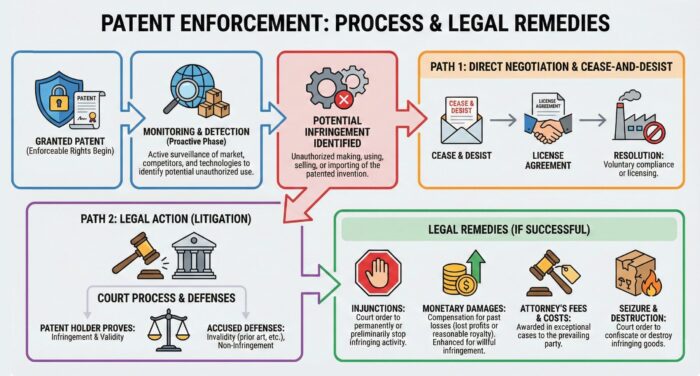
When informal efforts fail, the patent owner can initiate a patent infringement lawsuit. The process begins with filing a complaint in the appropriate federal district court. The complaint identifies the patent at issue, alleges how the defendant’s acts infringe one or more patent claims, and requests relief, such as injunction, damages, and other available relief. The defendant (the accused infringer) must respond by filing an answer, in which they will typically deny infringement and may assert defenses or counterclaims, such as claiming the patent is invalid or unenforceable.
Once the pleadings are set, the case enters discovery, a pretrial phase where both sides gather evidence. During discovery, each side can demand documents, emails, and other records, take depositions of witnesses, and consult experts. In patent cases, discovery is often extensive, both sides may hire expert witnesses. The expert witnesses are typically technical experts having knowledge in the field of the invention. Experts are used to compare the accused product to the patent and explain technical aspects of the invention. Financial experts are also engaged to assess damages.
Patent cases also involve a critical pretrial step called claim construction through a Markman hearing with the court. The judge determines the meaning of disputed patent claim terms based on the parties briefing on the issue of claim construction. The claim construction decided by the court is a critical step in the case. It can shape the outcome of infringement and validity issues.
A patent infringement case is likely to involve motion practice, including summary judgment motions on critical issues and claims in the case. The court may resolve some issues through summary judgment where a party can show that certain facts are established and that they result in a certain legal outcome based on those facts. In other words, based on the established facts, the legal outcome can be determined without trial. Summary judgment motions are referred to as dispositive motions because they can provide a final judgment on the issues addressed in the motion.
Once dispositive motion practice has ended, the case proceeds to a patent trial. If monetary damages are sought, either party can demand a jury trial. In such cases, a jury will decide key factual questions like whether infringement occurred and the amount of damages. For purely equitable relief like an injunction, the trial would be a bench trial before a judge.
During the trial, each side presents evidence and witnesses. The patent owner must prove infringement by a preponderance of the evidence, meaning it’s more likely than not that infringement occurred. The defendant, meanwhile, will try to cast doubt on infringement or prove the patent is invalid, often relying on technical comparisons and prior art patents or publications. After deliberation, the jury or judge will render a verdict. The court then enters a judgment, and the losing party has the right to appeal to the Federal Circuit. Patent litigation can be a long process. It is not uncommon for cases to take 1–3 years or more from filing to trial, given the complexity and volume of evidence.
Facing a patent infringement suit, defendants have several defenses and strategies available. The most common defenses include arguing that the patent is invalid or that no infringement actually occurred: e.g. the accused product is different or omits a feature of the patent claims. U.S. patents are presumed valid once issued, but a defendant can rebut this presumption by proving the patent should not have been granted. Typical patent invalidity arguments are that the invention was not new or was obvious in view of earlier technology, known as prior art, or that the patent has some legal defect. In fact, a patent challenger will often comb through prior patents and publications to show the patented invention was already known or obvious. If successful, the court may invalidate the patent, and the patent holder would lose all rights. Other defenses might be that the patent owner committed some misconduct with the United States Patent and Trademark Office (USPTO) in the process of acquiring the patent, referred to as inequitable conduct. The defendant may additionally or alternatively argue that the patent does not cover patent eligible subject matter.
Because validity is such a central issue, accused infringers frequently use a parallel strategy: challenging the patent through administrative proceedings. The USPTO’s Patent Trial and Appeal Board (PTAB) provides procedures like post grant review and inter partes review (IPR), which allow a challenger to petition for cancellation of some or all patent claims. Congress created IPRs in 2012 as a cost-effective and timely alternative to court litigation for testing patent validity. If an accused infringer files an IPR petition, a PTAB panel will decide, usually within about 18 months, whether the patent claims are valid over prior art. IPRs often run in parallel with district court litigation on the same patent. Often, courts will even pause or stay the court case pending the PTAB’s decision. A successful IPR can render the whole patent or certain claims invalid, mooting the infringement suit. From the patent owner’s perspective, this means that enforcement can involve fighting on two fronts: in federal court and at the USPTO. It’s crucial for businesses to work closely with patent counsel on these defense strategies, as they involve complex legal and technical analyses.
If the patent owner succeeds in proving infringement (and fends off any invalidity defenses), the court will award remedies to compensate for and stop the infringement. The two primary remedies in patent cases are injunctive relief and monetary damages.
An injunction is a court order that prohibits the infringer from continuing the infringing activities. U.S. patent law expressly authorizes courts to grant injunctions “in accordance with the principles of equity” to prevent the violation of patent rights. In practice, after winning a case the patent holder will often seek a permanent injunction to stop the defendant from making or selling the infringing product. However, an injunction is not automatic even if infringement is proven. In the landmark eBay Inc. v. MercExchange case, the U.S. Supreme Court ruled that courts must apply the traditional four-factor equitable test before issuing a patent injunction, rather than issue injunctions as a matter of course. eBay Inc. v. MercExchange, L.L.C., 547 U.S. 388 (2006). This means the patent owner must demonstrate (1) irreparable harm from continued infringement, (2) that monetary damages are inadequate to compensate, (3) the balance of hardships favors an injunction, and (4) the public interest would not be disserved.
Many patent cases settle without an injunction, but for a business that practices its patent (e.g., by selling its patented product), an injunction can be a vital tool to protect market share by excluding competitors. In some circumstances, courts may deny injunctions. For instance, if the patent owner is a non-practicing entity that primarily seeks royalties, the court may deny an injunction and instead limit the remedy to money. There is also the option of a preliminary injunction early in a case, but those are granted only if the patent owner shows a likelihood of success on the merits and risk of irreparable harm, which is a higher bar.
Monetary damages are the main remedy to compensate the patent owner for past infringement. The Patent Act mandates that a successful patent owner be awarded infringement damages adequate to compensate for the infringement, “but in no event less than a reasonable royalty” for the use of the invention by the infringer. In other words, the patent holder should receive at least a fair licensing payment for the unauthorized use of the patent. Often, if the patent owner can prove that the infringement caused them to lose sales or profits, they can seek lost profits damages. The lost profits are the profit the company would have made but for the infringement. Lost profit awards require showing, for example, that the patent owner had the capacity to make those additional sales and that there were no non-infringing substitutes the customers would have bought instead. If lost profits are too speculative or cannot be proved, then reasonable royalties become the fallback measure of damages. A reasonable royalty is typically determined by imagining a hypothetical negotiation between the patent owner and infringer at the time infringement began. Factors such as existing licensing rates for similar patents, the invention’s value, and the sales of the infringing products are taken into account in setting this royalty.
Importantly, U.S. law also allows enhanced damages for willful infringement. If the infringer intentionally copied the invention or behaved egregiously, the court may increase the damages up to three times the amount found. Courts reserve these punitive enhancements for exceptional cases of misconduct. As the Supreme Court noted, enhanced damages under 35 U.S.C. § 284 are designed as a sanction for “egregious infringement behavior” rather than a typical case. In Halo Electronics v. Pulse Electronics, the Supreme Court affirmed that willful infringers can face treble damages at the judge’s discretion, and it removed stricter "objective recklessness” standard to ensure truly egregious cases are punished. Halo Elecs., Inc. v. Pulse Elecs., Inc., 579 U.S. 93 (2016). The court also eliminated the clear and convincing evidence standard for willful infringement, placing the application of enhanced damages in the discretion of the court.
Finally, the Patent Act provides that in exceptional cases the court may order the losing party to pay the winner’s attorney fees. Historically, fee awards were rare, but the Supreme Court’s Octane Fitness decision made it easier for prevailing parties to be awarded attorney fees under 35 U.S.C. 285 when the opposing party’s claims or conduct stand out as unusually weak or unreasonable. Octane Fitness, LLC v. ICON Health & Fitness, Inc., 572 U.S. 545 (2014). This means if a company is dragged into a baseless patent suit or faces an opponent engaging in litigation misconduct, it has a chance to recover its legal fees. For patent owners, it also means that if they prove deliberate infringement plus litigation misconduct, they could get their attorneys’ bills paid. Aside from fees, the court will also award court costs (filing fees, etc.) to the winner as routine. All these remedies, injunctions, damages, enhanced damages, and fee, are aimed at making the patent owner whole and deterring infringement, while not unduly punishing legitimate innovators.
Patent enforcement is a powerful tool to protect your competitive edge, but it comes with substantial considerations for any business. Patent litigation is costly and complex. Even a relatively straightforward patent infringement lawsuit can cost hundreds of thousands of dollars in legal fees through discovery and trial. For example, industry surveys show that a case with relatively modest stakes under $1 million in controversy still has a median total cost around $600,000–$700,000 through the end of trial, and cases with more at risk easily run into millions. These costs include not only attorneys’ fees, but also expert witness fees (patent cases often require multiple experts), discovery expenses, and the opportunity cost of management and engineers spending time on the lawsuit rather than the business. Litigation also can take years to reach a resolution, creating uncertainty that can cloud a company’s investment and product strategies.
Because of the high costs and risks, most patent infringement suits never reach a full trial and final judgment. Settlements are common, studies suggest the majority of patent cases settle out of court. Courts often encourage settlement or mediation, and some even require the parties to attempt mediation before trial. Settlement can involve a payment or cross-licensing agreement that resolves the dispute privately. For a patent owner, accepting a reasonable royalty through settlement might make business sense if it guarantees compensation and avoids the uncertainty of a jury trial. For the accused infringer, a settlement or license can eliminate the risk of an injunction or a large damages award.
When deciding on patent enforcement, a company should evaluate the extent of infringement and the strength of evidence, and conduct a cost-benefit analysis. Questions to consider include:
In some cases, simply having a patent and sending a notice can bring the other party to the table for a business resolution without a lawsuit. In other circumstances, especially when an infringer is undermining your market or your patent is a core asset, enforcement through litigation may be necessary despite the costs, to protect your investment in the patented technology.
Patent enforcement in the United States is a key mechanism for companies to safeguard their innovations. However, it is complex and requires a carefully crafted strategy. Business owners, entrepreneurs, and inventors should have a basic understanding of patent rights and how they are enforced. Effective patent enforcement often comes down to a combination of legal and business considerations. If infringement arises, the patent owner should consult with patent counsel to determine the strengths and weaknesses of the case, evaluate the economic impact of the infringement, and then choose an enforcement path that makes sense under the specific circumstances, whether that’s a licensing deal or a full-fledged patent infringement lawsuit.
Every situation is unique. Thus, the legal strategy should be tailored to the particular circumstances. With a clear understanding of the enforcement process and remedies, and with the guidance of experienced patent attorneys, business owners can navigate patent enforcement effectively and foster an innovative, fair marketplace. If you are facing a patent infringement situation or have another intellectual property matter with which you need assistance, contact our office for a free consultation.
© 2025 Sierra IP Law, PC. The information provided herein does not constitute legal advice, but merely conveys general information that may be beneficial to the public, and should not be viewed as a substitute for legal consultation in a particular case.

"Mark and William are stellar in the capabilities, work ethic, character, knowledge, responsiveness, and quality of work. Hubby and I are incredibly grateful for them as they've done a phenomenal job working tirelessly over a time span of at least five years on a series of patents for hubby. Grateful that Fresno has such amazing patent attorneys! They're second to none and they never disappoint. Thank you, Mark, William, and your entire team!!"
Linda Guzman


Sierra IP Law, PC - Patents, Trademarks & Copyrights
FRESNO
7030 N. Fruit Ave.
Suite 110
Fresno, CA 93711
(559) 436-3800 | phone
BAKERSFIELD
1925 G. Street
Bakersfield, CA 93301
(661) 200-7724 | phone
SAN LUIS OBISPO
956 Walnut Street, 2nd Floor
San Luis Obispo, CA 93401
(805) 275-0943 | phone

SACRAMENTO
180 Promenade Circle, Suite 300
Sacramento, CA 95834
(916) 209-8525 | phone
MODESTO
1300 10th St., Suite F.
Modesto, CA 95345
(209) 286-0069 | phone
SANTA BARBARA
414 Olive Street
Santa Barbara, CA 93101
(805) 275-0943 | phone
SAN MATEO
1650 Borel Place, Suite 216
San Mateo, CA, CA 94402
(650) 398-1644. | phone
STOCKTON
110 N. San Joaquin St., 2nd Floor
Stockton, CA 95202
(209) 286-0069 | phone
PORTLAND
425 NW 10th Ave., Suite 200
Portland, OR 97209
(503) 343-9983 | phone
TACOMA
1201 Pacific Avenue, Suite 600
Tacoma, WA 98402
(253) 345-1545 | phone
KENNEWICK
1030 N Center Pkwy Suite N196
Kennewick, WA 99336
(509) 255-3442 | phone
2023 Sierra IP Law, PC - Patents, Trademarks & Copyrights - All Rights Reserved - Sitemap Privacy Lawyer Fresno, CA - Trademark Lawyer Modesto CA - Patent Lawyer Bakersfield, CA - Trademark Lawyer Bakersfield, CA - Patent Lawyer San Luis Obispo, CA - Trademark Lawyer San Luis Obispo, CA - Trademark Infringement Lawyer Tacoma WA - Internet Lawyer Bakersfield, CA - Trademark Lawyer Sacramento, CA - Patent Lawyer Sacramento, CA - Trademark Infringement Lawyer Sacrament CA - Patent Lawyer Tacoma WA - Intellectual Property Lawyer Tacoma WA - Trademark lawyer Tacoma WA - Portland Patent Attorney - Santa Barbara Patent Attorney - Santa Barbara Trademark Attorney
