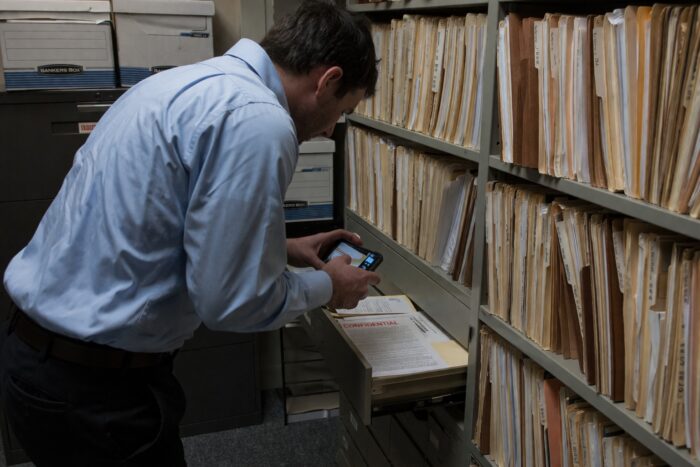
Trade secret misappropriation can cause significant damage to a company. Under federal law, the Defend Trade Secrets Act (DTSA), enacted in 2016, creates a federal civil cause of action allowing a trade secret owner to bring trade secret misappropriation claims in federal court for the unlawful acquisition, disclosure, or use of a company’s trade secrets, including through improper means such as theft, breach of confidentiality, or unauthorized access under 18 U.S.C. § 1836. The DTSA operates alongside the Uniform Trade Secrets Act (UTSA), which has been adopted in most jurisdictions and provides a parallel framework under state laws for addressing trade secrets misappropriated through improper use or disclosure. We discuss herein the requirements and legal standards for trade secret misappropriation claims.
Trade secrets may include formulas, processes, software code, pricing, manufacturing methods, customer lists, referral lists, and other secret information or proprietary information. Under federal trade secret law, the Defend Trade Secrets Act (DTSA) defines a trade secret broadly to include financial and business information, and technical data, provided that the information “derives independent economic value” from not being generally known and is not readily ascertainable through proper means under 18 U.S.C. § 1839(3). Courts applying this statute have emphasized that the trade secret owner must do more than simply label information as confidential; the company must take reasonable steps under the circumstances to maintain secrecy, such as restricting access and using nondisclosure agreements. For example, courts have held that failure to implement meaningful safeguards can defeat trade secret claims because the information is not truly secret within the meaning of the statute.
Similarly, the Uniform Trade Secrets Act, which has been adopted across most U.S. jurisdictions, defines trade secrets in nearly identical terms, requiring that the information have independent economic value and be subject to reasonable efforts to maintain its secrecy. The DTSA does not displace state laws such as the Uniform Trade Secrets Act (UTSA), so trade secret claims are often pursued in federal and state courts together or in parallel. As of 2024 the UTSA had been adopted in 48 states, the District of Columbia, Puerto Rico, and the U.S. Virgin Islands.
Courts interpreting the UTSA have repeatedly held that information that is readily ascertainable through proper means, such as public sources or reverse engineering, does not qualify for protection, even if the company considers it sensitive. At the same time, courts recognize that materials like customer lists or pricing data may qualify as trade secrets where they reflect compiled, non-public business information that competitors could not easily duplicate. In practice, whether information qualifies as a trade secret often turns on the specific circumstances, including how the information was developed, who had access to it, and what steps the trade secret holder took to maintain its secrecy.
The Economic Espionage Act of 1996 establishes federal law criminal liability for trade secret misappropriation involving theft, improper use, or disclosure of a company’s trade secrets, particularly where the conduct benefits foreign entities or foreign governments or involves commercial advantage. Under 18 U.S.C. §§ 1831 and 1832, it is a crime to knowingly steal, acquire, or disclose trade secrets without authorization, including through improper means such as theft, breach of confidentiality, or espionage, where the information derives independent economic value and is used in interstate or foreign commerce.
Section 1831 specifically targets economic espionage intended to benefit foreign entities, while § 1832 addresses commercial trade secret misappropriation for private economic gain. Courts interpreting these provisions have emphasized that the statute applies broadly to confidential business information, including proprietary information, customer lists, and technical data that maintain secrecy and are not readily ascertainable. For example, in United States v. Chung, 659 F.3d 815 (9th Cir. 2011), the court upheld a conviction under 18 U.S.C. § 1831 where a defendant acquired sensitive aerospace trade secrets over many years and retained them with the intent to benefit the Chinese government, finding sufficient evidence that the information had economic value and was subject to reasonable efforts to maintain secrecy.
Similarly, in United States v. Aleynikov, 676 F.3d 71 (2d Cir. 2012), the court addressed the scope of 18 U.S.C. § 1832 in a case involving alleged theft of proprietary source code for high frequency trading, ultimately reversing the conviction based on the statutory requirement that the trade secret be “related to or included in a product that is produced for or placed in interstate or foreign commerce,” illustrating the importance of statutory elements in trade secret cases.
In United States v. Nosal, 844 F.3d 1024 (9th Cir. 2016), the defendant conspired with former employees to access and download confidential data from his former employer’s database after his credentials were revoked. The Ninth Circuit upheld criminal liability under the Economic Espionage Act, reinforcing that unauthorized access and misuse of proprietary information constitutes trade secret misappropriation under federal law.
The Economic Espionage Act also provides for significant civil and criminal penalties, including fines, imprisonment, and forfeiture, reinforcing that trade secret misappropriation can constitute both a civil offense and a federal crime. These provisions operate alongside the Defend Trade Secrets Act, which provides a federal civil cause of action for trade secret misappropriation claims under 18 U.S.C. § 1836, allowing trade secret owners to pursue remedies in federal court while criminal enforcement proceeds under the Economic Espionage Act.
Not all confidential business information qualifies as a trade secret. The information must derive independent economic value because competitors or other persons cannot readily obtain it. A core requirement of a trade secret is whether the information derives independent economic value from not being generally known or readily ascertainable and whether the company took reasonable efforts to protect trade secrets and maintain secrecy. See 18 U.S.C. § 1839(3). In Kewanee Oil Co. v. Bicron Corp., 416 U.S. 470 (1974), the Supreme Court held that trade secrets are protectable intellectual property where secrecy provides economic value. Similarly, in InteliClear, LLC v. ETC Global Holdings, Inc., 978 F.3d 653 (9th Cir. 2020), the court held that plaintiffs must identify specific secret information and demonstrate that it derives independent economic value from its secrecy, reinforcing that generalized or publicly available business information does not qualify as protected trade secrets.
In practice, trade secret misappropriation often arises when a defendant acquires knowledge of proprietary information under circumstances giving rise to a duty to maintain secrecy, such as through nondisclosure agreements or employment relationships, and then engages in improper use or disclosure without express or implied consent. These principles are captured in the statutory framework under both federal law and state laws, which recognize that the unlawful acquisition and use of trade secrets, whether through employee misconduct, breach, or theft, can give rise to significant civil and criminal penalties, including injunctive relief and damages.
Trade secret misappropriation generally arises in two ways: (1) acquisition of a trade secret by improper means, or (2) disclosure or use of trade secrets without express or implied consent where the defendant knew or had reason to know that the information was acquired through improper means or under circumstances giving rise to a duty to maintain secrecy. This framework is codified in both federal law under the DTSA and under UTSA, which together form the backbone of modern trade secret law.
Under these statutes, “improper means” is broadly defined to include theft, bribery, misrepresentation, breach or inducement of a breach of a duty to maintain secrecy, and electronic espionage under 18 U.S.C. § 1839(6). Courts routinely apply this definition in trade secret cases involving employee misconduct or competitive intelligence gathering. For example, in E.I. duPont deNemours & Co. v. Christopher, 431 F.2d 1012 (5th Cir. 1970), the defendant used aerial photography to capture confidential plant construction details. The court held that even though the information was technically visible from the air, the conduct constituted improper means because it circumvented reasonable efforts to maintain secrecy, illustrating that misappropriation can occur even without physical trespass.
Importantly, not all acquisition or use of valuable business information constitutes misappropriation. The DTSA and UTSA expressly exclude lawful methods such as reverse engineering, independent derivation, or acquisition through proper means. This distinction was emphasized in Kewanee Oil Co., the Supreme Court recognized that competitors are free to discover trade secrets through legitimate means, even if the result is identical to the trade secret holder’s proprietary information.
Courts also frequently address situations involving breach of confidentiality obligations. In BladeRoom Group Ltd. v. Emerson Electric Co., 331 F. Supp. 3d 977 (N.D. Cal. 2018), the defendant allegedly obtained confidential data during a partnership and later used it to develop competing technology. The court allowed trade secret misappropriation claims to proceed, finding that acquisition and subsequent use under circumstances involving a duty of confidentiality satisfied the statutory definition of misappropriation.
As a practical matter, trade secret misappropriation often occurs when employees or business partners acquire knowledge of a company’s trade secrets through authorized access but later engage in improper use or disclosure. Courts analyze whether the defendant’s conduct violated confidentiality obligations, exceeded authorized access, or involved deceptive practices. These “circumstances giving rise” to a duty to maintain secrecy are central to many trade secret claims and frequently determine whether the conduct crosses the line into actionable misappropriation.
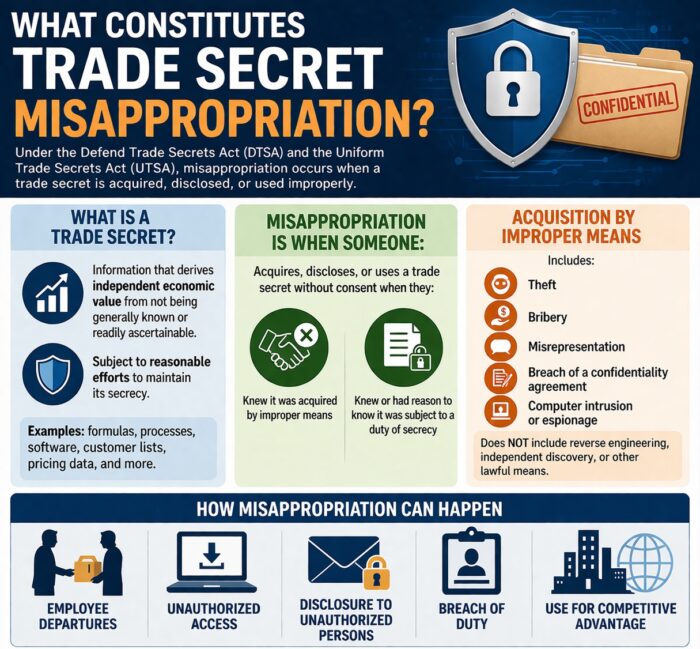
A classic trade secret misappropriation scenario arises when an employee departs and takes sensitive information, such as customer lists, pricing data, or source code, to a competitor. Both the DTSA and the USTA authorize courts to grant injunctive relief for actual or threatened misuse, but require evidence of improper use or threatened disclosure, not mere possession of knowledge. In PepsiCo, Inc. v. Redmond, 54 F.3d 1262 (7th Cir. 1995), a former executive joined a competitor with detailed strategic plans. The court held that inevitable disclosure of trade secrets justified an injunction based on likely misuse. However, courts generally reject restraints based solely on knowledge without evidence of threatened misappropriation. Accordingly, businesses should protect trade secrets through nondisclosure agreements, access controls, and disciplined offboarding, rather than relying primarily on non compete agreements.
In trade secret misappropriation claims under the Defend Trade Secrets Act and the Uniform Trade Secrets Act, plaintiffs must identify trade secrets with particularity, showing the information derives independent economic value from not being generally known and was subject to reasonable efforts to maintain secrecy. Courts require more than vague descriptions of business information or general know-how. In InteliClear, LLC, the court held that plaintiffs must clearly delineate the alleged trade secrets, rejecting conclusory “catchall” descriptions. Similarly, in Oakwood Labs. LLC v. Thanoo, 999 F.3d 892 (3d Cir. 2021), the court held that a complaint must plausibly allege both the existence of protectable trade secrets and specific acts of misappropriation, including acquisition by improper means or improper use or disclosure.
Plaintiffs must also prove the defendant acquired, disclosed, or used the trade secrets without consent under circumstances giving rise to a duty of secrecy under 18 U.S.C. § 1839(5). These standards apply in both federal court and under parallel state laws governing trade secret litigation.
Common defenses in trade secret misappropriation claims focus on whether the information qualifies as protected under trade secret law. Under the UTSA and the DTSA, defendants argue the information was generally known, readily ascertainable, independently developed, or obtained through reverse engineering or other proper means. As discussed above, the Supreme Court in Kewanee Oil Co. held that reverse engineering and independent discovery are lawful and defeat misappropriation. Defendants also assert disclosure occurred with express or implied consent or that plaintiffs failed to take reasonable steps to maintain secrecy. Courts routinely reject vague claims, as in InteliClear, LLC, which required specific identification of trade secrets. Additionally, UTSA implementation by individual states may preempt duplicative tort claims like tortious interference, limiting recovery to statutory or contractual theories.
Trade secret litigation under the Defend Trade Secrets Act provides robust remedies, including injunctive relief, actual-loss damages, unjust-enrichment damages, and a reasonable royalty where misappropriated trade secrets cannot be otherwise quantified under 18 U.S.C. § 1836(b)(3)(A). The Uniform Trade Secrets Act has similar provisions. Courts may award exemplary damages up to twice the damages amount and attorneys’ fees for willful and malicious misappropriation, reflecting the seriousness of trade secret claims under 18 U.S.C. § 1836(b)(3)(C)-(D). The DTSA also authorizes ex parte seizure in extraordinary circumstances to prevent dissemination of a company’s trade secrets under 18 U.S.C. § 1836(b)(2).
In PPG Industries Inc. v. Jiangsu Tie Mao Glass Co. Ltd., 47 F.4th 156 (3d Cir. 2022), the defendant, a competitor, used improperly acquired proprietary information to accelerate product development; the court held that damages could include avoided research-and-development costs as a measure of unjust enrichment. Similarly, courts applying Federal Rule of Civil Procedure 65 routinely grant injunctions to prevent ongoing disclosure or use, emphasizing that trade secret misappropriation remedies aim both to compensate the trade secret owner and to prevent further competitive harm.
In trade secret litigation, courts actively balance disclosure obligations with the need to protect trade secrets and other confidential business information. Federal Rule of Civil Procedure 26(c)(1)(G) authorizes courts to issue protective orders limiting access, requiring sealed filings, or permitting in camera proceedings to prevent disclosure of a company’s trade secrets. Similarly, the Defend Trade Secrets Act requires courts to “preserve the confidentiality of trade secrets” during litigation under 18 U.S.C. § 1835. The Uniform Trade Secrets Act provides similar protections.
Courts routinely enforce these safeguards. In In re Remington Arms Co., 952 F.2d 1029 (8th Cir. 1991), the court held that protective orders restricting disclosure of proprietary information were appropriate to prevent competitive harm. Courts will implement procedural mechanisms to maintain secrecy while allowing plaintiffs to pursue trade secret misappropriation claims without forfeiting protection.
To defend trade secrets, a company must show it took reasonable efforts to maintain secrecy, as required under the DTSA and the UTSA, both of which define trade secrets as information deriving independent economic value from not being generally known and subject to protection measures. Courts consistently enforce this requirement. In InteliClear, the court held that failure to clearly identify and protect alleged trade secrets can defeat claims. Practically, this means protections such as limiting access and using confidentiality nondisclosure agreements should be implemented and diligently enforced.
Also, under the Defend Trade Secrets Act, employers must provide DTSA whistleblower immunity notices in agreements governing confidential information. Courts have enforced this strictly, and failure to comply with 18 U.S.C. § 1833(b) can preclude recovery of exemplary damages and attorneys’ fees in a suit against a current or former employee, even where trade secret misappropriation is otherwise proven.
If you believe trade secrets have been misappropriated, act immediately to secure devices, preserve evidence, and cut off access, as courts routinely consider early conduct when evaluating injunctive relief under Federal Rule of Civil Procedure 65. The DTSA allows a trade secret owner to file a federal civil action and seek emergency relief, including injunctions and, in extraordinary circumstances, ex parte seizure of property to recover misappropriated trade secrets. See 18 U.S.C. § 1836(b). For example, in Henry Schein, Inc. v. Cook, 191 F. Supp. 3d 1072 (N.D. Cal. 2016), the court granted a preliminary injunction where a former employee retained and threatened to use confidential customer data, emphasizing the risk of ongoing disclosure.
In more serious cases involving theft, foreign entities, or coordinated improper use, criminal referral to the US Department of Justice through the local US Attorney's office may be appropriate under the Economic Espionage Act, which imposes fines and imprisonment for trade secret misappropriation involving interstate or foreign commerce. Delay can undermine trade secret claims, as courts require proof of what was acquired, how it was disclosed, and whether misuse is continuing.
Trade secret misappropriation presents a substantial legal and business risk to any company that relies on confidential or proprietary information. Assets such as customer lists, pricing strategies, technical processes, and other sensitive business information may qualify as trade secrets, but only where the trade secret holder can demonstrate that the information derives independent economic value from not being generally known and that reasonable steps were taken to maintain its secrecy. When these elements are satisfied, both federal and state laws, including the DTSA and the UTSA, provide robust remedies, including injunctive relief, damages, and, in some cases, enhanced penalties. However, where a company fails to adequately protect its information, courts may find that the material is readily ascertainable or insufficiently safeguarded, leaving it vulnerable to lawful use by competitors. Proactive protection and enforcement are therefore essential to preserving a company’s competitive advantage.
If you need assistance with trade secret matters or other intellectual property matters, please contact our office for a consultation.
© 2026 Sierra IP Law, PC. The information provided herein does not constitute legal advice, but merely conveys general information that may be beneficial to the public, and should not be viewed as a substitute for legal consultation in a particular case.

"Mark and William are stellar in the capabilities, work ethic, character, knowledge, responsiveness, and quality of work. Hubby and I are incredibly grateful for them as they've done a phenomenal job working tirelessly over a time span of at least five years on a series of patents for hubby. Grateful that Fresno has such amazing patent attorneys! They're second to none and they never disappoint. Thank you, Mark, William, and your entire team!!"
Linda Guzman


Sierra IP Law, PC - Patents, Trademarks & Copyrights
FRESNO
7030 N. Fruit Ave.
Suite 110
Fresno, CA 93711
(559) 436-3800 | phone
BAKERSFIELD
1925 G. Street
Bakersfield, CA 93301
(661) 200-7724 | phone
SAN LUIS OBISPO
956 Walnut Street, 2nd Floor
San Luis Obispo, CA 93401
(805) 275-0943 | phone

SACRAMENTO
180 Promenade Circle, Suite 300
Sacramento, CA 95834
(916) 209-8525 | phone
MODESTO
1300 10th St., Suite F.
Modesto, CA 95345
(209) 286-0069 | phone
SANTA BARBARA
414 Olive Street
Santa Barbara, CA 93101
(805) 275-0943 | phone
SAN MATEO
1650 Borel Place, Suite 216
San Mateo, CA, CA 94402
(650) 398-1644. | phone
STOCKTON
110 N. San Joaquin St., 2nd Floor
Stockton, CA 95202
(209) 286-0069 | phone
PORTLAND
425 NW 10th Ave., Suite 200
Portland, OR 97209
(503) 343-9983 | phone
TACOMA
1201 Pacific Avenue, Suite 600
Tacoma, WA 98402
(253) 345-1545 | phone
KENNEWICK
1030 N Center Pkwy Suite N196
Kennewick, WA 99336
(509) 255-3442 | phone
2023 Sierra IP Law, PC - Patents, Trademarks & Copyrights - All Rights Reserved - Sitemap Privacy Lawyer Fresno, CA - Trademark Lawyer Modesto CA - Patent Lawyer Bakersfield, CA - Trademark Lawyer Bakersfield, CA - Patent Lawyer San Luis Obispo, CA - Trademark Lawyer San Luis Obispo, CA - Trademark Infringement Lawyer Tacoma WA - Internet Lawyer Bakersfield, CA - Trademark Lawyer Sacramento, CA - Patent Lawyer Sacramento, CA - Trademark Infringement Lawyer Sacrament CA - Patent Lawyer Tacoma WA - Intellectual Property Lawyer Tacoma WA - Trademark lawyer Tacoma WA - Portland Patent Attorney - Santa Barbara Patent Attorney - Santa Barbara Trademark Attorney
