
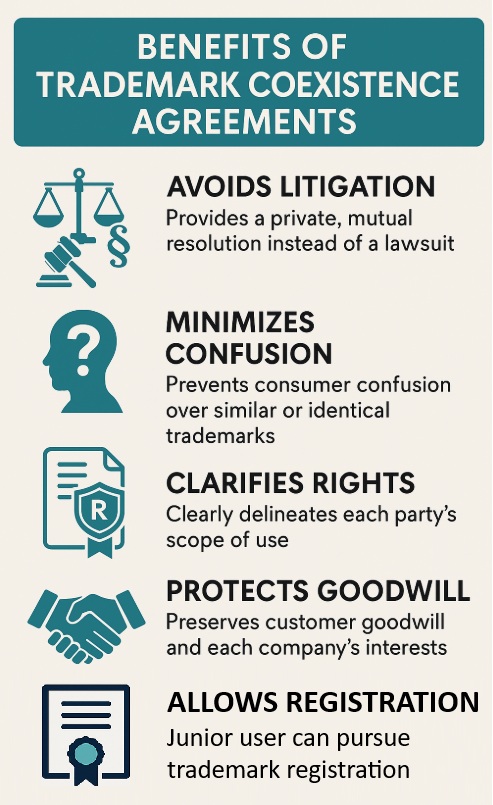
Trademark coexistence agreements are contracts that permit two parties to use similar or identical trademarks without interfering with each other’s business. Essentially, it’s a formal agreement between trademark owners to avoid conflict by dividing their rights, e.g., by splitting along regions or product lines. These agreements often come into play when businesses discover they have confusingly similar brand names or logos and want to avoid a trademark dispute or litigation. Rather than resorting to litigation, the parties can negotiate a coexistence agreement as a fair compromise. This approach allows each company to keep using its mark while minimizing confusion and clarifying the scope of each party’s rights.
Under U.S. trademark law, two similar marks cannot coexist if consumers would likely be confused about the source of the goods or services. Section 2(d) of the Lanham Act (15 U.S.C. §1052(d)) forbids registration of a similar trademark that is likely to cause confusion with an existing registered mark. In practice, if a new trademark application is too close to an existing trademark registration, the U.S. Patent and Trademark Office (USPTO) will issue a refusal for likelihood of confusion as part of the trademark prosecution process, putting the trademark applicant in a tough spot with potentially negative consequences.
The trademark applicant might have to abandon their application or be subject to a trademark infringement lawsuit filed by the trademark registrant. Often, the trademark applicant’s best option is to negotiate a trademark coexistence agreement, rather than risk their mark being unregistrable. Such an agreement, if accepted by the USPTO, can allow both to obtain registration and continue using their marks by clarifying each one’s field of use and preventing consumer confusion.
The terms trademark coexistence agreement and trademark consent agreement are related. A consent agreement usually refers to a simple contract where one party (often the senior user) formally consents to the other’s use or registration of the same or a similar trademark. It typically includes a statement that the parties believe confusion is unlikely. A consent agreement can allow the junior user to register their trademark if it provides sufficient detail about how and why consumer confusion will be avoided. The USPTO and courts look far more favorably on a detailed agreement than on a mere “naked” consent that lacks specifics.
By contrast, a trademark coexistence agreement is a more comprehensive arrangement. A trademark coexistence is an agreement that includes mutual restrictions about how the two marks will be used. For example, the agreement might split the market by territory, by product lines, or by related industries, so that each company’s use of the mark remains distinct. A formal trademark coexistence agreement documents these limitations and the parties’ mutual rights, providing clear divisions and guidelines on the parties' use of their respective marks and making it easier to convince courts and administrative agencies (e.g., USPTO, US Customs and Border Protection, etc.) that no public confusion will arise.
Signing a coexistence agreement is not a magic wand, but it can significantly influence legal outcomes. Under the familiar DuPont test for likelihood of confusion (a set of factors courts and the USPTO use to evaluate trademark conflicts), one factor is whether the parties have an agreement. Courts have indicated that a well-crafted coexistence agreement should be given considerable weight in the analysis. One court observed that when those closest to the marketplace agree there will be no confusion, it is difficult to insist otherwise. The Federal Circuit similarly instructs that the USPTO should not override the judgment of trademark owners who consent to coexist unless other factors clearly show confusion is likely.
However, if an agreement is too flimsy and doesn’t truly prevent confusion, the USPTO can still refuse registration. The Trademark Trial and Appeal Board, which handles appeals of refusals by the trademark office, has held that coexistence agreements that do not include sufficient terms to avoid consumer confusion are ineffective and will not support registration of confusingly similar marks. In re Bay State Brewing Company, Inc., 117 USPQ2d 1958 (TTAB 2016). In short, a comprehensive agreement that includes concrete provisions and evidence showing confusion is unlikely is much more likely to persuade courts and the USPTO.
Even if two companies are willing to compromise, their agreement cannot come at the expense of the public. Trademark law ultimately exists to protect consumers from confusion. If a coexistence deal would leave consumers likely to be dangerously confused, it may be against public interest for both to use that mark. For example, if two pharmaceutical companies used the same trademark for different drugs, that may endanger patients through the confusion and mistaken prescription fills.
Likewise, trademark coexistence agreements must be crafted to avoid violating antitrust regulations. Generally, such agreements do not violate antitrust regulations, but if the arrangement essentially carves up the market and harms competition, a court could strike it down. In general, these agreements are considered legitimate, good-faith solutions (a limited compromise on exclusivity, not an illegal restraint of trade) so long as they include enough detail to safeguard the public’s interest.
In Clorox Co. v. Sterling Winthrop, Inc., 117 F.3d 50 (2d Cir. 1997), Clorox challenged a trademark agreement that prohibited it from selling disinfectants under the mark PINE-SOL, arguing the restriction violated antitrust law by creating a barrier to entry. The Second Circuit rejected this claim, holding that the agreement did not restrain overall competition because Clorox remained free to sell disinfectants under other names, and a trademark confers only a right to a name, not a monopoly on a product. The court emphasized that antitrust laws protect competition as a whole, not individual competitors, and thus trademark agreements are generally valid unless they significantly harm market-wide competition.
A coexistence agreement is a practical solution when trademark use by two enterprises has a potential to cause consumer confusion. It allows concurrent use of similar marks by separate entities, effectively turning potential trademark litigation into a private, mutual resolution. It offers a way to find a fair compromise respecting both parties’ rights and customer goodwill, and provides a means of avoiding future disputes in connection with their similar marks.
However, a coexistence agreement must be carefully crafted, considering the nature of each party’s use and providing convincing division of trademark use, ownership, and domain that provides protection against consumer confusion. It should clearly delineate each party’s scope of use to eliminate any likelihood of confusion. Done properly and in good faith, coexistence agreements protect each company’s interests while also safeguarding the public.
If you need assistance with a coexistence situation or other issues relating to trademarks, please contact our office for a free consultation.
© 2025 Sierra IP Law, PC. The information provided herein does not constitute legal advice, but merely conveys general information that may be beneficial to the public, and should not be viewed as a substitute for legal consultation in a particular case.

"Mark and William are stellar in the capabilities, work ethic, character, knowledge, responsiveness, and quality of work. Hubby and I are incredibly grateful for them as they've done a phenomenal job working tirelessly over a time span of at least five years on a series of patents for hubby. Grateful that Fresno has such amazing patent attorneys! They're second to none and they never disappoint. Thank you, Mark, William, and your entire team!!"
Linda Guzman


Sierra IP Law, PC - Patents, Trademarks & Copyrights
FRESNO
7030 N. Fruit Ave.
Suite 110
Fresno, CA 93711
(559) 436-3800 | phone
BAKERSFIELD
1925 G. Street
Bakersfield, CA 93301
(661) 200-7724 | phone
SAN LUIS OBISPO
956 Walnut Street, 2nd Floor
San Luis Obispo, CA 93401
(805) 275-0943 | phone

SACRAMENTO
180 Promenade Circle, Suite 300
Sacramento, CA 95834
(916) 209-8525 | phone
MODESTO
1300 10th St., Suite F.
Modesto, CA 95345
(209) 286-0069 | phone
SANTA BARBARA
414 Olive Street
Santa Barbara, CA 93101
(805) 275-0943 | phone
SAN MATEO
1650 Borel Place, Suite 216
San Mateo, CA, CA 94402
(650) 398-1644. | phone
STOCKTON
110 N. San Joaquin St., 2nd Floor
Stockton, CA 95202
(209) 286-0069 | phone
PORTLAND
425 NW 10th Ave., Suite 200
Portland, OR 97209
(503) 343-9983 | phone
TACOMA
1201 Pacific Avenue, Suite 600
Tacoma, WA 98402
(253) 345-1545 | phone
KENNEWICK
1030 N Center Pkwy Suite N196
Kennewick, WA 99336
(509) 255-3442 | phone
2023 Sierra IP Law, PC - Patents, Trademarks & Copyrights - All Rights Reserved - Sitemap Privacy Lawyer Fresno, CA - Trademark Lawyer Modesto CA - Patent Lawyer Bakersfield, CA - Trademark Lawyer Bakersfield, CA - Patent Lawyer San Luis Obispo, CA - Trademark Lawyer San Luis Obispo, CA - Trademark Infringement Lawyer Tacoma WA - Internet Lawyer Bakersfield, CA - Trademark Lawyer Sacramento, CA - Patent Lawyer Sacramento, CA - Trademark Infringement Lawyer Sacrament CA - Patent Lawyer Tacoma WA - Intellectual Property Lawyer Tacoma WA - Trademark lawyer Tacoma WA - Portland Patent Attorney - Santa Barbara Patent Attorney - Santa Barbara Trademark Attorney
