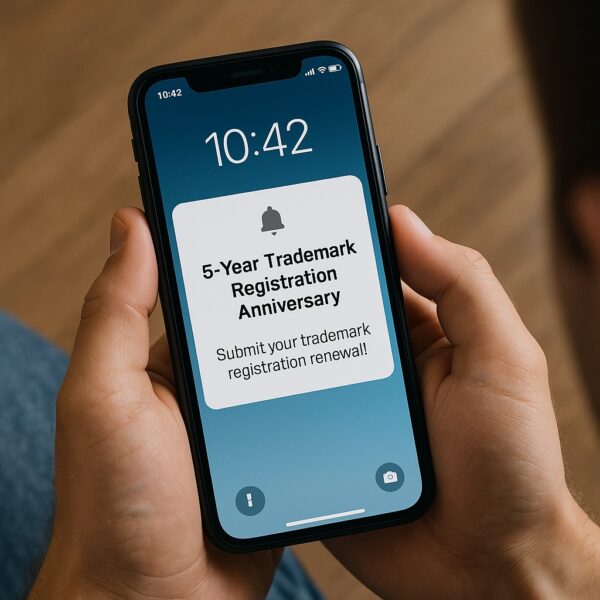
Trademark renewal filings are required to maintain a federal trademark registration and the legal protection it provides. Under U.S. trademark law, a trademark registration issued by the United States Patent and Trademark Office (USPTO) remains valid for ten years from the registration date. The trademark owner must submit a trademark renewal application at the end of the ten-year registration period.
The USPTO also requires trademark owners to file affidavit of use documents between the fifth and sixth anniversaries of registration to keep the registration active. Failing to meet these trademark renewal deadlines will result in cancellation of the registered mark, meaning the trademark is no longer on the federal register. This article breaks down the trademark renewal process and timeline in plain language, helping business owners understand how to renew their trademarks on time to ensure continuous protection for their brand.
Renewing your trademark registration on time ensures your registered mark remains on the federal Principal Register, giving you ongoing nationwide rights and legal presumptions under trademark law. Timely renewals mean your trademark remains active and you avoid cancellation of the registration. If a registration lapses, the USPTO will cancel it and the mark will lose the benefits of federal registration, including the presumption of ownership and validity.
In most cases, a trademark owner who misses the final renewal deadline must start over with a new registration application to regain protection. This not only costs additional filing fees and time, but also means losing the earlier registration date and priority, which can expose you to new risks. For example, others may have filed for a similar mark after the original registration date and before your second application is filed to recapture your rights, resulting in complications in recapturing your trademark rights. In short, trademark renewal is essential for maintaining your trademark rights and avoiding gaps in legal protection for your brand.
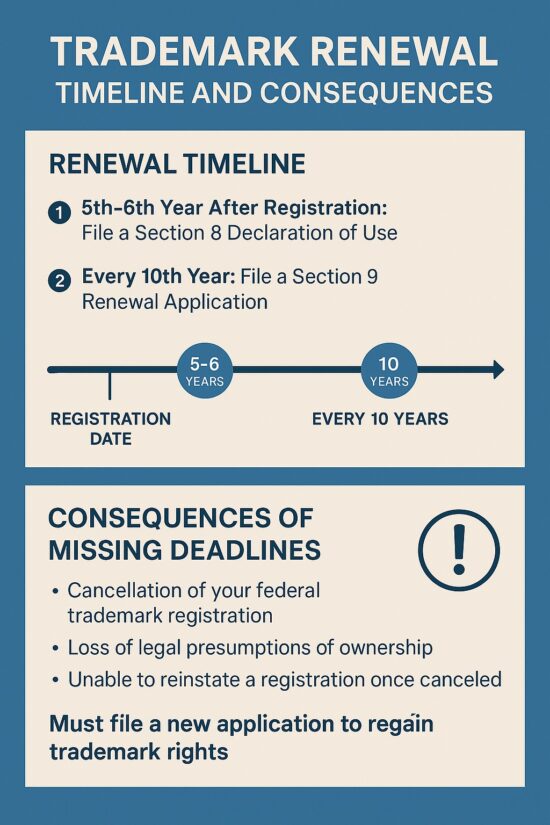
Federal trademark registrations have very specific timelines for required renewal filings. The key renewal periods and deadlines for a U.S. trademark are:
Between the fifth and sixth anniversaries of your registration, you must file a Section 8 Declaration of Use (or Excusable Nonuse) to confirm your mark is in use in commerce. This filing includes a sworn statement, a specimen of use (example of the mark in use), and the required fee per class. If your mark has been in continuous use for five consecutive years, you may also file an optional Section 15 declaration to make the registration incontestable.
Before each ten-year anniversary of your registration, you must file a Section 9 renewal application to keep the registration alive for the next decade. This is filed together with a Section 8 declaration of continued use at the ten-year mark. This combined Sections 8 and 9 filing is due in the one-year window before the end of each ten-year registration period: between the ninth and tenth anniversaries. Filing the renewal extends your registration for an additional ten-year term, and this cycle repeats every ten years as long as you continue to renew your trademark.
If you miss the standard filing window for the 6th-year or 10th-year filings, the USPTO allows a six-month grace period after the deadline to submit the trademark maintenance documents and fees. You can still renew during this grace period by submitting the required renewal documents and paying an additional fee (surcharge) per class. However, if you do not renew by the end of the grace period, the registration expires by operation of law as of the deadline, and no further extension is possible. Courts have emphasized that the statutory renewal deadlines cannot be waived or extended, even for inadvertence or mistake. In other words, after the grace period passes, a lapse is final and the only option is to file a new application.
The first required renewal document is the Section 8 Declaration of Use (or Affidavit of Use), due between the 5th and 6th year after registration. The purpose of this filing is to show the mark is still in continuous use in commerce on the goods/services listed in your registration. In the Section 8 submission, the trademark owner must declare that the mark is in use, list the specific goods or services in the registration that are in use, provide a specimen of use showing the mark in use, and pay the required fee.
If any goods or services are no longer in use, they should be removed from the registration to avoid issues. In cases where the mark is temporarily not in use due to special circumstances (e.g., a temporary business closure or supply chain issues), the owner can file a declaration of excusable nonuse, explaining the circumstances that excuse the nonuse and affirming that there is no intent to abandon the mark.
Filing the Section 8 declaration on time is critical to the validity of trademark registration. If you fail to file the Section 8 by the deadline, including the 6-month grace period, the USPTO will cancel your registration. In practice, this means your trademark registration will be removed from active status and marked “dead” in the USPTO records, stripping your mark of the benefits of registration. To keep an active registration, you must be sure to submit the Section 8 maintenance documents on time in the 5th year after registration.
In addition to the Section 8 affidavit of use, the trademark owner must file a Section 9 renewal application every ten years from the registration date. Section 9 is essentially a request to renew and extend the term of the registration for another ten-year period. Federal law provides that each registration may be renewed for successive 10-year periods by filing a renewal application within the year before the expiration of the current ten-year term, or within a six-month grace period after expiration. In practice, at the ten-year mark and every ten years thereafter, owners file a combined Section 8 and 9 submission: this includes the declaration of continued use (Section 8) and the formal renewal request (Section 9) together in one filing.
Submitting the Section 9 renewal with the Section 8 proof of use by the ten-year deadline will renew the trademark registration, preserve its priority to the original trademark application filing date, and keep your registration in force for another ten years. There is no limit on the number of times you can renew a trademark. As long as the mark remains in use and you meet the deadlines, your federal trademark registration can be renewed indefinitely, providing potentially continuous protection for your brand. Conversely, if the owner does not file the renewal application by the end of the grace period, the registration will expire and trademark rights afforded by the registration will cease as of that expiration date.
Trademark Sections 8 and 9 renewals are submitted electronically via the USPTO’s Trademark Electronic Application System (TEAS) through the USPTO.gov website. The trademark owner (or their attorney) must log in with a USPTO.gov account and access the appropriate form. The “Declaration of Use under Section 8” for mid-term maintenance, or the combined “Sections 8 and 9” form for a ten-year renewal can be accessed through the TEAS portal. The trademark identification information (e.g., registration number or serial number) is needed to access the record. The trademark renewal documents can then be electronically submitted through the TEAS portal.
When filing, you must verify the goods/services that are still in use, and attach the valid specimens of use images showing the mark in use in commerce. You can sign the declaration electronically and submit the payment all through the TEAS system. Once you submit the renewal application, you should receive a confirmation and a tracking number via the email address of record. The USPTO will then review the submission. If everything is in order, the USPTO will issue a notice or update the record to show your registration is renewed. The USPTO sends an official notice of acceptance for Section 8 and notice of renewal for Section 9.
If there is any problem with your filing, the USPTO will issue an office action explaining the deficiency. For example, if the submission is missing a specimen of use, or the affidavit of use wasn’t signed by the correct party, the filing will be defective. You are typically given an opportunity to respond and correct any issues within a set time. If a response to the office action curing the deficiency is timely filed, the maintenance filing can be accepted.
The USPTO sends courtesy email reminders to trademark owners and attorneys of record when a maintenance filing window opens: at the start of the 5th year and 9th year after registration. However, the USPTO is not obligated to send these notices, and not receiving a reminder (or having it go to spam) does not excuse missing a deadline. If you do not file the necessary renewal documents in time, your registration will be canceled or expire regardless of a lack of email notice. Therefore, trademark owners should be diligent about their renewal timelines and keep their own calendar reminders, or work with a trademark attorney, rather than relying on USPTO courtesy emails.
Renewing a trademark involves paying USPTO government fees, which are charged per class of goods or services in your registration. The exact fees can change over time, but as of recent fee schedules, the base filing fee for a Section 8 declaration is $325 per class and the Section 9 renewal fee at $325 per class, if filed electronically. These fees would be higher if filed on paper, but almost all trademark owners use the electronic TEAS filing. If you file during the six-month grace period after a deadline, an additional surcharge of $100 per class is required. All fees must be paid at the time of filing the renewal; if your registration covers multiple classes, the cost is multiplied by the number of classes.
It’s wise to check the USPTO’s current fee schedule when preparing to renew your trademark, because fees can be adjusted periodically. Also note that fees are nonrefundable, so ensure that your documents are in order to avoid having to re-file. Many trademark owners budget for these trademark renewal fees as a predictable business expense every decade. While hiring a trademark attorney or law firm to handle the renewal will incur legal service fees on top of the USPTO fees, it can help in avoiding mistakes. Whether or not you use an attorney, make sure to submit the required fee and documents on time to keep your trademark registration in good standing.
Failing to file the necessary renewal documents by the deadline has serious consequences: your federal trademark registration will be canceled or expire, and you will lose the benefits of an active registration. The mark itself does not necessarily stop being a trademark. You can still have common law rights if you continue using it, but your mark will no longer be listed on the federal register, which means losing the presumptions of ownership and nationwide scope that come with a registration. The USPTO will change the status of the registration to “dead,” and it will no longer block others from registering similar marks. In short, the valuable trademark protection afforded by a federal registration is gone once the registration is canceled for non-renewal.
If a deadline is missed by accident, unfortunately there is very little recourse. The law provides no mechanism to “undo” a lapse caused by failure to renew in time. The Trademark Trial and Appeal Board has underscored that the renewal deadlines are strict and set by statute. They cannot be extended or waived, even if a delay was unintentional. For example, even if your trademark was involved in litigation or a Trademark Trial and Appeal Board proceeding, that would not stop the USPTO from canceling a registration that wasn’t renewed. No pending dispute will toll the deadline. In a precedential case, a registrant who missed the Section 8 filing due to a calendaring error could not revive the registration because the deadline had passed. The registration was deemed expired by operation of law. The takeaway is that timely renewals are absolutely essential to avoid cancellation.
In very limited circumstances, a trademark owner might attempt a petition to revive or reinstate a registration, but these are only granted if the failure to renew was due to extraordinary situations like USPTO error. For instance, if the USPTO trademark office incorrectly failed to process a timely filing or sent a notice to the wrong address, one can petition the Director for reinstatement. Even then, strict time limits apply. Such a petition must be filed within two months of the cancellation notice. Absent USPTO error, once a registration is canceled for missing a renewal, the owner’s only option is to file a new registration application for the mark and start the process over. This underscores the importance of timely renewals.
To preserve continuous protection, trademark owners should stay abreast of all renewal deadlines and plan ahead. It’s often best to file the renewal as early as possible in the allowed window. Many businesses rely on docketing systems or their attorneys to send advance reminders well before the USPTO deadlines. By proactively managing your trademark portfolio and filing each required Section 8 and Section 9 on time, you can avoid cancellation of your registered trademarks and ensure your trademark rights remain intact.
The trademark renewal process is very manageable once you know the specific timelines and requirements. By filing the necessary Section 8 and Section 9 documents on schedule, a trademark owner can keep their registration in force indefinitely. Remember, a little advance planning ensures that your trademark will never inadvertently expire. If you need assistance with trademark renewals and maintenance or other trademark matters, please contact our office for a free consultation.
© 2025 Sierra IP Law, PC. The information provided herein does not constitute legal advice, but merely conveys general information that may be beneficial to the public, and should not be viewed as a substitute for legal consultation in a particular case.

"Mark and William are stellar in the capabilities, work ethic, character, knowledge, responsiveness, and quality of work. Hubby and I are incredibly grateful for them as they've done a phenomenal job working tirelessly over a time span of at least five years on a series of patents for hubby. Grateful that Fresno has such amazing patent attorneys! They're second to none and they never disappoint. Thank you, Mark, William, and your entire team!!"
Linda Guzman


Sierra IP Law, PC - Patents, Trademarks & Copyrights
FRESNO
7030 N. Fruit Ave.
Suite 110
Fresno, CA 93711
(559) 436-3800 | phone
BAKERSFIELD
1925 G. Street
Bakersfield, CA 93301
(661) 200-7724 | phone
SAN LUIS OBISPO
956 Walnut Street, 2nd Floor
San Luis Obispo, CA 93401
(805) 275-0943 | phone

SACRAMENTO
180 Promenade Circle, Suite 300
Sacramento, CA 95834
(916) 209-8525 | phone
MODESTO
1300 10th St., Suite F.
Modesto, CA 95345
(209) 286-0069 | phone
SANTA BARBARA
414 Olive Street
Santa Barbara, CA 93101
(805) 275-0943 | phone
SAN MATEO
1650 Borel Place, Suite 216
San Mateo, CA, CA 94402
(650) 398-1644. | phone
STOCKTON
110 N. San Joaquin St., 2nd Floor
Stockton, CA 95202
(209) 286-0069 | phone
PORTLAND
425 NW 10th Ave., Suite 200
Portland, OR 97209
(503) 343-9983 | phone
TACOMA
1201 Pacific Avenue, Suite 600
Tacoma, WA 98402
(253) 345-1545 | phone
KENNEWICK
1030 N Center Pkwy Suite N196
Kennewick, WA 99336
(509) 255-3442 | phone
2023 Sierra IP Law, PC - Patents, Trademarks & Copyrights - All Rights Reserved - Sitemap Privacy Lawyer Fresno, CA - Trademark Lawyer Modesto CA - Patent Lawyer Bakersfield, CA - Trademark Lawyer Bakersfield, CA - Patent Lawyer San Luis Obispo, CA - Trademark Lawyer San Luis Obispo, CA - Trademark Infringement Lawyer Tacoma WA - Internet Lawyer Bakersfield, CA - Trademark Lawyer Sacramento, CA - Patent Lawyer Sacramento, CA - Trademark Infringement Lawyer Sacrament CA - Patent Lawyer Tacoma WA - Intellectual Property Lawyer Tacoma WA - Trademark lawyer Tacoma WA - Portland Patent Attorney - Santa Barbara Patent Attorney - Santa Barbara Trademark Attorney
