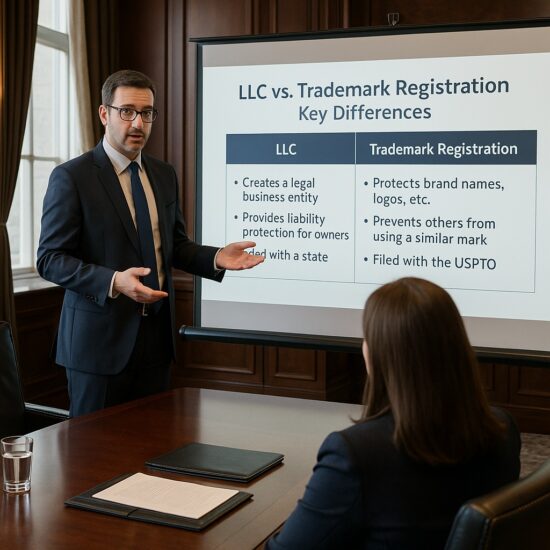
Business owners often wonder whether to form a limited liability company (LLC) or register a trademark, or both, to protect their new venture. These tools serve very different purposes in U.S. law. Generally speaking, an LLC is a business entity that provides personal liability protection, while a trademark is intellectual property that carries certain exclusive rights that protect your branding against third party use. Understanding the difference between a trademark vs LLC is crucial for small business owners, sole proprietors, and entrepreneurs looking to safeguard both their personal assets and their brand. We provide here an overview of LLCs and trademarks, their legal protections, the distinctions between them, and why you might need one or the other (or both).
An LLC (limited liability company) is a legal business structure created under state law that establishes a company as a separate legal entity. Forming an LLC is a common business formation step for small businesses because an LLC offers limited liability protection to its owners, called “members”. In practice, this means the LLC exists separately from its owners, and the members are not personally liable for the LLC’s business debts or legal obligations. For example, if the company incurs debt or gets sued, generally only the LLC’s assets are at risk, not the owners’ personal assets like their home or personal property. This liability protection shields owners’ personal wealth from business risks, a benefit not available to a sole proprietorship where the owner is personally responsible for all business liabilities. In essence, an LLC protects owners’ personal assets by creating a legal wall between the business and its members.
From a tax perspective, an LLC is very flexible. By default, a single-member LLC is a “disregarded entity” for tax purposes, meaning its profits and losses are reported on the owner’s personal tax return (Schedule C of Form 1040) rather than a separate business return. Multi-member LLCs typically file pass-through returns by default. However, LLCs can elect corporate taxation if desired. This flexibility, combined with personal liability protection, makes the LLC a popular business entity choice for small business owners.
A trademark is a type of intellectual property that consists of any name, word, logo, slogan, symbol, or combination thereof that identifies and distinguishes the source of goods or services of others. In other words, a trademark is tied to your business’s brand identity, it protects the names, logos, or designs that consumers associate with your products or services. Trademark rights are acquired by using a distinctive mark in commerce and are primarily governed primarily under federal law (the Lanham Act). Registering a trademark with the United States Patent and Trademark Office (USPTO) is not mandatory, but it provides significant legal protection and benefits. According to the USPTO, a registered trademark “provides legal protection for your brand” and gives you nationwide rights to that mark. By contrast, simply registering a business name with a state as an LLC or otherwise does not grant nationwide trademark rights.
A federal trademark registration with the USPTO grants the owner exclusive rights to use the mark nationwide in connection with the registered goods or services, subject to certain limitations. It also puts the public on notice that you are the trademark owner. Importantly, a trademark allows you to prevent others from using a name or logo in a way that is likely to confuse consumers. Trademark law prohibits uses that are “likely to cause confusion, or to cause mistake, or to deceive” consumers regarding the source of goods or services. This means your trademark provides brand protection: if another business adopts a similar name or logo for similar offerings, you could take legal action for trademark infringement to stop them. In short, a trademark protects your brand identity and customer loyalty, whereas an LLC protects your business’s owners from personal liability.
It is important to recognize that an LLC and a trademark serve entirely different roles. An LLC is a legal entity: a company that can own property, enter contracts, and assume debts in its own name. In contrast, a trademark is an intangible asset: a form of intellectual property that trademark law grants to the mark’s owner. The legal protection each offers is different. An LLC offers liability protection and a formal business structure, whereas a trademark offers brand protection and exclusive rights in a name or symbol. One does not automatically include the other. For example, you could form an LLC for your business and never register its name as a trademark, or you could register a trademark for a brand without forming a separate LLC. However, these tools often complement each other. Many small businesses use an LLC to shield the owners from liability and register trademarks to protect the business’s name and logo. Generally speaking, think of the LLC as protecting the business owners by separating the business from the owners and the trademark as protecting the brand by giving you rights against copycats and confusingly similar names.

The primary benefit of an LLC is personal liability protection. The LLC structure creates a liability shield often referred to as the “corporate veil.” As noted above, members of an LLC are not liable for the company’s obligations just by virtue of being owners. This limited liability protection means that if the LLC cannot pay its debts or faces a lawsuit, the owners’ personal assets (their personal bank accounts, real estate, or other personal property) are generally safe from creditors of the business. For example, if your LLC takes out a business loan and later defaults, the lender cannot come after your personal home or car to satisfy the debt, absent personal guarantees or fraud. Likewise, if the business is sued for something that happened in the course of business, the owners are typically not personally liable for any judgment. This is a key difference between operating as an LLC versus as a sole proprietorship or general partnership, where the owners have unlimited personal liability for business debts. Every state’s laws provide for this liability shield.
That said, limited liability is not absolute. Owners must properly maintain the LLC as a separate entity. The owners of the LLC must keep business finances separate from personal finances and follow required corporate formalities. Otherwise a court might “pierce the veil” and hold owners liable in cases of serious misconduct or commingling. If the LLC is managed and operated correctly, it offers protection for the owners’ personal assets from business debts and lawsuits against the business. This asset protection is a major reason business owners choose the LLC legal structure.
While an LLC protects the owners, a trademark protects the business’s brand identity in the marketplace. Your brand (business name, product names, logos, slogans, etc.) is often one of your most valuable assets. Trademarks are the legal mechanism to protect that asset. By using and federally registering a trademark, you obtain exclusive rights to use that mark for the goods or services listed in the registration, across the entire country. Federal registration with the USPTO gives a trademark owner a nationwide presumptive right to the mark and a legal presumption that you are the owner of the mark. This is critical for brand protection. It means if another business starts using a name or logo that is similar to yours in a way that could confuse customers, you have strong legal grounds to stop them, potentially through a trademark infringement lawsuit if they do not cease voluntarily. Trademark rights also allow you to register with U.S. Customs to block importation of infringing goods, and to use the federal courts to enforce your rights.
Importantly, simply forming an LLC or incorporating a business does not by itself create trademark rights in your business name. Trademark rights come from using the name or logo as a mark (i.e. to identify the source of your products or services in commerce) and are strengthened by trademark registration. Many small business owners assume that because they have an LLC or a registered business name, they automatically “own” that name for all purposes, but that’s not the case. You secure brand protection only by using the name as a trademark and, preferably, by obtaining a federal trademark registration. As the USPTO explains, registering a trade name (business name) with the state allows you to do business under that name, but it offers no protection against others using a similar name in other states or contexts. A trademark registration is what gives you the right to exclusive use of that name or logo in your field nationwide.
It is worth emphasizing the difference between an LLC’s name (or any business entity name) and a trademark. A business name, sometimes called a trade name, “DBA,” or "fictitious name”, is essentially the name you operate under. Registering a business name when you form an LLC, corporation, or file a DBA is done at the state’s office (e.g., the Secretary of State) and is only intended to ensure no two businesses in the state have the exact same name. This registered business name does not confer trademark rights. U.S. trademark law explicitly distinguishes trade names versus trademarks: “The terms ‘trade name’ and ‘commercial name’ mean any name used by a person to identify his or her business or vocation,” whereas a “trademark identifies and distinguishes… goods” or services. See 15 U.S.C. §1127. Simply put, your LLC’s name is an identifier of your company, while a trademark is an identifier of the source of your goods or services in commerce. It is possible that other businesses in different states might have identical or similar LLC names, and this often does not violate any law because each is registered only at the state level. However, if multiple parties try to market under that name nationally, the first to have a valid federal trademark registration could stop the others. This is why it’s important to conduct a thorough trademark search before settling on a business name. Using a name that conflicts with an existing federal trademark could lead to you having to rebrand or even being on the receiving end of a cease-and-desist letter or infringement suit. Conversely, if you secure a trademark, you gain the ability to prevent later adopters from using confusingly similar names in the market.
Another scenario to note is that your LLC and trademark names do not have to be the same. For example, your company might be registered as “ABC Enterprises LLC” but you market your product under a different brand name. The brand name is what you would register as a trademark. Many companies have an official corporate name and one or more trademarks for their products or services. Also, an LLC can own a trademark. If you have an LLC, it’s often wise for the LLC to own the trademarks rather than an individual owner, so that the brand value stays with the company.
The process for forming an LLC is separate from the trademark application process, and they involve different agencies. To create an LLC, you generally file Articles of Organization (or a similar formation document) with your state and pay the required filing fees. This is done through a state office, commonly the Secretary of State’s business registry. For example, California law requires filing Articles of Organization with the Secretary of State to validly form an LLC. The filing fees and requirements vary by state, but commonly you’ll provide an LLC name, a registered agent, business address, and sometimes an operating agreement. Once the state approves and files your LLC, your company is officially a legal entity. You would then typically obtain an Employer Identification Number (EIN) from the IRS for tax and banking purposes, and you’re ready to do business as an LLC.
Federally registering a trademark, on the other hand, is done through the United States Patent and Trademark Office (USPTO). The trademark application process involves submitting an application through the USPTO TEAS system that includes the mark itself, the goods or services it will be used for, and evidence of use (or an intent-to-use declaration). You must also pay a filing fee per class of goods/services. The USPTO will then have an attorney examiner review the application, possibly issue office action refusals. For example, if the mark is descriptive or there is a likelihood of confusion with an existing mark, the examiner will refuse registration and issue an office action. You can respond to the office action to address the examiner's refusals and try to resolve any issues in the application. If all goes well, the examiner will approve the mark for publication. The whole process can take several months to over a year to complete. Once registered, the trademark must be maintained with periodic filings and fees to keep the federal trademark protection active.
By contrast, forming an LLC is usually a faster process: many states approve LLC filings within days or weeks. There are ongoing maintenance requirements, including annual report filings and paying state taxes or fees. Note that states also offer their own state trademark registrations (e.g., California trademark registrations are filed with the California Secretary of State), but those only protect you within that state and generally carry fewer rights than a federal registration. Most businesses that plan to operate nationally or online prefer the federal trademark route for nationwide protection of their brand.
Because LLCs and trademarks fulfill different purposes, many businesses will benefit from having both an LLC and a trademark. The LLC (or corporation or other legal entity) is important for liability protection and organizing your business’s legal structure and tax setup. The trademark is brand protection that secures your name or logo so that you have exclusive rights and can build customer loyalty without fear of another company exploiting your brand. One is not a substitute for the other. If you only form an LLC but never register your trademark, you might have a shield against personal liability, but you could be forced to rebrand if someone else holds trademark rights to your business name. Conversely, if you only register a trademark but operate as a sole proprietorship or partnership, your brand might be protected, but your personal liability exposure remains, meaning your personal assets are at risk from business liabilities.
For most small business owners, it’s wise to consider both: forming an LLC (or other appropriate business entity) and registering trademarks for your key brand names or logos. They are complementary. The LLC establishes a legitimate business structure and can lend credibility to your business in the eyes of customers and partners, while the trademark establishes legal rights to your brand identity and provides a legal presumption of nationwide ownership. In fact, having a registered trademark can increase the value of your company. It becomes an asset the LLC owns.
In summary, an LLC and a trademark are two distinct legal tools every entrepreneur should understand. An LLC is a business structure that protects the owners by separating the business’s liabilities from personal assets, while a trademark is an intellectual property right that protects the brand by granting exclusive rights to use a name or logo and preventing others from using confusingly similar identifiers. For comprehensive protection of a new business, you would ideally leverage both the LLC for liability protection and the trademark for brand protection.
Finally, because every business is unique, it may be beneficial to consult with a qualified attorney about your specific situation. If you are starting a business and need guidance on forming an LLC and/or pursuing trademark protection, contact us for a consultation.
© 2025 Sierra IP Law, PC. The information provided herein does not constitute legal advice, but merely conveys general information that may be beneficial to the public, and should not be viewed as a substitute for legal consultation in a particular case.

"Mark and William are stellar in the capabilities, work ethic, character, knowledge, responsiveness, and quality of work. Hubby and I are incredibly grateful for them as they've done a phenomenal job working tirelessly over a time span of at least five years on a series of patents for hubby. Grateful that Fresno has such amazing patent attorneys! They're second to none and they never disappoint. Thank you, Mark, William, and your entire team!!"
Linda Guzman


Sierra IP Law, PC - Patents, Trademarks & Copyrights
FRESNO
7030 N. Fruit Ave.
Suite 110
Fresno, CA 93711
(559) 436-3800 | phone
BAKERSFIELD
1925 G. Street
Bakersfield, CA 93301
(661) 200-7724 | phone
SAN LUIS OBISPO
956 Walnut Street, 2nd Floor
San Luis Obispo, CA 93401
(805) 275-0943 | phone

SACRAMENTO
180 Promenade Circle, Suite 300
Sacramento, CA 95834
(916) 209-8525 | phone
MODESTO
1300 10th St., Suite F.
Modesto, CA 95345
(209) 286-0069 | phone
SANTA BARBARA
414 Olive Street
Santa Barbara, CA 93101
(805) 275-0943 | phone
SAN MATEO
1650 Borel Place, Suite 216
San Mateo, CA, CA 94402
(650) 398-1644. | phone
STOCKTON
110 N. San Joaquin St., 2nd Floor
Stockton, CA 95202
(209) 286-0069 | phone
PORTLAND
425 NW 10th Ave., Suite 200
Portland, OR 97209
(503) 343-9983 | phone
TACOMA
1201 Pacific Avenue, Suite 600
Tacoma, WA 98402
(253) 345-1545 | phone
KENNEWICK
1030 N Center Pkwy Suite N196
Kennewick, WA 99336
(509) 255-3442 | phone
2023 Sierra IP Law, PC - Patents, Trademarks & Copyrights - All Rights Reserved - Sitemap Privacy Lawyer Fresno, CA - Trademark Lawyer Modesto CA - Patent Lawyer Bakersfield, CA - Trademark Lawyer Bakersfield, CA - Patent Lawyer San Luis Obispo, CA - Trademark Lawyer San Luis Obispo, CA - Trademark Infringement Lawyer Tacoma WA - Internet Lawyer Bakersfield, CA - Trademark Lawyer Sacramento, CA - Patent Lawyer Sacramento, CA - Trademark Infringement Lawyer Sacrament CA - Patent Lawyer Tacoma WA - Intellectual Property Lawyer Tacoma WA - Trademark lawyer Tacoma WA - Portland Patent Attorney - Santa Barbara Patent Attorney - Santa Barbara Trademark Attorney
