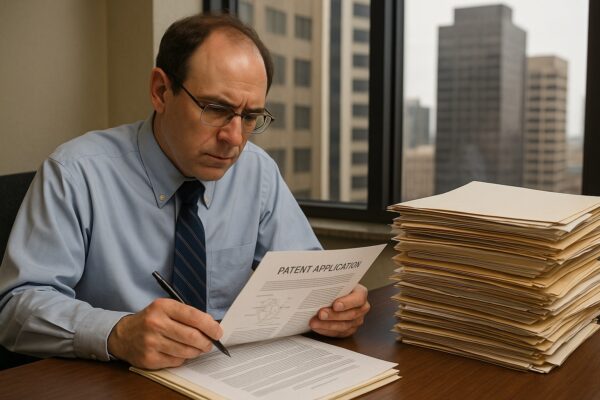
Patent examiners are the gatekeepers of patent rights in the United States patent system. They are employed by the United States Patent and Trademark Office (USPTO), a federal agency under the Department of Commerce headed by the Director of the USPTO. Their primary job is to examine patent applications to determine if an invention meets the legal requirements for a patent grant. This article discusses who patent examiners are, what they do, and how they impact the process of securing intellectual property rights. We cover the roles and responsibilities of patent examiners, and their qualifications. We also cover examination procedures and relevant laws, rules, and court decisions that apply to patent examiners.
Patent examiners are highly trained professionals and civil servant federal employees with backgrounds in science or engineering. In fact, to be hired as a patent examiner, one usually must possess at least a bachelor of science degree in a relevant technical field, such as electrical engineering, mechanical engineering, chemical engineering, computer science, or other technical discipline. Many examiners even hold advanced degrees in addition to the required bachelor's degree. This technical expertise enables examiners to understand highly technical inventions in their particular area of training. Examiners are typically placed in an "art unit" associated with their education and training.
Examiners are organized into specialized art units, which are groupings by technology area within the Patent Office's examiner corps. There is a broad range of art units in the USPTO covering the span of modern technology from software and artificial intelligence to complex machinery to biotech innovations. Each art unit deals with patent applications that cover technology related to its technology focus. For example, an application for a new software invention will be assigned to an art unit dealing with computer technology, while a biomedical invention goes to a different unit.
By assigning applications in this way, the USPTO ensures that each patent application is reviewed by an examiner with knowledge in the appropriate scientific or engineering discipline. The patent examiners are career professionals. Many are engineers or scientists by training and are often veterans in their fields. In fact, the USPTO is recognized as a top veteran-friendly agency, including some in patent examiner roles contributing their skills to the USPTO’s mission. As federal employees, examiners enjoy a stable career with rigorous training and ongoing education in patent law and technology.
Becoming a patent examiner requires a strong foundation in science or engineering. Most examiners enter the USPTO with a technical BS degree and must be U.S. citizens who pass a background check. New examiners undergo intensive training on patent laws, rules, and examination procedures. They learn to apply Title 35 of the United States Code (the federal patent laws) and follow the USPTO’s Manual of Patent Examining Procedure (MPEP) and regulations.
Examiners start at junior ranks, often called assistant examiners or juniors, and work under the guidance of more experienced colleagues. Over time, they can earn promotions and signatory authority, meaning they gain the power to sign off on decisions without supervisor approval. After demonstrating mastery of patent laws and examination skills, an examiner becomes a Primary Examiner. Primary examiners can independently issue office actions and review the work of junior examiners. This structured training and progression ensure that examiners have the ability, expertise, and judgment required to evaluate patent applications thoroughly. The administration of the USPTO is also populated by many former patent examiners who rose through the ranks to become department heads, deputy commissioners and other administrative roles.
The USPTO employs thousands of examiners. As of 2025, there were over 8,500 patent examiners on staff, including professionals with backgrounds in many engineering disciplines, computer science, biotechnology, and more. Each examiner typically specializes in a technology domain, which helps them assess highly technical patent applications. Ongoing training keeps examiners current with legal developments, such as new court decisions, and emerging technologies. In sum, patent examiners are highly qualified professionals with both technical know-how and legal training, operating at the intersection of technology, law, and government service.
Patent examiners also receive instruction on national security and confidentiality protocols, since some inventions have sensitive implications. For instance, an invention with potential national security impact might be flagged under special procedures under the Invention Secrecy Act for review by defense agencies. Examiners must coordinate with agencies like the Department of Defense or intelligence community in such cases. If an invention’s disclosure would be detrimental to national security, the government will impose a secrecy order to withhold publication of the patent application under 35 U.S.C. § 181. This means examiners at times work closely with other government agencies to ensure that patents do not inadvertently compromise security or defense interests.
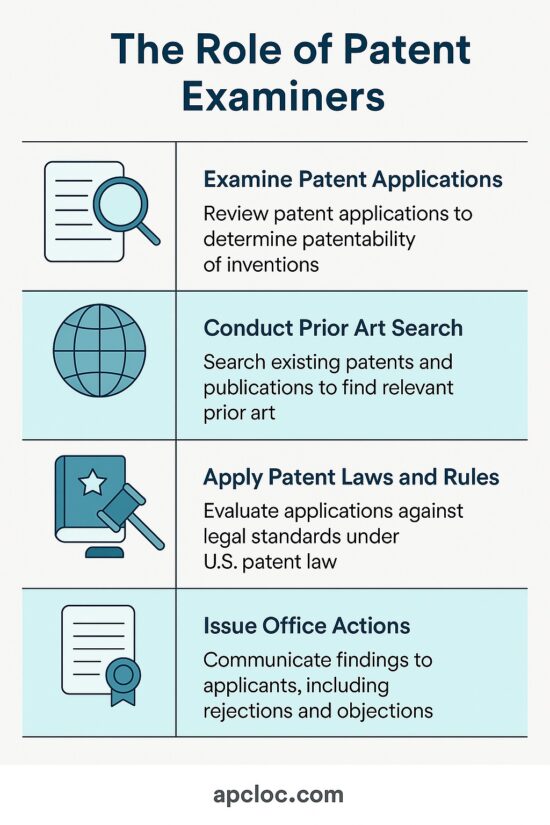
When an inventor or other applicant files a patent application, it enters the queue for examination. Each patent examiner is assigned a docket of applications to review. By law, the USPTO Director “shall cause an examination to be made of the application and the alleged new invention” to determine if “the applicant is entitled to a patent under the law”. In practice, the patent examiners carry out this mandate. The examiner’s responsibilities include: (1) reading and understanding the patent application, including the description, drawings, and claims defining the invention; (2) conducting a search for prior art (earlier patents, published articles, or existing products) that relates to the claimed invention; and (3) comparing the invention against the prior art to evaluate patentability criteria such as novelty and non-obviousness.
USPTO rules require examiners to perform a thorough patent search of the available prior art and to analyze the application for compliance with all legal requirements. This means an examiner will search patent databases, technical journals, and other sources worldwide. US patent law holds that information that is sufficiently publicly disclosed anywhere in the world is within the scope of prior art that can be used as a basis for the patent examiner to reject a patent application.
The examiner must compare the disclosures of the most closely related prior art to the claimed invention to determine whether the patent claims are novel (i.e., the claimed invention has not previously existed in the public knowledge) and that it would not have been obvious for a person having ordinary skill in the relevant art to come up with the claimed invention based on the prior art. When assessing novelty and obviousness, the goal is to ensure that the invention is truly new and not an obvious variation of what has come before.
Examiners also check that the application meets formal and technical requirements. For example, it is required that the inventor has fully described the invention, as required by 35 U.S.C. § 112. The claims must also be clear and supported by the disclosure. The patent examiners also verify that the invention falls within the proper categories of patentable subject matter under 35 U.S.C. § 101, which means it must be a process, machine, manufacture, or composition of matter, and not a mere abstract idea, law of nature, or natural phenomenon.
Patent examiners make determinations of whether a claimed invention is patentable by applying U.S. patent laws, USPTO rules, and guidance from judicial precedents. Several key legal criteria must be met for an application to be "allowed" or approved for a patent grant. The main pillars are defined in the patent statutes: 35 U.S.C. § 101 (patentable subject matter), 35 U.S.C. § 102 (novelty), 35 U.S.C. § 103 (non-obviousness), and 35 U.S.C. § 112 (written description, enablement, and definiteness). Examiners carefully evaluate the claims of an application under each of these provisions:
Throughout this analysis, patent examiners are guided not only by statutes but also by rules and case law precedent. For instance, 37 C.F.R. § 1.104 sets out the nature of examination. An examiner must make a complete search and state clear reasons for any rejection, citing the best prior art references available. If claims are rejected for lack of novelty or obviousness, the examiner is required to cite the most pertinent prior art and explain how it applies. Similarly, examiners may rely on court decisions interpreting these statutes, such as Graham v. John Deere Co., 383 U.S. 1 (1966) (the foundational obviousness case), Mayo Collaborative Services v. Prometheus Laboratories, Inc., 566 U.S. 66 (2012)(dealing with laws of nature), and others to ensure their analysis aligns with current law. The Manual of Patent Examining Procedure (MPEP) compiles these laws and court decisions into examination guidance, and examiners consult it regularly. In effect, examiners act as quasi-judicial officials applying complex legal standards to determine an application’s fate.
After reviewing a patent application, the examiner communicates findings to the applicant through written reports known as office actions. An office action summarizes the examiner’s evaluation and specifies any rejections, objections, or requirements. Under 35 U.S.C. § 132(a), if the examiner rejects one or more claims or raises objections, they must notify the applicant, “stating the reasons for such rejection, or objection or requirement, together with such information and references as may be useful in judging the propriety of continuing the prosecution”.
An office action will provide a detailed explanation of any issues with the application, citing relevant prior art or legal grounds. For example, a typical non-final office action might state that the claims are rejected under 35 U.S.C. 102 as being anticipated by some prior patent or other prior art, and then go on to explain which parts of the cited patent correspond to each element in the claims. It would also list any objections to informalities in specification, drawings, abstract, or claims and requirements, such as requiring the applicant to make an election between multiple inventions if the application is deemed to claim more than one distinct invention.
The examination process is iterative. The first office action is often a “non-final” action, giving the applicant an opportunity to respond. The applicant, usually through a patent attorney or patent agent, can reply by making arguments, amending the claims to overcome the examiner’s rejections, or submitting evidence, such as expert declarations in support of patentability. The patent examiner will then consider the response. If the issues are not resolved, the examiner may issue a “final” office action on a second round, maintaining the rejection. Even a final action doesn’t necessarily end the process, the applicant can file a Request for Continued Examination (RCE) or appeal the rejections, as discussed below.
During prosecution, examiners and applicants’ representatives can also have interviews, informal discussions either by phone or in person to clarify issues or explore possible amendments. These examiner interviews are often invaluable, allowing inventors or their attorneys to better understand the examiner’s reasoning and to present arguments or claim changes that might lead to an allowance. Examiners are generally open to such discussions, as it can make the process more efficient and improve the quality of examination.
When an examiner is satisfied that an application meets all legal requirements, they will issue a Notice of Allowance. This indicates the claims are in condition for patent grant. The applicant then pays an issue fee, and the patent will be issued. On the other hand, if the examiner concludes that the application cannot be allowed, even after the applicant’s responses, the final rejection can be made. It is worth noting that examiners have production goals and a large volume of cases. In recent years, the USPTO’s backlog of unexamined patent applications number in the hundreds of thousands, and examiners must balance efficiency with thoroughness. However, statistics show that a significant percentage of applications eventually get allowed, often after one or more rounds of negotiation and amendment. Engaging with the examiner in a professional, responsive manner can greatly help applicants reach a favorable outcome.
If a patent application is finally rejected by an examiner and the applicant does not wish to make further amendments, the patent system provides avenues to challenge the decision. Applicants should be aware that an examiner’s decision is not necessarily the end of the road. The first level of appeal is within the USPTO itself. The applicant can appeal to the Patent Trial and Appeal Board (PTAB), an administrative tribunal that reviews examiner rejections. A panel of administrative patent judges will reconsider the application and the examiner’s cited prior art and arguments. They may affirm or reverse the examiner’s decision in whole or in part. Many appeals result in either the examiner being reversed, leading to allowance of the patent or a remand for further examination with guidance.
If the PTAB also rules against the applicant, the next available step is judicial review in the courts. U.S. law provides two alternative routes: (1) an appeal to the U.S. Court of Appeals for the Federal Circuit, which will review the case on the administrative record; or (2) a civil action in federal district court in the Eastern District of Virginia under 35 U.S.C. § 145, where the applicant can present new evidence. In either case, the court will ultimately decide if the patent should issue. Notably, such proceedings are usually against the Director of the USPTO, not against the individual examiner. In fact, courts have made clear that an examiner cannot be personally sued or compelled to justify their decision in court.
Examiners act in a quasi-judicial capacity, and the proper recourse for an applicant is the appeal process, not a lawsuit against the examiner. For instance, a federal court in 2016 dismissed an attempted suit against a patent examiner on grounds of sovereign immunity, noting that Congress has only waived immunity for actions against the USPTO or its Director (e.g., appeals), not against individual examiners. The Federal Circuit similarly observed that an applicant’s remedies for a rejected patent are limited to the statutory appeal paths. One cannot circumvent the process by suing the examiner personally.
Additionally, examiners and other USPTO personnel are generally shielded from testifying in later patent litigation about their mental process or technical analysis during examination. Several court decisions have established that because examination is a quasi-judicial function, probing an examiner’s subjective thoughts is inappropriate. For example, the Federal Circuit in Western Electric Co. v. Piezo Tech., Inc., 860 F.2d 428 (Fed. Cir. 1988) held that a patent examiner may not be compelled to answer questions in court that “probe the examiner’s technical knowledge of the subject matter” of the patent.
Likewise, other courts have ruled it improper to inquire into an examiner’s reasoning or decision-making. The written record of the patent file must speak for itself. This doctrine means that once a patent is issued, any litigation over that patent typically focuses on the patent documents and prior art, not on calling the examiner as a witness. The examiner’s analysis is documented in the file history, also known as the prosecution history. It would be considered highly unusual and against USPTO policy for an examiner to provide testimony about why they allowed or rejected particular claims. This policy is rooted in maintaining the integrity of the examination process and treating examiners like judges on the record they create.
For business owners, the key takeaway is that while patent examiners have significant power in determining whether your invention gets patented, their decisions are constrained by laws and can be reviewed. If you receive an adverse decision, you have options through the appeal procedures. Examiners operate under consistent legal standards and cannot be influenced by external pressures. They must remain impartial. A strong case on the merits, supported by solid arguments and evidence, is your best strategy to ultimately obtain a patent, whether at the examiner level or on appeal.
Patent examiners evaluate patent applications to ensure that only deserving inventions receive the exclusive rights of a patent. Examiners are not adversaries; they are professionals tasked with upholding the patent laws and protecting the public interest by granting high-quality patents. By filing a well-prepared application and engaging constructively during prosecution, responding to office actions with clear arguments or claim amendments, applicants can work with examiners toward a favorable result. All communications with an examiner become part of the official record, and this file history can later impact how a patent is interpreted in the market and during enforcement in any patent litigation, so it is important to address the examiner’s points thoroughly and respectfully.
For patent applicants, navigating patent examination can be confusing and frustrating, but you don’t have to do it alone. Consider consulting a patent attorney. They can assist you with preparing, filing, and prosecuting applications that are in the best condition for examination and allowance. By engaging a skilled patent attorney, you will be better equipped to secure strong intellectual property protection for your innovations, turning your ideas into valuable assets for your company under the protection of the United States patent system.
If you need assistance with the patent process or other intellectual property matter, please contact our office for a free consultation.
© 2025 Sierra IP Law, PC. The information provided herein does not constitute legal advice, but merely conveys general information that may be beneficial to the public, and should not be viewed as a substitute for legal consultation in a particular case.

"Mark and William are stellar in the capabilities, work ethic, character, knowledge, responsiveness, and quality of work. Hubby and I are incredibly grateful for them as they've done a phenomenal job working tirelessly over a time span of at least five years on a series of patents for hubby. Grateful that Fresno has such amazing patent attorneys! They're second to none and they never disappoint. Thank you, Mark, William, and your entire team!!"
Linda Guzman


Sierra IP Law, PC - Patents, Trademarks & Copyrights
FRESNO
7030 N. Fruit Ave.
Suite 110
Fresno, CA 93711
(559) 436-3800 | phone
BAKERSFIELD
1925 G. Street
Bakersfield, CA 93301
(661) 200-7724 | phone
SAN LUIS OBISPO
956 Walnut Street, 2nd Floor
San Luis Obispo, CA 93401
(805) 275-0943 | phone

SACRAMENTO
180 Promenade Circle, Suite 300
Sacramento, CA 95834
(916) 209-8525 | phone
MODESTO
1300 10th St., Suite F.
Modesto, CA 95345
(209) 286-0069 | phone
SANTA BARBARA
414 Olive Street
Santa Barbara, CA 93101
(805) 275-0943 | phone
SAN MATEO
1650 Borel Place, Suite 216
San Mateo, CA, CA 94402
(650) 398-1644. | phone
STOCKTON
110 N. San Joaquin St., 2nd Floor
Stockton, CA 95202
(209) 286-0069 | phone
PORTLAND
425 NW 10th Ave., Suite 200
Portland, OR 97209
(503) 343-9983 | phone
TACOMA
1201 Pacific Avenue, Suite 600
Tacoma, WA 98402
(253) 345-1545 | phone
KENNEWICK
1030 N Center Pkwy Suite N196
Kennewick, WA 99336
(509) 255-3442 | phone
2023 Sierra IP Law, PC - Patents, Trademarks & Copyrights - All Rights Reserved - Sitemap Privacy Lawyer Fresno, CA - Trademark Lawyer Modesto CA - Patent Lawyer Bakersfield, CA - Trademark Lawyer Bakersfield, CA - Patent Lawyer San Luis Obispo, CA - Trademark Lawyer San Luis Obispo, CA - Trademark Infringement Lawyer Tacoma WA - Internet Lawyer Bakersfield, CA - Trademark Lawyer Sacramento, CA - Patent Lawyer Sacramento, CA - Trademark Infringement Lawyer Sacrament CA - Patent Lawyer Tacoma WA - Intellectual Property Lawyer Tacoma WA - Trademark lawyer Tacoma WA - Portland Patent Attorney - Santa Barbara Patent Attorney - Santa Barbara Trademark Attorney
