Copyright litigation refers to the legal process of enforcing one’s rights in creative works through lawsuits in federal court to address unauthorized use of copyrighted works (“copyright infringement”). A copyright owner can sue in federal civil court to stop the alleged infringement and recover damages, if they have gone through the copyright registration process for the infringed work. The copyright litigation process is time-consuming and expensive, but it is a necessary process for protecting valuable creative works like music, literature, visual arts, and other works that include creative expression. We discuss herein copyright litigation, covering what acts qualify as infringement, how lawsuits are pursued, common related claims, defenses to copyright claims (e.g., fair use), and remedies available to the copyright owner.
Copyright is a form of intellectual property (IP) that protects original creative works. It covers a broad range of works, including literature (blog posts, novels, movie scripts, etc.), music (sound recordings and written compositions), visual arts (photos, paintings, illustrations), motion pictures and other audiovisual works, theatrical works, and even architecture. If you or your business create content in any medium, that content may be protected under U.S. copyright law.
Owning a copyright gives the creator (or copyright owner) a bundle of exclusive rights in the work. Under the Copyright Act, these rights include: (1) reproducing the work (making copies); (2) creating derivative works based on it (e.g. adaptations or sequels); (3) distributing copies of the work to the public; (4) publicly performing the work; and (5) publicly displaying the work. In 1995, a sixth right was added for sound recordings: the exclusive right to perform the recording via digital audio transmission. In essence, only the copyright owner (or those they authorize) may exercise these rights. If someone else does any of these without permission, it likely infringes the copyright.
It is also important to understand what copyright does not protect. Copyright safeguards the expression of ideas, but not the underlying ideas or facts themselves. It does not cover names, logos, slogans, or brand names; those are typically protected by trademark law. Similarly, functional inventions or processes are covered by patents, not copyright. Content created by the U.S. government or in the public domain is not protected by copyright. This means, for example, that while a novel or software code you wrote is protected, a general idea for a marketing strategy or a common symbol is not. Understanding these boundaries will help you recognize what falls under “copyright issues” and what might be outside copyright’s scope.
Copyright infringement occurs when someone violates one of the copyright owner’s exclusive rights without authorization. In practical terms, this means using a protected work in a way reserved for the owner, such as copying text or images from a website, distributing music or videos without a license, publicly displaying someone’s photo or artwork, or creating an unauthorized derivative like a knock-off design, all without the copyright owner’s permission. Even well-meaning businesses can inadvertently commit infringement by using content found online or hiring a contractor who uses “borrowed” material. If that happens, your company could be sued and potentially held liable for damages.
To succeed in a copyright infringement lawsuit, the plaintiff (copyright owner) must prove two key elements. First, the plaintiff must show ownership of a valid copyright in the work. This typically involves demonstrating that the work is original and fixed in a tangible form (written, recorded, saved digitally, etc.). Second, the plaintiff must prove that the defendant infringed, i.e., that the defendant copied protected expression from the plaintiff’s work without permission. Often, direct evidence of copying is unavailable, so courts look for substantial similarities between the plaintiff’s work and the defendant’s work, plus evidence that the defendant had access to the original, since independent creation of the same content would not infringe.
In straightforward cases, infringement can be shown by a defendant’s unauthorized use. For example, selling pirated copies of a book or software is clear-cut infringement. In more complex cases, such as when only a portion of a work, courts will filter out unprotected elements, such as general ideas or common scenes, and ask whether the defendant took enough original expression to constitute improper appropriation. If only the general idea or concept was similar, it may not be infringement, but if the particular expression was copied, the court may find infringement. For example, in Twentieth Century-Fox Film Corp. v. MCA, Inc., 715 F.2d 1327 (9th Cir. 1983), the Ninth Circuit held that summary judgment was improper where Fox alleged that Universal’s Battlestar: Galactica copied protected expression from Star Wars. Fox claimed that the television series appropriated numerous specific expressive similarities from the film, including plot elements, character relationships, settings, and sequences. The Ninth Circuit concluded that the similarities raised genuine issues of material fact as to whether defendants copied only the unprotectable idea of a space fantasy adventure or instead copied protectable expression, making the issue one for trial.
It is worth noting that intent is not required for civil infringement liability, even unintentional or unaware copying can infringe. However, willfulness (knowing infringement) can increase the penalties, as discussed below. The bottom line is that if your business uses content created by someone else, whether it’s text, images, music, software code, or architectural plans, you should ensure you have the right to do so, or you risk a potential infringement claim.
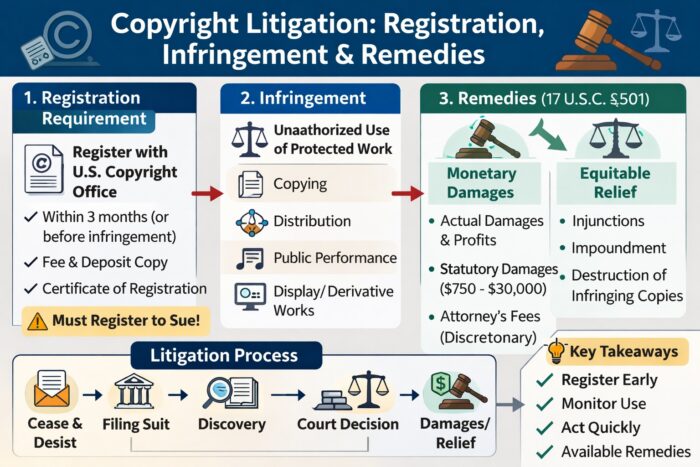
Copyright protection exists automatically as soon as an original work is fixed in a tangible medium, and registration is not required to own a copyright. However, U.S. law requires a copyright to be registered with the U.S. Copyright Office before the copyright owner can file an infringement lawsuit in federal court. In other words, while unregistered works are still protected, you cannot sue over an unregistered U.S. work until you obtain a copyright registration certificate, a rule recently affirmed by the Supreme Court. This makes registration an essential step if you need to enforce your rights and provides many benefits. The registration process involves depositing a copy of the work with the Copyright Office and paying a filing fee, after which the Office issues a certificate of registration. Fortunately, the registration process can be done online and is relatively inexpensive compared to litigation costs.
Beyond being a legal prerequisite to sue, registration comes with additional benefits in litigation. Most importantly, if you registered your work before an infringement began or within 3 months of the first publication of the work, you are eligible to seek statutory damages and attorney’s fees from an infringer. Statutory damages are set amounts of money per work infringed, defined by statute, which the plaintiff can elect instead of proving actual damages. This means even if you cannot quantify your loss, the court can award between $750 and $30,000 per infringed work without requiring detailed proof. If the infringement was willful, the court can increase statutory damages up to $150,000 per work as a punishment. Additionally, the Copyright Act gives courts discretion to order the losing party to pay the prevailing party’s attorney's fees. Together, the availability of statutory damages and fee-shifting gives registered copyright holders significant leverage. The risk of having to pay hefty damages and the other side’s legal bills often pressures defendants into settlement. Conversely, if you never registered your work before the infringement, you will be limited to actual damages and the infringer’s profits and cannot recover attorney's fees, which may make a case less economically feasible to pursue. The takeaway for businesses is clear: if you have valuable original content (e.g., software, writings, designs, etc.), register it early to preserve your full range of remedies in case of litigation. The Copyright Office’s public records also put others on notice of your claims, which can help deter infringement in the first place.
Copyright litigation is generally a federal matter. Copyright is governed by federal statute (Title 17 of the U.S. Code), so lawsuits must be brought in federal court. In fact, federal courts have exclusive jurisdiction over copyright claims, meaning state courts usually cannot hear copyright infringement cases. Many copyright suits arise in industry centers like California and New York. For example, the Ninth Circuit, which is the federal appeals court covering the West Coast, and the Second Circuit, which is the federal appeals court covering New York, are widely regarded as two of the most important jurisdictions for copyright law developments. This is no surprise, as California’s entertainment and software industries and New York’s publishing and media industries generate a large share of U.S. copyright disputes. However, a lawsuit may be filed in any federal district that has a connection to the dispute, typically where the defendant resides or where the infringement took place. For instance, if an infringing product was distributed nationwide, the plaintiff might have a choice of forums. The choice of venue can sometimes impact how the law is interpreted, since different circuits have slightly different precedents, but the core copyright principles are federal and thus similar across jurisdictions.
Timing is another important consideration. Copyright claims are subject to a statute of limitations. In the U.S., the Copyright Act provides that a civil action must be commenced “within three years after the claim accrued” under 17 U.S.C. § 507(b). In some copyright cases, courts apply an injury rule, under which a claim accrues when the infringing act occurs. In other cases, courts have applied a discovery rule, under which a claim accrues when the plaintiff discovers, or reasonably should have discovered, the infringement.
The Supreme Court has stated that it has not definitively resolved whether the Copyright Act always incorporates a discovery rule, but in Warner Chappell Music, Inc. v. Nealy, 601 U.S. 366 (2024), it addressed the question of whether damages dating back more than three years are available where the claim is timely under the discovery rule. In Nealy, the plaintiff alleged that music rights had been exploited without authorization for many years, but he claimed he did not discover the alleged infringement until much later. The defendants argued that even if the suit was timely under a discovery-based accrual rule, the plaintiff still could not recover damages for infringements occurring more than three years before the complaint was filed. The Supreme Court rejected that separate three-year damages cap. Assuming the claim is timely under the applicable accrual rule, the Court held that the Copyright Act does not impose an additional bar that automatically limits recovery to only the three years immediately preceding suit.
Business owners who suspect their work is being infringed should act diligently and seek legal advice promptly, rather than “sleep on their rights.” On the flip side, if your business is accused of infringement long after the fact, the statute of limitations could be a defense. For instance, if a plaintiff knew of an unauthorized use for over three years and did nothing, their claim might be time-barred.
It is also worth noting that not every potential defendant can be sued in copyright. Thanks to the Eleventh Amendment and principles of state sovereign immunity, state government entities and state universities, agencies, etc. are generally immune from copyright infringement suits. In 2020, the U.S. Supreme Court unanimously held that Congress’s attempt to allow copyright suits against states, the Copyright Remedy Clarification Act, was unconstitutional, and therefore states cannot be sued for copyright infringement without their consent. This means if, say, a public university or state government office infringes your work, your remedies may be limited, unless Congress crafts a new valid law. Private parties and corporations, however, have no such immunity and can be sued for infringement like anyone else. Additionally, foreign defendants can be sued in U.S. courts for acts of infringement that have sufficient connection to the United States, though jurisdictional and enforcement issues can arise in international cases. In any event, it is crucial to file in the proper court and within the allowed timeframe to ensure your copyright claims are heard.
A copyright lawsuit follows the same general trajectory as other civil litigation, but there are some features particular to IP cases. Typically, the process begins with the copyright owner (plaintiff) sending a cease and desist letter or takedown notice to the alleged infringer. If the dispute isn’t resolved informally, the plaintiff files a complaint in federal court. The pleadings stage will frame the claims and defenses. For example, a complaint might allege that “the defendant reproduced and distributed the plaintiff’s software without authorization, infringing the plaintiff’s exclusive rights under 17 U.S.C. §106,” and the defendant’s answer may deny the allegations and possibly raise defenses, like fair use or invalidity of the copyright.
After pleadings, the case enters discovery, where each side exchanges information and evidence. This can involve document production, such as sales records of an allegedly infringing product, or proof of the plaintiff’s ownership and registration; depositions of witnesses; and expert reports. Copyright cases often require expert testimony, especially on issues like substantial similarity of music or code, or to calculate damages. For instance, an expert might opine on the portion of the defendant’s profits attributable to the infringement. Copyright litigation can be complex and costly, even when the monetary stakes of the infringement seem limited because of the need for expert analysis, extensive evidence gathering, and other factors.
It is common for either party to file a summary judgment motion after discovery. In a summary judgment motion, a party argues that there are no genuine disputes of material fact for a jury to decide, and that they are entitled to judgment as a matter of law. For example, an accused infringer might move for summary judgment that the works are not substantially similar, or that the use is protected by fair use, thus no trial is needed. Courts in some circuits have been willing to decide lack of substantial similarity as a matter of law and dismiss cases early if the works are clearly different. In other circuits, courts are more cautious, often finding that as long as there is some similarity, the question of substantial similarity should go to a jury, making summary judgment for the defense harder to obtain. If the case is not resolved on motions, it will proceed to a trial, where a judge or jury will determine whether infringement occurred and what damages or relief should be granted.
Throughout this process, parties will often discuss settlement. The reality is that full trials are relatively rare in copyright cases. Many disputes end before reaching the verdict stage. One reason is that litigation can be expensive and time-consuming, costing hundreds of thousands of dollars if the process is taken through trial to a verdict. Cases can take a year or more to resolve, imposing distractions and legal fees on both sides.
Recognizing this, Congress recently created an alternative forum called the Copyright Claims Board (CCB) as part of the 2020 CASE Act. The CCB is a small-claims tribunal within the Copyright Office that provides a voluntary alternative to federal court for smaller disputes. It can hear claims of up to $30,000 in damages, using a streamlined process without extensive discovery or in-person hearings. The CCB cannot issue injunctions, though it can order an infringer to stop if both parties agree, but it offers a lower-cost path to resolve minor infringements. Business owners with a relatively small copyright claim may consider the CCB as an option to avoid the full federal litigation process. However, both parties must voluntarily participate. A respondent can opt out, forcing the claimant to go to federal court. For larger or more complex cases, traditional federal litigation remains the main avenue.
Copyright litigation often doesn’t exist in a vacuum. In many cases, a plaintiff will assert multiple intellectual property claims in the same lawsuit. For instance, if someone is selling bootleg copies of a motion picture, the movie studio might sue for copyright infringement and for trademark infringement if the bootleg uses the studio’s logos or the movie’s branded characters to market the product. Copyright is just one segment of IP; other types include patents, trade secrets, and trademarks. It is not uncommon for a dispute to touch on more than one area. A classic example is when a business believes a competitor stole its creative content and is engaging in misleading practices in the marketplace. The competitor’s actions might violate copyright law and also constitute trademark infringement or unfair competition under broader business tort principles.
U.S. law allows plaintiffs to bundle such related claims in one suit. Unfair competition is a particularly common add-on claim in IP lawsuits. Unfair competition law, at its core, aims to prevent deceptive or unethical business practices that aren’t specifically covered by other IP laws. As one firm explains, unfair competition claims are often included alongside trademark and copyright infringement claims to address misconduct that falls outside the precise scope of those laws. For example, if a former employee takes your company’s confidential client list and creative marketing content, you might sue them for trade secret misappropriation for stealing secret information and for copyright infringement for copying original text or graphics, and also add an unfair competition claim for the overall unethical scheme. Unfair competition can encompass things like passing off one’s goods as another’s, false advertising, idea theft in certain circumstances, and other misrepresentations in commerce. Note that some unfair competition claims may be preempted by the Copyright Act if they don’t involve an extra element beyond copying the work, but many claims can coexist with a copyright claim.
Trademark infringement is another claim that frequently overlaps with copyright disputes. Trademarks protect names, logos, and identifiers of source, such as character names, brand logos, or band names. If an alleged infringer is not only copying your content but also using your brand name or logo, you would pursue trademark claims under the Lanham Act in addition to copyright. In fact, a single unauthorized venture can trigger several IP claims. Imagine someone screens your company’s film without permission and uses your characters’ images and movie title to advertise the event. Such a situation involves copyright infringement (the unauthorized public performance of the film) and trademark infringement (unauthorized use of protected names in advertising). A copyright plaintiff could also file for trademark infringement if the infringed property has branded aspects used in commerce, such as character names or logos.
Finally, breach of contract or other civil claims might be present. For example, if the parties had a license agreement or employee agreement and one party exceeded their permissions, a breach of contract claim would accompany the copyright claim. In summary, parties in IP disputes often cast a wide net: plaintiffs often assert claims for copyright infringement alongside trademark infringement, unfair competition, breach of contract, and more in the same lawsuit. As a business owner, it’s useful to recognize that an infringement scenario may implicate multiple legal issues. Conversely, if your business is accused of infringement, be aware the plaintiff might allege related wrongdoing, like claiming your marketing amounted to false advertising or that you breached some implied agreement. These overlapping claims increase the stakes of litigation, but sometimes also present additional defenses. Each type of claim has its own elements and defenses, so consult with an IP attorney to navigate the multi-faceted dispute.
The rise of the internet and digital media has brought special challenges to copyright enforcement. When infringement happens online, such as users uploading music, videos, or images to websites or social media without permission, the question arises: who is liable, the user or the platform hosting the content or both? In the late 1990s, to foster growth of internet services, Congress passed the Digital Millennium Copyright Act (DMCA), which includes provisions that create a safe harbor for online service providers. See 17 U.S.C. §512. In short, the DMCA safe harbor protects internet platforms from monetary liability for copyright infringement committed by their users, as long as the service meets certain conditions. These conditions include: (1) the service provider must not have actual knowledge of the infringing material on its system and not be “willfully blind” to obvious infringement; (2) if the provider becomes aware of infringement, for example, via a proper takedown notice from a copyright holder, it must act expeditiously to remove or disable access to the infringing material; and (3) the provider must not receive a direct financial benefit from the infringement in cases where it has the right and ability to control the activity. In practice, compliance often means having a registered DMCA agent, a published takedown policy, and promptly removing content when a valid notice is received.
For example, imagine your company runs a video-sharing website. One of your users uploads a popular song or movie without authorization. Under the DMCA, if you swiftly take down that content once you are notified, your company would likely be shielded from liability for that user’s post if you were not aware of it beforehand. Generalized knowledge that “there’s probably some infringement on our platform” is not enough to lose safe harbor; the courts require knowledge of specific infringing material. The Second Circuit emphasized this in Viacom Int’l, Inc. v. YouTube, Inc., 676 F.3d 19 (2d Cir. 2012). In that case, media company plaintiffs claimed that YouTube hosted thousands of unauthorized clips of television shows and other copyrighted programming uploaded by users. Plaintiff Viacom argued that YouTube was generally aware that infringing material was widespread on its platform. The U.S. District Court granted summary judgment in YouTube’s favor, finding that YouTube fell within the DMCA safe harbor for all the claims asserted by the plaintiffs regarding the alleged copyright infringement on its platform. The court noted that YouTube had a robust notice-and-takedown system and that placing the burden on content owners to notify platforms of infringing material “makes sense, as the infringing works in suit may be a small fraction of millions of works” on the platform. In other words, an internet service with millions of user uploads cannot realistically screen everything for licenses or fair use, so the law shifts the policing burden to copyright owners – they send notices of specific infringing material, and the service must respond quickly.
The Second Circuit held, however, that generalized awareness of infringement on a platform is not enough to disqualify a service provider from DMCA safe-harbor protection; instead, the provider must have actual knowledge or “red flag” awareness of specific infringing material. As long as the service provider does not have actual or “red flag” knowledge of a particular infringement and is not inducing users to infringe, it can avoid being held liable for the infringements of its users.
For business owners, the DMCA safe harbor is crucial if your business model involves user content. By registering an agent with the Copyright Office and implementing DMCA-compliant policies, you can significantly reduce the risk of copyright liability from user posts. However, note that the safe harbor will not protect you if your own company is directly posting infringing content, nor if you encourage or induce infringement. In Metro-Goldwyn-Mayer Studios Inc. v. Grokster, Ltd., 545 U.S. 913 (2005), the Supreme Court held that distributors of peer-to-peer file-sharing software could be liable for induced copyright infringement where the services were marketed to former Napster users, the companies promoted the software as a way to obtain copyrighted music and movies for free, and their business model depended on high-volume infringing use by users. The Court explained that a party that distributes a product “with the object of promoting its use to infringe copyright” may be liable for the resulting third-party infringement.
Also, the DMCA safe harbor does not categorically bar injunctive relief. Section 512 limits monetary relief for qualifying service providers, but it expressly preserves certain forms of injunctive and other equitable relief under subsection (j), including orders directed at restraining access to infringing material or accounts involved in repeat infringement.
In summary, the DMCA provides powerful protections for online services, but compliance and a neutral stance are key. If your business is the one whose content is being infringed online, the DMCA also provides a tool for you as a copyright holder: you can send takedown notices to platforms hosting infringing copies of your work, and they are obligated to remove the material or potentially lose their immunity.
Being accused of copyright infringement does not automatically mean you will be held liable. There are several defenses and exceptions to infringement in copyright law. The most well-known is fair use. Codified in Section 107 of the Copyright Act, fair use permits certain uses of copyrighted material without permission if the use is considered socially beneficial or unlikely to harm the copyright owner’s market. Fair use is a somewhat flexible doctrine, evaluated case-by-case by weighing four statutory factors:
Courts ask why and how you used the work. Uses for criticism, comment, news reporting, teaching, scholarship or research are explicitly mentioned as examples of favored purposes. Nonprofit or educational uses are more likely fair than purely commercial ones. Transformative uses, those that add new meaning or message to the original, rather than just republishing it, also weigh in favor of fair use, as recent court decisions have emphasized. For example, a parody song that mocks the original is transformative, whereas simply using a song as background music in a commercial is not.
This factor looks at the type of work used. Using factual or informational works is more likely to be fair use than using highly creative works (e.g., songs or novels), since creative works sit at the core of copyright. Also, using unpublished works is viewed less favorably because the law favors the author's or owner's right to control the first publication.
Here, the court considers both the quantity and the quality of what was taken. Using a small, necessary excerpt of a work may be fair, but using the “heart” of the work might weigh against fair use. There is no strict rule on amount. For example, copying 200 words from a 300-page book could be fair, whereas copying 30 seconds of a 3-minute song might not be, if those 30 seconds are the hook of the song.
Perhaps the most important factor, this looks at whether the secondary use harms the existing or potential market for the original work. If the use acts as a substitute for the original, it will likely weigh against fair use. For example, if people watch your summary of a movie instead of buying the movie, this factor will weigh against a finding of fair use. If the use is in a different market and doesn’t usurp demand (e.g., a few lines of a song in a historical documentary), this factor can favor fair use.
No single factor is determinative; courts balance them together. Fair use is famously unpredictable, which can be frustrating. However, some categories of use have generally been upheld as fair use: quoting text for a book review or academic commentary, parodying a popular work, using a short clip or still image in a news report, or creating a search engine thumbnail image index. On the other hand, uses that simply save the user the cost or effort of purchasing the original, such as sharing full copies of music, movies, or software, are routinely found not to be fair use. A recent Supreme Court decision in 2023, Andy Warhol Foundation for the Visual Arts, Inc. v. Goldsmith, 598 U.S. 508 (2023), underscored that even transformative intent does not guarantee fair use. In that case, photographer Lynn Goldsmith took a 1981 photograph of Prince, and Vanity Fair initially licensed the photograph for use as an artist reference. Andy Warhol later created a series of Prince images based on that photograph, and after Prince’s death, the Warhol Foundation licensed one of those images to Condé Nast for a magazine cover. The Supreme Court held, in the context of that commercial magazine licensing, that the first fair-use factor did not favor fair use because the secondary use shared substantially the same commercial purpose as Goldsmith’s original photograph. The Court emphasized that each challenged use must be examined in its specific context. The key for businesses is that they should not assume a use is fair simply because credit was given or because the use was not highly profitable. Fair use is a legal defense that would ultimately be decided by a judge or jury if litigated. When in doubt, seek a license or consult counsel, especially for any commercial use of someone else’s content.
Aside from fair use, other defenses and exceptions exist. One is consent or license. If you actually had permission or an implied license to use the work, then there is no infringement. For example, if a photographer licensed you an image for your website, you can defend an infringement claim by showing that license. Invalid copyright is another defense: the defendant might argue the plaintiff’s work is not protected. For example, the defendant may argue that the work is too factual or not original. In some cases, defendants claim independent creation. Another defense is de minimis use, which means the copying was so minor as to be trivial. Courts sometimes accept this when the copied portion is extremely small or unrecognizable in the defendant’s work. First Sale doctrine permits resale of lawfully made copies, which is not exactly a defense to making copies but allows, say, reselling purchased books or DVDs without infringement. There are also specific statutory exceptions for things like library archiving, some educational performances, and others that likely won’t apply to most business contexts.
If your business is accused of infringement, it’s important to evaluate these defenses. Sometimes a strong fair use argument or proof of a license can lead the other side to drop the case or result in a quick win on summary judgment. On the flip side, if you are the plaintiff, be prepared that the defendant may invoke fair use or other defenses. Many high-profile cases have turned on the fair use analysis, which can be somewhat subjective. Ultimately, fair use and other defenses are highly fact-specific. Courts will consider the nuances of your situation, which is why getting legal advice on the strength of a fair use position is wise before banking on it.
If a copyright infringement claim is proven, the focus shifts to remedies: what the court will award or order to right the wrong. Copyright law provides both injunctive relief (an order to stop the infringement) and monetary damages to compensate the owner and/or disgorge the infringer’s gains.
Injunctive relief is often the first thing a copyright owner seeks. Because every unauthorized copy or distribution is a new violation of the exclusive rights, ongoing infringement can cause harm that money alone cannot fix. It can devalue the work, harm the market, or damage the creator’s control over their creation. A court can issue a preliminary injunction early in the case to halt the activity while the case is pending and a permanent injunction after a final judgment to prohibit the defendant from infringing the work in the future.
To get a permanent injunction, a plaintiff must satisfy the traditional equity test, including demonstrating irreparable harm if the infringement were to continue. In the past, courts often presumed irreparable harm from copyright infringement, but after the Supreme Court’s decision in eBay Inc. v. MercExchange, L.L.C., 547 U.S. 388 (2006), courts require actual evidence of irreparable harm rather than applying any automatic presumption. For example, in Perfect 10, Inc. v. Google, Inc., 653 F.3d 976 (9th Cir. 2011), the plaintiff, an adult entertainment publisher and owner of copyrighted photographs, sued Google over its display of thumbnail versions of Perfect 10’s images in Google Image Search and its linking to third-party websites that displayed allegedly infringing full-size copies. The Ninth Circuit court affirmed the denial of injunctive relief, holding that Perfect 10 had not met its burden to show irreparable harm caused by Google’s conduct. In many straightforward cases, however, it is not hard to show that an unlicensed use undermines your exclusive rights in a way that money cannot fully repair, especially if the infringement is continuous or threatens your market.
Courts commonly grant injunctions to stop infringing activities once liability is established, preventing further unauthorized distribution or display of the copyrighted material. An injunction might order the destruction or impounding of infringing goods, the removal of infringing content from websites, or other steps to cease the violation. For business owners, this means that if you lose an infringement case, you will likely be legally barred from any further use of the work. Violating an injunction can lead to contempt of court. If you’re the plaintiff, an injunction is a powerful tool to regain control over your work and avoid future infringement by that defendant.
U.S. copyright law offers two main types of damages: actual damages plus any of the infringer’s profits, or statutory damages. The plaintiff typically must choose one or the other. Actual damages aim to compensate the copyright owner for the losses suffered due to the infringement. This could include lost sales, lost licensing fees, or diminution of the work’s value. In addition, the plaintiff can seek to recover the profits the defendant earned from the infringement, to the extent those profits are not already counted in the actual damages. The law only permits disgorging profits attributable to the infringement. The plaintiff has to show a causal link. For instance, if a defendant’s advertisement used your photo, you might claim the ad helped generate sales, and seek those profits. Once the plaintiff shows the gross revenue the defendant made from the infringing activity, the burden shifts to the defendant to prove which portions of that revenue were not due to the infringing material. In some cases, this actual damages route can yield large awards, especially if the infringement involved a hit product or was widespread. However, calculating and proving actual damages can be complicated and often requires financial experts.
Statutory damages, on the other hand, are often a more straightforward option, if the work was registered in time. Statutory damages do not require proving any specific loss or profit. The Copyright Act provides a range of $750 to $30,000 per infringed work for ordinary infringements, “as the court considers just.” The judge or jury can decide an amount in that range based on the circumstances (e.g. how egregious or willful the infringement was, the need to deter, etc.). If the infringement is found to be willful, the maximum per-work statutory award can go up to $150,000. Conversely, if the infringer proves they were not aware and had no reason to know they were infringing (an “innocent infringer”), the minimum can drop to $200 per work.
In practice, courts have broad discretion within these ranges. Statutory damages serve both compensatory and deterrent purposes. Even if an infringement caused little measurable harm, the court might award a significant sum to penalize the behavior and deter others. For example, in cases against small businesses or individuals who use images without a license, courts still frequently award at least the minimum or more, to reinforce that infringing is more expensive than simply licensing the content. Some copyright holders, particularly music publishers and photographers, are known for suing over relatively minor infringements precisely because statutory damages and attorney's fees make it economically viable to do so. As a defendant, you should be aware that even if the actual harm was minimal, you could face a statutory damages award of several thousands of dollars per work. And if multiple works were infringed (e.g., 10 songs or 50 photos), the damages can multiply quickly.
In addition to damages, the court may order the losing party to pay the prevailing party’s attorney’s fees and court costs, under 17 U.S.C. §505, but such an award is discretionary, not automatic. The statute expressly provides that “the court in its discretion may” award costs and “a reasonable attorney’s fee to the prevailing party.”
The Supreme Court has made clear that this discretion applies equally to prevailing plaintiffs and prevailing defendants. In Fogerty v. Fantasy, Inc., 510 U.S. 517 (1994), the Court rejected the idea that prevailing copyright plaintiffs should ordinarily recover fees while prevailing defendants should face a higher bar. Instead, courts must treat both sides alike and decide fee requests based on equitable considerations, not a one-sided presumption.
The Supreme Court later clarified how courts should exercise that discretion in Kirtsaeng v. John Wiley & Sons, Inc., 579 U.S. 197 (2016).The Supreme Court stated that “substantial weight” should be given to the objective reasonableness of the losing parties position, whether it be plaintiff's asserted claims and the defendant's defenses. Those circumstances may include factors such as frivolousness, motivation, compensation, and deterrence. In other words, objective reasonableness is important, but it is not controlling, and there is no strong presumption that fees will be awarded simply because one side prevailed.
As a practical matter, this means a business that wins a copyright case may recover attorney’s fees, but should not assume that fees will automatically be awarded. Likewise, a party with a weak, unreasonable, or strategically abusive position faces a greater risk that the court will shift fees under § 505.
Finally, for truly egregious cases, criminal penalties may apply. While ordinary infringement is a civil matter, willful infringement done for commercial advantage or private financial gain can lead to criminal charges by the Department of Justice. Typically, criminal copyright infringement involves large-scale piracy: e.g. a bootleg DVD ring, or an operator of a pirate software website. Criminal infringement can result in fines and even imprisonment. For example, willfully infringing copyrights (e.g., distributing copies worth over $2,500) can be punishable by up to 5 years in prison and $250,000 in fines for a first offense. And each act can count as a separate offense.
The DOJ must prove willfulness, meaning knowledge that the act was infringing, and usually some level of distribution or profit motive. For instance, someone who knowingly uploads a movie to the internet for free, right before the studio’s release, thus harming the commercial value, could be charged on the theory they intended to harm the market for commercial gain of others. In sum, criminal enforcement is relatively rare and typically not a risk for inadvertent infringement by a small business, but it underscores the seriousness with which large-scale, intentional infringement is viewed.
Most copyright disputes involving businesses are resolved out of court, often through negotiated settlements. Litigation is expensive and unpredictable, so both sides frequently have an incentive to reach a deal. A settlement might involve the defendant stopping the infringing use and perhaps paying a license fee or damages, or even a favorable settlement permitting some continued use under agreed conditions. For example, in Viacom International Inc. v. Cablevision Systems Corp., No. 1:11-cv-04265 (S.D.N.Y. filed June 23, 2011), Viacom sued Cablevision after Cablevision launched its “Optimum App,” which allowed cable subscribers to stream live television programming, including Viacom channels, to iPads within their homes over Cablevision’s cable system. Viacom alleged that this feature exceeded Cablevision’s contractual rights and asserted claims for breach of contract, copyright infringement, trademark infringement, and unfair competition.
The case ended in a settlement that allowed Cablevision’s service to continue with certain limitations rather than being shut down outright. Reports at the time explained that the settlement permitted cable subscribers to view content on additional in-home screens, including tablets, reflecting a negotiated business solution instead of a merits ruling by the court. This illustrates how a creative settlement can resolve IP disputes without a winner-take-all court judgment.
If your business is accused of infringement, you should address it immediately. Don’t ignore cease-and-desist letters or DMCA takedown notices. Often, there is room to resolve the issue amicably, perhaps by promptly removing the content, paying a retroactive license fee, or entering a new license going forward. An early consultation with a copyright attorney can help you evaluate the claim’s validity and negotiate from a position of knowledge. As one law firm advises, if you receive an infringement notice or demand, you should consider contacting an attorney familiar with copyright litigation promptly to assess your potential exposure and options. Sometimes a quick response and willingness to cure the problem can prevent a full-blown lawsuit. If a lawsuit is filed, settlement can still occur at any stage, even after judgment, though earlier is usually better to control costs.
On the proactive side, businesses should implement preventive measures to avoid infringing others’ copyrights in the first place. Train your employees and content creators about copyright rules. For instance, employees can be trained to use stock images with proper licenses, writing original copy or verifying that any source material is public domain or licensed, and being cautious with music or footage in marketing materials. Employers should establish appropriate internal policies. For example, legal or managerial approval should be required before using third-party content in any project. These steps can significantly reduce the risk of accidental infringement. The ultimate goal is never to be accused in the first place, and measures like employee training and clear procedures can help protect your company from copyright litigation. Also, if your business relies on user-generated content, have a DMCA policy and content moderation practices to swiftly address complaints. This not only helps with safe harbor protection but also shows good faith.
Lastly, remember that competent legal counsel is invaluable in navigating complex copyright matters. Copyright law has many nuances and evolving case law. An experienced attorney can assist clients in both enforcing their rights and defending against claims. They can also help negotiate licenses or settlements that avoid litigation entirely. Speaking with a lawyer who has litigated copyright disputes can help manage the risk and expense of a potential lawsuit. In other words, a bit of legal guidance up front can save you from costly lessons later.
Copyright litigation involves a myriad of legal and practical issues, but understanding the basics can help business owners avoid infringement and deal effectively with infringement claims if they do arise. We have seen that copyright law grants creators exclusive rights and provides strong remedies to enforce those rights, from injunctions stopping infringing activities to hefty statutory damages against violators.
When disputes do arise, remember that early resolution is often preferable. Litigation in federal court is a serious undertaking with high stakes. By being proactive and informed, and by consulting legal professionals when needed, you can significantly reduce the risk of copyright issues derailing your business. Every business should treat copyright matters with the importance they deserve. If you need assistance with a copyright infringement issue or other intellectual property matter, contact our office for a consultation.
© 2026 Sierra IP Law, PC. The information provided herein does not constitute legal advice, but merely conveys general information that may be beneficial to the public, and should not be viewed as a substitute for legal consultation in a particular case.

"Mark and William are stellar in the capabilities, work ethic, character, knowledge, responsiveness, and quality of work. Hubby and I are incredibly grateful for them as they've done a phenomenal job working tirelessly over a time span of at least five years on a series of patents for hubby. Grateful that Fresno has such amazing patent attorneys! They're second to none and they never disappoint. Thank you, Mark, William, and your entire team!!"
Linda Guzman


Sierra IP Law, PC - Patents, Trademarks & Copyrights
FRESNO
7030 N. Fruit Ave.
Suite 110
Fresno, CA 93711
(559) 436-3800 | phone
BAKERSFIELD
1925 G. Street
Bakersfield, CA 93301
(661) 200-7724 | phone
SAN LUIS OBISPO
956 Walnut Street, 2nd Floor
San Luis Obispo, CA 93401
(805) 275-0943 | phone

SACRAMENTO
180 Promenade Circle, Suite 300
Sacramento, CA 95834
(916) 209-8525 | phone
MODESTO
1300 10th St., Suite F.
Modesto, CA 95345
(209) 286-0069 | phone
SANTA BARBARA
414 Olive Street
Santa Barbara, CA 93101
(805) 275-0943 | phone
SAN MATEO
1650 Borel Place, Suite 216
San Mateo, CA, CA 94402
(650) 398-1644. | phone
STOCKTON
110 N. San Joaquin St., 2nd Floor
Stockton, CA 95202
(209) 286-0069 | phone
PORTLAND
425 NW 10th Ave., Suite 200
Portland, OR 97209
(503) 343-9983 | phone
TACOMA
1201 Pacific Avenue, Suite 600
Tacoma, WA 98402
(253) 345-1545 | phone
KENNEWICK
1030 N Center Pkwy Suite N196
Kennewick, WA 99336
(509) 255-3442 | phone
2023 Sierra IP Law, PC - Patents, Trademarks & Copyrights - All Rights Reserved - Sitemap Privacy Lawyer Fresno, CA - Trademark Lawyer Modesto CA - Patent Lawyer Bakersfield, CA - Trademark Lawyer Bakersfield, CA - Patent Lawyer San Luis Obispo, CA - Trademark Lawyer San Luis Obispo, CA - Trademark Infringement Lawyer Tacoma WA - Internet Lawyer Bakersfield, CA - Trademark Lawyer Sacramento, CA - Patent Lawyer Sacramento, CA - Trademark Infringement Lawyer Sacrament CA - Patent Lawyer Tacoma WA - Intellectual Property Lawyer Tacoma WA - Trademark lawyer Tacoma WA - Portland Patent Attorney - Santa Barbara Patent Attorney - Santa Barbara Trademark Attorney
