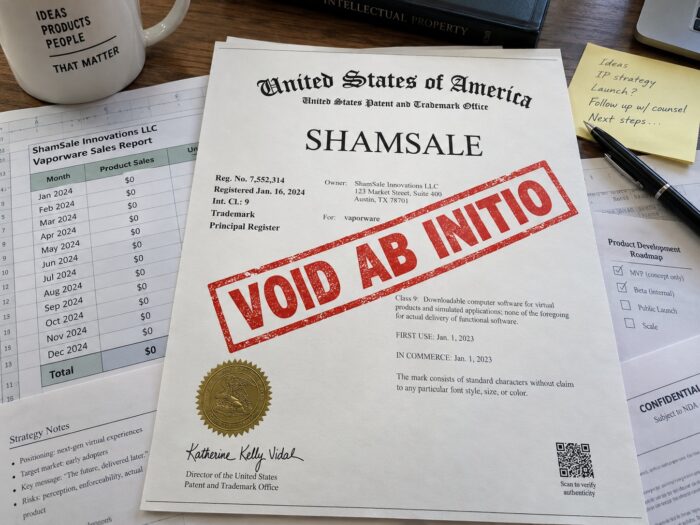
A business can complete a trademark application and submit the required forms, pay the filing fee, use the trademark properly in commerce, receive a trademark registration, and at the end of the process still have an invalid registration. The legal phrase "void ab initio" means legally invalid from the outset. This is a relatively common problem in trademark applications, particularly those that are filed without the assistance of an experienced trademark attorney. It is important to have someone that understands legal ownership, actual use, and filing requirements when filing a trademark application. The validity of the resulting registration is dependent on proper filing of the application.
The Latin term ab initio means “from the beginning.” Void ab initio therefore means legally invalid from the outset. For a trademark application, the phrase concerns whether a valid application was created on the filing date, not simply whether registration is ultimately refused. An application can satisfy the USPTO’s minimum submission requirements yet lack an essential legal qualification that must exist when filed. See 37 C.F.R. § 2.21. Receiving a filing date does not establish that those substantive requirements were satisfied. Unlike a correctable paperwork error, a defect rendering a trademark application void ab initio undermines the legal foundation of the original filing. See 37 C.F.R. § 2.71.
A trademark application claiming actual use of the trademark is filed under Trademark Act Section 1(a). This type of use-based application requires proper use of the trademark in commerce before the application filing date. Use in commerce requires the provision of the listed goods or services in commerce under 15 U.S.C. § 1127. A registration issuing from an underlying application filed under Section 1(a) is deemed void ab initio if use in commerce was not established as of the filing date. Use in commerce established after the filing date cannot retroactively satisfy the current use requirement of a trademark application filed under Section 1(a).
Every application filed under Section 1(a) is submitted with a sworn statement that the applied-for mark is in use in commerce on all of the goods and services listed in the application as of the filing date. Failure to meet this requirement cannot be cured by later use or any other curative filing after a registration is issued. However, the application may be converted into an intent-to-use based application prior to registration under proper circumstances, as discussed below.
It is important to understand that the legal effect of failing to make current use of the mark prior to the filing date concerns only the validity of a trademark application or trademark registration issuing therefrom. It does not affect any common law trademark rights that the applicant has established from making use of the mark and consumer recognition of the mark as a source identifier of the applicant's goods or services.
“Use in commerce” requires genuine trademark use in ordinary trade within commerce Congress may regulate, not merely public exposure. See 15 U.S.C. § 1127. Thus, use in commerce is defined by the extent of Congress's power to regulate commerce under the Commerce Clause of the U.S. Constitution. Commerce includes interstate trade, U.S. trade with foreign countries, and qualifying local activity affecting interstate commerce. Transactions need not involve goods physically crossing state lines: an in-state sale to an out-of-state customer can qualify without proof that the goods left the state. The nature of the activity, not simply its location, matters.
In Christian Faith Fellowship Church v. Adidas AG, an Illinois church had a trademark registration for the mark “ADD A ZERO” for use on clothing. 841 F.3d 986 (Fed. Cir. 2016). The church had sold two hats for $38.34 under the ADD A ZERO mark at its Illinois bookstore to an out-of-state customer from Wisconsin before it filed its application for the mark. The church successfully registered the mark, but it was later challenged in a cancellation proceeding before the Trademark Trial and Appeal Board. The Board cancelled the registration, finding the in-state sale as inadequate to qualify as genuine use in commerce satisfying 15 U.S.C. § 1127. The Federal Circuit reversed and remanded, holding that such transactions, considered together, substantially affect interstate commerce. No proof of goods physically crossing state lines or a specific interstate effect from that sale was required. The nature of the activity, not simply its location, was determinative.
Advertising promotes availability; it does not establish that services were actually performed. A proper service specimen, such as a website directly associating the mark with the services identified, is acceptable only when those services have actually been rendered in commerce. See 37 C.F.R. § 2.56(b)(2). In Couture v. Playdom, Inc., 778 F.3d 1379 (Fed. Cir. 2015), the applicant filed a use-based application for the mark PLAYDOM in 2008 using a website advertising writing and production services as a specimen. However, the applicant did not provide the applied-for services to clients until 2010. The court affirmed cancellation of the registration as void ab initio, holding that offering services without providing them did not establish use in commerce when filed. Advertising alone is not sufficient to satisfy the use in commerce requirement of Section 1(a). An inexperienced entrepreneur assuming that the promotion of their brand and trademark is sufficient to support an application under Section 1(a) may face the same result as Couture.
For goods, use in commerce requires qualifying sales or transportation in the ordinary course of trade, not token transactions merely to reserve trademark rights. See 15 U.S.C. § 1127. A proper specimen of use documents actual trademark display as customers encounter it, for example, photographs showing the mark on products, attached labels, packaging, or a point-of-sale display. An online store page can qualify when it directly associates the mark with pictured or described goods and provides ordering information. Ordinary advertising is generally insufficient, and mockups depicting intended rather than actual use are unacceptable. See 37 C.F.R. § 2.56(b)(1), (c).
Section 1(b) of the Lanham Act permits filing before actual use, but the named applicant must have a bona fide intent supported by objective evidence at the time of filing. See 15 U.S.C. § 1051(b). This is an intent-to-use application rather than an application based on current use. A bona fide intent is a firm, good faith intention to use the mark commercially. Objective evidence, such as development records or supplier discussions, must support that intent for each listed item. Merely wishing to reserve a mark is insufficient. If the applicant does not have a bona fide intent at the time of filing or cannot demonstrate a bona fide intent by actions that show efforts to offer the applied-for goods or services in commerce, the application and any registration issuing therefrom are void ab initio.
If an applicant files an intent-to-use application, the applicant must establish use through an amendment to allege use before publication approval, or a statement of use after a notice of allowance, including specimens and a verified declaration. See 37 C.F.R. §§ 2.76, 2.88. Thus, no registrations are available under Section 1 of the Trademark Act for marks that are not used in commerce. It should be noted that there are application bases under Section 44(e) or an extension of protection under Section 66(a) that do not require pre-registration use in U.S. commerce. However, those applications are based on claims for priority to foreign applications and are beyond the scope of this article.
In M.Z. Berger & Co. v. Swatch AG, 787 F.3d 1368 (Fed. Cir. 2015), M.Z. Berger sought to register the mark “iWatch” for use on watches, clocks, and accessories. Swatch opposed the registration. During the opposition proceeding, M.Z. Berger presented conflicting testimony and images created only to advance the application. The court found that M.Z. Berger's evidence failed to prove a bona fide commercial intent to use the mark. The Federal Circuit upheld the opposition, holding that an asserted bona fide intent must be supported by some objective evidence that, under the totality of the relevant circumstances, demonstrates that there was real intent to use the mark in commerce at the time of filing the application. The evidentiary threshold is low, but there must be something to demonstrate the intention.
An application must identify the actual owner on the filing date. Generally, the owner is the person or legal entity, such as a corporation, LLC, or partnership, that uses the mark and controls the nature and quality of the goods or services, directly or through controlled licensees. For example, an application that names a person (e.g., the founder) rather than the company that owns the mark as the owner can be considered void ab initio. Permissible errors in the named owner, such as a misspelling or a mistaken identification of the owner as an LLC when it is actually a corporation, are correctable by amendment. Amendments replacing the original applicant with another entity to cure nonownership are not permissible. See 37 C.F.R. § 2.71(d).
It is imperative to verify the ownership before signing the applicant declaration attesting that the applicant believes it owns the applied-for mark. Attempting to correct mistakenly identified ownership by replacing the original applicant with the proper owner is not allowed.
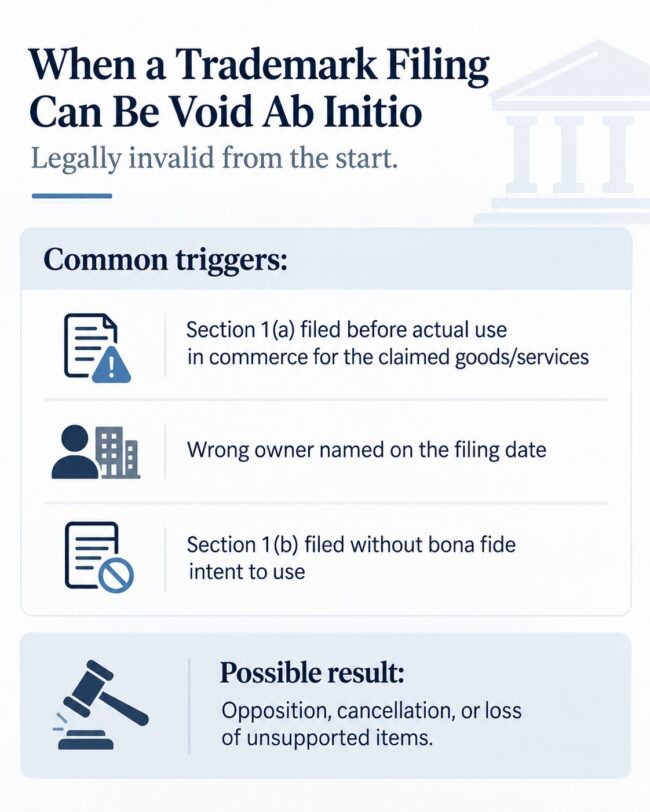
Failure to use a mark for certain goods need not invalidate all the goods listed. In Grand Canyon West Ranch, LLC v. Hualapai Tribe, 78 USPQ2d 1696 (TTAB 2006), the Tribe listed unused rail, tram, bicycle, and animal transportation services. With no fraud pleaded, the Board permitted deleting those services and entered only partial summary judgment, preserving the remaining claims. Deletion did not prevent the registration of the mark in connection with the services that were in use at the time of filing. However, if the inclusion of the services that were not provided in commerce in the application at the time of the filing date was done with the knowledge that the inclusion was improper, and with intent to defraud the USPTO, the entire application may be rendered void ab initio.
Fraud requires a knowingly false, material statement intended to deceive the USPTO, not merely an innocent mistake. Materiality concerns whether the statement affects entitlement to registration or renewal. Deceptive intent may be inferred from circumstances, but falsity alone is insufficient. In In re Bose Corp., 580 F.3d 1240 (Fed. Cir. 2009), Bose’s renewal declaration claimed continued use of WAVE for tape recorders and players despite discontinued sales. Its general counsel believed repairing and returning previously sold products constituted use in commerce. The Federal Circuit reversed the fraud-based cancellation, rejecting the Board’s “should have known” standard as improperly equating negligence with fraud. An honest misunderstanding did not establish deceptive intent, even though the declaration was materially inaccurate. Nevertheless, the court remanded to restrict the registration by removing the unused goods.
During the application process, an applicant may request an amendment from Section 1(a) current use basis to Section 1(b) intent-to-use basis when acceptable specimens of use are unavailable or to remedy non-use at the time of filing. A verified declaration must confirm bona fide intent to use the mark in commerce for the affected goods or services both when filed and currently. The conversion cannot create intent that did not exist as of the filing date. TMEP §806.03(c).
Before publication, the examining attorney can consider the amendment and implement the conversion to a Section 1(b) intent-to-use application. After publication, procedural requirements include petitioning the Director of the USPTO for permission, submitting a proposed amendment and supporting declaration, and paying a petition fee. An approved petition reopens examination and allows the trademark examiner to consider the conversion to a Section 1(b) basis. If accepted, the application is republished as an intent-to-use application. See 37 C.F.R. § 2.35(b)(2).
If an application has been opposed by a third party during the publication period, the applicant must instead submit a motion requesting the conversion to the Trademark Trial and Appeal Board within the opposition proceeding. The motion may be filed either with the opposing parties’ consent or unilaterally without consent. See 37 C.F.R. §2.133(a). A proper conversion preserves the original filing date per 37 C.F.R. §2.35(b)(3). Conversion is unavailable either after registration or to withdraw a timely filed statement of use.
An affected party may file a notice of opposition before the Trademark Trial and Appeal Board asserting that a pending trademark application is void ab initio during the publication period for the application. The pleading must explain the threatened harm and the specific filing defect that renders the application void ab initio. See 15 U.S.C. § 1063.
After a trademark is registered, the registration may be challenged through a petition to cancel the registration as void ab initio based on non-use, incorrect identification of ownership, or a lack of bona fide intent to use the mark in commerce at the time of filing. This kind of challenge must be pursued within five years of the issuance of the registration. These bases are barred after five years and are no longer available. See 15 U.S.C. § 1064(1).
However, other grounds for cancellation may be asserted after five years. Fraud in obtaining registration can be asserted at any time, and a claim that the mark has never been used in commerce can be pursued after three years from the date of registration. See 15 U.S.C. § 1064(3), (6). Proof of fraud is unnecessary for a nonuse claim.
A contract may be void ab initio when its sole purpose is unlawful (such as contracting to commit a crime), performance is inherently impossible from inception, or a party entirely lacks the capacity to understand the transaction. Cal. Civ. Code §§ 38, 1598. A contract void ab initio is treated as never legally existing. In such cases, the contract never comes to be and no enforceable contractual rights or duties are created. The putative contract supports no demand for performance and cannot be ratified. A contract void ab initio also cannot support any third-party claims allegedly derived from it. In such cases, restitution may be sought to restore any benefits provided pursuant to the contract void ab initio to prevent unjust enrichment.
Some contracts are not automatically void, but can be rescinded if there was fraudulent inducement, duress, undue influence, or qualifying mistakes in the formation of the contract. See Cal. Civ. Code § 1689. Such contracts are said to be voidable. Voidable contracts remain effective unless challenged and rescinded by one of the parties and may be ratified (i.e., knowingly affirmed despite the defect(s) in the contract). Unlike a contract void ab initio, a voidable contract creates enforceable obligations until voided. Separately, an otherwise valid contract may contain an invalid clause that can be severed without invalidating the entire contract. See Cal. Civ. Code § 1599.
A court may declare a statute unconstitutional and deem it void ab initio when it violates the Constitution. As a result, the statute is invalid from enactment, rather than merely from the judgment date. However, that description does not automatically erase prior legal consequences. In Chicot County Drainage Dist. v. Baxter State Bank, 308 U.S. 371 (1940), the Supreme Court preserved a final debt-adjustment judgment despite the statute’s subsequent invalidation because the affected parties had an opportunity to challenge constitutionality of the statute in the original proceeding but failed to do so.
An annulment based on bigamy generally recognizes a marriage as void ab initio because one spouse was already legally married to someone still living. Statutory exceptions cover certain missing or presumed-dead spouses. Cal. Fam. Code § 2201.
Protecting your business requires more than submitting a trademark application and paying a filing fee. Before seeking to obtain registration, you need to take care to confirm the correct applicant, ownership, and filing basis. Preserve evidence supporting actual use or bona fide intent and verify every statement in the declaration. Some defects can be corrected during the application process. Others may render a trademark application void ab initio and jeopardize the resulting registration. Having an experienced trademark attorney review the filing before submission, and address problems while corrective options remain available, can help protect your investment in the mark.
© 2026 Sierra IP Law, PC. The information provided herein does not constitute legal advice, but merely conveys general information that may be beneficial to the public, and should not be viewed as a substitute for legal consultation in a particular case.

"Mark and William are stellar in the capabilities, work ethic, character, knowledge, responsiveness, and quality of work. Hubby and I are incredibly grateful for them as they've done a phenomenal job working tirelessly over a time span of at least five years on a series of patents for hubby. Grateful that Fresno has such amazing patent attorneys! They're second to none and they never disappoint. Thank you, Mark, William, and your entire team!!"
Linda Guzman


Sierra IP Law, PC - Patents, Trademarks & Copyrights
FRESNO
7030 N. Fruit Ave.
Suite 110
Fresno, CA 93711
(559) 436-3800 | phone
BAKERSFIELD
1925 G. Street
Bakersfield, CA 93301
(661) 200-7724 | phone
SAN LUIS OBISPO
956 Walnut Street, 2nd Floor
San Luis Obispo, CA 93401
(805) 275-0943 | phone

SACRAMENTO
180 Promenade Circle, Suite 300
Sacramento, CA 95834
(916) 209-8525 | phone
MODESTO
1300 10th St., Suite F.
Modesto, CA 95345
(209) 286-0069 | phone
SANTA BARBARA
414 Olive Street
Santa Barbara, CA 93101
(805) 275-0943 | phone
SAN MATEO
1650 Borel Place, Suite 216
San Mateo, CA, CA 94402
(650) 398-1644. | phone
STOCKTON
110 N. San Joaquin St., 2nd Floor
Stockton, CA 95202
(209) 286-0069 | phone
PORTLAND
425 NW 10th Ave., Suite 200
Portland, OR 97209
(503) 343-9983 | phone
TACOMA
1201 Pacific Avenue, Suite 600
Tacoma, WA 98402
(253) 345-1545 | phone
KENNEWICK
1030 N Center Pkwy Suite N196
Kennewick, WA 99336
(509) 255-3442 | phone
2023 Sierra IP Law, PC - Patents, Trademarks & Copyrights - All Rights Reserved - Sitemap Privacy Lawyer Fresno, CA - Trademark Lawyer Modesto CA - Patent Lawyer Bakersfield, CA - Trademark Lawyer Bakersfield, CA - Patent Lawyer San Luis Obispo, CA - Trademark Lawyer San Luis Obispo, CA - Trademark Infringement Lawyer Tacoma WA - Internet Lawyer Bakersfield, CA - Trademark Lawyer Sacramento, CA - Patent Lawyer Sacramento, CA - Trademark Infringement Lawyer Sacrament CA - Patent Lawyer Tacoma WA - Intellectual Property Lawyer Tacoma WA - Trademark lawyer Tacoma WA - Portland Patent Attorney - Santa Barbara Patent Attorney - Santa Barbara Trademark Attorney
