Common law trademark rights are an important aspect of U.S. trademark law that every business owner should understand. In the United States, trademark rights can arise automatically from the actual use of a name, logo, or other distinctive identifier in commerce, without any formal registration. These unregistered or “common law” trademarks can provide a level of protection for your brand, but they come with significant limitations. This article explains what common law trademark rights are, how they are acquired, and how they differ from federally registered trademarks. We’ll also discuss enforcement mechanisms, and the scope of common law rights.
“Common law” trademark rights refer to the rights you automatically acquire by using a distinctive mark, such as a business name, logo, or slogan in commerce, and that are not registered with the United States Patent and Trademark Office (USPTO). Unlike patents or copyrights, you do not gain trademark rights through the creation of something, the right grows out of use of a source identifier (something that identifies the source of your goods) in commerce through the sales and provision of your goods and services. In other words, you must engage in bona fide commercial use of the mark for trademark law to recognize exclusive rights.
U.S. courts have long held that there is no property right in a trademark per se without an associated business use. A trademark is simply an instrument to protect the goodwill of a business. The Lanham Act (federal trademark law) echoes this principle by defining “use in commerce” as the bona fide use of a mark in the ordinary course of trade, and not made merely to reserve a right. See 15 U.S.C. § 1127. So if you are the first to use a particular mark in commerce for certain goods or services, you become the senior “common law” trademark owner of that mark in your market. These common law marks can use the “™” (trademark) or “SM” (service mark) symbol to put others on notice of your claim, even though they lack federal registration.
Under U.S. trademark law, rights are generally determined on a first-to-use basis, not simply first-to-file. This means the first business to actually use a distinctive mark on goods or services in commerce usually has priority over others. If you have been using a name or logo in your business, you may have developed enforceable rights in that mark, making it a common law trademark even without any registration. These rights are often described as “senior” rights against later users.
Importantly, the mark must be inherently distinctive or have acquired distinctiveness (secondary meaning) for trademark rights to exist. Generic marks cannot acquire trademark protection under either common law or federal law. A generic term is a term that is the common name of the goods sold (e.g. calling a coffee shop “Coffee Shop”), and will not qualify for any trademark protection under common law or federal law. Assuming your mark is distinctive, continuous and actual use is key to establishing and maintaining common law rights. Stopping use can lead to loss of those rights by abandonment. Also, mere token use or non-commercial use will not suffice. In short, trademark rights belong to those who earn them through bona fide use in trade under both federal and state law. The use-based system is underpinned by legal policy that favors trademark use as a protection for consumers, who can expect reliable quality from a particular source identified by a trademark, and an open competitive marketplace that is not hindered by parties trying to reserve or hold onto trademarks that have fallen out of bona fide use.
One critical limitation of common law trademark protection is that it is typically limited to the particular geographic area where you are using the mark and where your goods or services are known. Unlike a federal registration, which can confer nationwide rights, a common law trademark generally grants the owner exclusive rights only within the region or market area of actual use and reputation. For example, if you operate a local business under a unique name in southern California, your common law rights may allow you to stop competitors from using a confusingly similar name in the same locale. However, you likely cannot prevent a different company from using the same or a similar mark in a distant area (e.g. on the other side of the country) where your brand has no presence.
As the U.S. Supreme Court noted in the landmark Tea Rose case, a trademark owner “may not monopolize markets that his trade has never reached”. Hanover Star Milling Co. v. Metcalf, 240 U.S. 403 (1916). In practical terms, this means two businesses in different states could unknowingly develop identical common law marks, each valid in their own local spheres. When their markets eventually collide, priority will favor the one who used the mark first, but the junior user might retain rights in the remote area where it first operated. Common law trademark holders therefore enjoy exclusive rights in their established geographic area, but not automatically beyond it. This local nature of common law rights often makes expansion tricky. You might find your brand name is free to use in your city, yet already “taken” by someone else in another region. It is a reminder that trademark clearance searches should cover not only federal registrations but also other parties’ unregistered (common law) uses across state lines.
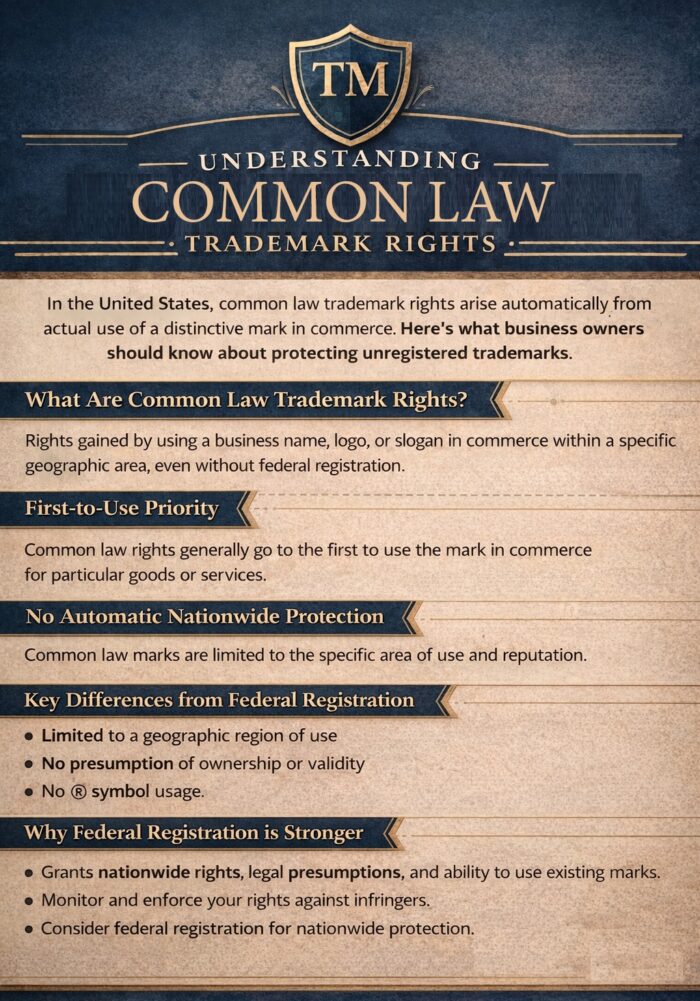
Because of the inherent limits on unregistered marks, business owners should understand the differences between common law trademarks and federal trademarks registered with the USPTO. Both forms of trademarks grant the exclusive right to use a mark in connection with particular goods or services, but the scope and strength of those rights differ significantly.
A federal trademark registration on the Principal Register gives the owner nationwide protection for the mark, even in areas where the owner has not yet done business. In contrast, a common law mark only protects you in the areas where you have established a market presence. Another key difference is the legal presumptions that come with a federal registration. When you register a trademark federally, the registration certificate is prima facie evidence of your ownership and the validity of the mark, and of your exclusive right to use the mark nationwide for the listed goods or services. This means that in a legal dispute, you benefit from a presumption that your mark is valid and protectable, shifting the burden to others to prove otherwise.
An unregistered mark has no such automatic presumption. The owner must affirmatively prove that the mark is valid (i.e., distinctive and not generic), and that it has priority in the specific market, every time they enforce it. Thus, common law trademark owners face a heavier evidentiary burden in court. Additionally, federal registration provides constructive notice to the public of your claim to the mark, putting everyone on notice nationwide, so no one can later claim they innocently adopted the same name.
Common law rights, on the other hand, do not appear in any central registry, so other businesses might inadvertently adopt a similar mark unaware of your local use, potentially leading to disputes. In summary, a federally registered trademark offers benefits and rights that are broader and stronger than common law trademark rights, including nationwide scope, legal presumptions of validity and ownership, and easier enforceability.
Given the above differences, it’s worth highlighting the concrete benefits of federal trademark registration for trademark holders. First and foremost, a federal registration grants nationwide protection for your mark. Under the Lanham Act, a federal registrant is deemed to have rights throughout the entire United States, as of the filing date of the application, assuming the mark is ultimately registered. This can prevent other parties from using confusingly similar marks anywhere in the country, even in areas where you haven’t yet expanded your business. By contrast, a common law mark owner who only operates a local business has rights only in that locale and cannot claim exclusive rights in other areas absent use there.
Registration also provides a legal presumption that your trademark is valid, distinctive, and owned by you. There is also a presumption of your exclusive right to use the mark on the goods/services nationwide. This can be decisive in court because you will not have to prove the basic facts of your rights from scratch. After five years on the federal register, a mark can even achieve incontestable status, which cuts off many grounds of challenge and serves as conclusive evidence of your exclusive rights, subject to a few exceptions.
Federal registration also enables use of the registered trademark ® symbol, which puts the public on notice of your registration and can deter infringers. Common law mark owners can only use “TM” or “SM”. Using the Ⓡ symbol without a federal registration is unlawful. The registered trademark symbol is more than just decorative, it signifies that the mark is officially recorded at the USPTO and it legally eliminates any defense of innocent infringement by making others legally assumed to know of your rights.
Moreover, a federal registration gives you the ability to enlist powerful enforcement mechanisms. You can record your registered mark with U.S. Customs to block importation of counterfeit or infringing goods. You also unlock certain remedies under federal law that are not available for unregistered marks, such as the possibility of statutory damages and attorney’s fees in cases of willful trademark counterfeiting. For example, federal law provides statutory damages against counterfeiters of registered marks under 15 U.S.C. § 1117(c), and only owners of registered marks can sue for trademark dilution under 15 U.S.C. § 1125(c). In short, federal registration not only broadens your trademark rights geographically, but also bolsters your position legally, providing evidentiary advantages and stronger enforcement mechanisms and more robust remedies. For any business aiming to expand or franchise beyond a local area, these benefits of federal registration are invaluable.
Whether your mark is a common law mark or a federally registered mark, as the trademark owner you are responsible for enforcing your rights. Both state and federal trademark law provide causes of action to stop others from using marks that are confusingly similar to yours in a way that is likely to mislead consumers. The classic hallmark of trademark infringement is likelihood of confusion: if another company’s use of the same name or a similar mark on related goods or services is likely to cause consumers to mistakenly believe there is an association, common source, or sponsorship, then that use infringes your rights.
Common law trademark holders typically can bring an infringement claim under state law unfair competition doctrines or state trademark statutes, seeking injunctions or damages for business harm. In addition, the federal Lanham Act offers an unfair competition cause of action for owners of unregistered marks through Section 43(a) (15 U.S.C. § 1125(a)). Section 43(a) forbids “any false designation of origin” or misleading use of a mark that is likely to confuse consumers, and it effectively protects unregistered trademarks from infringement in federal court. This means that even without a federal registration, you can sue an infringer under federal law for using a mark that unfairly competes with or passes off their goods as yours, assuming the activity affects interstate commerce. Both registered and unregistered marks are thus granted some level of federal protection under the Lanham Act.
However, owning a federally registered trademark significantly enhances your enforcement position. For a registered mark, you can sue for infringement under Section 32 of the Lanham Act (15 U.S.C. § 1114), which is only available to registered marks and carries the aforementioned presumptions, broader remedies, etc. By contrast, a common law mark owner suing under Section 43(a) must prove the validity of their mark and their priority without benefit of a registration certificate. Additionally, certain claims like federal dilution or counterfeiting require a registration.
Regardless of registration, the trademark enforcement process typically involves sending cease-and-desist letters, negotiating coexistence or rebranding if appropriate, and potentially filing a lawsuit for trademark infringement or unfair competition. Because enforcement can be legally complex and fact-intensive, it’s often wise to consult an experienced trademark attorney to strategize the best approach. An attorney can help gather evidence of your priority and market scope and guide you through federal court litigation or settlement with the infringing party.
Remember, failing to enforce your mark against infringers can weaken your rights over time. Trademark owners have a duty to police their marks. If you allow others to use identical or similar marks in commerce without challenge, your mark’s distinctiveness could be diluted and your exclusive rights may erode.
Trademark protection in the United States operates on multiple levels. Common law trademark rights originally evolved under state law through judicial decisions and statutes, and are not preempted by federal law. Every state has its own trademark laws and many have a registration system for state trademarks, usually through the Secretary of State’s office. A state trademark registration can offer a public record of your claim and some procedural advantages within that state, but it still only protects your mark within that single state’s borders. It does not confer the nationwide rights or legal presumptions of a federal registration. In essence, a state registration typically just reinforces the existing common law rights in that state and is often seen as a supplement for marks that are not eligible for federal registration or are used only intrastate. Moreover, state laws provide remedies for unfair competition and passing off, which can be used to enforce common law marks. For instance, if someone in your state uses a similar mark to free-ride on your business reputation, causing consumer confusion, you might bring a claim under state unfair competition statutes or common law principles to stop the “false designation” of origin, which is analogous to a federal 43(a) claim, but at the state level.
Some states allow recovery of damages, attorney’s fees, or even statutory remedies under their laws, though these vary state by state. It’s worth noting that the Lanham Act explicitly coexists with state law, meaning you can have both federal and state claims in a trademark lawsuit. Often, a trademark infringement suit in federal court will include a parallel claim for violation of the state’s unfair competition law. Ultimately, while federal law provides the most powerful tools, especially when you have a registered mark, state trademark law continues to play a role in protecting trademarks at the local level.
Before you adopt a new business name, product name, or logo, and certainly before you invest in a federal trademark application, it’s crucial to perform a comprehensive trademark search as due diligence. Many entrepreneurs make the mistake of checking only the USPTO’s online database of federally registered trademarks. While a USPTO search is essential to catch any federally registered or pending marks that might conflict, it is not sufficient by itself. This is because unregistered marks (common law trademarks) will not appear in the federal trademark registry.
A thorough search needs to cover federal registrations and other sources of potential trademark rights: namely, state trademark registrations and common law, unregistered uses. A common law trademark search means digging into various databases and public records to find any business or brand using a similar name or logo in commerce, even without a federal record. This can include searching the internet, corporate and business name databases, trade directories, industry publications, domain name records, and state business registries. The goal is to uncover any prior users of the mark or a similar mark that carries existing unregistered rights that might conflict with your proposed mark.
For example, you might discover a small company in another state that has been using a similar brand name for similar goods. Even if they never registered federally, their common law trademark could still block your expansion or impact your federal registration in the future. Likewise, checking state trademark registrations is important, as a preexisting state trademark registration in any given state could prevent you from using your mark in that state and be a basis for opposition or cancellation of your federal registration.
Thus, a comprehensive trademark search includes: (1) the USPTO records for federally registered or applied-for marks to avoid conflicts that would bar your federal application due to confusingly similar registered marks; (2) a search of state trademark databases and business name filings; and (3) a diligent common law search for unregistered usage, using search engines, industry databases, and possibly a professional trademark research service. Conducting these trademark searches up front helps identify potential conflicts and avoids costly legal problems down the road.
It is advisable to have a trademark attorney conduct the search and analysis, as they are skilled in conducting such searches and analyzing the results. Ignoring common law trademark owners during clearance can lead to nasty surprises, such as receiving a cease-and-desist letter after you’ve already launched your brand, or having your federal application opposed by someone who claims earlier use. In summary, due diligence in the form of trademark searches is a must for anyone looking to establish strong trademark rights and reduce the risk of infringement of others’ marks.
Navigating trademark rights can be complex, especially when dealing with the interplay of common law rights, state registrations, and federal registrations. As a business owner, you should take proactive steps to protect your business and branding. First, choose a strong, distinctive trademark: the more unique, the stronger protection it will have. Second, conduct a thorough trademark search to avoid unintentional infringement of another’s mark. It is worth noting that ignorance of a prior user is not a defense if your use causes confusion. Third, make continuous use in commerce of the mark in connection with the goods to establish common law rights. Fourth, consider the scope of your business and expansion plans. If you operate only locally and plan to remain a local enterprise, you might rely on common law rights or register the mark at the state level for added certainty. However, if the reach of your brand is beyond your region, or you foresee that your market will expand beyond your initial state of operation, you should consider obtaining a federal trademark registration. It is highly advisable to secure nationwide federal trademark rights to prevent others from locking you out of new markets. Registering sooner rather than later can also prevent scenarios where someone else files a federal application for a similar trademark and obtains nationwide priority over you.
Even after you have rights, enforcement and maintenance are ongoing tasks. You should monitor the marketplace and USPTO trademark filings for potentially conflicting uses. Many companies set up trademark watch services or regularly search for similar names to catch problems early. If you do discover an infringer or a conflicting user, timely action is important. Trademark enforcement could range from a polite heads-up or request to change the name for minor, unintentional conflicts, to sending a formal cease-and-desist letter, and possibly filing a lawsuit in state or federal court for trademark infringement and unfair competition.
Keep in mind that lawsuits can be costly and outcomes uncertain, so it is wise to consult a trademark lawyer to evaluate the strength of your case and explore alternatives, such as co-existence agreements or re-branding solutions before rushing to court. An experienced trademark attorney can help you understand the nuances of trademark law rights, including how common law rights might be proven, what evidence you’d need to show priority and consumer recognition in a given area, and what damages or remedies you could seek. They can also handle the federal trademark application process for you, increasing the chances of approval and advising on how to describe your goods or services to maximize protection.
In the U.S., the United States Patent and Trademark Office’s application process can take many months and involves potential refusals or oppositions; having a knowledgeable attorney can make a big difference in overcoming these hurdles. Ultimately, investing in professional guidance can save a business from costly mistakes, such as infringing someone else’s mark or failing to fully capitalize on your own brand’s value.
Common law trademark rights offer a foundational layer of protection for names, logos, and other brand identifiers based on actual use in commerce. They are a meaningful part of U.S. trademark law, providing local or regional trademark rights even without formal registration. However, common law rights are inherently limited in scope and lack many benefits of federal trademarks. Relying solely on unregistered “common law” marks can leave a business exposed to risk. Federal trademark registration with the USPTO remains the gold standard for robust trademark protection, granting nationwide rights, legal presumptions, and stronger enforcement tools under the Lanham Act.
If you need assistance in evaluating your trademark protection or other intellectual property matters, contact our office for a consultation.
© 2026 Sierra IP Law, PC. The information provided herein does not constitute legal advice, but merely conveys general information that may be beneficial to the public, and should not be viewed as a substitute for legal consultation in a particular case.

"Mark and William are stellar in the capabilities, work ethic, character, knowledge, responsiveness, and quality of work. Hubby and I are incredibly grateful for them as they've done a phenomenal job working tirelessly over a time span of at least five years on a series of patents for hubby. Grateful that Fresno has such amazing patent attorneys! They're second to none and they never disappoint. Thank you, Mark, William, and your entire team!!"
Linda Guzman


Sierra IP Law, PC - Patents, Trademarks & Copyrights
FRESNO
7030 N. Fruit Ave.
Suite 110
Fresno, CA 93711
(559) 436-3800 | phone
BAKERSFIELD
1925 G. Street
Bakersfield, CA 93301
(661) 200-7724 | phone
SAN LUIS OBISPO
956 Walnut Street, 2nd Floor
San Luis Obispo, CA 93401
(805) 275-0943 | phone

SACRAMENTO
180 Promenade Circle, Suite 300
Sacramento, CA 95834
(916) 209-8525 | phone
MODESTO
1300 10th St., Suite F.
Modesto, CA 95345
(209) 286-0069 | phone
SANTA BARBARA
414 Olive Street
Santa Barbara, CA 93101
(805) 275-0943 | phone
SAN MATEO
1650 Borel Place, Suite 216
San Mateo, CA, CA 94402
(650) 398-1644. | phone
STOCKTON
110 N. San Joaquin St., 2nd Floor
Stockton, CA 95202
(209) 286-0069 | phone
PORTLAND
425 NW 10th Ave., Suite 200
Portland, OR 97209
(503) 343-9983 | phone
TACOMA
1201 Pacific Avenue, Suite 600
Tacoma, WA 98402
(253) 345-1545 | phone
KENNEWICK
1030 N Center Pkwy Suite N196
Kennewick, WA 99336
(509) 255-3442 | phone
2023 Sierra IP Law, PC - Patents, Trademarks & Copyrights - All Rights Reserved - Sitemap Privacy Lawyer Fresno, CA - Trademark Lawyer Modesto CA - Patent Lawyer Bakersfield, CA - Trademark Lawyer Bakersfield, CA - Patent Lawyer San Luis Obispo, CA - Trademark Lawyer San Luis Obispo, CA - Trademark Infringement Lawyer Tacoma WA - Internet Lawyer Bakersfield, CA - Trademark Lawyer Sacramento, CA - Patent Lawyer Sacramento, CA - Trademark Infringement Lawyer Sacrament CA - Patent Lawyer Tacoma WA - Intellectual Property Lawyer Tacoma WA - Trademark lawyer Tacoma WA - Portland Patent Attorney - Santa Barbara Patent Attorney - Santa Barbara Trademark Attorney
