
Trademark enforcement means taking steps to stop others from using your mark without permission. Strong enforcement preserves your goodwill and prevents consumer confusion. In the United States, trademark rights come from use in commerce, but they are strengthened by obtaining a federal trademark registration. This article outlines key enforcement strategies, both legal and practical, that trademark owners can use to protect their marks and business.
Under U.S. trademark law, you automatically have rights in a mark by using it. These "common law rights" are co-extensive with consumer recognition of your brand. Common law trademark rights are co-extensive with your brand's reach and recognition. However, a federal registration with the USPTO significantly strengthens your position. A federally registered trademark gives you nationwide rights and legal presumptions of ownership and validity. It also makes enforcement easier, e.g., by providing a presumption of rights and ownership and certain statutory remedies. By contrast, unregistered rights are limited to the geographic areas or markets where you’ve used the mark. While registration isn’t mandatory, it is a key factor in effective trademark enforcement.
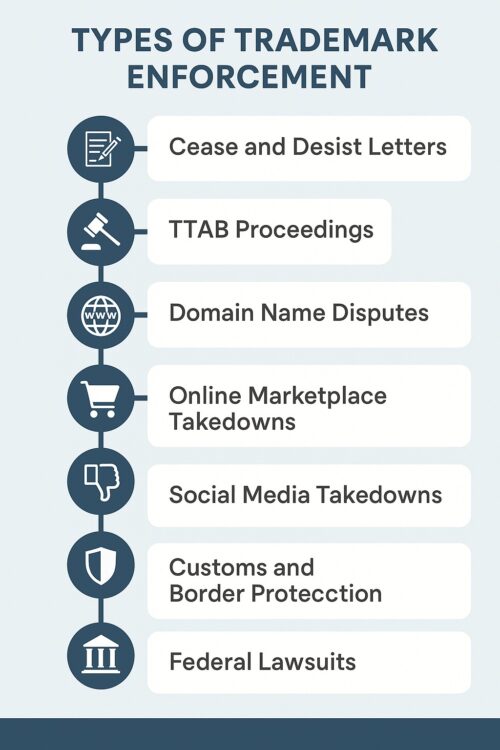
A common first step is a cease and desist letter. This formal notice, usually sent by your trademark attorney or law firm, tells the infringing party about your rights and demands that they stop using the allegedly infringing mark. A strong cease and desist letter will cite your trademark (and registration, if applicable), explain why the other party’s use is unlawful and likely to cause consumer confusion, and threaten legal action if the behavior continues. Many trademark disputes are resolved at this stage without a lawsuit. It is wise to have a lawyer draft the letter to ensure the proper tone and evidence are included.
If someone attempts to register a mark that conflicts with yours, you can oppose their application through the United States Patent and Trademark Office (USPTO)’s Trademark Trial and Appeal Board (TTAB). A trademark opposition is a proceeding to stop a pending application from registering, e.g., because the proposed mark is too similar to your trademark and likely to cause consumer confusion. Similarly, if a confusingly similar mark has already been registered, you can initiate a TTAB cancellation proceeding to try to remove that registration. TTAB proceedings are handled within the trademark office. The board can refuse or cancel a registration, but it cannot award damages or injunctions. This route helps trademark owners police the register by keeping conflicting marks from being granted federal rights.
If someone registers a domain name that includes your trademark, you have two main options. First, the federal Anticybersquatting Consumer Protection Act (ACPA) allows you to sue in federal district court to obtain the domain from a bad-faith registrant. In such cases, courts can transfer or cancel the infringing domain and even award damages. Second, you can use the Uniform Domain-Name Dispute-Resolution Policy (UDRP), a quicker arbitration process. In a UDRP proceeding, you must prove the domain is identical or confusingly similar to your mark and that it was registered in bad faith. A UDRP panel can order the domain transferred to you, but cannot award money. UDRP is faster and less expensive than a lawsuit, so many trademark owners try UDRP first and resort to an ACPA lawsuit if necessary.
To prevail in a UDRP proceeding, the trademark owner must prove three elements: (1) the disputed domain name is identical or confusingly similar to the owner’s valid mark, such as a federally registered trademark; (2) the registrant has no rights or legitimate interests in the domain; and (3) the domain was registered and used in bad faith, such as to sell the domain to the trademark owner, block the owner’s registration, or mislead consumers by creating confusion. A successful UDRP complaint results in the transfer or cancellation of the domain, but the panel cannot award monetary damages or legal fees. Because UDRP cases are typically resolved within about 60 days, many trademark owners use this route before considering an ACPA lawsuit.
To file a UDRP complaint, the trademark owner must select an approved dispute-resolution provider, most commonly the World Intellectual Property Organization (WIPO) Arbitration and Mediation Center. The complaint should identify the infringing domain name(s), the complainant’s trademark rights with registration numbers or evidence of use, the respondent’s lack of legitimate interests, and the circumstances evidencing bad-faith registration and use. Supporting documentation, such as trademark registration certificates, website screenshots, and WHOIS records, should be attached. Complaints may be submitted electronically to WIPO through domain.disputes@wipo.int along with the applicable filing fee, which varies based on the number of domains and whether one or three panelists are requested. After filing, WIPO notifies the registrar to lock the domain and invites the respondent to submit a response, typically within 20 days. The appointed panel reviews the evidence and issues a decision, and if transfer is ordered, the domain registrar implements it unless the respondent files a court action to block the transfer.
Incorporating the UDRP into your enforcement strategy gives you an efficient, cost-effective way to reclaim infringing domain names and reinforce your broader brand protection efforts.
E-commerce platforms like Amazon, eBay, and Alibaba have notice-and-takedown systems that enable trademark owners to act against unauthorized uses of their marks in listings. As a trademark owner you can report a listing that uses your mark without permission and request its removal, an effective tool for brand protection and enforcement in the online marketplace. For example, if you’re enrolled in Amazon’s Amazon Brand Registry, you have access to the “Report a Violation” tool and the general Amazon Report Infringement Form. This tool allows rights owners or their agents to report suspected infringement of trademarks, copyrights, patents or other intellectual property. You can join the Amazon Brand Registry if you have trademark registrations or pending federal trademark applications that cover the goods you wish to sell on Amazon. Once you submit a report identifying the infringing listing (e.g., ASIN, URL, screenshots), Amazon will review your submission and, if valid, remove or block the listing.
On eBay, the rights-owner mechanism is the VeRO Program (“Verified Rights Owner”) which is designed specifically for intellectual property owners to report infringing listings. The report form (Notice of Claimed Infringement) can be downloaded from eBay’s resources: Notice of Claimed Infringement (PDF) where you fill in item numbers, describe the infringing use, attach your trademark registration or rights evidence, and submit via email (vero@ebay.com). After eBay receives a complete VeRO submission, it will review and remove listings that violate rights owner trademarks or other intellectual property rights.
For Alibaba’s global group of e-commerce marketplaces, rights owners use the IPP Platform (Intellectual Property Protection Platform) to submit takedown requests for listings that use your trademark without authorization via the “Complaint Submission” page on the portal. The process typically requires you to register your brand, submit evidence of your trademark rights, verify your account, then select the infringing listing URLs and submit a complaint along with supporting screenshots and documentation. Once the listing is accepted as infringing, Alibaba may remove the listing or suspend the seller’s account.
By taking advantage of these online marketplace takedown tools, a brand owner can rapidly intervene against unauthorized use of the registered mark or other marks, reinforcing broader enforcement strategies and preventing consumer confusion, without immediately resorting to formal litigation.
Social media platforms offer procedures to address trademark misuse. If someone is using your trademark on Facebook, Instagram, X (formerly Twitter), or another network without authorization, you can file a trademark infringement report on that platform. You’ll need to provide evidence of your rights (your USPTO-registered mark) and show how the use is infringing. For instance, by posting your mark in a way that suggests it is the infringer’s own trademark or service mark. If the platform finds a violation, it may remove the offending content or disable the account. While you won’t obtain damages through this process, social-media takedowns let you promptly halt misuse of your mark and support your broader brand protection efforts.
To help you take action:
By using these procedures, you add a quick, practical enforcement tool to your process. This is a cost-effective solution in many situations that may allow you to avoid the expense of filing a civil action to enforce your trademark rights.
Another enforcement avenue is working with U.S. Customs to block counterfeit or infringing imports. Owners of federally registered trademarks can record their mark with CBP, putting customs officers on alert for imported goods bearing your trademark or a substantially similar mark, when those goods are not authorized. Under 15 U.S.C. § 1124, CBP can detain, seize, forfeit or destroy such shipments. If you register your trademark with CBP, you enlist a governmental enforcement partner at the border before the goods reach the U.S. marketplace. To be eligible, the mark must be a valid trademark registration, meaning it is registered on the Principal Register of the United States Patent and Trademark Office (not merely the Supplemental Register) and registered for use on goods.
The most powerful enforcement mechanism available to trademark owners is a federal trademark infringement lawsuit under the Lanham Act, codified at 15 U.S.C. §§ 1051 et seq. A civil action in federal district court provides the broadest remedies and establishes an authoritative record of enforcement. When a brand owner brings a trademark infringement claim, they may proceed under 15 U.S.C. § 1114(1) for infringement of a federally registered mark and under 15 U.S.C. § 1125(a) for unfair competition. These provisions allow trademark owners to pursue injunctive and monetary relief against parties who use confusingly similar marks in commerce without authorization.
To prevail on a federal infringement claim, the plaintiff must establish:
Proof of registration with the United States Patent and Trademark Office (USPTO) serves as prima facie evidence of validity, ownership, and exclusive rights to use the mark nationwide under 15 U.S.C. § 1057(b). However, even unregistered marks can be protected under § 1125(a) when they have acquired distinctiveness through use in commerce.
Courts evaluate likelihood of confusion using a multi-factor analysis that varies slightly among circuits but is conceptually consistent. Commonly considered factors include:
For example, the Polaroid factors from Polaroid Corp. v. Polarad Electronics Corp., 287 F.2d 492 (2d Cir. 1961) and the Sleekcraft factors from AMF Inc. v. Sleekcraft Boats, 599 F.2d 341 (9th Cir. 1979) remain leading articulations of this framework. While no single factor is dispositive, courts emphasize overall marketplace context: how consumers encounter and perceive the marks in commerce.
If the lawsuit is a success, the court may grant several forms of relief. The most common is an injunction under 15 U.S.C. § 1116, prohibiting further use of the infringing mark. Permanent injunctive relief is available upon a showing of likelihood of confusion and irreparable harm, and since the 2020 Trademark Modernization Act, courts now presume irreparable harm upon a finding of infringement.
Monetary remedies under 15 U.S.C. § 1117(a) may include:
The court may enhance damages or profits in instances of willful infringement or bad faith, particularly where the infringer intended to trade on the goodwill of the trademark owner. However, the U.S. Supreme Court in Romag Fasteners, Inc. v. Fossil, Inc., 590 U.S. 212 (2020) clarified that while willfulness remains a significant factor, it is not a prerequisite for recovering the defendant’s profits under § 1117(a).
Lastly, remember that trademark enforcement isn’t limited to federal law. State trademark and unfair competition laws provide additional avenues. Every state has its own trademark laws against confusing or deceptive business practices. You can assert state law claims for trademark infringement, unfair competition, and other types of claims with Lanham Act claims in the same case. Claims under state unfair competition law (e.g., Cal. Bus. & Prof. Code § 17200) often complement Lanham Act claims. State and federal trademark laws generally coexist. The Lanham Act does not preempt state law. Using state statutes or common-law claims can give you extra remedies for local disputes or other issues beyond the scope of federal law. You can also bring a trademark infringement suit in state court under both federal and state laws.
Beyond the immediate relief obtained, prevailing in a Lanham Act lawsuit strengthens a company’s overall brand protection strategy. Judicial findings of infringement reinforce the strength and distinctiveness of the mark, deter future infringers, and bolster the brand’s reputation for vigilance. In certain industries, courts also allow publication of injunctions or notices to third parties, further protecting consumers from confusion.
In short, while federal trademark litigation is a significant undertaking, it remains the cornerstone of trademark enforcement in the United States. It combines the authority of a federal court order with the full range of monetary and injunctive remedies, providing a decisive means to enforce and protect valuable trademark rights in commerce.
Willful trademark counterfeiting isn’t just a civil matter, it is also a crime. The Trademark Counterfeiting Act (18 U.S.C. § 2320) makes it a federal offense to intentionally traffic in goods or services bearing a counterfeit mark, with penalties including fines and prison time. While only government prosecutors can bring criminal charges, you can help by reporting egregious trademark counterfeiters to law enforcement. Criminal enforcement can lead to raids that confiscate fake goods and shut down illicit operations, deterring future infringers.
Protecting your trademarks requires vigilance and prompt action. Minor infringements might be handled through cease-and-desist letters or online takedowns, while major conflicts may require a lawsuit. What’s crucial is that you do not ignore unauthorized uses of your mark. If you allow infringement to go unchecked, your trademark rights can weaken over time. Consistent enforcement maintains your mark’s strength and helps avoid customer confusion. By using the enforcement tools available, you can enforce your rights effectively and keep your brand secure.
If you need assistance with a trademark enforcement matter or other intellectual property matter, contact our office for a free consultation.
© 2025 Sierra IP Law, PC. The information provided herein does not constitute legal advice, but merely conveys general information that may be beneficial to the public, and should not be viewed as a substitute for legal consultation in a particular case.

"Mark and William are stellar in the capabilities, work ethic, character, knowledge, responsiveness, and quality of work. Hubby and I are incredibly grateful for them as they've done a phenomenal job working tirelessly over a time span of at least five years on a series of patents for hubby. Grateful that Fresno has such amazing patent attorneys! They're second to none and they never disappoint. Thank you, Mark, William, and your entire team!!"
Linda Guzman


Sierra IP Law, PC - Patents, Trademarks & Copyrights
FRESNO
7030 N. Fruit Ave.
Suite 110
Fresno, CA 93711
(559) 436-3800 | phone
BAKERSFIELD
1925 G. Street
Bakersfield, CA 93301
(661) 200-7724 | phone
SAN LUIS OBISPO
956 Walnut Street, 2nd Floor
San Luis Obispo, CA 93401
(805) 275-0943 | phone

SACRAMENTO
180 Promenade Circle, Suite 300
Sacramento, CA 95834
(916) 209-8525 | phone
MODESTO
1300 10th St., Suite F.
Modesto, CA 95345
(209) 286-0069 | phone
SANTA BARBARA
414 Olive Street
Santa Barbara, CA 93101
(805) 275-0943 | phone
SAN MATEO
1650 Borel Place, Suite 216
San Mateo, CA, CA 94402
(650) 398-1644. | phone
STOCKTON
110 N. San Joaquin St., 2nd Floor
Stockton, CA 95202
(209) 286-0069 | phone
PORTLAND
425 NW 10th Ave., Suite 200
Portland, OR 97209
(503) 343-9983 | phone
TACOMA
1201 Pacific Avenue, Suite 600
Tacoma, WA 98402
(253) 345-1545 | phone
KENNEWICK
1030 N Center Pkwy Suite N196
Kennewick, WA 99336
(509) 255-3442 | phone
2023 Sierra IP Law, PC - Patents, Trademarks & Copyrights - All Rights Reserved - Sitemap Privacy Lawyer Fresno, CA - Trademark Lawyer Modesto CA - Patent Lawyer Bakersfield, CA - Trademark Lawyer Bakersfield, CA - Patent Lawyer San Luis Obispo, CA - Trademark Lawyer San Luis Obispo, CA - Trademark Infringement Lawyer Tacoma WA - Internet Lawyer Bakersfield, CA - Trademark Lawyer Sacramento, CA - Patent Lawyer Sacramento, CA - Trademark Infringement Lawyer Sacrament CA - Patent Lawyer Tacoma WA - Intellectual Property Lawyer Tacoma WA - Trademark lawyer Tacoma WA - Portland Patent Attorney - Santa Barbara Patent Attorney - Santa Barbara Trademark Attorney
