
A Copyright Licensing Agreement is a legally binding contract in which a copyright owner gives another party permission, through a copyright license, to use a creative work or other copyrighted material for a specific purpose under specific conditions. A license agreement is important because it turns informal approval into defined rights granted, obligations, and limits. The document should identify the parties, describe the work, state who retains ownership, and explain whether the license is exclusive, non-exclusive, limited by territory, or limited to a particular time period. It should also address restrictions on copying, distribution, sublicensing, modification, derivative works, and unauthorized use. Payment terms may include a one-time fee, royalties, or other compensation tied to the licensee’s use. A termination clause should explain when the license ends and what happens afterward. Clear terms reduce disputes and help protect intellectual property while allowing lawful commercial use.
A strong copyright licensing agreement starts with accurate basic information. The licensing agreement should list the full legal names, addresses, entity types, company details, and signing authority for all parties involved, including the licensor, the licensee, and any parent, affiliate, agent, or authorized representative signing on behalf of a company. This matters because the license granted is only reliable if the party granting it actually has the authority to do so. The effective date should also be stated clearly, along with any start date for access, delivery, or permitted use.
The agreement should identify the copyrighted work with enough specific details to avoid confusion. For example, the contract may cover photographs, website copy, videos, music, training content, software, product illustrations, marketing materials, or other creative work. Attachments, file names, copyright registration numbers, version numbers, URLs, titles, creation dates, and approved formats can help define the exact copyrighted material being licensed.
The agreement should also confirm accurate ownership of the copyright and any associated intellectual property rights. Under U.S. copyright law, copyright initially belongs to the author unless the work is a work made for hire or ownership has been transferred. See 17 U.S.C. §§ 101, 201. If the agreement includes an exclusive license or other transfer of copyright ownership, it must be in writing and signed by the copyright owner or authorized agent, as required by 17 U.S.C. § 204(a). The contract should also specify whether related rights are included, such as trademarks, trade secrets, publicity rights, source code access, or third-party materials. Clear ownership language helps prevent later disputes over the rights granted, restrictions, and lawful use.
Licensing agreements can be exclusive, non-exclusive, sole, or based on standardized Creative Commons licenses. In U.S. copyright law, the starting point is the copyright owner’s bundle of exclusive rights, including reproduction, distribution, public performance, public display, and preparation of derivative works under 17 U.S.C. § 106.
An exclusive license gives one licensee the sole right to use designated copyrighted material within the stated scope, territory, and time period. In practice, the licensor may not grant the same specific rights to another party, and the copyright owner may be barred from exercising those rights if the agreement makes the license exclusive and there is no reservation allowing the owner to exercise such rights. Under U.S. copyright law, an exclusive license is a “transfer of copyright ownership,” even when limited by duration or territory, and unlike a nonexclusive license, it must be in a written agreement signed by the owner or authorized agent to be valid. 17 U.S.C. §§ 101, 204(a). The clause should identify the exclusive rights being granted, such as reproduction, distribution, display, performance, or creation of derivative works under 17 U.S.C. § 106, and reserve all other rights to the licensor. Because an exclusive licensee may have standing to sue for infringement of the licensed rights under 17 U.S.C. § 501(b), the parties should address enforcement obligations, costs, and notice requirements so that the parties coordinate in copyright enforcement.
An exclusive license should not be confused with a full copyright assignment. An assignment transfers ownership of the copyright, or a specified ownership interest, from the copyright owner to another party. After an assignment, the assignee owns the assigned rights and may generally control, enforce, sell, or further license those rights, subject to any contractual limits. An exclusive license, by contrast, grants the licensee exclusive permission to exercise particular rights while the licensor may retain overall ownership and all rights not expressly granted. In short, an assignment changes who owns the copyright interest, while an exclusive license controls who may use defined rights.
A nonexclusive license lets the copyright owner grant the same license to use a copyrighted work to multiple licensees at the same time. Unlike an exclusive license, it does not transfer copyright ownership. 17 U.S.C. § 101 defines a transfer of copyright ownership to include an assignment or exclusive license, but not a nonexclusive license. Because 17 U.S.C. § 204(a)’s writing requirement applies to transfers of copyright ownership, nonexclusive licenses may be written, oral, or implied from conduct. In Effects Associates, Inc. v. Cohen, 908 F.2d 555 (9th Cir. 1990), a filmmaker hired Effects Associates to create special-effects footage for the movie The Stuff, paid less than the agreed amount, and used the delivered footage in the film without a signed copyright license. The Ninth Circuit held that Effects had impliedly granted a nonexclusive license because it created the footage at Cohen’s request, delivered it for use in the film, and intended Cohen to copy and distribute it as part of the movie. Thus, while a nonexclusive license can arise informally, it is preferable to have a written agreement that defines the scope, territory, time period, payment terms, restrictions, and whether the licensee may reproduce, display, distribute, perform, or create derivative works from the copyrighted material.
A sole license is a contract-based middle ground between an exclusive license and a nonexclusive license. In a sole license, the licensor agrees not to grant the same license to use the copyrighted material to any other licensee, but the copyright owner keeps the right to use the work itself. This contractual structure can be useful when a business wants market protection without paying for a fully exclusive grant. The agreement should carefully identify the rights granted, such as reproduction, distribution, display, performance, or creation of derivative works, because U.S. copyright law treats those rights as separate exclusive rights under 17 U.S.C. § 106.
Creative Commons licenses are standardized public copyright licenses that allow a copyright holder to give advance permission for certain uses of a creative work. Common versions include CC BY, CC BY-SA, CC BY-ND, CC BY-NC, CC BY-NC-SA, and CC BY-NC-ND. These licenses can be helpful for online content, educational materials, photographs, and other creative assets, but they are not one-size-fits-all. For example, some allow commercial use, some prohibit it, some allow adaptations, and some restrict derivative works. A business owner should confirm the specific conditions before relying on a Creative Commons license, especially using third party creative materials for advertising, software, trademarks, or paid products.
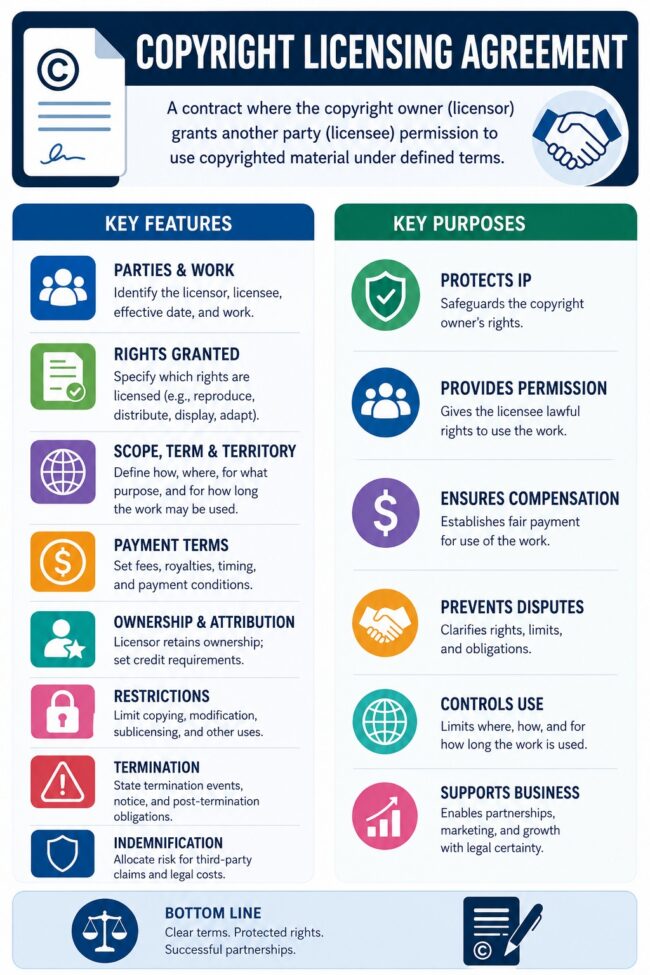
The grant of rights is the heart of a copyright licensing agreement because it identifies the exact copyright license being given. Under U.S. copyright law, the copyright owner controls a bundle of exclusive rights, including the rights to reproduce the copyrighted work, prepare derivative works, distribute copies, publicly perform the work, publicly display the work, and, for sound recordings, perform the work through certain digital audio transmissions. See 17 U.S.C. § 106.
The grant clause should not rely on broad phrases like “use the work.” Instead, the agreement should state exactly what the license allows the licensee to do: view, download, copy, reproduce, modify, edit, display, publish, provide access to, sublicense, sell, or distribute the copyrighted material. It should also state whether the rights granted include the right to create derivative works, such as translations, adaptations, updated versions, excerpts, compilations, or customized marketing materials.
The clause should also define the scope of the license, including territory, platform, media, time period, specific purpose, and any restrictions or approval rights. Finally, the licensor should reserve all other rights not expressly granted so the licensee does not assume broader permission than the contract actually provides.
A solid copyright license agreement should define the scope of the license with practical precision. The agreement should identify the approved media, platforms, number of copies, audience, sales or marketing channels, territory, and specific purpose for which the licensee may use the copyrighted work. For example, a licensing agreement might allow use of an image on a company website in the United States for one year, but not in paid advertising, merchandise, social media campaigns, or international distribution.
In U.S. copyright law, the copyright owner controls distinct exclusive rights, including reproduction, preparation of derivative works, distribution, public performance, and public display. Because those rights can be licensed separately, the agreement should clearly identify the specific rights granted to the licensee, while expressly reserving all other rights to the copyright owner.
Use restrictions should also state when prior written consent is required. Common restrictions include sublicensing, editing, translating, adapting the work, using it in advertising, combining it with third party material, creating derivative works, transferring the license, or expanding the use into new platforms or territories. This level of detail helps prevent unauthorized use and disputes over whether a particular use falls inside or outside the license.
The payment terms should state exactly how and when the licensee will compensate the licensor for the license. Copyright license agreements commonly use two payment types: a copyright fee, often a one-time payment due on signing, delivery, or the effective date, and royalty fees, which are ongoing payments tied to revenue, usage, downloads, subscribers, views, sales, or another measurable metric. Because a copyright owner controls exclusive rights such as reproduction, distribution, public display, public performance, and derivative works, the payment clause should match the actual rights granted and the permitted scope of use.
The clause should also cover invoices, due date, taxes, reports, audit rights, late payment interest, currency, and whether the license remains valid only if amounts are paid. This distinction matters because a missed payment may create only a contract claim unless the agreement makes payment a condition of the license. In Graham v. James, 144 F.3d 229 (2d Cir. 1998), Richard Graham hired Larry James to convert a CD-ROM retrieval program from BASIC into C++. James owned the copyright in the C++ version, but the parties had a licensing agreement under which Graham could use the program in CD-ROM releases in exchange for payment of $1,000 per release plus $1 per disk sold. Graham later failed to pay royalties and removed James’s copyright notice. The Second Circuit held that those breaches did not automatically convert Graham’s licensed use into copyright infringement because the payment and notice provisions were covenants, not express conditions limiting the scope of the license. The court therefore distinguished between breach of contract and infringement. Use outside the licensed rights, however, may still trigger infringement under 17 U.S.C. § 501.
Most licensors retain original copyright ownership in a copyright licensing agreement. The agreement grants permission to use the copyrighted work, but it does not transfer title unless the contract expressly states that ownership or specific intellectual property rights are being assigned. Copyright ownership may be transferred in whole or in part, but an exclusive license or assignment should be clearly documented in writing. See 17 U.S.C. §§ 101, 201(d), 204(a).
The agreement should also address attribution, including whether the licensee must credit the copyright owner, author, company, or creator, and the exact form of that credit. Attribution terms are especially important for creative work used in advertising, software, publications, social media, or branded content. For certain works of visual art, 17 U.S.C. § 106A provides limited rights of attribution and integrity, separate from ordinary ownership rights.
A non-disclosure clause may be essential when the licensee receives source files, unpublished materials, customer data, pricing, know-how, technical documentation, business plans, or trade secrets. This clause should define the protected information, limit disclosure to employees or contractors with a need to know, require reasonable safeguards, and state whether confidentiality obligations survive termination of the agreement. Under U.S. law, trade secret protection depends in part on taking reasonable measures to keep the information secret under 18 U.S.C. § 1839(3).
The agreement should also address practical business obligations, including implementation assistance, technical support, audit rights, quality control, and whether the licensee must obtain prior written consent before using third-party fonts, stock images, music, plug-ins, trademarks, or other rights.
A non-compete clause may be included that provides competitive restrictions in a broader commercial arrangement involving intellectual property, software, proprietary workflows, or sensitive market information.
A strong termination clause should identify the events that end the copyright license, including breach of contract, failure to pay, unauthorized use, insolvency, reputational misuse, failure to obtain required approvals, or use outside the granted rights. The clause should require written notice, state whether the breaching party has a cure period, and explain what happens after termination. For example, the licensee may need to stop using the copyrighted material, remove it from websites or products, delete digital files, return confidential materials, cease distribution activities, and provide written certification of compliance.
This matters because once the agreement expires or is terminated, continued use may exceed the rights granted and become copyright infringement under U.S. copyright law. Conduct that was permitted during the license term may become actionable unauthorized use after termination.
Indemnification clauses allocate legal risk if a third-party claims that use of the copyrighted work infringes its intellectual property rights, violates privacy or publicity rights, or breaches another agreement. These risks can include infringement damages, injunctions, takedown demands, lost revenue, settlement payments, and attorneys’ fees. In a copyright licensing agreement, the licensor should typically indemnify the licensee for claims that the licensor does not own or control the copyrighted material, lacks authority to grant the license, or supplied work that infringes another party’s rights. The licensee should typically indemnify the licensor for claims arising from the licensee’s unauthorized use, modification, distribution, failure to follow restrictions, or combination of the work with other materials. The indemnifying party may be required to defend the claim at its own expense, provide reasonable assistance, and pay covered losses, subject to notice, settlement approval, exclusions, and control of defense.
A well-structured copyright licensing agreement helps protect the copyright owner, gives the licensee reliable permission, and reduces disputes over scope, payment, ownership, territory, derivative works, and termination. A proper license agreement is specifically identifies the work, defines the rights granted, states the duration and territory, includes clear payment terms, preserves ownership, manages confidentiality, allocates risk, and requires written notice before key actions. For copyrighted material that is not in the public domain or covered by a valid exception, a written and signed copyright license is the safest path to lawful commercial use. Licenses are also critical tools for leveraging the important value and rights provided by copyrights.
© 2026 Sierra IP Law, PC. The information provided herein does not constitute legal advice, but merely conveys general information that may be beneficial to the public, and should not be viewed as a substitute for legal consultation in a particular case.

"Mark and William are stellar in the capabilities, work ethic, character, knowledge, responsiveness, and quality of work. Hubby and I are incredibly grateful for them as they've done a phenomenal job working tirelessly over a time span of at least five years on a series of patents for hubby. Grateful that Fresno has such amazing patent attorneys! They're second to none and they never disappoint. Thank you, Mark, William, and your entire team!!"
Linda Guzman


Sierra IP Law, PC - Patents, Trademarks & Copyrights
FRESNO
7030 N. Fruit Ave.
Suite 110
Fresno, CA 93711
(559) 436-3800 | phone
BAKERSFIELD
1925 G. Street
Bakersfield, CA 93301
(661) 200-7724 | phone
SAN LUIS OBISPO
956 Walnut Street, 2nd Floor
San Luis Obispo, CA 93401
(805) 275-0943 | phone

SACRAMENTO
180 Promenade Circle, Suite 300
Sacramento, CA 95834
(916) 209-8525 | phone
MODESTO
1300 10th St., Suite F.
Modesto, CA 95345
(209) 286-0069 | phone
SANTA BARBARA
414 Olive Street
Santa Barbara, CA 93101
(805) 275-0943 | phone
SAN MATEO
1650 Borel Place, Suite 216
San Mateo, CA, CA 94402
(650) 398-1644. | phone
STOCKTON
110 N. San Joaquin St., 2nd Floor
Stockton, CA 95202
(209) 286-0069 | phone
PORTLAND
425 NW 10th Ave., Suite 200
Portland, OR 97209
(503) 343-9983 | phone
TACOMA
1201 Pacific Avenue, Suite 600
Tacoma, WA 98402
(253) 345-1545 | phone
KENNEWICK
1030 N Center Pkwy Suite N196
Kennewick, WA 99336
(509) 255-3442 | phone
2023 Sierra IP Law, PC - Patents, Trademarks & Copyrights - All Rights Reserved - Sitemap Privacy Lawyer Fresno, CA - Trademark Lawyer Modesto CA - Patent Lawyer Bakersfield, CA - Trademark Lawyer Bakersfield, CA - Patent Lawyer San Luis Obispo, CA - Trademark Lawyer San Luis Obispo, CA - Trademark Infringement Lawyer Tacoma WA - Internet Lawyer Bakersfield, CA - Trademark Lawyer Sacramento, CA - Patent Lawyer Sacramento, CA - Trademark Infringement Lawyer Sacrament CA - Patent Lawyer Tacoma WA - Intellectual Property Lawyer Tacoma WA - Trademark lawyer Tacoma WA - Portland Patent Attorney - Santa Barbara Patent Attorney - Santa Barbara Trademark Attorney
