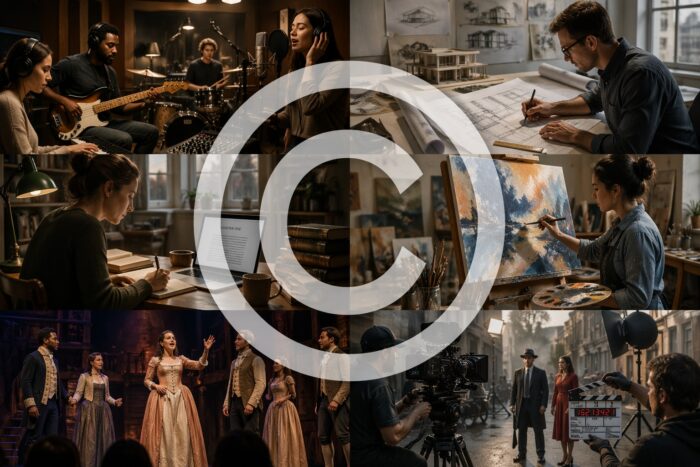
Why are copyrights important? They turn a creative work into a valuable intellectual property asset and give creators and businesses a legal framework to protect, control, and monetize original expression. Under U.S. copyright law, copyright protection arises automatically for original works of authorship as soon as an author fixes the work in a tangible form of expression, whether the work is writing, music, images, videos, websites, computer programs, or other original works; at the same time, the law does not protect ideas themselves, only the author’s original expression of those ideas. Those rights provide practical benefits by allowing copyright owners to control reproduction, distribution, publication, display, licensing, and other uses of their work, which encourages creativity and helps ensure creators can capture the value of what they create.
Modern copyright law did not begin as a broad natural right to control every use of a creative work. Its roots are older and narrower. England's Statute of Anne in 1710 was the first modern copyright statute, recognizing an author’s legal right in his or her own work. The first federal U.S. copyright law, enacted in 1790, was modeled on the Statute of Anne and protected books, maps, and charts for an initial term of fourteen years, with a possible fourteen-year renewal. Copyright law was initially developed as a limited system for encouraging creation and publication, not as a monopoly over information or ideas.
The American rationale appears directly in the Copyright Clause, which gives Congress power to secure exclusive rights to authors for limited times “to promote the Progress of Science and useful Arts.” U.S. Const. art. I, § 8, cl. 8. At the time of the Framing, “Science” referred to knowledge and learning, and the Framers wanted a uniform national system of intellectual property protection rather than a patchwork of state-by-state rules. The federal copyright system provides the reward of copyrights to a creator or author, incentivizing people and businesses to spend money, time, and resources to create new content, software, music, branding, and other intellectual property.
However, the constitutional language shows that copyright does significantly more than reward one person or artist. It is intended to encourage creativity, creation, and investment for the benefit of the general public. The Supreme Court has repeatedly described copyright as a system meant to stimulate the production of original works by giving creators a meaningful economic incentive. See Sony Corp. of Am. v. Universal City Studios, Inc., 464 U.S. 417 (1984).
Copyright protection begins at creation when the author fixes the material in a tangible medium, such as a file, manuscript, recording, photograph, design, or source code. Section 102(a) of the Copyright Act is the core rule: it provides that copyright subsists in “original works of authorship fixed in any tangible medium of expression,” whether the work is embodied in a medium now known or later developed. 17 U.S.C. § 102(a). Section 102(a) also identifies the main categories of protected works, including literary works, musical works, dramatic works, pantomimes and choreographic works, pictorial, graphic, and sculptural works, motion pictures and other audiovisual works, sound recordings, and architectural works, which is why everything from a blog post to computer programs can qualify for copyright protection when the statutory requirements are met. See 17 U.S.C. § 102(a)(1)–(8).
Section 101 explains how that rule operates in practice. It defines a work as “created” when it is fixed in a copy or phonorecord for the first time, and it defines “fixed” to mean that the work is embodied, by or under the authority of the author, in a form that is sufficiently permanent or stable to be perceived, reproduced, or otherwise communicated for more than a transitory duration. See 17 U.S.C. § 101. The same section also defines a “computer program” as a set of statements or instructions used in a computer, helping explain why source code, software, and other original works in digital form can receive automatic protection once the author fixes them in a tangible medium.
Section 106 is the core rights-grant in copyright law, granting copyright owners the exclusive rights to reproduce the copyrighted work, prepare derivative works, distribute copies or phonorecords, perform certain works publicly, display certain works publicly, and, for sound recordings, perform the work publicly by digital audio transmission. See 17 U.S.C. § 106. Because the statute separates those rights, a creator or business can control different forms of use, such as reproduction, public display on a website, or distribution of multiple copies, rather than treating copyright as one indivisible asset. That statutory structure is what allows copyright protection to function as a practical business tool. The owner can grant permission for one use, deny another, or license only part of the bundle of rights while retaining the rest.
Copyrights allow artists, authors, developers, and companies to turn their own work into an asset that can be monetized through sales, subscriptions, licenses, transfer agreements, syndication, and publication. Section 201(d) provides that copyright ownership is divisible, meaning ownership of one or more exclusive rights may be transferred separately from the others. See 17 U.S.C. § 201(d). In practice, that allows a company to license website content for one platform, reserve publication rights in journals, or authorize a publisher to distribute a book while keeping digital rights or adaptation rights. The Supreme Court has also recognized the economic value of the right of first publication, which lets copyright owners control when and how original works reach the market. See Harper & Row, Publishers, Inc. v. Nation Enters., 471 U.S. 539 (1985). For business owners, that means writing, music, advertising, software, training materials, and other copyrighted work can generate profits and protect investment.
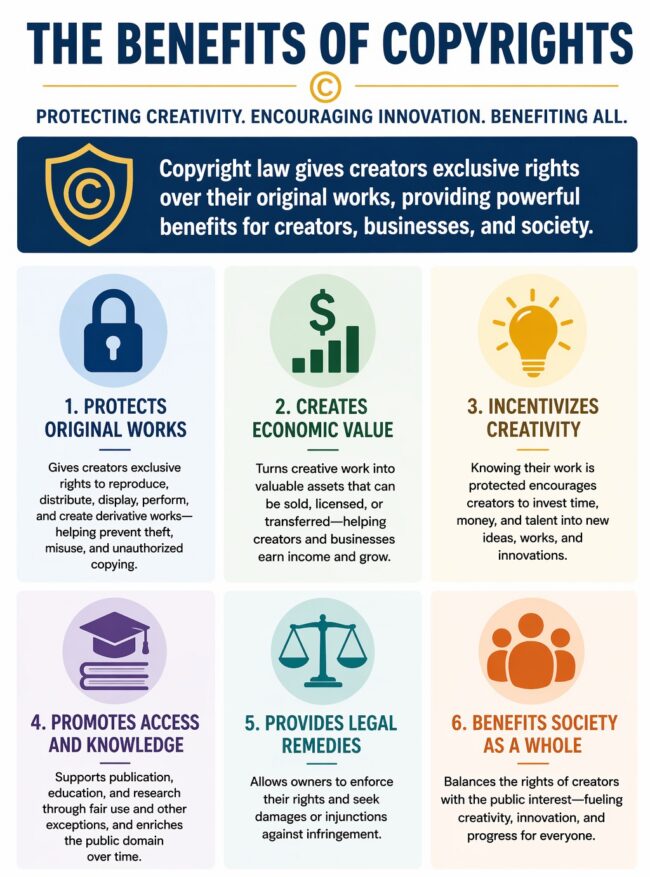
Section 501 states the basic rule of infringement: anyone who violates any of the exclusive rights of the copyright owner is an infringe. See 17 U.S.C. § 501(a). Because those exclusive rights are listed in Section 106, copyright infringement occurs when a work is reproduced, distributed, displayed, performed, or altered into derivative works without the copyright owner's permission, unless an exception such as fair use applies under 17 U.S.C. § 107. Section 504(b) then provides an important civil remedy by allowing the copyright owner to recover actual damages plus any profits of the infringer that are attributable to the infringement. See 17 U.S.C. § 504(b). That means unauthorized reproduction, website copying, or improper publication can lead to claims for lost earnings, lost license fees, and wrongful profits.
Some willful infringement can also trigger criminal penalties. For example, qualifying criminal copyright infringement for commercial advantage or private financial gain may be punished under 17 U.S.C. § 506 and 18 U.S.C. § 2319. Section 506(a) identifies willful infringement for commercial advantage or private financial gain, as well as certain large-scale copying or prerelease conduct. The corresponding criminal penalties of 18 U.S.C. § 2319 include up to five years in prison for a qualifying first felony offense. Federal law also permits a fine of up to $250,000 for an individual convicted of a felony, unless a more specific statute governs under 18 U.S.C. § 3571(b)(3). So while many copyright disputes involve money damages, willful and serious copyright infringement can expose an infringer to criminal prosecution as well.
Copyright registration is not required for copyright protection to exist, because protection arises automatically once the author fixes the work in a tangible medium. But Section 411(a) generally requires registration before the owner of a U.S. work may file an infringement lawsuit. See 17 U.S.C. § 411(a). The Supreme Court has held that the Copyright Office must act on the application before a copyright infringement lawsuit may begin; merely submitting the application is not enough. Fourth Estate Pub. Benefit Corp. v. Wall-Street.com, LLC, 586 U.S. 296 (2019). Registration also improves remedies. Section 504(c) authorizes statutory damages, Section 505 allows courts to award costs and attorney fees, and Section 412 limits access to those remedies for works that are registered after infringement occurs. Registration is therefore a required step, not because it creates the copyright, but because it allows enforcement through copyright litigation.
Section 201(a) provides the default rule that copyright ownership initially vests in the author or authors of the work. See 17 U.S.C. § 201(a). However, copyright ownership is not necessarily permanent or indivisible. Section 201(d) makes copyright ownership divisible, meaning that copyright owners can transfer or license one or more exclusive rights while retaining others. See 17 U.S.C. § 201(d). For example, an author may license a publisher to publish and distribute a book, while retaining other rights to create derivative works, reuse portions of the material, or display the work publicly.
Section 204(a) also requires that a transfer of copyright ownership be in writing and signed by the owner of the rights being transferred or the owner’s authorized agent. See 17 U.S.C. § 204(a). This matters because paying someone to create a work does not automatically mean the buyer receives an assignment of the copyrights. A business may receive a copy of the creative work, and may even have an implied or express license to use it, but copyright ownership usually requires clear transfer language. For that reason, written agreements should address authorship, ownership, licenses, permission, reproduction, publication, distribution, display, and derivative works before the work is created or delivered.
Licensing is a distinct but closely related concept to copyright ownership. While ownership involves who holds the copyright, a license is permission granted by the copyright owner allowing another person or business to use a copyrighted work in specific ways without transferring ownership. Because Section 106 grants copyright owners exclusive rights to reproduce, distribute, display, perform, and create derivative works, a license is the mechanism by which one or more of those rights can be shared or limited for particular uses. Licenses can be broad or narrow, exclusive or non-exclusive, and may include terms governing publication, reproduction, distribution, credit, duration, territory, and payment. For example, in exchange for a licensing fee, a business may license website content, software, music, or written material for limited use while retaining full copyright ownership. Unlike a transfer, a license does not require transferring ownership under Section 204(a), but clear written agreements remain essential to define permission, avoid disputes, and ensure both parties understand the scope of use.
Section 201(b) creates the work-made-for-hire exception. When a work qualifies as a “work made for hire,” the employer or other person for whom the work was prepared is considered the author and owns the copyright unless the parties have agreed otherwise in a signed writing. See 17 U.S.C. § 201(b). Section 101 defines two categories of works for hire: first, works prepared by an employee within the scope of employment; and second, certain specially ordered or commissioned works, but only if they fall within one of the statutory categories and the parties expressly agree in a signed written instrument that the work is a work made for hire. See 17 U.S.C. § 101.
Thus, if a company employee creates original works within the scope of employment, the company owns the copyrights as a work made for hire. But if a company hires an independent contractor, such as a writer, developer, photographer, designer, artist, or consultant, the company may receive the work product without receiving the underlying copyright ownership unless the work qualifies as a statutory work made for hire or the contractor signs a valid copyright assignment. Clear authorship, work-made-for-hire, transfer, and assignment language is therefore essential whenever a business pays someone else to create original works.
Section 101 defines “publication” as the distribution of copies or phonorecords of a copyrighted work to the general public by sale or other transfer of ownership, or by rental, lease, or lending; it also includes offering to distribute copies to a group for further distribution, public performance, or public display. See 17 U.S.C. § 101. Importantly, the statute also clarifies that a public performance or public display of a work does not, by itself, constitute publication. This distinction matters because whether and when a "publication date" for a work is established can affect how copyright law applies to the work, including issues relating to ownership, registration, notice, and the scope of copyright protection.
In practice, publication is closely tied to how copyright owners exercise their exclusive rights, particularly the rights to reproduce, distribute, and display a work under Section 106. Whether a work is formally published often depends on the actions of the copyright owner and the terms of any agreement governing dissemination of the material. For example, distributing multiple copies of a work through a publisher, website, or journals will generally constitute publication, while merely displaying a work online without offering copies for download may not qualify as "publication" under the statute.
The rules around publication are especially important in the context of different publication models. The Copyright Act does not require either a traditional publication model or an open access model. Instead, publication outcomes typically depend on who owns the copyright and what rights have been granted through contract, license, or agreement. Authors often transfer copyright ownership or grant exclusive rights to a publisher as part of the publication process, which can limit their ability to reproduce, distribute, or reuse their own work without permission, including posting to an institutional (e.g., University) repository or database. Under an open access model, the author more often retains copyright ownership and certain exclusive rights, while authorizing broader access, distribution, and display of the work, often through licenses such as Creative Commons, so that the work can be made publicly available, while still maintaining attribution and defined conditions of use.
Creative Commons licenses result from copyright owners providing advance permission to the public to publish, distribute, publicly display, publicly perform, and/or create derivative works through a license. Section 201(d) provides that the copyright bundle is divisible, allowing the owner to reserve some rights while allowing others to the general public. In practical terms, a Creative Commons license lets a creator publish material broadly while specifying the conditions of reuse, such as whether users must give credit, whether commercial use is allowed, or whether derivative works may be made. In open access publishing, that makes Creative Commons a useful tool for balancing access, attribution, and control.
Copyright protection does not last forever. The term of a copyright under 17 U.S.C. § 302(a) is the life of the author plus seventy years for any work created on or after January 1, 1978. Section 305 adds that copyright terms run to the end of the calendar year in which they would otherwise expire. See 17 U.S.C. § 305. Those statutory term rules reflect the Constitution’s requirement that copyright exist only for limited times, not in perpetuity. Once the term ends, the work enters the public domain, and the general public may reproduce, distribute, display, adapt, and build on the material without permission. That transition is an important part of the system because copyright law is designed both to protect creators during the copyright term and to expand public access after that term expires.
Copyrights are important because they protect original works while supporting the broader purpose of copyright law: encouraging creativity, publication, and access to knowledge. Copyright protection can turn writing, music, software, website content, photographs, videos, and other creative work into valuable intellectual property assets. By giving copyright owners exclusive rights to reproduce, distribute, display, perform, license, and create derivative works, copyright provides control, revenue opportunities, and remedies against unauthorized use. Registration with the Copyright Office further strengthens enforcement and may expand available remedies in litigation. However, the core goal of the copyright system is to promote the progress of science, the useful arts, and the creation of new works for the benefit of the students, libraries, universities, businesses, and society as a whole.
If you need assistance with copyright matters or other intellectual property matter, please contact our office for a consultation.
© 2026 Sierra IP Law, PC. The information provided herein does not constitute legal advice, but merely conveys general information that may be beneficial to the public, and should not be viewed as a substitute for legal consultation in a particular case.

"Mark and William are stellar in the capabilities, work ethic, character, knowledge, responsiveness, and quality of work. Hubby and I are incredibly grateful for them as they've done a phenomenal job working tirelessly over a time span of at least five years on a series of patents for hubby. Grateful that Fresno has such amazing patent attorneys! They're second to none and they never disappoint. Thank you, Mark, William, and your entire team!!"
Linda Guzman


Sierra IP Law, PC - Patents, Trademarks & Copyrights
FRESNO
7030 N. Fruit Ave.
Suite 110
Fresno, CA 93711
(559) 436-3800 | phone
BAKERSFIELD
1925 G. Street
Bakersfield, CA 93301
(661) 200-7724 | phone
SAN LUIS OBISPO
956 Walnut Street, 2nd Floor
San Luis Obispo, CA 93401
(805) 275-0943 | phone

SACRAMENTO
180 Promenade Circle, Suite 300
Sacramento, CA 95834
(916) 209-8525 | phone
MODESTO
1300 10th St., Suite F.
Modesto, CA 95345
(209) 286-0069 | phone
SANTA BARBARA
414 Olive Street
Santa Barbara, CA 93101
(805) 275-0943 | phone
SAN MATEO
1650 Borel Place, Suite 216
San Mateo, CA, CA 94402
(650) 398-1644. | phone
STOCKTON
110 N. San Joaquin St., 2nd Floor
Stockton, CA 95202
(209) 286-0069 | phone
PORTLAND
425 NW 10th Ave., Suite 200
Portland, OR 97209
(503) 343-9983 | phone
TACOMA
1201 Pacific Avenue, Suite 600
Tacoma, WA 98402
(253) 345-1545 | phone
KENNEWICK
1030 N Center Pkwy Suite N196
Kennewick, WA 99336
(509) 255-3442 | phone
2023 Sierra IP Law, PC - Patents, Trademarks & Copyrights - All Rights Reserved - Sitemap Privacy Lawyer Fresno, CA - Trademark Lawyer Modesto CA - Patent Lawyer Bakersfield, CA - Trademark Lawyer Bakersfield, CA - Patent Lawyer San Luis Obispo, CA - Trademark Lawyer San Luis Obispo, CA - Trademark Infringement Lawyer Tacoma WA - Internet Lawyer Bakersfield, CA - Trademark Lawyer Sacramento, CA - Patent Lawyer Sacramento, CA - Trademark Infringement Lawyer Sacrament CA - Patent Lawyer Tacoma WA - Intellectual Property Lawyer Tacoma WA - Trademark lawyer Tacoma WA - Portland Patent Attorney - Santa Barbara Patent Attorney - Santa Barbara Trademark Attorney
