
Intellectual property licensing is a commonplace way for a business owner to monetize intellectual property. It allows for monetization of intellectual property assets without investing in new or further manufacturing or development, and without giving up ownership. In a typical licensing agreement, one party allows another party to use valuable intellectual property assets in exchange for fees, royalties, or other compensation, while the licensor retains ownership. Intellectual property licensing is particularly important in certain industries, such as software, pharmaceuticals, and fashion, where it helps companies share technology, use brands effectively, enter new markets, and generate revenue without building every product or sales channel themselves.
An intellectual property licensing agreement is a contract under which one party, the licensor, grants rights to another, the licensee. The IP licensing agreement defines the IP rights granted, whether the deal is exclusive or non-exclusive, what services or know-how are included, and the financial terms, such as royalties or other compensation tied to revenue or sales.
Licensing intellectual property spans multiple categories of intellectual property assets. For example, patent licensing allows a licensee to make, use, or sell a patented invention, with patent law expressly permitting exclusive rights in all or part of the United States under 35 U.S.C. § 261. Copyright licensing permits use, reproduction, distribution, or display of creative works, and exclusive licenses are treated as transfers of exclusive rights that must be in writing per 17 U.S.C. § 204(a). Trademark licensing allows a licensee to use brand names or logos to sell products or services, but requires the licensor to maintain quality control to protect the underlying intellectual property rights per 15 U.S.C. § 1055. Trade secret licensing allows access to confidential information, processes, or know-how, provided the agreement includes strict confidentiality provisions to preserve the value of those trade secrets.
Intellectual property licenses provide that the licensor retains ownership of the intellectual property while granting defined usage rights to the licensee, enabling both parties to align their business objectives and generate value through carefully negotiated license agreements.
IP licensing creates additional revenue streams for IP owners without direct manufacturing costs or the need to sell products themselves. The licensee often gets faster market access through established technology, trademarks, or development work. This can serve very different business objectives: a software company may want scale, a pharmaceutical company may want a commercialization partner, and a fashion brand may want controlled brand expansion. The revenue generated can also fund future innovation.
Licensing intellectual property can involve a wide range of intellectual property assets, including patents, trademarks, copyrights, and trade secrets, as well as related IP assets such as software, data, confidential information, and technical know-how. Intellectual property licensing terms may vary depending on the nature of the IP, and the business objectives of the licensor and licensee.
For example, patents typically involve licensing a patented invention for the right to make, use, or sell products or technology. These IP licensing arrangements often include detailed provisions regarding development, manufacturing, and commercialization responsibilities, particularly where the licensee is responsible for bringing a product to market. In industries such as pharmaceuticals, a pharmaceutical company may obtain exclusive rights within a specific geographic area to develop and sell products based on the patented technology, often in exchange for milestone payments and ongoing royalties.
Trademark licensing focuses on brand use and consumer-facing activities. A trademark IP licensing agreement typically grants the licensee the right to use trademarks in connection with specific goods or services, but requires strict quality control provisions to maintain the value of the brand. The licensor retains ownership and must monitor how the marks are used to ensure consistency and protect goodwill, particularly where the licensee is offering services or selling products under the licensed brand. Even though there is no statutory requirement that there be a written trademark license agreement, it is important to have a written agreement for trademark rights. Trademark rights may be lost if there are no written terms regarding quality control and auditing. A trademark licensing arrangement that does not have quality control provisions results in naked licensing, which can result in a loss of trademark rights.
Copyright licensing commonly applies to creative works, including software, media, and written content. In software licensing, for instance, the licensee is granted access to use the code subject to limitations on copying, modification, or distribution. These agreements may be structured as non-exclusive license arrangements allowing multiple parties to use the same work, or as exclusive licenses depending on the intended use and market strategy.
Trade secrets are licensed through carefully structured agreements that provide access to confidential information, processes, or formulas while imposing strict obligations on the receiving party. Because trade secrets derive their value from secrecy, these agreements must include robust confidentiality and use restrictions to ensure the licensee does not disclose or misuse the information. Trade secret protection is governed in part by federal law, including 18 U.S.C. § 1836(b), and requires ongoing diligence by the licensor to preserve the secrecy of the information.
In many cases, licensing intellectual property involves a combination of these rights. A single IP licensing agreement may include patents, trademarks, copyrighted materials, and trade secrets bundled together to support a broader commercial relationship, such as distributing technology, offering integrated services, or expanding into new markets.
Exclusive license grants provide the licensee with exclusive rights to use specified intellectual property within a defined field, market segment, or geographic area, often to the exclusion of even the licensor. In many intellectual property licensing structures, this level of exclusivity means the licensor retains ownership but agrees not to grant the same rights to other parties and, in some cases, may also agree not to compete directly within the licensed scope. This type of intellectual property licensing agreement is frequently used where the licensee is expected to make substantial investments in development, commercialization, or regulatory approval, such as in a patented invention licensed by a pharmaceutical company, because exclusivity helps justify the financial risk. Under patent law, such grants are expressly permitted under 35 U.S.C. § 261. In the copyright context, an exclusive license is treated as a transfer of ownership rights and must generally be in writing under 17 U.S.C. § 204(a).
By contrast, a non-exclusive license allows the licensor to grant the same intellectual property rights to multiple parties simultaneously. In a non-exclusive arrangement, the licensor retains ownership and broad flexibility to continue licensing the same IP assets to other licensees, making it a common approach for software, technology platforms, and standardized services where widespread adoption is a core business objective. For example, a software company may enter into non-exclusive IP licensing agreements with hundreds or thousands of business customers, each paying subscription fees to access the same platform. Similarly, a company that owns valuable patents covering a widely used technology standard may license those patents on a non-exclusive basis to multiple manufacturers so they can sell products compliant with that standard. In the trademark context, a brand owner might grant non-exclusive rights to multiple retailers to sell products under the same brand in different channels, provided quality control standards are maintained. Because multiple parties can access and use the same intellectual property, royalty rates and compensation structures may differ significantly from exclusive licenses, often favoring volume-based revenue generated across many licensees rather than a single high-value deal.
Sublicenses introduce an additional layer of complexity in IP licensing agreements. A sublicense permits the original licensee to grant some portion of its licensed rights to another party, but only if the original agreement expressly authorizes such downstream licensing. The scope of sublicensing rights is typically tightly controlled through contractual provisions governing territory, field of use, and financial terms, ensuring that the licensor retains control over how its intellectual property assets are disseminated. In many cases, sublicenses are critical for expanding into new markets or enabling distribution through multiple parties, particularly where the original licensee lacks the infrastructure to fully commercialize the IP on its own.
The distinctions between an intellectual property assignment and an exclusive license are subtle. At a fundamental level, an assignment transfers ownership of intellectual property rights, while an intellectual property licensing agreement grants limited rights to use the IP while the licensor retains ownership, even if all other rights are provided to the licensee during the term of the license.
In the patent context, the Supreme Court in Waterman v. Mackenzie, 138 U.S. 252 (1891), established the governing framework: an assignment exists only where the transfer conveys (i) the entire patent, (ii) an undivided share of the patent, or (iii) the exclusive rights in a defined geographic area. Any lesser transfer, such as granting rights limited by field of use, duration, or other restrictions, constitutes licensing intellectual property rather than a transfer of ownership. This distinction is codified in 35 U.S.C. § 261, which recognizes both assignment and the ability to grant exclusive license grants or non-exclusive license rights without transferring title. As a result, even an “exclusive” IP licensing agreement may leave the licensor as the legal owner of the patented invention, with the licensee holding contractual rights rather than full property interests.
Trademark law imposes additional constraints that further distinguish assignment from IP licensing. Under 15 U.S.C. § 1060(a)(1), a trademark assignment must include the associated goodwill of the business; otherwise, the transfer is invalid. This reflects the underlying policy that trademarks signify source and quality, not merely abstract IP assets. By contrast, trademark licensing, whether exclusive or non-exclusive, permits a licensee to use the mark while the licensor retains ownership, provided the licensor maintains adequate quality control. Failure to do so can result in abandonment of trademark rights through “naked licensing,” as recognized in FreecycleSunnyvale v. Freecycle Network, 626 F.3d 509 (9th Cir. 2010). Thus, in trademark-focused license agreements, the licensor’s ongoing obligations are a defining feature that distinguishes licensing from a complete assignment.
Copyright law also reinforces the separation between ownership and use rights in intellectual property licensing. Under 17 U.S.C. § 202, ownership of a copyright is distinct from ownership of the material object in which the work is embodied. Additionally, 17 U.S.C. § 101 defines an exclusive license as a transfer of one or more exclusive rights, but only to the extent expressly granted in the agreement. 17 U.S.C. § 204(a) requires that such transfers of ownership be in writing. Courts analyzing whether a transaction is a copyright assignment or merely a copyright licensing agreement focus on whether an exclusive right under the Copyright Act has been conveyed. See, e.g., Righthaven LLC v. Hoehn, 716 F.3d 1166 (9th Cir. 2013) (holding that a purported assignment that left the transferor with significant control and economic interests did not transfer ownership, but instead created a limited license). Thus, in copyright transactions, the scope of rights granted, and any retained interests by the licensor, determine whether the agreement effects a true assignment or remains within the realm of intellectual property licensing.
Intellectual property licenses, whether structured as exclusive licenses, non-exclusive licenses, or hybrid arrangements, generally involve granting rights rather than transferring ownership. The licensor can retain rights, continue exploiting the IP, or license it to multiple parties depending on the agreement’s exclusivity provisions. By contrast, an assignment typically transfers all substantial rights, leaving the assignor with no continuing interest except as contractually reserved.
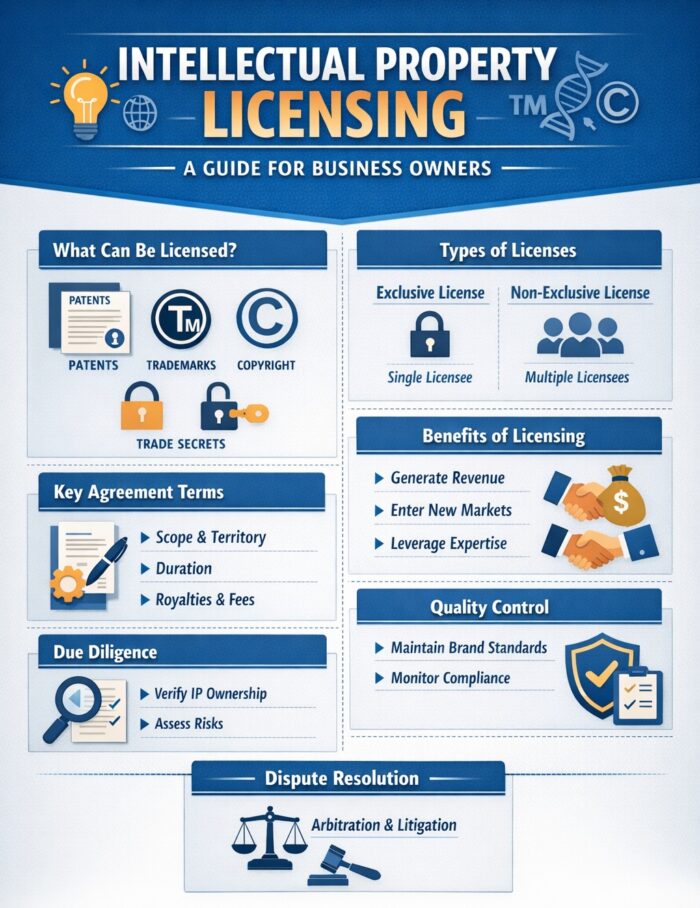
Well-drafted intellectual property licensing agreements must precisely define the scope of the IP rights being granted, including what specific intellectual property assets, such as patents, trademarks, software, or trade secrets, are covered, how the technology or know-how may be used, and whether the licensee has rights to modify, develop, or create derivative works.
Exclusivity is another central provision. The agreement should clearly state whether the deal involves exclusive license grants, a non-exclusive license, or some hybrid structure. An exclusive arrangement may grant exclusive rights within a defined geographic area, market segment, or field of use. The defined geographic area determines where the licensee can sell products or provide services, while the term of the license agreement dictates how long the granted rights will last. These elements influence royalty rates, long-term business planning, and each party’s ability to enter new markets or pursue future licensing opportunities. Strong agreements also include detailed financial terms, specifying how royalties are calculated and paid. This may include a percentage of sales, fixed fees, milestone payments, or other forms of compensation tied to revenue generated. Clear definitions of “net sales,” payment timing, and audit mechanisms are essential to avoid disputes.
Quality control and performance obligations are particularly important in license agreements involving trademarks. The licensor retains ownership of the brand and must ensure consistent quality, often through product standards and ongoing oversight. Failure to maintain quality control can jeopardize intellectual property rights. Additional provisions should address reporting and audit rights, allowing the licensor to verify compliance and confirm accurate royalties. Reservation of rights clauses ensure the IP owner continues to retain rights not expressly granted, preserving flexibility for other deals or internal use. Assignment and sublicensing restrictions control whether the licensee can transfer its rights to another company or affiliate, which is critical for managing risk and maintaining control over the subject IP.
Ownership of improvements and derivative works is another frequently negotiated issue. The agreement should specify whether new development created during the relationship belongs to the licensor, the licensee, or is shared, as this can significantly affect future innovation and value.
Finally, liability, indemnification, and dispute resolution provisions allocate risk between the parties and establish how conflicts will be handled. These clauses define which party is responsible for infringement claims, regulatory compliance, or third-party disputes, and often include arbitration or litigation frameworks.
As a legal matter, certain forms of intellectual property licensing must meet statutory requirements. For example, in copyright law, an exclusive license is treated as a transfer of ownership and must generally be in writing and signed. Careful drafting of these provisions ensures the agreement aligns with applicable laws, protects both parties’ interests, and supports long-term business success.
Royalty rates depend on many factors, including exclusivity, technology maturity, market size, patent strength, geographic area, and expected sales. Financial terms may include royalties based on sales, a lump sum payment, milestone compensation, or a combination of those structures. For example, a pharmaceutical company licensing a patented invention and related know-how may negotiate different royalties for development milestones and commercial sales. One caution for patents: post-expiration royalty provisions are restricted under Kimble v. Marvel Entertainment, LLC, 576 U.S. 446 (2015), reaffirming Brulotte v. Thys Co., 379 U.S. 29 (1964).
Trademark licensing is a critical component of intellectual property licensing, but it comes with strict quality control obligations. Under 15 U.S.C. § 1055, a licensor must actively control the nature and quality of the goods or services offered by a licensee, and the trademark use by the licensee must be for the benefit the registrant. Otherwise, the trademark may be weakened or even abandoned. This means that any intellectual property licensing agreement or IP licensing agreement involving trademarks should include detailed provisions governing quality standards, inspection rights, and compliance obligations to protect the value of the IP assets.
For many business owners, trademark licensing also overlaps with franchise licensing. A licensing arrangement may be considered a franchise when the licensee is granted the right to use trademarks as part of a broader business system, receives significant control or assistance from the licensor, and pays required fees. These elements can trigger federal franchise laws under 16 C.F.R. Part 436. As a result, licensors must carefully evaluate whether their licensing intellectual property strategy creates franchise obligations. Proper structuring ensures the licensor retains ownership, maintains brand value, and continues generating revenue while managing legal risk and supporting long-term business objectives.
Best practices begin with due diligence by both licensor and licensee. Each side should verify ownership, chain of title, existing obligations, prior assignment issues, market conditions, and whether the IP actually supports the business plan. For patents, that includes checking whether inventors properly assigned rights, whether protection exists in the relevant markets, and whether third parties claim competing interests. Due diligence is often the difference between a strategic deal and a future liability problem.
A well-drafted agreement should say which party is responsible for maintenance, enforcement, insurance, indemnity, recordkeeping, and compliance. Reporting and audit provisions matter because they test the accuracy of royalty payments. Dispute resolution clauses also matter. Many IP license agreements require arbitration, and written arbitration provisions in commercial contracts are generally enforceable under 9 U.S.C. § 2. Clear provisions on obligations and liability help protect both sides long after the initial exchange is complete.
Not all intellectual property licensing occurs through privately negotiated license agreements between a single licensor and licensee. Open source and Creative Commons frameworks are widely used forms of IP licensing that allow broad public access to intellectual property assets, often by multiple parties simultaneously under standardized terms. These IP licensing agreements typically grant a non-exclusive license to use, modify, and distribute works, subject to conditions such as attribution, share-alike requirements, or limitations on commercial use.
Courts have made clear that these conditions are enforceable legal obligations. In Jacobsen v. Katzer, 535 F.3d 1373 (Fed. Cir. 2008), the Federal Circuit held that open source license terms constituted enforceable conditions of the copyright grant, not mere contractual covenants. The defendant’s failure to comply with attribution and notice requirements exceeded the scope of the license granted, resulting in copyright infringement rather than just breach of contract.
Intellectual property licensing is a powerful business tool. It helps IP owners retain rights, expand into new markets, and generate revenue from IP assets without surrendering ownership. The key is disciplined drafting and management. Define the rights granted, negotiate fair royalty terms, protect confidential information, monitor compliance, and match the agreement to real business objectives. IP licensing can create lasting value for both licensor and licensee.
If you need assistance with intellectual property licensing or other intellectual property matter, please contact our office for a consultation.
© 2026 Sierra IP Law, PC. The information provided herein does not constitute legal advice, but merely conveys general information that may be beneficial to the public, and should not be viewed as a substitute for legal consultation in a particular case.

"Mark and William are stellar in the capabilities, work ethic, character, knowledge, responsiveness, and quality of work. Hubby and I are incredibly grateful for them as they've done a phenomenal job working tirelessly over a time span of at least five years on a series of patents for hubby. Grateful that Fresno has such amazing patent attorneys! They're second to none and they never disappoint. Thank you, Mark, William, and your entire team!!"
Linda Guzman


Sierra IP Law, PC - Patents, Trademarks & Copyrights
FRESNO
7030 N. Fruit Ave.
Suite 110
Fresno, CA 93711
(559) 436-3800 | phone
BAKERSFIELD
1925 G. Street
Bakersfield, CA 93301
(661) 200-7724 | phone
SAN LUIS OBISPO
956 Walnut Street, 2nd Floor
San Luis Obispo, CA 93401
(805) 275-0943 | phone

SACRAMENTO
180 Promenade Circle, Suite 300
Sacramento, CA 95834
(916) 209-8525 | phone
MODESTO
1300 10th St., Suite F.
Modesto, CA 95345
(209) 286-0069 | phone
SANTA BARBARA
414 Olive Street
Santa Barbara, CA 93101
(805) 275-0943 | phone
SAN MATEO
1650 Borel Place, Suite 216
San Mateo, CA, CA 94402
(650) 398-1644. | phone
STOCKTON
110 N. San Joaquin St., 2nd Floor
Stockton, CA 95202
(209) 286-0069 | phone
PORTLAND
425 NW 10th Ave., Suite 200
Portland, OR 97209
(503) 343-9983 | phone
TACOMA
1201 Pacific Avenue, Suite 600
Tacoma, WA 98402
(253) 345-1545 | phone
KENNEWICK
1030 N Center Pkwy Suite N196
Kennewick, WA 99336
(509) 255-3442 | phone
2023 Sierra IP Law, PC - Patents, Trademarks & Copyrights - All Rights Reserved - Sitemap Privacy Lawyer Fresno, CA - Trademark Lawyer Modesto CA - Patent Lawyer Bakersfield, CA - Trademark Lawyer Bakersfield, CA - Patent Lawyer San Luis Obispo, CA - Trademark Lawyer San Luis Obispo, CA - Trademark Infringement Lawyer Tacoma WA - Internet Lawyer Bakersfield, CA - Trademark Lawyer Sacramento, CA - Patent Lawyer Sacramento, CA - Trademark Infringement Lawyer Sacrament CA - Patent Lawyer Tacoma WA - Intellectual Property Lawyer Tacoma WA - Trademark lawyer Tacoma WA - Portland Patent Attorney - Santa Barbara Patent Attorney - Santa Barbara Trademark Attorney
