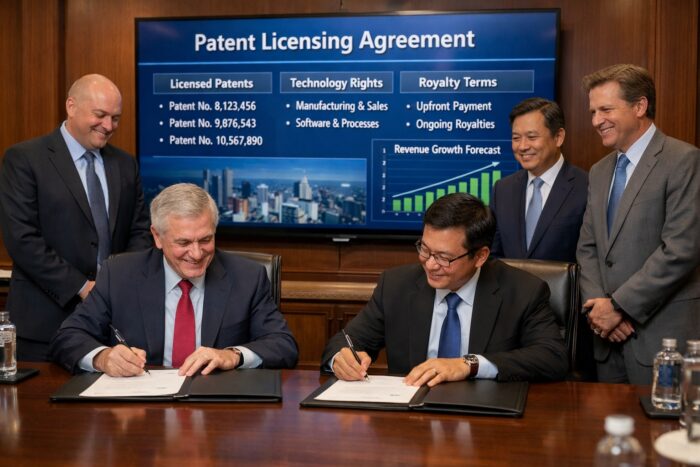
Patent licensing lets a patent owner (the licensor) grant a license to another person or company (the licensee) to use a patented invention or patented technology. Rather than transferring ownership of the patent itself, a patent licensing agreement gives the licensee defined permission, under negotiated and agreed terms, to make, use, manufacture, sell, and/or import products or services that fall within the scope of the patent rights. In practice, a well-structured license agreement specifies how and where the patented invention may be used, the duration and scope of the license, and the payment terms, including upfront fees or ongoing royalties. For the licensee, this arrangement provides lawful access to valuable intellectual property while avoiding the cost and risk of a patent infringement dispute. For the patent owner, patent licensing offers a way to protect and monetize innovations, expand into new markets, and generate revenue without bearing the full cost of manufacturing, distribution, or sales.
Patent licensing agreements can benefit both parties by aligning business goals with intellectual property rights, allowing inventions and technology to reach the market efficiently while creating a sustainable revenue stream for the patent owner.
A United States patent gives the patent owner a set of enforceable patent rights, including the right to exclude other parties from making, using, selling, offering for sale, or importing the patented invention under 35 U.S.C. § 154. Patent licensing does not transfer ownership of those rights. Instead, a license is a carefully defined permission that allows a licensee to engage in specific activities that would otherwise infringe the patent.
In practical terms, a patent license agreement sets the agreed terms under which the licensee may operate. Those terms define what the licensee may do, how they may do it, where they may do it, and for how long. Any activity that falls outside the negotiated scope of the license agreement, such as selling into an unauthorized market, exceeding field-of-use limitations, or continuing use after expiration, may constitute patent infringement under 35 U.S.C. § 271.
Patent licensing agreements are highly flexible and can be tailored to a wide range of business models. A license may apply to physical products, an industrial or manufacturing process, or software implementations of the patented technology. In many cases, licensors also bundle additional intellectual property with the patent rights, such as trade secrets, proprietary know-how, documentation, or technical assistance. This bundling can increase the value of the deal by giving the licensee faster and more reliable access to the technology needed to commercialize the invention successfully.
A well-drafted patent license clarifies expectations, aligns incentives, and creates a framework where both parties can develop, manufacture, and sell products based on the patented technology without crossing into infringement territory.
A license agreement and a patent assignment serve very different purposes under patent law, even though both involve rights in a patented invention. An assignment permanently transfers ownership of the patent itself, including the right to exclude others and to enforce the patent, making the recipient the new patent owner. By contrast, a patent license generally grants limited permission to use, make, or sell the patented technology while ownership remains with the licensor. Courts carefully distinguish true assignments from exclusive licenses that do not transfer “all substantial rights,” as explained in Waterman v. Mackenzie, 138 U.S. 252 (1891). However, some licenses carry sufficient rights to provide the licensee with standing to sue (i.e., the right to sue) for infringement of the licensed patent.
In the Waterman case, the Supreme Court held that only a transfer of all substantial rights in a patent, such as the exclusive right to make, use, and sell the patented invention for the full term of the patent, constitutes an assignment. Transfers that fall short of conveying all substantial rights are treated as licenses, even if labeled “exclusive.” This distinction determines who is considered the patent owner, who has standing to sue for patent infringement, and whether ownership must be recorded under 35 U.S.C. § 261.
One of the most important decisions in any patent licensing strategy is whether to grant exclusivity. The level of exclusivity directly affects the patent owner’s control over the patented invention, the size and predictability of royalty payments, and the licensee’s willingness to invest in development, manufacture, and sales.
An exclusive license grants one party the exclusive right to use, make, and sell the patented technology within a defined scope, such as a specific field of use, territory, or market segment. In most cases, an exclusive license prevents the patent owner from granting licenses to other parties within that same scope and may also restrict the owner’s own ability to practice the invention. Because exclusivity can provide a strong competitive advantage, exclusive licenses often command higher upfront fees, milestone payments, or ongoing royalties. For the licensee, exclusivity can justify the significant cost of commercialization and reduce the risk that competitors will enter the same space using the same intellectual property rights.
By contrast, a non-exclusive license allows the patent owner to grant licenses to multiple parties at the same time. This approach gives the licensor flexibility to pursue a wider range of licensing opportunities and can be an effective way to generate revenue from many companies across an industry. Non-exclusive licensing is common in software, platform technologies, and standardized processes where broad adoption is more valuable than exclusivity. While individual royalty rates may be lower, licensing to multiple parties can create a steady and diversified revenue stream for the patent owner.
A sole license sits between these two models. Under a sole license, the licensee becomes the only licensee, but the patent owner retains the right to use and practice the patented invention itself. This structure can be attractive when the owner wants to remain active in the market, for example, continuing internal development or limited sales, while still partnering with a single commercial licensee. Sole licenses can balance collaboration and control, allowing the licensor to participate in the technology’s growth without opening the door to additional licensees.
Choosing between an exclusive license, a non-exclusive license, or a sole license is a strategic business decision. It should align with the company’s overall licensing strategies, long-term business goals, and realistic assessment of how much control, risk, and revenue the patent owner is willing to exchange for market access and partner investment.
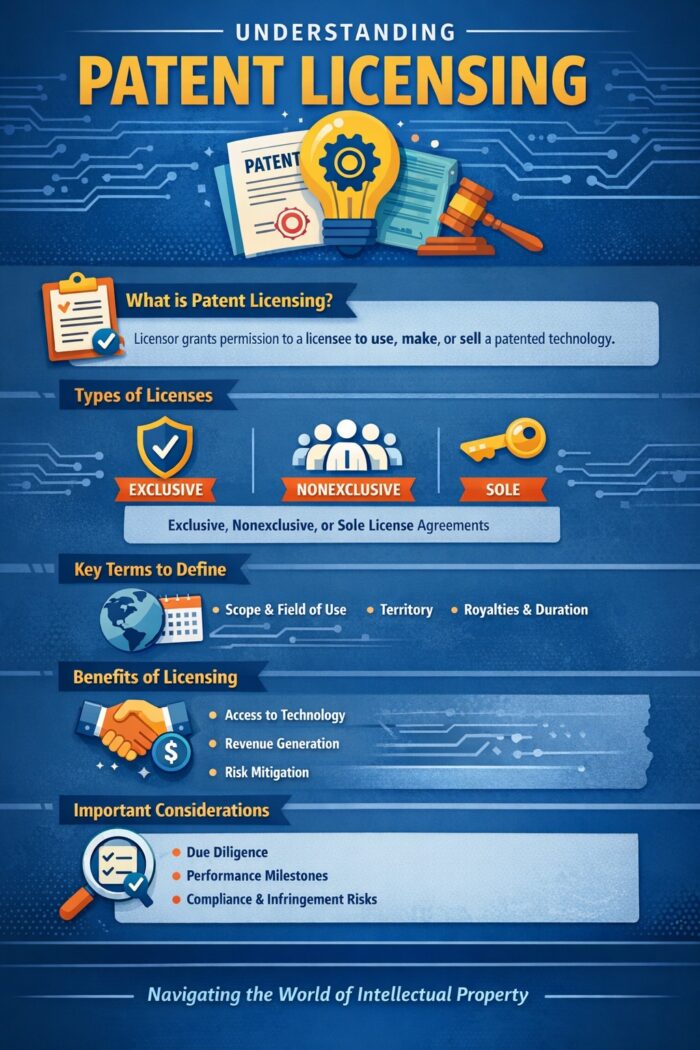
The grant clause is the heart of any patent licensing agreement. It defines exactly which patent rights the patent owner is granting to the licensee, and what rights are being withheld. In practice, this clause determines the scope of the license, the permitted field of use, the geographic territory, which can be as narrow as a single country or as broad as “the world”, and the term or time limit of the license agreement.
Clarity in the grant clause protects both parties. A narrowly drafted grant can preserve the licensor’s ability to grant licenses to other parties, maintain a competitive advantage, or retain freedom to operate in adjacent markets. A clearly defined grant also helps the licensee assess whether the licensed patented technology is sufficient to justify investment in development, manufacture, marketing, and sales.
Field-of-use restrictions are especially important in modern licensing strategies. A patent may cover a core invention that applies across multiple industries, such as software, medical devices, or industrial processes. Courts have long recognized that field-of-use limits can be enforceable when they are clearly negotiated and reflected in the agreement, as illustrated by General Talking Pictures Corp. v. W. Elec. Co., 304 U.S. 175 (1938). Western Electric owned patents covering vacuum-tube amplifier technology. Rather than granting a blanket license, Western Electric licensed the patents to a manufacturer only for a limited field of use, specifically, for non-commercial applications such as private or home use. The license expressly excluded commercial use, such as use in theaters.
Despite this restriction, the licensee knowingly manufactured amplifiers for commercial theaters and sold them to General Talking Pictures Corp., which was aware of the field-of-use limitation. When Western Electric sued for patent infringement, the defendants argued that once a license existed, downstream sales should be protected. The Supreme Court rejected that argument, finding that a patent owner may lawfully grant a license restricted to a particular field of use, and that any manufacture or sale outside that field is unauthorized and therefore constitutes patent infringement.
Territory is another critical term. A license may be limited to specific regions of the United States. A license granting broader territory can be attractive to the licensee. For licensors, however, broader territory should usually be matched with stronger performance obligations or higher royalty payments to ensure the licensee actually exploits the market.
The term of the grant should also be explicit. Many agreements tie the license duration to the life of the relevant patents, while others impose shorter contractual terms with renewal options. The agreement should specify how termination works, including termination for breach, insolvency, failure to meet minimum sales, or nonpayment of royalties. These termination rights are essential tools for licensors to enforce compliance and protect the long-term value of their intellectual property.
Finally, a well-drafted grant clause often addresses related issues that can otherwise create disputes later: whether sublicenses are allowed, who owns improvements or derivative inventions developed by the licensee, how confidential information is handled, and what happens to rights upon expiration or termination. Taken together, these provisions ensure the license is aligned with the parties’ negotiated business goals and reduces the risk of future infringement claims or contract disputes.
Royalties and payment terms sit at the heart of most patent licensing agreements because they define how the patent owner turns intellectual property rights into predictable revenue. Royalty structures vary widely depending on the patented technology, the industry, the bargaining power of the parties, and the licensee company’s ability to commercialize the invention.
In many deals, royalty payments take the form of a running royalty tied to sales, such as a per-unit fee or a percentage of net revenue. Other arrangements use lump-sum payments, milestone payments linked to development or regulatory events, or minimum royalties designed to ensure the licensee actively exploits the patent rather than shelving it. These structures allow licensors to collect royalties while helping licensees fund ongoing development, manufacturing, and market expansion.
Common licensing strategies include tiered royalty rates that increase as sales volume grows, blended or bundled royalties for software and related services, and hybrid models combining upfront fees with ongoing royalties. High-value utility patents, particularly in biotech, pharmaceuticals, and platform technologies, may justify significant upfront payments or milestone-based compensation to offset the licensor’s risk and opportunity cost.
Equally important are the payment terms that govern how and when royalties are paid. Well-drafted license agreements typically require regular royalty reports, clear definitions of “net sales,” audit rights to verify compliance, and remedies such as interest or late fees if payments are delayed. These provisions reduce disputes, improve transparency, and protect the licensor’s money flow over the life of the agreement.
One legal constraint deserves special attention: in the United States, royalty obligations tied to patent rights generally cannot extend beyond the patent’s expiration in a way that improperly leverages the patent monopoly. The Supreme Court reaffirmed this rule in Kimble v. Marvel Ent., LLC, 576 U.S. 446 (2015). In Kimble, the inventor of a toy that allowed children to shoot foam string from their hands (similar to Spider-Man’s web shooters) entered into a license agreement with Marvel. Under the agreement, Marvel agreed to make ongoing royalty payments without an explicit end date, even after the underlying patent expired. When the patent term ended, Marvel stopped paying royalties and challenged the agreement.
The Supreme Court ruled in Marvel’s favor, holding that post-expiration royalties tied to patent rights are unenforceable. The Court relied on its earlier decision in Brulotte v. Thys Co., 379 U.S. 29 (1964), reasoning that allowing patent royalties to extend beyond expiration would improperly extend the patent monopoly beyond the time period granted by Congress. Once a patent expires, the patented technology enters the public domain, and other parties must be free to use it without paying royalties.
The practical takeaway is straightforward but important: royalties that are explicitly based on patent rights must stop when the patent expires. Even if both parties willingly agreed to longer payments, courts will not enforce them if they are tied to the patent itself.
However, Kimble does not prohibit all post-expiration payments. The Court emphasized that parties remain free to structure licensing agreements creatively and lawfully. For example, post-expiration payments may be permissible if they are clearly allocated to non-patent rights, such as trade secrets, know-how, confidential information, or bundled technology and services. Similarly, parties may amortize pre-expiration patent value over a longer payment schedule, provided the agreement makes clear that the payments are not royalties for post-expiration patent use.
Poorly drafted royalty clauses can unintentionally invalidate payment obligations, while carefully structured agreements can preserve economic value without violating patent law. Consulting a knowledgeable patent attorney during negotiation and drafting is essential to ensure that royalty provisions comply with Kimble while still achieving the parties’ commercial goals.
In most cases, once a patented invention is sold in an authorized transaction, such as a sale by a licensee operating under a valid patent license agreement, the patent owner’s ability to control that specific product through patent rights is significantly limited. This doctrine, known as patent exhaustion, means that the initial authorized sale exhausts the patent holder’s right to control the use, resale, or further distribution of that particular item under patent law.
The U.S. Supreme Court has repeatedly confirmed this principle. In Quanta Computer, Inc. v. LG Electronics, Inc., 553 U.S. 617 (2008), the Court held that an authorized sale of a product that substantially embodies a patent exhausts the patent holder’s rights, even when the sale occurs under a license agreement with restrictions not imposed directly on downstream purchasers.
More recently, in Impression Products, Inc. v. Lexmark International, Inc., 581 U.S. 152 (2017), the Court reaffirmed that once a patented product is sold, whether in the United States or abroad, with the patent owner’s authorization, the patent owner generally cannot rely on patent law to enforce post-sale restrictions. Lexmark sold patented printer cartridges subject to contractual “single-use” and “no resale” restrictions, and later attempted to sue downstream resellers for patent infringement when those cartridges were refurbished and resold. The Supreme Court rejected that approach. It held that an authorized sale of a patented item, whether made directly by the patent owner or by a licensee acting within the scope of a license agreement, exhausts the patent rights in that item. Once exhaustion occurs, the patent owner may not rely on patent law to enforce post-sale restrictions on use or resale, even if those restrictions were clearly stated at the time of sale. The Court further confirmed that exhaustion applies to authorized foreign sales as well as domestic sales.
For purposes of patent licensing, Lexmark draws a bright line between patent rights and contract rights. While a licensor may negotiate detailed payment terms, distribution limits, or resale conditions in a patent licensing agreement, those obligations generally bind only the contracting party (the licensee). Once the licensed product is sold into the market, patent law typically cannot be used to control how downstream purchasers use, resell, or refurbish that product.
If your company plans to control downstream sales, pricing, refurbishment, or reuse after the first authorized sale, those controls typically must be enforced through contract law, not patent infringement claims. In other words, while a licensor may structure payment terms, reporting obligations, or distribution limits in the agreement with the licensee, those restrictions may not “run with the product” to bind other parties once the product enters the market.
This is especially important when licensing software, components, or platform technologies that will be integrated into larger systems and resold by multiple parties. Careful drafting of the scope of the license, field-of-use limitations, and commercialization pathways, and a clear understanding of where patent exhaustion begins and ends, can help protect revenue expectations while avoiding overreliance on post-sale patent enforcement that courts are unlikely to support.
Many patent licensing negotiations begin before a United States patent has actually issued, when the application is still patent pending at the United States Patent and Trademark Office (USPTO). From a business perspective, this timing can be attractive: it allows companies to secure early access to promising technology, begin development, and move toward commercialization while the patent prosecution process continues.
However, licensing a patented invention that is not yet granted carries risk. The patent claims may issue in a narrower form than expected, or may never issue at all. Well-drafted license agreements address this uncertainty by allocating risk between the patent owner (or inventor) and the potential licensee. For example, agreements may adjust royalty payments, reduce or eliminate obligations if no enforceable patent rights issue, or convert the deal into a limited know-how or technology license. The U.S. Supreme Court confirmed that such arrangements are enforceable, even if a patent never issues, so long as the agreement reflects the parties’ negotiated expectations. Aronson v. Quick Point Pencil Co., 440 U.S. 257 (1979). In Aronson, an inventor agreed to license a keyholder design to a company while the invention was patent pending. The contract required a higher royalty if a patent issued and a lower, ongoing royalty if no patent issued within a set time. Ultimately, the patent application was denied. The licensee argued that continuing to pay royalties was improper because there was no issued patent and that federal patent law preempted the agreement. The Court held that federal patent law does not prohibit parties from contractually allocating risk regarding a patent pending invention. Because the agreement did not improperly extend patent exclusivity or restrain the public’s ability to use unpatented ideas, it was governed by state contract law and remained valid even though no patent issued.
Equally important is planning for the future. Licensing agreements should clearly address who owns future inventions, later-developed improvements, and new products that build on the original patented technology. In most cases, ownership depends on the relationship between the parties, whether the inventor is an individual, an employee, or has already transferred rights by assignment to an employer or assignee. Some agreements give the licensor ownership of improvements while granting the licensee a right to use them; others require the parties to grant licenses back to one another or negotiate additional terms.
Failing to address these issues can create disputes years later, particularly when a licensed technology becomes commercially successful or spawns multiple product lines across a growing market. From a strategic standpoint, careful drafting around patent pending rights and future inventions helps protect long-term value, preserves the company’s ability to innovate, and ensures the licensing relationship remains aligned as the business and technology evolve.
A properly structured patent license acts as a shield against patent infringement claims by clearly defining what the licensee is permitted to do with the patented technology. As long as the licensee operates within the agreed scope of the license agreement, its activities are authorized and not infringing. However, when a licensee exceeds those limits, such as selling outside the licensed market, manufacturing unapproved products, or continuing use after termination, the protection disappears, and infringement liability may arise.
Under patent law, a patent owner may enforce patent rights through litigation and, if successful, seek remedies including injunctive relief to stop unauthorized use under 35 U.S.C. § 283 and monetary damages adequate to compensate for the infringement under 35 U.S.C. § 284. Patent infringement damages are commonly based on lost profits or, more frequently, a reasonable royalty reflecting what the parties would have negotiated. In exceptional cases, courts may also award attorneys’ fees to the prevailing party under 35 U.S.C. § 285. Careful monitoring and enforcement are therefore critical to protecting the value of a licensing program.
Successful patent licensing depends on careful negotiation and a realistic assessment of practical fit between the parties. A potential licensee should conduct due diligence to validate claim coverage, confirm freedom to operate, and evaluate expected costs, including royalty payments, development expenses, and compliance obligations. Just as important is assessing the company’s ability to manufacture, market, and sell products that incorporate the patented technology at commercial scale. From the licensor’s perspective, negotiations often focus on protecting the value of the patent by requiring performance milestones, minimum royalties, or minimum sales thresholds to ensure the licensee actively commercializes the invention rather than shelving it.
In highly competitive technology markets, cross licenses are a common and practical solution. Cross licenses allow companies to exchange access to each other’s patented technology, reducing the risk of patent infringement claims and avoiding product roadblocks. This approach is particularly useful when multiple parties own complementary or overlapping patents within the same industry, enabling faster development, broader market access, and more efficient use of intellectual property rights.
Patent licensing can help an owner monetize inventions, protect a competitive advantage, and let a licensee access technology without patent litigation risk. The key is translating business goals into precise scope, exclusivity, and economics. For material deals, a patent attorney can help draft patent licensing agreements that hold up when real-world sales, disputes, and patent enforcement pressure arise.
If you need assistance with patent licensing or other intellectual property matters, contact our office for a free consultation.
© 2026 Sierra IP Law, PC. The information provided herein does not constitute legal advice, but merely conveys general information that may be beneficial to the public, and should not be viewed as a substitute for legal consultation in a particular case.

"Mark and William are stellar in the capabilities, work ethic, character, knowledge, responsiveness, and quality of work. Hubby and I are incredibly grateful for them as they've done a phenomenal job working tirelessly over a time span of at least five years on a series of patents for hubby. Grateful that Fresno has such amazing patent attorneys! They're second to none and they never disappoint. Thank you, Mark, William, and your entire team!!"
Linda Guzman


Sierra IP Law, PC - Patents, Trademarks & Copyrights
FRESNO
7030 N. Fruit Ave.
Suite 110
Fresno, CA 93711
(559) 436-3800 | phone
BAKERSFIELD
1925 G. Street
Bakersfield, CA 93301
(661) 200-7724 | phone
SAN LUIS OBISPO
956 Walnut Street, 2nd Floor
San Luis Obispo, CA 93401
(805) 275-0943 | phone

SACRAMENTO
180 Promenade Circle, Suite 300
Sacramento, CA 95834
(916) 209-8525 | phone
MODESTO
1300 10th St., Suite F.
Modesto, CA 95345
(209) 286-0069 | phone
SANTA BARBARA
414 Olive Street
Santa Barbara, CA 93101
(805) 275-0943 | phone
SAN MATEO
1650 Borel Place, Suite 216
San Mateo, CA, CA 94402
(650) 398-1644. | phone
STOCKTON
110 N. San Joaquin St., 2nd Floor
Stockton, CA 95202
(209) 286-0069 | phone
PORTLAND
425 NW 10th Ave., Suite 200
Portland, OR 97209
(503) 343-9983 | phone
TACOMA
1201 Pacific Avenue, Suite 600
Tacoma, WA 98402
(253) 345-1545 | phone
KENNEWICK
1030 N Center Pkwy Suite N196
Kennewick, WA 99336
(509) 255-3442 | phone
2023 Sierra IP Law, PC - Patents, Trademarks & Copyrights - All Rights Reserved - Sitemap Privacy Lawyer Fresno, CA - Trademark Lawyer Modesto CA - Patent Lawyer Bakersfield, CA - Trademark Lawyer Bakersfield, CA - Patent Lawyer San Luis Obispo, CA - Trademark Lawyer San Luis Obispo, CA - Trademark Infringement Lawyer Tacoma WA - Internet Lawyer Bakersfield, CA - Trademark Lawyer Sacramento, CA - Patent Lawyer Sacramento, CA - Trademark Infringement Lawyer Sacrament CA - Patent Lawyer Tacoma WA - Intellectual Property Lawyer Tacoma WA - Trademark lawyer Tacoma WA - Portland Patent Attorney - Santa Barbara Patent Attorney - Santa Barbara Trademark Attorney
