
When comparing design patents and copyrights, you need to understand what the law is trying to protect and why. Both are forms of intellectual property, but they serve different policy goals within the broader system of intellectual property protection. A design patent focuses on protecting the ornamental design and visual appearance of a product: how something looks when it is embodied in a functional object. By contrast, copyright protection is aimed at safeguarding creative expression, such as art, drawings, sculptural works, and other creative works that are fixed in a tangible medium (e.g., a canvas, a digital recording, film, a vinyl record, etc.).
The legal policy behind design patent protection is to encourage innovation in product design by granting exclusivity that helps businesses and creators compete and recover investment in a competitive market. Copyright law, on the other hand, emphasizes encouraging creativity and dissemination by providing protection for original creative works. These conceptual differences are discussed in more detail below. Understanding the distinctions is critical for choosing the appropriate protection for your company or project and avoiding costly disputes over ownership and infringement.
A design patent protects the ornamental design and overall visual appearance of a manufactured article under 35 U.S.C. § 171. This is in contrast to the common conception of a patent. Most people think of a utility patent when they hear the word "patent", which covers the function of an invention. In plain terms, a design patent covers how the product looks rather than how it functions. This form of patent protection is directed to the visual appearance of a functional object.
Copyright protection covers original works of authorship that have been fixed in a tangible medium of expression, such as artwork, drawings, written works, and sculptural works under 17 U.S.C. §§ 101, 102(a). Unlike design patents, copyrights cover several forms of expression, including audio, visual, written, and computer code. There are some areas of overlap between the forms of intellectual property, as explained below.
Design patent protection focuses on the ornamental design of a manufactured product, not how the product works. A design patent protects the patented design’s decorative design choices, including lines, contours, surface ornamentation, proportions, and other aesthetic features, and is evaluated by overall visual impression, as explained in Egyptian Goddess, Inc. v. Swisa, Inc., 543 F.3d 665 (Fed. Cir. 2008). This specific protection allows for blocking knock-offs and similar designs of products covered by a design patent.
The key inquiry is how the patented design looks to an ordinary observer, evaluated based on the overall visual impression rather than isolated details. This form of protection is especially valuable for businesses selling physical products in a competitive market where appearance drives consumer purchasing decisions. A design patent protects the aesthetic features of a product even when the product itself is a functional object.
A manufactured article can be functional in nature, but it is critical that the claimed design is not purely functional. The design patent functionality analysis is focused on whether the claimed design protected functional aspects or the ornamental visual appearance of the product. Functionality of the overall article does not defeat design patentability so long as the claimed design is not dictated solely by function. Useful articles commonly incorporate ornamental choices, such as shape, surface decoration, and proportions, that are not strictly necessary for performance.
L.A. Gear, Inc. v. Thom Mcan Shoe Co., 988 F.2d 1117 (Fed. Cir. 1993) provides an example of a design patent (United States Design Patent No. 299,081) for a highly functional manufactured article with utilitarian features that still included patentable, ornamental features. The claimed shoe design included the shape and placement of decorative side panels, the configuration of the heel counter, the layered overlays, and the overall ornamental styling of the upper. See the image below. These are highly functional elements, but they included designs that were not dictated by function. The Federal Circuit explained that the key question with respect to functionality is whether alternative designs could perform the same function. The court upheld the design patent because the shoe’s aesthetic features, such as decorative overlays and overall visual styling, were not the only way to achieve athletic performance. If a product’s appearance is the only way it can work, design patent protection is unavailable, and utility patent law is the proper route.
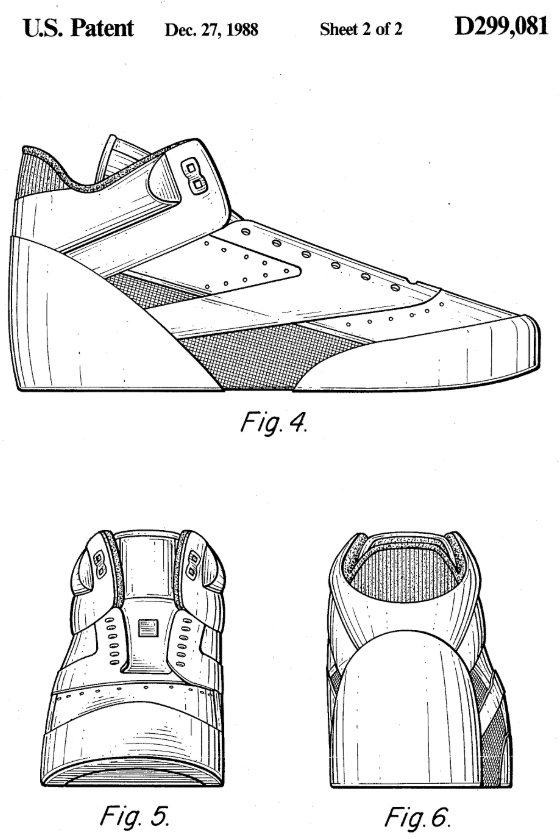
In other words, while design patents cannot protect functional designs or utilitarian aspects, they can protect how a functional object looks as long as the appearance is not determined by function. This makes design patent protection well-suited for consumer goods, packaging, electronics, furniture, tools, and other products where the decorative design differentiates the brand.
Unlike copyright protection, a design patent prohibits others from making, using, selling, offering for sale, or importing a product that embodies a substantially similar design, regardless of independent creation. Copyright infringement requires access to the original work and copying thereof. Design patents do not. A design patent can be infringed by someone who has never seen and is completely unaware of the design patent and any products it covers.
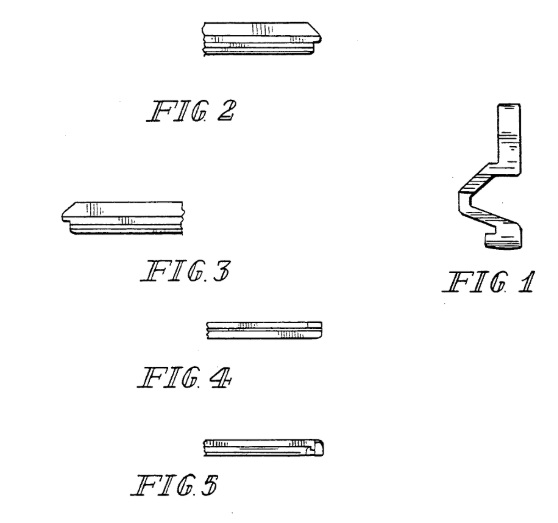
Design patents cannot protect purely functional or utilitarian aspects of a functional object. Under design law, the claimed appearance must be ornamental, not dictated solely by function. A clear illustration of a design dictated by function is provided in Best Lock Corp. v. Ilco Unican Corp., 94 F.3d 1563 (Fed. Cir. 1996). The case involved a design patent for a key blade, as shown below (United States Design Patent No. D327,636). The Federal Circuit invalidated a design patent, finding that the shape was entirely driven by the need to fit a corresponding lock, leaving no room for alternative ornamental designs. Because the configuration was essential to how the product worked, it was functional rather than decorative. If your competitive advantage lies in performance or mechanical interaction, protection must come from utility patent law, not a design patent.
Under copyright law, copyright protects original works of authorship and other creative works, such as art, illustrations, drawings, sculptural works, written content, software code, and architectural designs, once they are created and fixed in a tangible medium of expression. See 17 U.S.C. § 102(a). "Original” means the work was independently created and contains at least a minimal degree of creativity, and “fixed” means it is recorded in a sufficiently permanent form. Protection arises automatically at creation, without a copyright registration.
Copyright protects the expressive elements of a work, including its form, composition, and artistic choices. However, copyright does not protect ideas, concepts, systems, processes, or methods of operation. In other words, you cannot protect ideas themselves, only the particular expression of those ideas.
The following are the categories of copyrightable subject matter. Creative works generally fall into one of the following categories:
Literary works include books, articles, blog posts, manuals, marketing copy, and software code. The creative expression lies in the author’s choice of words, structure, and organization. Facts, ideas, and short phrases are not protected, but original text is.
Musical works consist of original compositions, including melody, harmony, and lyrics. Copyright protects the musical expression itself, not general chord progressions or musical styles. A recorded song may involve multiple copyrights for sheet music, composition, and sound recording.
Dramatic works include plays, screenplays, and scripts. Protection covers dialogue, plot structure, characters, and stage directions, so long as they are sufficiently developed and original.
These include original dance routines and choreographed movements that are fixed, such as in video or notation. Everyday movements or athletic routines generally lack the creativity required for protection.
This category includes paintings, drawings, illustrations, logos, photographs, and sculptural works. Copyright protects artistic choices such as composition, shape, line, and visual style. For useful articles, protection extends only to separable artistic elements.
Films, videos, commercials, and online content are protected as audiovisual works. The creative expression includes visual sequencing, editing, dialogue, and audiovisual composition.
Sound recordings protect the fixation of sounds, such as a recorded performance. The creative expression lies in the performance and production choices, not the underlying musical composition.
Architectural designs protect original building designs as embodied in plans or constructed buildings, focusing on the overall form and arrangement of spaces, not purely functional features.
Computer code is expressly protected as a literary work under 17 U.S.C. § 101. Copyright protects original source code and object code, including structure, sequence, and organization, to the extent they reflect creative expression. Functional concepts, algorithms, programming languages, and methods of operation are not protected, but the particular expressive implementation of code may justify copyright registration.
Copyright protection is limited to creative expression, not ideas, concepts, or functional principles. Under U.S. copyright law, a work must be an “original work of authorship” to qualify for protection under 17 U.S.C. § 102(a). This requirement has two core components: originality and expression.
Creative expression refers to the author’s particular way of expressing an idea. Copyright law expressly excludes ideas, procedures, systems, methods of operation, and concepts from protection under 17 U.S.C. § 102(b). This “idea–expression dichotomy” means copyright protects how something is expressed, not what is expressed. For example, a general product concept or design idea is not protected, but original artwork, drawings, graphics, or sculptural elements reflecting creative choices may be.
Originality is a low but meaningful threshold. A work must be independently created by the author and possess at least a minimal degree of creativity. It does not need to be novel, innovative, or unique in a patent-law sense. As the Supreme Court explained, originality requires only some creative spark, even if modest. A work copied entirely from another source, even if labor-intensive, fails this test. Conversely, two authors can create similar works, and each may be protected if each work was independently created.
The Supreme Court’s decision in Feist Publications, Inc. v. Rural Telephone Service Co., 499 U.S. 340 (1991) makes clear that copyright protects originality, not effort, investment, or mere factual compilation, and that similarity alone is not enough to establish infringement. In the case, the Rural Telephone Service published a standard white-pages telephone directory listing subscribers alphabetically with their phone numbers. Feist Publications copied many of those listings for use in its own directory. Rural sued for copyright infringement, arguing that its effort in collecting and organizing the data justified protection under the so-called “sweat of the brow” doctrine. The Supreme Court rejected that theory, holding that copyright protection extends only to original expression, not facts themselves.
For a useful article, copyrightable subject matter generally does not include the article’s physical shape or other functional designs, unless an artistic element can be conceptually separated from the item’s utilitarian function. See 17 U.S.C. § 101. The Supreme Court clarified this rule in Star Athletica, L.L.C. v. Varsity Brands, Inc. 580 U.S. 405 (2017). In that case, the Court held that decorative designs on cheerleading uniforms, such as stripes, chevrons, and color blocks, could qualify for copyright protection even though the uniforms themselves were functional objects. The key question was whether the artistic features could be perceived as a two-dimensional or three-dimensional work of art separate from the useful article and would qualify as copyrightable on their own.
Applying this standard, copyright will usually not protect, e.g., the overall form of a bottle, chair, or other functional object. However, it may protect separable artwork applied to that object, such as a graphic illustration, sculptural embellishment, or surface design. The bottom line is that copyright protects creative expression, not functional designs or the utilitarian aspects of products.
Copyrights arise automatically when an original work of authorship is created and fixed in a tangible medium of expression, such as a drawing, photograph, sculpture, or digital design file under 17 U.S.C. §§ 101–102(a). No filing, registration, or notice is required for a copyright owner to obtain basic copyright protection, and the work is automatically protected the moment it is fixed. A copyright holder exclusive rights to reproduce, distribute, display, perform, and create derivative works from the protected work under 17 U.S.C. § 106. However, while automatic protection exists, copyright registration with the U.S. Copyright Office is required before filing a copyright infringement lawsuit and is often critical for enforcing rights in court under 17 U.S.C. § 411(a).
Design patent rights do not arise automatically. Design patent protection requires filing a design patent application with the U.S. Patent and Trademark Office and completing a formal examination process under 35 U.S.C. §§ 111, 131, 171. The application must include a filing fee, precise drawings that define the ornamental design, and a detailed application that complies with USPTO rules. Only after the Patent Office allows and issues the patent does the owner receive enforceable design patent protection.
Although copyright arises automatically when an original work is created and fixed in a tangible medium of expression, registration with the U.S. Copyright Office carries important legal consequences (17 U.S.C. §§ 102(a), 408). Most critically, copyright registration is required before filing a copyright infringement lawsuit in federal court under 17 U.S.C. § 411(a). Timely registration, generally before infringement or within three months of first publication, also enables statutory damages and attorney’s fees, which are otherwise unavailable (17 U.S.C. § 412). A registration further creates a presumption of validity and ownership if made within five years of publication, strengthening enforcement and reducing litigation risk (17 U.S.C. § 410(c)).
In the United States, a design patent application must be filed within one year of the first offer for sale, public disclosure, or public use of the design, or patent protection is permanently barred under 35 U.S.C. § 102(a)(1). In the case of sales of the claimed design, confidentiality and lack of public disclosure is not controlling. In Helsinn Healthcare S.A. v. Teva Pharm. USA, Inc., 139 S. Ct. 628 (2019), the Supreme Court confirmed that even confidential or non-public sales activity can qualify as an invalidating “on sale” event under patent law. For design patents, this means early licensing deals, investor pitches, marketing decks, or website launches may quietly start the clock.
A copyright owner receives a defined bundle of exclusive rights under copyright law. These include the rights to reproduce the work, distribute copies, publicly display or perform the work, and prepare derivative works based on the original creation under 17 U.S.C. § 106. In practice, this means only the copyright owner can decide who may copy the work, sell or distribute it, post it online, or modify it into a new version.
However, copyright protects against copying, not against similarity alone. If a competing company independently creates a similar design without copying the original, that independent creation is a complete defense to copyright infringement. This limitation can be significant in a competitive market where multiple designers are responding to the same trends or functional constraints.
Design patents operate very differently. A design patent prohibits others from making, using, offering for sale, selling, or importing the patented design regardless of whether copying occurred under 35 U.S.C. § 154(a)(1). A violation of any of these rights results in design patent infringement under 35 U.S.C. § 271(a). Unlike design patents, copyright does not prevent others from making or selling a similar-looking product if they arrived at the design on their own.
Design patents last for a fixed term of 15 years from the date of issuance, providing a defined window of patent protection for the patented design under 35 U.S.C. § 173. This limited duration reflects the goal of design patent law: encouraging innovation in ornamental and aesthetic features without granting perpetual exclusivity. Importantly for businesses, design patents do not require maintenance fees to keep them in force. Maintenance fees apply to utility patents, not design patents, making long-term cost management more predictable.
By contrast, copyright protection is much longer, generally lasting for the life of the author plus 70 years, which can extend protection well beyond the commercial life of a product (17 U.S.C. § 302(a)). For works made for hire, corporate applicants, or works published under a pseudonym or anonymously, the term is 95 years from first publication or 120 years from creation, whichever expires first under 17 U.S.C. § 302(c). Copyright does not require maintenance fees or periodic renewals.
In considering design patent vs copyright protections, you should consider the particular kind of product, article, or content you are creating and determine whether it is proper subject matter for design patent or copyright. Design patents offer powerful, targeted protection for the visual appearance of a product, while copyright can extend protection to artistic elements that exist independently of function. For example, a fancy original lamp design may be effectively sculpture with a lighting element added to provide function. Such a design can be protected by both design patent and copyright registration, providing overlapping and broader protection.
Speaking with a patent attorney or intellectual property attorney can help ensure that protection is secured for your intellectual property. An experienced attorney can provide both legal guidance and practical business advice that can guide your decisions on whether to pursue design patent and/or copyright protection. If you have a patent, copyright, or other intellectual property matter, contact our office for a free consultation with an experienced patent attorney.
© 2026 Sierra IP Law, PC. The information provided herein does not constitute legal advice, but merely conveys general information that may be beneficial to the public, and should not be viewed as a substitute for legal consultation in a particular case.

"Mark and William are stellar in the capabilities, work ethic, character, knowledge, responsiveness, and quality of work. Hubby and I are incredibly grateful for them as they've done a phenomenal job working tirelessly over a time span of at least five years on a series of patents for hubby. Grateful that Fresno has such amazing patent attorneys! They're second to none and they never disappoint. Thank you, Mark, William, and your entire team!!"
Linda Guzman


Sierra IP Law, PC - Patents, Trademarks & Copyrights
FRESNO
7030 N. Fruit Ave.
Suite 110
Fresno, CA 93711
(559) 436-3800 | phone
BAKERSFIELD
1925 G. Street
Bakersfield, CA 93301
(661) 200-7724 | phone
SAN LUIS OBISPO
956 Walnut Street, 2nd Floor
San Luis Obispo, CA 93401
(805) 275-0943 | phone

SACRAMENTO
180 Promenade Circle, Suite 300
Sacramento, CA 95834
(916) 209-8525 | phone
MODESTO
1300 10th St., Suite F.
Modesto, CA 95345
(209) 286-0069 | phone
SANTA BARBARA
414 Olive Street
Santa Barbara, CA 93101
(805) 275-0943 | phone
SAN MATEO
1650 Borel Place, Suite 216
San Mateo, CA, CA 94402
(650) 398-1644. | phone
STOCKTON
110 N. San Joaquin St., 2nd Floor
Stockton, CA 95202
(209) 286-0069 | phone
PORTLAND
425 NW 10th Ave., Suite 200
Portland, OR 97209
(503) 343-9983 | phone
TACOMA
1201 Pacific Avenue, Suite 600
Tacoma, WA 98402
(253) 345-1545 | phone
KENNEWICK
1030 N Center Pkwy Suite N196
Kennewick, WA 99336
(509) 255-3442 | phone
2023 Sierra IP Law, PC - Patents, Trademarks & Copyrights - All Rights Reserved - Sitemap Privacy Lawyer Fresno, CA - Trademark Lawyer Modesto CA - Patent Lawyer Bakersfield, CA - Trademark Lawyer Bakersfield, CA - Patent Lawyer San Luis Obispo, CA - Trademark Lawyer San Luis Obispo, CA - Trademark Infringement Lawyer Tacoma WA - Internet Lawyer Bakersfield, CA - Trademark Lawyer Sacramento, CA - Patent Lawyer Sacramento, CA - Trademark Infringement Lawyer Sacrament CA - Patent Lawyer Tacoma WA - Intellectual Property Lawyer Tacoma WA - Trademark lawyer Tacoma WA - Portland Patent Attorney - Santa Barbara Patent Attorney - Santa Barbara Trademark Attorney
