
Design patents protect the ornamental design or visual characteristics of a tangible product, referred to as an “article of manufacture”. Essentially, design patents protect how the product looks. This is in contrast to utility patents, which protect new and useful inventions: how a product works or is used. In other words, a utility patent protects functional aspects.
This distinction between design and utility patents is a fundamental and important distinction. If you are filing a design patent, you need to understand that you are protecting the visual appearance and ornamental aspects (e.g., the shape of the design, the surface ornamentation applied, etc.), not the functional features of the design. Utilitarian aspects are generally not protected by a design patent. This article explains the concept of design patent functionality: a purely functional element in a design cannot be protected by a design patent.
Under U.S. patent law, a utility patent covers the functional components of an invention (e.g. processes, machines, or useful improvements), while a design patent covers only the invention's ornamental appearance. For example, a utility patent could protect an innovative locking mechanism in a jewelry cabinet, whereas a design patent could protect the cabinet's new decorative shape or surface ornamentation. Both types of patents require the invention to be novel and non-obvious over the prior art (previous designs and technologies). However, utility patents provide intellectual property protection for the function of a design or innovation, while design patents protect how something looks.
The legal framework reflects this:
35 U.S.C. § 101 (the utility patent statute) requires a “new and useful” invention,
35 U.S.C. § 171 (the design patent statute) grants protection to a “new, original and ornamental design for an article of manufacture”. Thus, a design patent provides patent protection for the product's ornamental design, but not its functional purpose or use.
From a practical standpoint, there are additional differences in patent law between these two patent types. U.S. utility patents have a term of 20 years from the filing date and require periodic maintenance fees. Design patent protection lasts 15 years from issuance and no maintenance fees are needed. Both are examined by the United States Patent and Trademark Office (USPTO) in a formal examination process, but a design patent application consists mostly of drawings showing the ornamental design, while a utility patent application contains detailed descriptions and claims defining functional elements.
In short, the U.S. patent system provides separate routes to protect different aspects of an invention: functional utility patent applications for new functions or mechanisms, and design patent applications for new visual design elements.
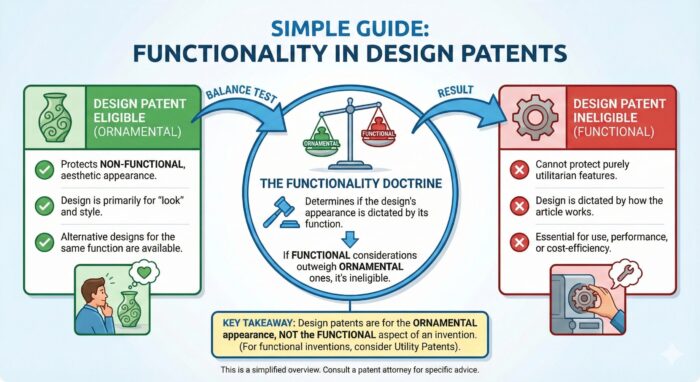
To be patentable under United States patent law, a design must be primarily ornamental and not dictated by functional considerations to qualify for legal protection. The design is viewed in its entirety, and the question is whether the claimed design as a whole is driven by aesthetic choice or by the product's utilitarian purpose. In other words, even if a product serves a useful function (as most do), the specific design elements (shape, configuration, surface decoration) must be chosen for ornamental appearance, not because they are the only way the product could function.
An “ornamental” feature is one created for the purpose of decoration, not merely a by-product of engineering or efficiency. Design patents can protect the ornamental appearance of a wide range of articles, far beyond traditional physical products. In addition to tangible items like furniture, tools, and consumer goods, design patent protection extends to digital and electronic displays, including elements of a graphical user interface shown on a computer screen. For example, computer icons, layout arrangements, and visual transitions displayed on electronic devices may be eligible for design patent protection when they are purely ornamental and not dictated by function. As long as the claimed design is applied to an article of manufacture and conveys a distinctive visual impression, U.S. design patents can safeguard both physical and digital design innovations.
Design patent law allows for protection of the aesthetic features of a design applied to a useful article, but not the article's function. For example, a coffee mug can have the same utilitarian function in countless shapes. A particular novel shape or pattern on the mug is protectable by a design patent, but a spout or handle shape that is engineered solely for pouring or gripping might be considered functional. The legal framework ensures that patent protection of functional features (which are in the domain of utility patents) and ornamental features (which are the domain of design patents) are kept separate.
A fundamental principle of design patent law is that a primarily functional design is not patentable as a design patent. Courts have emphasized that if a design is “dictated solely by the function” of the article, it cannot be the subject of a design patent. In the words of the U.S. Supreme Court, to qualify for design patent protection, an article's design must present an aesthetically pleasing appearance not dictated by function alone. Sport Dimension, Inc. v. The Coleman Co., 820 F.3d 1316 (Fed. Cir. 2016). The Federal Circuit likewise stated: “if a particular design is essential to the use of the article, it can not be the subject of a design patent”. L.A. Gear, Inc. v. Thom McAn Shoe Company, 988 F.2d 1117 (Fed. Cir. 1993). In short, design patents do not cover any functional aspects of an invention.
Importantly, this does not mean a product with a function cannot get a design patent, it means the applied-for design itself must be ornamental. The inquiry is whether the visual characteristics of the design were chosen for appearance or if they are dictated solely by functional necessity. If significant aspects of the design were chosen for brand identity or style (i.e. to make the product look attractive or distinctive), rather than to make the product work, those are considered ornamental characteristics eligible for design patent protection. But if the design elements are the only feasible way for the product to perform its function, the design is considered primarily functional and unprotectable as a design patent. In sum, a design patent can include articles that serve a utilitarian purpose, but the claimed design must be about aesthetic features, not the utility.
The ornamental aspects can be protected even if the article as a whole is useful and only a portion thereof is ornamental. For instance, a smartphone has many functional components, but a unique icon arrangement or case shape could be ornamental. The same invention or product can be protected by both utility and design patents. Patent practitioners often employ filing strategies for new designs that include both utility patent applications and design patent applications.
How do we determine if a design is too functional to patent? U.S. courts apply the “dictated by function” test. They ask whether the ornamental appearance was independent of the product's function or whether the design was dictated solely by functional needs. One useful indicator is the availability of alternative designs that can perform the same function. If other alternative designs could achieve the utilitarian aspects of the product, then the chosen design is not the only way the product could look and still work, which suggests the design was a creative choice rather than a functional mandate. A design is not dictated solely by its function when alternative designs for the article of manufacture are available. In practice, this means that even if a design has some functional considerations, it can be patented as long as the overall appearance was chosen from among different possibilities for how the product could look.
On the other hand, if no other design could perform the product's function, then the existing design is effectively functional and ineligible. A classic example comes from a case involving a key blank: the shape of the key was designed to fit a lock, leaving no room for aesthetic variation. Best Lock Corporation v. Ilco Unican Corporation, 94 F.3d 1563 (Fed. Cir. 1996).The court found that the key's shape was dictated by its functional purpose (to engage the lock keyway and to open the lock) and thus the design patent was invalid . In that case, every aspect of the shape served a functional feature, and there were no ornamentations or alternative shapes possible without losing utility. Thus, it failed the test; the design was purely functional, not ornamental.
Generally, if designers of ordinary skill in the field would all have to make the product look a certain way for it to work, that design is considered functional. But if those skilled in the art could devise many different looks while still achieving the function, then a particular look chosen is likely considered ornamental rather than functional. Courts and the USPTO often examine whether functional elements could be arranged or shaped differently. For example, could a handle or button have a different design and still work? If yes, the existing design isn't “inevitable” for function and thus may be entitled to a design patent. In essence, the existence of alternative designs that perform the same function is evidence that the claimed design was a matter of aesthetic choice, not engineering necessity.
In many products, certain elements serve a function while the overall product also has a distinctive appearance. When preparing a design patent application, it is possible to disclaim functional elements so that the patent focuses only on the ornamental aspects. The USPTO's rules and practice allow applicants to use broken lines in the patent drawings to indicate portions of the article that form no part of the claimed design (i.e. unclaimed functional features). Only the features drawn in solid lines are claimed as the patented design.
For example, if you are patenting the ornamental design of a chair but the specific shape of the chair's hidden mounting bracket is purely functional, you might show that bracket in broken lines in the drawings. The broken-line elements are not considered as part of the protected design, signaling to the patent examiner that those parts are just the environment or functional parts of the article. This practice helps ensure the design patent application process targets the ornamental design only, avoiding rejection for including functional elements.
During examination, USPTO examiners will scrutinize the drawings and description to ensure the design is indeed ornamental. They may reject a claim under 35 U.S.C. § 171 for “lack of ornamentality” if the design appears to be “primarily functional” based on the evidence. To overcome such a rejection, applicants can submit evidence showing the design was created for aesthetic reasons.
Evidence may include inventor affidavits or even advertising materials and product literature that highlight the item's style, novelty, or aesthetic features rather than its utility. For instance, if your product brochure or advertising emphasizes the sleek ornamental appearance or unique style of the design, that can support the argument that the design is not dictated solely by function.
Likewise, pointing out alternative designs can rebut an examiner's claim that the design is purely functional. In sum, careful drafting of design patent drawings using solid and broken lines appropriately and providing evidence of the design's aesthetic appeal can help secure a design patent even when the product has both ornamental and functional aspects.
For many products, both appearance and utility are important, and each can be protected in different ways. It is common to pursue dual protection by obtaining both a utility and design patent for the same product, as long as the applications cover different aspects. In fact, the USPTO allows you to file separate applications to cover both the utilitarian and ornamental aspects of an invention. For example, a company might secure a utility patent on a novel engine technology and also a design patent on the distinctive outer casing of the engine. Or consider a tech gadget: the utility patent protection might cover its electronic circuitry or software (the utilitarian aspects), while a design patent protects the unique exterior shape or GUI icon layout (the aesthetic aspects). These forms of protection can coexist without “double patenting” issues because they protect different aspects of the claimed invention.
The legal coverage provided by each is complementary: the utility patent stops others from using the same functional concept, and the design patent stops others from selling a product with the same ornamental look. This dual approach in the patent system is often the best strategy to comprehensively protect an innovative product that has both new function and new style. Keep in mind, each requires its own application and will be examined separately, and each will confer its own patent rights if granted.
Beyond patents, another layer of protection for product designs is trade dress, which is a form of trademark protection. Over time, an ornamental product design that is not functional can serve as a brand identity. Think of the shape of a Coca-Cola bottle or the grill of a Jeep. Trade dress can provide potentially indefinite protection for those ornamental design elements as identifiers of source, but it requires distinctiveness and that the design remain non-functional under trademark law.
Design patents have a term (15 years) but do not require proof of consumer association. Many companies use design patents to secure exclusive rights to an innovative design immediately, and later, if the design becomes iconic, they may rely on trade dress for long-term protection of the design elements as part of their brand. Both design patents and trade dress share a common requirement: the design cannot be functional if it's to be protected. Businesses can take advantage of these different forms of intellectual property rights to provide multiple safeguards for their product and market identity.
Filing a design patent application in the U.S. involves meeting certain formal requirements. The application includes a set of drawings (or photographs) illustrating the ornamental design from various views, a brief description of the drawings, and a single claim defining the design as shown. The application process also requires the inventor/designer (the person(s) who had the artistic conception for the design) to sign an inventor declaration attesting to the creation of the submitted design, and the submission some other forms, including an application data sheet identifying the inventors and information related to the application.
It is important that the drawings are done to professional standards, since they essentially are the claim. It is important to engage a skilled patent practitioner to assist in preparing the drawings. The design claimed is what is shown in solid lines in the images. Any omission or unclear detail could limit your protection or lead to an indefiniteness rejection.
The USPTO examination of a design application is generally focused on two areas: (1) novelty/non-obviousness: the design must be new and sufficiently distinct over prior art designs; and (2) ornamentality: the design must meet the subject matter requirements of §171 (i.e. be an ornamental design for an article of manufacture, not primarily dictated by function).
The examination process for design patents is usually quicker and more streamlined than for complex utility patents, often taking 1–2 years to grant. Patent examiner first reviews the application for formal requirements. If the examiner finds that there are multiple embodiments that are patentably distinct, the examiner will issue a restriction requirement that requires the applicant to elect only one of the designs embodied in the drawings of the application. After dealing the formality issues have been addressed, the examiner identifies the unique features that the articles includes, conducts a search of the prior art, and analyzes the design to determine whether it is novel and non obvious over the prior art. An office action may be issued that includes rejections based on formal matters and/or prior art bases. If the application is able to overcome the rejections.
If the rejections are overcome, the examiner will issue a notice of allowance indicating that the design is worthy of a design patent. The patent can subsequently be acquired by submitting a filing issue form and paying the required issue fee.
Once granted, a U.S. design patent has a 15-year term from issuance with no renewals or maintenance fees required. This is different from utility patents, which last 20 years from filing. You are also required to pay maintenance fees to keep the patent enforceable. This means design patents are relatively low-maintenance and generally easier to acquire.
The filing date is important for priority, especially if you plan to file in foreign countries for international industrial design protection (e.g., through the Hague Agreement process), since many countries require filing before public disclosure. The Hague Agreement provides a centralized system for pursuing design and industrial design protection in foreign countries.
U.S. design patents are enforceable in federal court just like utility patents. Design patent infringement is assessed by comparing the accused product design to the patented design through the eyes of an “ordinary observer", essentially asking if the two designs are substantially the same in overall impression. Notably, because design patents only protect the ornamental appearance, an accused product that has the same utilitarian features but a different look will not infringe. This was illustrated in a case where a patented tool design was a combination of certain functional components. Richardson v. Stanley Works, Inc., 597 F.3d 1288 (Fed. Cir. 2010).
In Richardson, the claimed design was for a multi-function carpentry tool made up of familiar functional components (hammer, jaw, crowbar/pry bar, etc.). The Federal Circuit held there was no design patent infringement because, even though the accused product used essentially the same functional components, they were arranged and shaped differently so that the overall visual impression was different in the eyes of the ordinary observer. The court also emphasized filtering out the strongly functional aspects when evaluating the design as a whole.
A design patent doesn't stop competitors from making products with the same function, it does prevent them from making something that looks “substantially the same” as your patented product. This is why protecting the ornamental design can play a crucial role in markets where visual appeal and distinctiveness drive consumer choice: for example, consumer electronics, fashion, furniture, and other style-centric goods. To maximize protection, consider protecting different aspects of your product through multiple IP routes. You should file the design application promptly to secure the earliest possible filing date, and coordinate any utility patent applications accordingly if you need to protect functional innovations as well.
Conclusion
U.S. design patents are a powerful tool for protecting designs, providing exclusive rights to the ornamental appearance of a product. They can be invaluable in preventing knockoffs that copy the look of your product. However, it's critical to remember that design patents cannot protect functional features or utilitarian aspects of an invention.
If your innovation lies in how a product works, you'll need a utility patent. If it lies in how the product looks, a design patent is the appropriate protection. Often, both types of protection are used in tandem to cover different aspects of a new product. This balanced strategy will fortify your product's intellectual property rights on all fronts, helping to preserve both its innovation and its unique design in the marketplace.
If you are seeking to obtain patent protection for your product or have other intellectual property matters to address, contact our office for a free consultation with a patent attorney.
© 2025 Sierra IP Law, PC. The information provided herein does not constitute legal advice, but merely conveys general information that may be beneficial to the public, and should not be viewed as a substitute for legal consultation in a particular case.

"Mark and William are stellar in the capabilities, work ethic, character, knowledge, responsiveness, and quality of work. Hubby and I are incredibly grateful for them as they've done a phenomenal job working tirelessly over a time span of at least five years on a series of patents for hubby. Grateful that Fresno has such amazing patent attorneys! They're second to none and they never disappoint. Thank you, Mark, William, and your entire team!!"
Linda Guzman


Sierra IP Law, PC - Patents, Trademarks & Copyrights
FRESNO
7030 N. Fruit Ave.
Suite 110
Fresno, CA 93711
(559) 436-3800 | phone
BAKERSFIELD
1925 G. Street
Bakersfield, CA 93301
(661) 200-7724 | phone
SAN LUIS OBISPO
956 Walnut Street, 2nd Floor
San Luis Obispo, CA 93401
(805) 275-0943 | phone

SACRAMENTO
180 Promenade Circle, Suite 300
Sacramento, CA 95834
(916) 209-8525 | phone
MODESTO
1300 10th St., Suite F.
Modesto, CA 95345
(209) 286-0069 | phone
SANTA BARBARA
414 Olive Street
Santa Barbara, CA 93101
(805) 275-0943 | phone
SAN MATEO
1650 Borel Place, Suite 216
San Mateo, CA, CA 94402
(650) 398-1644. | phone
STOCKTON
110 N. San Joaquin St., 2nd Floor
Stockton, CA 95202
(209) 286-0069 | phone
PORTLAND
425 NW 10th Ave., Suite 200
Portland, OR 97209
(503) 343-9983 | phone
TACOMA
1201 Pacific Avenue, Suite 600
Tacoma, WA 98402
(253) 345-1545 | phone
KENNEWICK
1030 N Center Pkwy Suite N196
Kennewick, WA 99336
(509) 255-3442 | phone
2023 Sierra IP Law, PC - Patents, Trademarks & Copyrights - All Rights Reserved - Sitemap Privacy Lawyer Fresno, CA - Trademark Lawyer Modesto CA - Patent Lawyer Bakersfield, CA - Trademark Lawyer Bakersfield, CA - Patent Lawyer San Luis Obispo, CA - Trademark Lawyer San Luis Obispo, CA - Trademark Infringement Lawyer Tacoma WA - Internet Lawyer Bakersfield, CA - Trademark Lawyer Sacramento, CA - Patent Lawyer Sacramento, CA - Trademark Infringement Lawyer Sacrament CA - Patent Lawyer Tacoma WA - Intellectual Property Lawyer Tacoma WA - Trademark lawyer Tacoma WA - Portland Patent Attorney - Santa Barbara Patent Attorney - Santa Barbara Trademark Attorney
