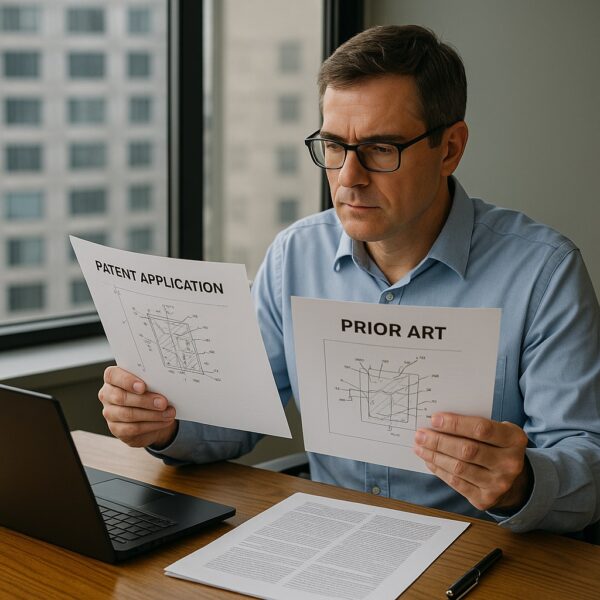
Securing a patent can provide crucial patent protection for a startup’s innovation, but the patent examination process may seem daunting to non-attorneys. In the United States, patent applications are reviewed by the U.S. Patent and Trademark Office (USPTO) through a structured patent examination process that can span many months or even years. Understanding the key steps, from filing a patent application to the examiner’s decision, will help you make informed choices. The following discussion addresses the patent application process for US utility patents.
The patent process can be understood by dividing it into distinct stages: filing, initial review, substantive examination (i.e., Office Actions and responses), and final disposition (grant or rejection). Each patent application is assigned to a technically trained patent examiner who evaluates whether the invention meets legal criteria for a patent grant.
The Patent Office’s review is thorough and substantive. Patent examiners search for prior art (existing patents, published patent applications, and other public disclosures), compare the claimed invention to the prior art to determine whether the claimed invention is novel and non-obvious, and ensure the application satisfies all formal legal requirements. This examination process is interactive: most patent applications receive at least one Office Action (written examination report) that outlines the examiner’s objections or rejections to which the applicant can respond through amendments and argument. Navigating these stages effectively can significantly impact the outcome of your patent and the scope of your patent rights.
The patent process begins by filing a non-provisional patent application with the USPTO. Upon filing, you receive a filing receipt confirming your application number and filing date, which marks the official start of your application’s life. The filing date is critical; under U.S. patent law, it establishes the cutoff for what counts as prior art against your claimed invention. The US became a first-to-file system in 2013 with the America Invents Act, which means that you cannot establish patent rights until you file an application. US patent law does not care when you invented something; it only recognizes your rights once you file a patent application.
Your application should include a detailed description (specification), any necessary drawings, and one or more patent claims defining the scope of the invention. By law, the specification must describe the invention in full, clear detail and submit claims that distinctly point out the invention. For example, 35 U.S.C. § 112 requires a written description sufficient to enable a skilled person to make and use the invention. It is wise to provide clear documentation. A well-prepared application that complies with all formal rules will avoid delays. If something is missing or incorrect (e.g., missing fees, absent inventor oath, omitted pages, etc.), the USPTO will send a notice of deficiencies, and you’ll need to correct it promptly to maintain your filing date.
Once filed, your application enters an initial review phase. The Office of Patent Application Processing checks that your application complies with basic requirements (so it can be given a filing date). This stage includes classifying the application and scheduling it for substantive examination. After this, the application is forwarded to an examination unit and assigned to a patent examiner. The USPTO sorts applications by technology area into specialized Technology Centers, ensuring your examiner has expertise in the field of your invention. While this initial review is mostly administrative, it sets the stage for the critical examination to follow.
The assigned examiner will read and analyze the claims and detailed description of your application to understand the claimed invention. Examiners must determine exactly what the inventor is seeking to patent. They will verify that formal requirements are met, including that the claims are in the proper format, the claims are supported in the specification, and that the claimed elements are represented in the drawings.
During substantive examination, the patent examiner evaluates your invention against the core patentability criteria set by U.S. law. The main conditions for a granted patent are established in the Patent Act: patentable subject matter (35 U.S.C. § 101), novelty (35 U.S.C. § 102), non-obviousness (35 U.S.C. § 103), and adequate disclosure (35 U.S.C. § 112). In plain terms, the examiner asks: Is the invention eligible, new, non-obvious, and properly described?
The invention must be a process, machine, manufacture, or composition of matter (or an improvement thereof). Essentially, a patentable invention must be a useful, man-made invention. Laws of nature, natural phenomena, and abstract ideas are excluded from patent protection. For example, the Supreme Court in Alice Corp. v. CLS Bank confirmed that implementing an abstract idea (like a fundamental economic practice) on a generic computer is not patent-eligible without an “inventive concept” to transform it into patentable subject matter. 573 U.S. 208 (2014). Most traditional products and processes do qualify as patentable subject matter, but purely abstract or scientific concepts cannot be patented by themselves without some novel, non-obvious practical application.
An invention must be new. The law says a person is entitled to a patent unless the claimed invention was already patented, described in a printed publication, in public use, on sale, or otherwise available to the public before the effective filing date of the application. In practice, the examiner performs a prior art search to see if any existing patents, published patent applications, or other public disclosures describe the same invention. If an earlier publication or product is found that contains all of your claimed features, the examiner will reject your claim for lack of novelty, often called an “anticipation” rejection under §102. Keep in mind that even your own public disclosures can count as prior art against you unless you filed the application promptly. U.S. patent law provides a limited one-year grace period for an inventor’s own disclosures, but it is risky to rely on it. It’s best to file before any public reveal of your invention.
Even if novel, the invention cannot be an obvious or trivial variation of what came before. The statute states that a patent may not be obtained if the differences between the claimed invention and the prior art would have been obvious to a person having ordinary skill in the art before the filing date of the patent application. This means the examiner will consider whether someone of ordinary expertise in the field, knowing the existing technologies, would find your invention an evident or predictable next step.
Often, examiners combine multiple prior references to show that all elements of your claim were known and yield nothing more than a predictable result. Obviousness rejections (§103 rejections) are common in the prosecution process. The Supreme Court’s decision in Graham v. John Deere Co. established factors for determining obviousness, including examining the “scope and content of the prior art,” the differences between the prior art and the claims, and the level of ordinary skill in the field. 383 U.S. 1 (1966). If you receive an obviousness rejection, it means the examiner believes your invention lacks an “inventive step” in view of known ideas. Overcoming it may require distinguishing your invention’s advantages or providing evidence that the improvement is not obvious, such as data demonstrating unexpected results.
The application must contain a written description of the invention sufficient to demonstrate you actually possessed the claimed invention (the written description requirement), and it must enable others to make and use it without undue experimentation (the enablement requirement). The specification should clearly describe how the invention works and include the best mode (preferred way) of practicing it. Additionally, the claims must particularly point out and distinctly claim the invention. If the examiner finds the description lacking or the claims unclear (indefinite), they may issue an objection or rejection under §112. For example, an overly broad claim that is not supported by the description, or a vague term, can draw an examiner objection. Clear documentation and description in the application before filing helps avoid these issues.
A cornerstone of patent examination is the prior art search. The patent examiner will conduct an in-depth search of existing patents, published patent applications, foreign patent documents, and other literature, such as scientific articles or industry publications, to find anything that is relevant to your invention. The goal is to determine if your claimed invention is indeed new and non-obvious in view of what is already known. This includes searching for similar features or solutions in the same field of technology, as well as analogous fields. If relevant prior art is found, the examiner compares it to your claims.
You might wonder what counts as prior art. The scope of the prior art is quite broad: any printed publications, patents, or public evidence of the invention before your filing date can be cited. For instance, if a competitor had a product on sale or a demonstration of a similar invention, it could be used as prior art. Patents and published applications are a major source. The USPTO examiners have access to databases of issued patents from all patent offices throughout the world and of published U.S. applications: generally, U.S. applications publish 18 months after filing. They also search non-patent literature (journals, websites, etc.) for existing technologies in the relevant field of technologies.
After the patentability search, the examiner evaluates the findings against the legal criteria discussed above. If no lethal prior art or issues are found, the examiner can allow the claims. However, it is more common that the examiner finds at least some issues that are communicated to you through an Office Action, as discussed next.
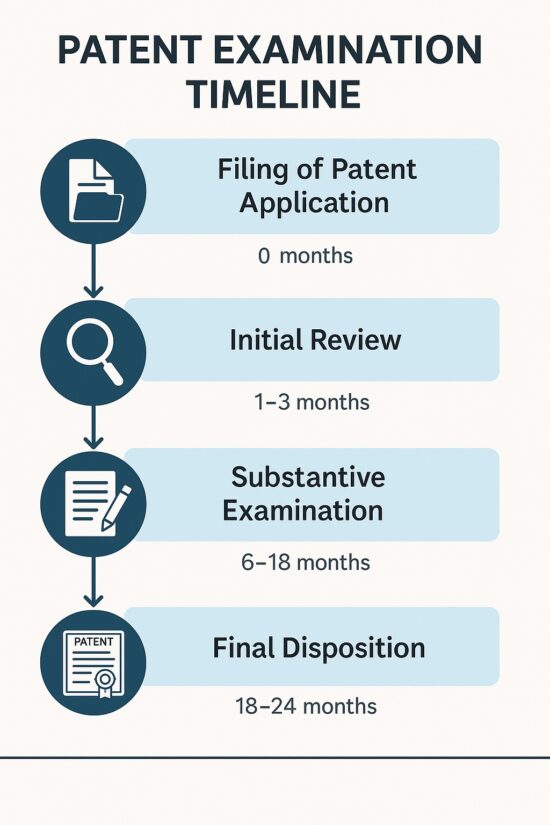
An Office Action is an official letter from the USPTO patent examiner to the applicant, and it is a normal part of the patent examination process. In fact, most patent applications receive a first Office Action roughly 1–2 years after filing. The Office Action will detail any rejections, objections, or examiner’s concerns about your application.
There are two common types of Office Actions: non-final and final. A non-final Office Action is the first addressing the substantive issues in the application. It will cite any prior art the examiner found and explain why one or more claims are rejected (e.g., “Claim 1 is rejected under 35 U.S.C. 102 as anticipated by Smith et al., U.S. Patent No. X,XXX,XXX,” or “Claim 2 is rejected under 35 U.S.C. 103 as unpatentable over Smith in view of Jones”). It may also include examiner’s objections on formal matters, requiring drawing corrections or claim wording issues. A non-final action gives you, the applicant, an opportunity to address the issues and file claim amendments.
If you respond but the examiner still finds problems, the next action might be a final Office Action. A final action means the examiner believes the major issues remain unresolved after your last response. Importantly, “final” doesn’t necessarily mean the end of the road, but it does signal that the examination is at an advanced stage. The examination report in a final action will articulate the outstanding rejections and usually will not introduce new grounds unless they were necessitated by claim amendments made in response to the non-final Office Action.
Getting an Office Action can be disheartening, but it is a routine part of the prosecution. Office Actions actually indicate that the USPTO is actively examining your case. As the USPTO explains, you will be notified in writing of the examiner’s decision by an office action that lays out the reasons for any rejections or objections. MPEP § 707.07(f). Think of it as a detailed feedback letter from the examiner. It’s your job to respond effectively, often with the help of a patent attorney or agent.
You typically have a 3-month deadline (extendable up to an additional 3 months with fees) to reply to each Office Action. In your response, you must address every point the examiner raised. This usually involves two strategies: amending the claims and/or making persuasive legal and technical arguments.
For example, if the examiner cited prior art against your claims, you might amend the claims to further distinguish your invention from that prior art. You will then explain in your reply how the amended claims avoid the cited references, or why the examiner’s reading of the prior art is incorrect. In other words, you point out errors in the rejection or highlight aspects of your invention that the examiner overlooked. Simply saying “the examiner is wrong” is not sufficient, you need to provide reasons or evidence. Sometimes, applicants submit expert declarations or experimental data as evidence that their invention has unexpected advantages, to help overcome rejections, especially for obviousness rejections under §103. You can also argue legal points by citing patent law precedents or showing the examiner misapplied a rule.
It’s important to respond in a thorough and timely manner. Failing to reply to an Office Action by the deadline will lead to abandonment of your application. Extensions of time are available for a fee, if you need more time, but dragging out responses will increase costs and delay a granted patent. The USPTO emphasizes that a reply should be a bona fide attempt to advance the case to conclusion. In practice, that means you should make real effort to resolve the examiner’s concerns, not just argue for argument’s sake. Often, a productive approach is to request an examiner interview (a phone or video call with the examiner) to discuss the rejections and potential claim amendments. Examiners are encouraged to engage with applicants to resolve issues collaboratively. Such discussions can clarify misunderstandings and speed up agreement on allowable subject matter.
If you provide a response to the examiner’s first Office Action, the examiner will re-examine your application in light of your response. If issues persist, you may get a second Office Action, which will likely be marked final. A final rejection limits your ability to amend as a matter of right, but you still have options to continue the process through (1) the submission of arguments, (2) by amendment if you file a request for continued examination (RCE) and the associated fee, or (3) through an appeal to the Patent Trial and Appeal Board (PTAB).
At the end of the examination, the USPTO will issue a final decision on your application’s fate. There are a few possible outcomes:
The ideal outcome is that the examiner finds all claims allowable or you amend them to allowable form. In this case, the USPTO will send you a Notice of Allowance. You then pay the issue fee, and the patent is granted and published as an issued patent. A granted U.S. patent gives the patent owner the right to exclude others from making, using, or selling the claimed invention, for a period of 20 years from the effective filing date.
If the examiner is not convinced by your amendments and arguments that the claims are patentable, they will issue a final rejection. This is not necessarily “game over”. You, as the applicant, have several paths to continue pursuing protection. One common approach is filing a Request for Continued Examination (RCE), which entails paying a fee to essentially reopen the prosecution and give the examiner another round of review on revised claims. An RCE puts your application back in the queue for further examination of new arguments and/or claim amendments.
Another option is to file a continuation application, which is a new application that carries the same filing date as the original. This approach is useful if you want to try a different claim strategy while keeping the earlier priority date.
Alternatively, if you believe the examiner is mistaken on the law or facts, you can appeal the rejection to the USPTO’s Patent Trial and Appeal Board (PTAB). On appeal, patent attorneys argue the case to administrative judges. These routes involve additional time and expense, so the decision often hinges on the importance of the invention and business considerations.
Some applications are abandoned by the applicant. This can happen intentionally. For example, if a final rejection issues and the applicant decides not to invest more in the process, or if business priorities change, it may not be worth the time and expense to continue pursuing the application. Abandonment also occurs if you simply fail to respond to an Office Action or pay a required fee in time. An abandoned application is no longer pending and generally cannot mature into a patent. Abandonment ends the application process.
An issued patent can also be abandoned. A patentee must pay periodic maintenance fees (renewal fees) at 3.5, 7.5, and 11.5 years after issuance to keep the patent valid. Failure to pay these fees in a timely manner results in abandonment.
It is worth noting that even after a patent is granted, the examination process can be flawed and issued patents can be challenged as being invalid on multiple bases. Patents are granted with a presumption of validity, but they can later be invalidated if the challenger provides sufficient argument and evidence. For instance, a competitor can request a re-examination of an issued patent by presenting new prior art that the USPTO had not considered to demonstrate invalidity.
In an ex parte re-examination proceeding, the patent goes back into the USPTO for another round of examination focused on the new evidence. Similarly, post-grant review or inter partes review are procedures that allow challengers to contest a patent’s validity. These mechanisms mean that patent owners should ensure their patents are on solid footing. A thoroughly vetted patent through the initial examination will be more likely to survive any such challenges.
In some circumstances, time can be of the essence. A patent can take quite awhile to be examined and granted. For example, waiting 2–3 years for an issued patent might be too slow in fast-moving industries. Fortunately, the USPTO offers ways to speed up the patent examination process. One option is the prioritized examination program, or Track One. By paying an additional fee and meeting certain requirements, an applicant can get “special status” for the application. The USPTO aims to provide a final decision in prioritized cases within 12 months. This expedited examination can be valuable if you need patent protection quickly to attract investors or assert your rights.
There are also other paths to special status. Some programs have offered acceleration for certain technologies or applicant categories. For example, the USPTO has run pilot programs for inventions related to climate change, COVID-19, and for first-time filers. These programs, when available, allow patent applications to benefit from accelerated examined without the hefty fees of Track One.
Additionally, under the Patent Prosecution Highway (PPH), if you have a corresponding foreign patent application that has been allowed, you can petition to fast-track the U.S. application by leveraging the foreign positive results. Even without formal programs, an application can be advanced out of turn for certain reasons, such as the inventor’s age or health (by petition to make special). Gaining special status means the USPTO will examine the application sooner, which can cut down pendency significantly.
While faster examination is appealing, it’s important to be ready for the initial review and Office Actions that will come sooner. Make sure your application is in clear compliance with all rules and is thoroughly prepared. Rushing to file without a solid detailed description and well-crafted claims can backfire if the expedited timeline leads to early rejections that could have been avoided. But when used appropriately, these procedures enable applicants to obtain patents much more quickly than the normal patent system would.
Patents are a key form of intellectual property that can protect your technology and give you a competitive edge, but they are only granted after careful scrutiny of the invention’s novelty, inventive step, and documentation. The patent examination process is a highly formalized, legal process that can leave the unfamiliar confused and disadvantaged. It is highly recommended that you seek the assistance of an experienced patent attorney during patent examination. Working with a patent attorney will allow you to make informed decisions during the examination and greatly increase the chances of securing a strong patent. With the right guidance, entrepreneurs can navigate the examination process and emerge with valuable patent rights that safeguard their hard-earned innovations.
If you need assistance with a patent application or other intellectual property matter, contact our office for a free consultation.
© 2025 Sierra IP Law, PC. The information provided herein does not constitute legal advice, but merely conveys general information that may be beneficial to the public, and should not be viewed as a substitute for legal consultation in a particular case.

"Mark and William are stellar in the capabilities, work ethic, character, knowledge, responsiveness, and quality of work. Hubby and I are incredibly grateful for them as they've done a phenomenal job working tirelessly over a time span of at least five years on a series of patents for hubby. Grateful that Fresno has such amazing patent attorneys! They're second to none and they never disappoint. Thank you, Mark, William, and your entire team!!"
Linda Guzman


Sierra IP Law, PC - Patents, Trademarks & Copyrights
FRESNO
7030 N. Fruit Ave.
Suite 110
Fresno, CA 93711
(559) 436-3800 | phone
BAKERSFIELD
1925 G. Street
Bakersfield, CA 93301
(661) 200-7724 | phone
SAN LUIS OBISPO
956 Walnut Street, 2nd Floor
San Luis Obispo, CA 93401
(805) 275-0943 | phone

SACRAMENTO
180 Promenade Circle, Suite 300
Sacramento, CA 95834
(916) 209-8525 | phone
MODESTO
1300 10th St., Suite F.
Modesto, CA 95345
(209) 286-0069 | phone
SANTA BARBARA
414 Olive Street
Santa Barbara, CA 93101
(805) 275-0943 | phone
SAN MATEO
1650 Borel Place, Suite 216
San Mateo, CA, CA 94402
(650) 398-1644. | phone
STOCKTON
110 N. San Joaquin St., 2nd Floor
Stockton, CA 95202
(209) 286-0069 | phone
PORTLAND
425 NW 10th Ave., Suite 200
Portland, OR 97209
(503) 343-9983 | phone
TACOMA
1201 Pacific Avenue, Suite 600
Tacoma, WA 98402
(253) 345-1545 | phone
KENNEWICK
1030 N Center Pkwy Suite N196
Kennewick, WA 99336
(509) 255-3442 | phone
2023 Sierra IP Law, PC - Patents, Trademarks & Copyrights - All Rights Reserved - Sitemap Privacy Lawyer Fresno, CA - Trademark Lawyer Modesto CA - Patent Lawyer Bakersfield, CA - Trademark Lawyer Bakersfield, CA - Patent Lawyer San Luis Obispo, CA - Trademark Lawyer San Luis Obispo, CA - Trademark Infringement Lawyer Tacoma WA - Internet Lawyer Bakersfield, CA - Trademark Lawyer Sacramento, CA - Patent Lawyer Sacramento, CA - Trademark Infringement Lawyer Sacrament CA - Patent Lawyer Tacoma WA - Intellectual Property Lawyer Tacoma WA - Trademark lawyer Tacoma WA - Portland Patent Attorney - Santa Barbara Patent Attorney - Santa Barbara Trademark Attorney
