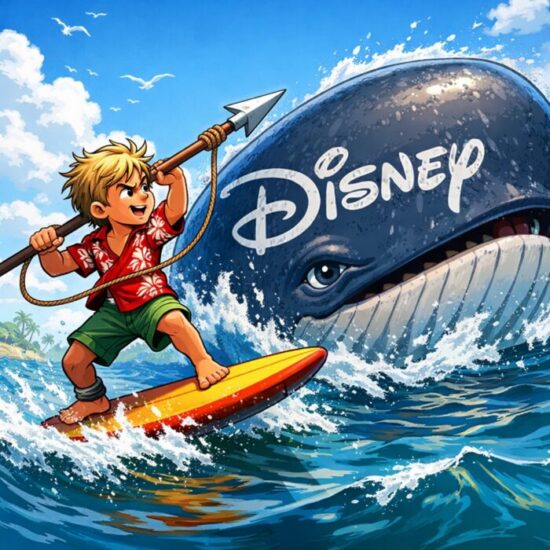
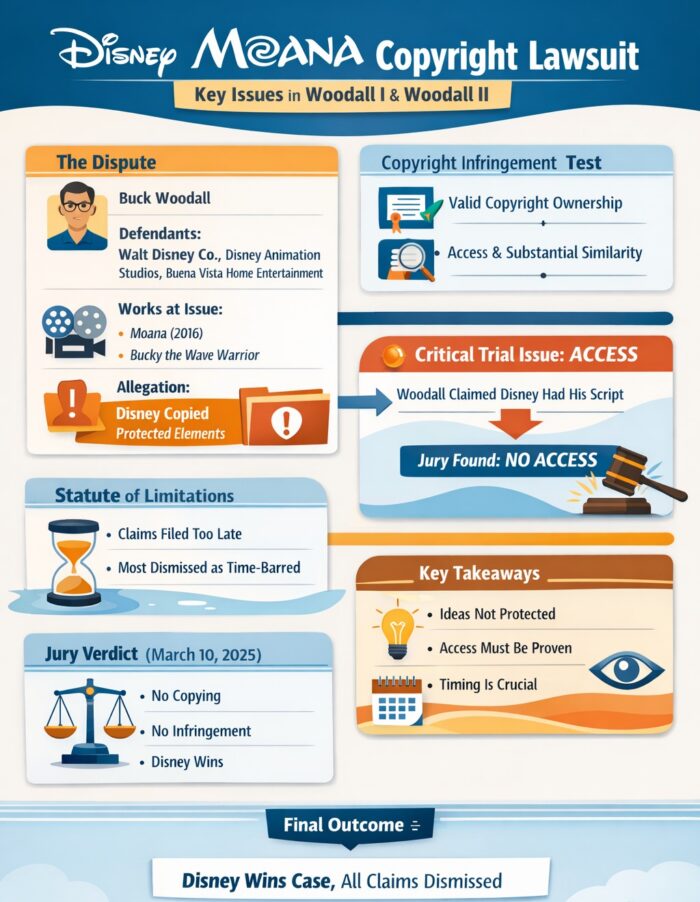
The Disney Moana copyright lawsuit refers to two related federal cases brought by Buck Woodall against The Walt Disney Co., Walt Disney Animation Studios, Buena Vista Home Entertainment, and others: Buck G. Woodall v. The Walt Disney Co., et al., No. 2:20-cv-03772 (Woodall I), and Buck G. Woodall v. The Walt Disney Co., et al., No. 2:25-cv-00273 (Woodall II). Woodall is the author of a written work that includes general story elements (e.g., teenage rebelliousness, a dangerous journey on a Polynesian island, and guidance by spiritual ancestors) that are allegedly similar to story elements in the Moana movies produced by Walt Disney Animation Studios. Woodall has twice sued the Disney defendants for copyright infringement and other related claims.
Moana is a Walt Disney Animation Studios film about an adventurous teenager from a fictional Polynesian island community who leaves home on a dangerous ocean journey to save her people. Disney’s official synopsis describes Moana as a teenager who, with help from the demigod Maui, sails out “to prove herself a master wayfinder and save her people.” The story draws on Polynesian voyaging traditions, ancestral identity, and mythic elements, including Maui, a tattooed demigod associated with a giant hook. Development of Moana was publicly underway by 2013, with directors Ron Clements and John Musker leading a film inspired by Polynesian culture and mythology. The film was released in November 2016 by the Walt Disney Company and is widely reported to have grossed well over $600 million worldwide.
Woodall’s Bucky story, as described in the Woodall I and related court filings, was different in several important respects. Woodall alleged that Bucky followed an ordinary teen or surfer boy who becomes involved in a dangerous voyage connected to a Polynesian island and the need to save his home. According to Woodall, both works involve teenagers who defy parental warnings, travel across Polynesian waters, learn about ancient Polynesian culture, navigate by the stars, encounter spiritual ancestors manifested through animals, and meet a tattooed demigod figure with a large hook.
Those alleged similarities were central to Woodall’s copyright infringement claims. At a high level, both stories involve a young protagonist, parental resistance, a dangerous journey, ocean voyaging, Polynesian cultural themes, ancestral guidance, and a demigod companion or guide. Woodall alleged that these parallels showed that Disney copied protected elements of his screenplay and related materials. Disney argued, however, that these were either general ideas, common mythic or cultural elements, scènes à faire, or independently created story features rather than protectable expression copied from Woodall’s work.
The differences were also important. Moana is set in an ancient or mythic Polynesian world and centers on Moana, the daughter of a chief, whose journey is tied to her destiny to be a future chief, wayfinding, and restoring balance for her people. Bucky, by contrast, was described as involving a modern-day American teenager who wants to learn how to surf. In other words, while the parties’ works allegedly share broad story elements, teenage rebellion, a dangerous voyage, Polynesian waters, spiritual ancestry, and a tattooed demigod, their protagonists, settings, motivations, and narrative framing differ in ways Disney argued defeated substantial similarity in protectable expression.
Woodall, a writer and Writers Guild member, alleged that he spent more than 15 years and over $500,000 developing a story and screenplay, variously titled Bucky, Bucky the Surfer Boy, and Bucky the Wave Warrior. According to court filings, Woodall's work included illustrations, character development, and a final draft script. Woodall alleged that both projects involve teenagers who defy parental orders and parental warnings to take a dangerous voyage across Polynesian waters to save their home, and several other similarities. Woodall asserted that both works feature spiritual ancestors manifested as animals and a tattooed demigod who shapes the main character’s path.
In Woodall I, the complaint asserted copyright infringement claims under 17 U.S.C. § 501, federal trade secret misappropriation under the DTSA, 18 U.S.C. § 1836, and state trade secret claims under the CUTSA, Cal. Civ. Code §§ 3426 et seq., along with fraud-based claims. Woodall II is narrower, limited to copyright claims centered on alleged further infringement arising from Moana 2.
To prevail on a copyright claim under 17 U.S.C. § 501, a plaintiff must prove ownership of a valid copyright and copying of protected expression. Where there is no direct evidence of copying, the plaintiff must show evidence that the defendants had access to the plaintiff’s work and that the accused work is substantially similar to protectable elements of that work. In practice, access plus probative similarity can support an inference of copying, but defendants can still rebut with coincidence, common source, or independent creation.
Judge Marshall’s analysis drew on several Ninth Circuit cases. In Rentmeester v. Nike, Inc., 883 F.3d 1111 (9th Cir. 2018), a photographer alleged that Nike copied his photograph of Michael Jordan in creating a later Jordan photograph and the “Jumpman” logo. The Ninth Circuit held that the photographer plausibly alleged ownership and copying in the factual sense because Nike had access to the photo, but the claim still failed because Nike did not copy enough protectable expression. The court emphasized that copyright did not protect the general idea of Jordan in a leaping pose. It protected only the photographer’s particular expressive choices, such as angle, timing, and composition.
In Loomis v. Cornish, 836 F.3d 991 (9th Cir. 2016), the plaintiff claimed that Jessie J’s song “Domino” copied a two-measure melody from his song “Bright Red Chords.” The Ninth Circuit affirmed summary judgment for the defendants because the plaintiff’s access theory was based largely on speculation, not admissible evidence showing that the songwriters had a reasonable opportunity to hear his work. That case is especially relevant to the Woodall dispute because it underscores that a plaintiff must show more than a bare possibility that creative material reached the alleged infringers.
In Funky Films, Inc. v. Time Warner Entertainment Co., 462 F.3d 1072 (9th Cir. 2006), the creators of a screenplay called The Funk Parlor alleged that HBO’s Six Feet Under copied their work. The court assumed access for purposes of the appeal but still affirmed summary judgment because the works were not substantially similar in protectable expression. Shared general concepts, such as a family-run funeral home, death, relationships, and business struggles, were too abstract to support infringement when the plots, characters, themes, mood, pace, dialogue, and sequence of events differed materially.
The court also applied the filtering principle illustrated by Satava v. Lowry, 323 F.3d 805 (9th Cir. 2003). There, one glass artist claimed copyright protection over lifelike glass-in-glass jellyfish sculptures. The Ninth Circuit reversed an injunction, holding that standard, stock, and natural elements, such as jellyfish tentacles, rounded bells, bright colors, vertical orientation, and clear glass, could not be monopolized. In other words, ideas, themes, and scènes à faire must be filtered out before comparing works for substantial similarity.
Applied to the Disney Moana copyright lawsuit, these cases meant that Woodall had to do more than identify shared high-level elements such as a Polynesian setting, a dangerous ocean voyage, an ordinary teen protagonist, ancestral spirits, or a tattooed demigod. Those features could support a narrative of similarity, but copyright infringement required evidence that Disney accessed Woodall’s work and copied protected expression rather than common ideas, cultural material, scènes à faire, coincidence, common sources, or independent creation.
On cross-motion practice under Federal Rule of Civil Procedure 56, District Judge Consuelo Marshall narrowed Woodall I substantially at the summary judgment stage. The court first held that Woodall owned the Bucky materials he registered with the Copyright Office, which meant his ownership theory survived. But most of the Woodall claims failed on timing. The court found that Woodall suspected alleged copying of Bucky by Moana by December 2016, and certainly by March 2017, yet did not file suit until April 2020. That timing barred his trade secret claims under 18 U.S.C. § 1836(d) and California Civil Code § 3426.6, and barred most copyright claims under the Copyright Act’s three-year limitations provision, 17 U.S.C. § 507(b). The court also granted Disney’s motion as to fraud-related claims and most copyright defendants, while denying summary judgment on access, substantial similarity, and independent creation for the narrow claim that remained.
The court referenced Warner Chappell Music, Inc. v. Nealy, 601 U.S. 366 (2024), because Woodall relied on it to argue that his copyright claim should not be time-barred. In Warner Chappell, music producer Sherman Nealy alleged copyright infringement going back about ten years but argued his claims were timely because he discovered the conduct less than three years before filing suit. The Supreme Court assumed, without deciding, that the discovery rule applied and held that a timely copyright plaintiff may recover damages for older acts of infringement. The Copyright Act does not create a separate three-year damages cap.
That distinction was decisive in Woodall I. Judge Marshall concluded that Warner Chappell did not save Woodall’s untimely claims because, unlike Nealy, Woodall had suspected the alleged infringement more than three years before he filed. The only copyright claim that survived was the claim tied to post-April 24, 2017 distribution of Moana by Buena Vista Home Entertainment, whose home video distribution allegedly continued into the limitations period. As a result, summary judgment reduced the case from broad claims against many Disney defendants to a narrow copyright infringement claim based on Buena Vista Home Entertainment’s later distribution activity.
The surviving copyright infringement issue turned on access. Woodall’s theory ran through Jenny Marchick, who was described as being connected through his family (his sister-in-law’s stepsister) and who had received plaintiff's works while working on the Disney lot. Judge Marshall held that this was enough to create a triable issue, because Marchick said she may have provided the Bucky material to someone at Disney TV Animation. But the Disney company's lawyers argued at trial that the Moana creators at Disney never saw Woodall’s screenplay. Also, Disney argued that the film was independently created through Disney’s ordinary processes, and was inspired by Polynesian people's proud history and folklore.
After a two-week trial, the jury found that Disney did not have access to Woodall’s materials. Because there was no access, Disney won automatically on the remaining copyright claim, and the jury never addressed the issue of whether the parties’ works were substantially similar. The court entered final judgment on March 13, 2025, in favor of all Disney defendants, with costs awarded.
Woodall filed Woodall II on January 10, 2025. The new complaint seeks damages, injunctions under 17 U.S.C. § 502, statutory damages under 17 U.S.C. § 504(c), fees under 17 U.S.C. § 505, and a share of gross revenue tied to alleged infringement resulting from Moana 2. The court stayed Woodall II on April 11, 2025, pending post-trial motions and any appeal in Woodall I. A Ninth Circuit appeal in Woodall I was opened on January 13, 2026.
The Moana copyright trial (Woodall I) underscores two practical points. First, broad story elements such as Polynesian culture, teen protagonists, a perilous ocean quest, fictional islands, great ocean voyagers, and general mythic elements (e.g., demigods, animal-spirit motifs, etc.) are treated as unprotectable concepts unless the plaintiff can tie them to concrete original expression. In the copyright infringement context, courts separate unprotectable ideas (such as commonly known information about cultures and general story elements) from protectable expression, such as the script and design of a hit film. Second, timing matters. Creators should immediately respond to suspected infringement to avoid being time-barred by a statute of limitations, eliminating what might otherwise be meritorious claims.
If you need assistance with copyright matters or other intellectual property matter, please contact our office for a consultation.
© 2026 Sierra IP Law, PC. The information provided herein does not constitute legal advice, but merely conveys general information that may be beneficial to the public, and should not be viewed as a substitute for legal consultation in a particular case.

"Mark and William are stellar in the capabilities, work ethic, character, knowledge, responsiveness, and quality of work. Hubby and I are incredibly grateful for them as they've done a phenomenal job working tirelessly over a time span of at least five years on a series of patents for hubby. Grateful that Fresno has such amazing patent attorneys! They're second to none and they never disappoint. Thank you, Mark, William, and your entire team!!"
Linda Guzman


Sierra IP Law, PC - Patents, Trademarks & Copyrights
FRESNO
7030 N. Fruit Ave.
Suite 110
Fresno, CA 93711
(559) 436-3800 | phone
BAKERSFIELD
1925 G. Street
Bakersfield, CA 93301
(661) 200-7724 | phone
SAN LUIS OBISPO
956 Walnut Street, 2nd Floor
San Luis Obispo, CA 93401
(805) 275-0943 | phone

SACRAMENTO
180 Promenade Circle, Suite 300
Sacramento, CA 95834
(916) 209-8525 | phone
MODESTO
1300 10th St., Suite F.
Modesto, CA 95345
(209) 286-0069 | phone
SANTA BARBARA
414 Olive Street
Santa Barbara, CA 93101
(805) 275-0943 | phone
SAN MATEO
1650 Borel Place, Suite 216
San Mateo, CA, CA 94402
(650) 398-1644. | phone
STOCKTON
110 N. San Joaquin St., 2nd Floor
Stockton, CA 95202
(209) 286-0069 | phone
PORTLAND
425 NW 10th Ave., Suite 200
Portland, OR 97209
(503) 343-9983 | phone
TACOMA
1201 Pacific Avenue, Suite 600
Tacoma, WA 98402
(253) 345-1545 | phone
KENNEWICK
1030 N Center Pkwy Suite N196
Kennewick, WA 99336
(509) 255-3442 | phone
2023 Sierra IP Law, PC - Patents, Trademarks & Copyrights - All Rights Reserved - Sitemap Privacy Lawyer Fresno, CA - Trademark Lawyer Modesto CA - Patent Lawyer Bakersfield, CA - Trademark Lawyer Bakersfield, CA - Patent Lawyer San Luis Obispo, CA - Trademark Lawyer San Luis Obispo, CA - Trademark Infringement Lawyer Tacoma WA - Internet Lawyer Bakersfield, CA - Trademark Lawyer Sacramento, CA - Patent Lawyer Sacramento, CA - Trademark Infringement Lawyer Sacrament CA - Patent Lawyer Tacoma WA - Intellectual Property Lawyer Tacoma WA - Trademark lawyer Tacoma WA - Portland Patent Attorney - Santa Barbara Patent Attorney - Santa Barbara Trademark Attorney
