Fictional characters are valuable intellectual property for many businesses. Think of iconic figures like Mickey Mouse, Harry Potter, or James Bond. Protecting fictional characters under intellectual property laws can provide valuable legal protection for creative works. Both copyright law and trademark law offer ways to shield characters from unauthorized use, even though the Copyright Act does not explicitly list “characters” as a category of protected works. This article explores how to establish copyright protection for a character might be secured, and how trademark protection can complement it.
Fictional characters often carry significant commercial and branding value. A well-developed character can become the face of a franchise or a character trademark for merchandise, providing strong brand recognition and valuable legal protection. For example, the boy wizard in a popular book series or a company mascot can generate revenue through films, toys, and more. Protecting fictional characters helps prevent others from exploiting your character’s name, image, or story without permission. In short, legal protection ensures you retain exclusive rights to profit from your creation.
Under U.S. copyright law, characters can be protected if they are part of an original work of authorship fixed in a tangible medium of expression. In practice, this means you create the character in some tangible form, for instance, by writing a story or comic book, or drawing the character’s image. Copyright does not protect a general idea or stock archetype of a character; it protects the specific expression of that character’s traits and story.
As the statute explains, no copyright can cover an idea, concept, or stock character type. Only the original expression of that idea in a tangible form can be protected. For example, the general idea of “a heroic female warrior” is free for all to use, but Wonder Woman, with her distinct costume, origin story, and personality traits is a protected original work owned by DC Comics. Once a character is fixed in a tangible medium (text, illustrations, film, etc.), the author automatically gains copyright ownership of that expression. This copyright protection is immediate and gives the author exclusive rights to copy, adapt, or license the character’s adventures and depictions. However, this protection does not necessarily extend to any use of the character.
Not every character is independently protectable by copyright. The character must be sufficiently unique and well delineated in its expression. U.S. courts have held that stock characters or basic types (e.g. the “hardboiled detective” or “mad scientist” archetype) are too general to be protected. In a landmark case, Nichols v. Universal Pictures, Judge Learned Hand explained that “the less developed the character, the less the copyrightability”. 45 F.2d 119 (2d. Cir. 1930). In that case, two characters (a Jewish father and Irish Catholic girl in love) were deemed mere prototypes, thinly drawn roles that were essentially unoriginal ideas and thus not protected by copyright.
To qualify for protection, a character must have distinctive attributes, backstory, and key elements that make it recognizable as the same character in multiple works. Courts often ask whether the character has specific visual or literary characteristics, and consistent traits or personality, that set it apart from a mere idea. For instance, a literary character described only in a few lines with no unique qualities might fail to qualify, whereas a richly described character like Sherlock Holmes, with his unique costume, mannerisms, and deductive genius can be protected even if only depicted in text. In short, a character that is sufficiently delineated with unique combinations of personality traits, appearance, and narrative role, may enjoy independent copyright protection.
Over time, courts have used two main tests to determine if a fictional character is protected by copyright. The first is the “distinctly delineated” or “well-delineated” character test. Under this approach (traced back to the Second Circuit decision in Nichols), a character is protected if it possesses a unique set of attributes and is recognizable as the same character across different works. The character must have constant, identifiable traits such that audiences know it’s the same person or figure in each story.
Under the well-delineated or distinctly delineated test, a fictional character may qualify for independent copyright protection if:
For example, Tarzan was found to be a “sufficiently delineated” character, with his specific upbringing in the jungle, manner of speech (“Me Tarzan”), and heroic traits, and thus was held copyrightable. Burroughs v. Metro-Goldwyn-Mayer, Inc., 519 F. Supp. 388 (S.D.N.Y. 1981). Similarly, the character Superman, with his distinct costume, origin from Krypton, and set of powers, was considered well-delineated and protected by copyright. Detective Comics v. Bruns Publications, 111 F.2d 432 (2d Cir. 1940). The key elements that make these characters unique also ensure they are more than generic ideas.
The second test, developed by the Ninth Circuit, is the “story being told” test. This is a stricter standard. It asks whether the character constitutes the story being told. In other words, is the character depicted at the core of the narrative such that the story is really about that character? If so, the character can be protected. If the character is merely a device to move the story forward, it might not get independent protection. In the famous Sam Spade case, the court treated the detective Sam Spade character as a vehicle for the plot: a mere "chessman in the game of telling the story". The court allowed his original author (Dashiell Hammett) to reuse the character in new stories despite having licensed one film adaptation. Warner Bros. Pictures Inc. v. Columbia Broadcasting System, 216 F.2d 945 (9th Cir. 1954).
On the other hand, when a character is so central that there would be no story without them, the law leans toward protection. For example, courts found that Rocky Balboa in the Rocky films was deemed both well-delineated and the focus of the story, a combination that clearly qualified him for copyright protection. Anderson v. Stallone, 11 U.S.P.Q.2d 1161 (C.D. Cal. 1989). If a character can satisfy both tests, having constant traits and unique expression (well-delineated), and is central to your narratives (nearly the story itself), it stands a strong chance of qualifying for independent copyright protection.
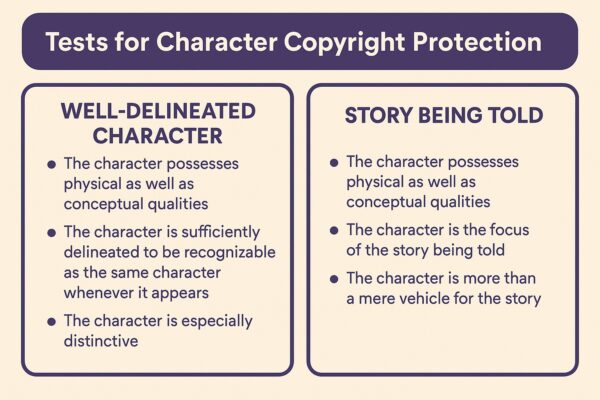
An inanimate character, may also rise to the level of copyright protection. In DC Comics v. Towle, the Ninth Circuit established one of the most influential modern tests for determining when a fictional character is entitled to independent copyright protection. 802 F.3d 1012 (9th Cir. 2015). The case involved the Batmobile, which Mark Towle reproduced and sold as custom-built replicas modeled on the versions appearing in the 1966 Batman television series and the 1989 Batman film. Towle argued that the Batmobile was merely a functional car design not eligible for character protection.
The court disagreed and held that the Batmobile was a copyrightable character. It articulated a three-part test requiring the plaintiff to show: (1) physical and conceptual qualities of the character; (2) sufficient delineation to be recognizable when it appears in different works, with characteristic traits and attributes; and (3) the character has distinctive and unique expressive elements.
Applying this Towle framework, the court emphasized the Batmobile’s consistent personality across decades: its bat-inspired appearance, high-tech gadgetry, crime-fighting purpose, and depiction as Batman’s loyal, almost sentient partner. Although portrayed in different visual forms, the Batmobile remained instantly identifiable. Thus, the Ninth Circuit confirmed that a fictional vehicle,when imbued with coherent, distinctive expressive traits, can qualify as a protected character.
In contrast, a recent decision the Ninth Circuit held that the collection of Ford Mustangs known as “Eleanor,” which appeared in four films (including Gone in 60 Seconds (2000)), does not constitute a copyright-protected character. See Carroll Shelby Licensing, Inc. v. Halicki, No. 23-3731, 2025 WL 1499052 (9th Cir. May 27, 2025).
In applying the Towle test, the court found that “Eleanor” failed all three prongs:
In sum, the court reaffirmed that not all recurring named objects in film, even if iconic, qualify as protected characters. The decision draws a clarifying line: a named object with no autonomy, little consistent design, no personality traits or narrative agency, and shifting physical form does not meet the threshold under Ninth Circuit precedent.
Many beloved characters have been recognized by courts as protected by copyright (and often by trademark as well). James Bond is a prime example: across novels and films, Bond maintains distinctive traits: a suave British spy with a “shaken, not stirred” martini preference, a license to kill, and high-tech gadgets. Courts have noted that despite being portrayed by multiple actors, Bond’s core characteristics remain consistent, making him sufficiently delineated to be protected. In one case, a court enjoined an unauthorized car commercial that evoked James Bond, recognizing the character’s legal protection in the context of copyright law. Metro-Goldwyn-Mayer v. American Honda Motor Co., 900 F. Supp. 1287 (C.D. Cal. 1995).
Comic characters like Mickey Mouse, Donald Duck, and Wonder Woman are also well-protected. These cartoon characters have clearly defined visual appearances and personalities, making it easy to prove copying. In fact, the Ninth Circuit held that Disney’s iconic characters were protected by copyright even before character-specific registrations existed. Walt Disney Productions v. Air Pirates, 581 F.2d 751 (9th Cir. 1978). Disney had registered comic strips and films depicting Mickey and friends, and the court ruled that “the fact that [the] characters are not the separate subject of a copyright [registration] does not preclude their protection.”
These cases show that a character’s image, persona, and unique elements can be legally safeguarded. However, if a character is too abstract or a general idea, it stays in the public domain for others to use.
Aside from copyright, trademark law can also provide valuable legal protection for fictional characters, particularly their names, logos, or images used in commerce. If your character’s name or design is used to brand products or services (e.g., a trademarked character logo on merchandise, or a character name as the title of a series), you can seek a trademark registration with the U.S. Patent and Trademark Office (USPTO).
Trademark rights arise from use in commerce and protect identifiers of source (names, titles, slogans, etc.), including character names or catchphrases closely associated with products or services. Unlike copyright, trademarks do not protect the creative story or personality of the character, they protect the character’s name or symbol as a brand. For example, “James Bond” and “007” are registered trademarks for movies and merchandise, and DC Comics holds trademarks for names like “Wonder Woman” and the Superman logo.
To succeed in a trademark claim, the character name or image must be distinctive or have acquired secondary meaning in the public’s mind. In other words, consumers recognize the name or figure as specifically associated with your company or product (e.g., “Mickey Mouse” immediately signifies Disney). If someone uses a confusingly similar name or depiction, it may constitute trademark infringement by misleading consumers into thinking there’s an affiliation. Trademark law allows the owner to stop others from using marks that cause likely confusion with the character’s name or likeness in commerce.
Trademarks can thus provide additional legal protection beyond copyright, especially for merchandising and franchise branding. Many famous characters enjoy dual protection: copyright protection for the character’s creative expression in stories and trademark protection for the character’s name or image used on goods. Thus, trademark rights in a character can provide additional exclusive rights over the character as a brand and help avoid potential conflicts in the marketplace.
Protecting a character involves a combination of copyright and trademark strategies. Here are key steps for business owners and creators:
Ensure your character is created in a tangible form. For example, you may establish your character in a detailed story, screenplay, or comic, or create concept art. The character must be more than an idea. This fulfills the legal requirement of fixation and establishes your initial copyright. Make the character as original and unique as possible, with well-defined traits, backstory, and visuals. The more original works featuring the character, the stronger its copyright profile.
Develop unique characteristics that set your character apart. Give them consistent personality traits, a unique look or costume, catchphrases, and a rich background. When a well-delineated character with distinctive features appears in a story (e.g., Harry Potter’s lightning-bolt scar, round glasses, and courageous personality), it is much more likely to be protectable. The character should be recognizable as the same character even in different stories or media: consistency is key. Avoid relying on clichés or solely on genre tropes (a “mere stock character”), which are not protected.
Although copyright exists upon creation, copyright registration with the U.S. Copyright Office is highly recommended to unlock full legal benefits of registration. You generally cannot register a character in isolation. Instead, you must register the work in which the character appears. For literary characters, register the short story, novel, or script that introduces them. For graphic or comic characters, you can register artwork or comic books that depict the character. Indeed, Disney protected its characters by registering comics and animation cels that contained those characters. The registration process involves submitting an application, a copy of the work (e.g. manuscript or drawing), and a fee. Having a registration is required before you can file a copyright infringement lawsuit in federal court, and it may entitle you to statutory damages and attorney’s fees if it is timely filed. In sum, registering puts the public on notice of your copyright ownership and strengthens your position if you ever need to take legal action.
If your character’s name, nickname, or image will be used to market products (like a line of toys, comics, or a game title), consider filing a trademark application with the USPTO. First, conduct a search to avoid potential conflicts with existing marks. Then, file an application to register the character name/logo for the relevant goods (e.g., “<Character Name>” for comic books, t-shirts, etc.). A trademark registration (once approved) grants nationwide rights and legal presumptions of your exclusive right to use that character name or image as a brand identifier. This can be crucial for franchised characters. For example, Warner Bros. trademarks names like Batman and Harry Potter to stop copycat merchandise. Once registered, maintain your trademark (with proper notice ™ or ® and renewals) and monitor for any infringing uses by competitors.
Copyright owners have the exclusive rights to reproduce the character’s stories, create sequels or adaptations (like films, spinoff novels, or comic adaptations), distribute and display those works, and prepare derivative works featuring the character. If someone else writes a new story using your character or produces art depicting your character without permission, it could be copyright infringement. In such cases, you may send cease-and-desist letters or ultimately file a lawsuit in federal court to enforce your rights. Courts will compare the alleged infringing character to yours to see if there is substantial similarity in protectable elements, bearing in mind that general concepts and independently created look-alikes might not infringe if the expression is not actually copied.
For trademarks, watch out for unauthorized commercial uses of your character’s name or likeness that could confuse consumers. Trademark infringement or dilution can harm the distinct identity of your character brand. Companies like DC Comics and Disney aggressively enforce both copyright and trademark, whether it’s unlicensed costumes (which can dilute a brand) or unapproved stories. As a character owner, you should be prepared to take legal action to stop infringers, which might involve seeking an injunction and damages.
On the flip side, when creating a new character for your business, ensure you are not infringing someone else’s rights. Avoid basing your character too closely on an existing protected character. Always check if famous characters are in the public domain or still under protection. For example, early depictions of Mickey Mouse have entered the public domain, but later evolutions of Mickey and associated trademarks remain off-limits. By respecting others’ intellectual property and robustly protecting your own, you can steer clear of costly copyright infringement disputes.
Copyrighting a character requires crafting a unique, well-defined character and anchoring it in a creative work. Once your character is fixed in a tangible medium and displays originality, it can be protected under U.S. copyright law as part of that work. A character that is distinctly delineated with unique traits and is integral to the story will enjoy strong protection under the tests courts have developed. Additionally, securing trademark protection for the character’s name or image (when used as a brand) can provide an additional layer of security.
By following the steps outlined, creators can ensure their fictional characters are well protected. If you need assistance with registering copyrights in a character or other work, or need assistance with other intellectual property matters, please contact our office for a consultation.
© 2025 Sierra IP Law, PC. The information provided herein does not constitute legal advice, but merely conveys general information that may be beneficial to the public, and should not be viewed as a substitute for legal consultation in a particular case.

"Mark and William are stellar in the capabilities, work ethic, character, knowledge, responsiveness, and quality of work. Hubby and I are incredibly grateful for them as they've done a phenomenal job working tirelessly over a time span of at least five years on a series of patents for hubby. Grateful that Fresno has such amazing patent attorneys! They're second to none and they never disappoint. Thank you, Mark, William, and your entire team!!"
Linda Guzman


Sierra IP Law, PC - Patents, Trademarks & Copyrights
FRESNO
7030 N. Fruit Ave.
Suite 110
Fresno, CA 93711
(559) 436-3800 | phone
BAKERSFIELD
1925 G. Street
Bakersfield, CA 93301
(661) 200-7724 | phone
SAN LUIS OBISPO
956 Walnut Street, 2nd Floor
San Luis Obispo, CA 93401
(805) 275-0943 | phone

SACRAMENTO
180 Promenade Circle, Suite 300
Sacramento, CA 95834
(916) 209-8525 | phone
MODESTO
1300 10th St., Suite F.
Modesto, CA 95345
(209) 286-0069 | phone
SANTA BARBARA
414 Olive Street
Santa Barbara, CA 93101
(805) 275-0943 | phone
SAN MATEO
1650 Borel Place, Suite 216
San Mateo, CA, CA 94402
(650) 398-1644. | phone
STOCKTON
110 N. San Joaquin St., 2nd Floor
Stockton, CA 95202
(209) 286-0069 | phone
PORTLAND
425 NW 10th Ave., Suite 200
Portland, OR 97209
(503) 343-9983 | phone
TACOMA
1201 Pacific Avenue, Suite 600
Tacoma, WA 98402
(253) 345-1545 | phone
KENNEWICK
1030 N Center Pkwy Suite N196
Kennewick, WA 99336
(509) 255-3442 | phone
2023 Sierra IP Law, PC - Patents, Trademarks & Copyrights - All Rights Reserved - Sitemap Privacy Lawyer Fresno, CA - Trademark Lawyer Modesto CA - Patent Lawyer Bakersfield, CA - Trademark Lawyer Bakersfield, CA - Patent Lawyer San Luis Obispo, CA - Trademark Lawyer San Luis Obispo, CA - Trademark Infringement Lawyer Tacoma WA - Internet Lawyer Bakersfield, CA - Trademark Lawyer Sacramento, CA - Patent Lawyer Sacramento, CA - Trademark Infringement Lawyer Sacrament CA - Patent Lawyer Tacoma WA - Intellectual Property Lawyer Tacoma WA - Trademark lawyer Tacoma WA - Portland Patent Attorney - Santa Barbara Patent Attorney - Santa Barbara Trademark Attorney
