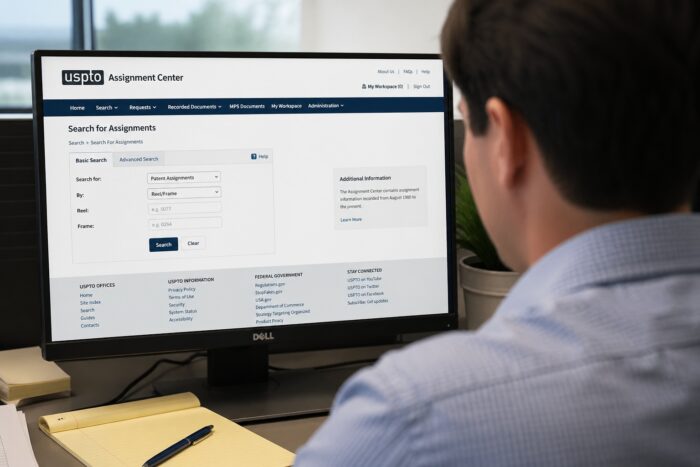
A patent assignment search is typically employed to determine patent ownership and chain of title for relevant competing technologies or potential licensing targets before a deal or dispute is pursued. Anyone can search and find the current recorded ownership for a patent or patent application. An assignment search is conducted through the USPTO assignment records public database. The recorded patent assignment information includes the assignor, the assignee, the chain of title, and provides a copy of the assignment document. This is an important tool for businesses and entrepreneurs conducting research on competitors, potential licensors, and partners relating to a particular technology.
A patent assignment is a written transfer of ownership rights in a patent or patent application from one entity (the assignor) to another (the assignee). A patent is a bundle of rights, including the rights to make, use, sell, offer for sale, and import the invention, as well as the right to exclude others from doing so. An assignment may transfer this entire bundle (a complete assignment) or only certain rights, such as a geographic interest, field-of-use limitation, or partial ownership (a partial assignment). These transfers may arise from an assignment, sale, corporate merger, financing transaction, or even an owner name change, all of which affect the chain of title. The USPTO permits recordation of these documents, including full and partial assignments, security interests, and other title-related instruments.
The database also includes security agreements, which grant a lender a lien in the patent as collateral, and release documents showing that a prior security interest has been satisfied. Other recordable instruments include merger documents, corporate reorganizations, and change-of-name filings, all of which clarify the chain of title. Parties may also record licenses in limited circumstances, although licensing typically does not transfer full ownership. Each recorded document is indexed by reel and frame numbers, along with assignor and assignee names, allowing users to search and find detailed records in the USPTO system for due diligence and transactional review.
The USPTO maintains official assignment records for each patent and patent application in which an assignment or transfer document has been recorded. However, it should be understood that recording is a ministerial act and does not determine legal validity. Under 35 U.S.C. § 261, recording an assignment provides constructive notice to the public. The USPTO Assignment Center serves as the primary system to record and find these ownership changes. Properly recorded documents, including merger or name-change filings, create clear links in title, helping businesses, investors, and legal professionals verify current ownership and avoid disputes.
Visit the United States Patent and Trademark Office Assignment Center, the USPTO’s web-based application for patent and trademark assignment information. This centralized system allows users to conduct a search across a comprehensive database of recorded assignments and other transfer instruments, making it the primary tool for those seeking patent ownership details. The USPTO states that its searchable patent system includes patent assignment information recorded from August 1980 to the present.
The USPTO's new system replaced two legacy systems: Assignments on the Web and the prior Patent Assignment Search. The updated platform is live, offering a more reliable and user-friendly interface with enhanced searches, improved navigation, and better access to detailed results. The same Assignment Center also supports trademark assignment searches, allowing stakeholders to find consistent ownership information for both patent and trademark records in one place.
Users can perform basic searches or switch to advanced search within the USPTO Assignment Center’s web-based application. To start, enter a patent number, patent application number, or publication number to quickly locate a specific record. If you are researching broader assignment records, you can search by assignor and assignee names, which helps identify transfers involving a particular entity or owner. More technical queries can use reel/frame numbers tied to a recorded document.
Once initial results are returned, the system allows users to refine those results using filtering options in the advanced search field, such as execution date, recordation date, or document type. This advanced search approach is especially useful for customers seeking patent and trademark assignment information across multiple transactions or time periods.
The USPTO's updated and modernized interface provides a more reliable and user-friendly experience, enabling users to efficiently conduct searches and obtain detailed results from its comprehensive database of recorded assignment information.
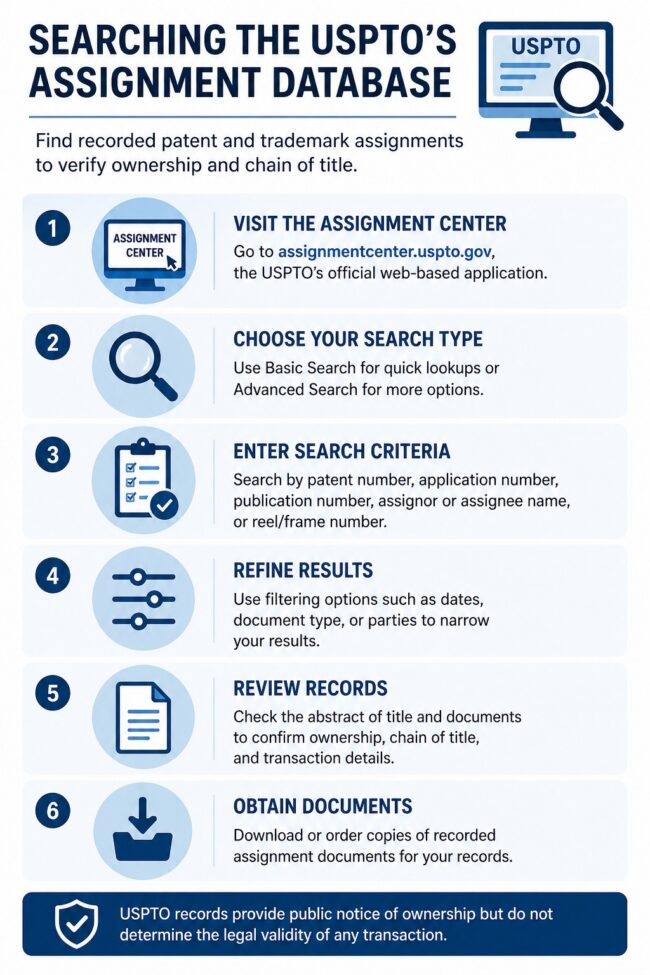
Once the search terms are entered, carefully review the results page, the abstract of title, and each recorded document in the USPTO database. Focus on identifying the current assignee, confirming the chain of ownership, and checking whether each assignment properly reflects a complete transfer between entities. Pay attention to names, reel/frame numbers, execution dates, and whether the recorded assignment information is relevant to your search objectives. USPTO records are generally available to the public, and copies can be obtained through the web system. However, access may be limited for certain unpublished patent application files, so additional diligence may be required to verify complete ownership history.
The USPTO records a patent assignment as a ministerial function within its assignment system. Under 37 C.F.R. § 3.54 and MPEP § 301, the patent and trademark office does not evaluate or verify whether the assignment document is valid, enforceable, or effective to transfer ownership. This means the USPTO does not confirm that the correct owner or assignee has been identified, nor does it resolve disputes between parties. The assignment records simply reflect information submitted and entered into the database. As a result, even if assignment information appears in the USPTO system, it may not fully establish legal title. For this reason, legal professionals often review the full chain of title, underlying agreements, and related records to confirm ownership, especially in transactions involving patent licensing, sale, or patent litigation.
Recording a patent assignment with the United States Patent and Trademark Office is technically optional, but it should be done to clarify ownership rights and avoid confusion in the chain of title that can lead to issues and costs down the road. Under 35 U.S.C. § 261, an unrecorded assignment may be void against a subsequent purchaser who acquires rights without notice, unless the transfer is timely recorded. In practice, this means recording establishes constructive notice in the public assignment records, helping third parties identify the true assignee through a patent assignment search. Proper recordation strengthens an owner’s position during due diligence, licensing, financing, or litigation by ensuring that patent assignment information in the USPTO database accurately reflects the chain of title.
To record a patent assignment, the original owner or assignee submits the required assignment information through the USPTO Assignment Center, a secure web based application available at: https://assignmentcenter.uspto.gov. The system allows users to upload documents directly through the web interface, typically in PDF format.
A proper submission must include a completed Recordation Cover Sheet, which identifies key details such as the names of the assignor and assignee, the relevant patent number or patent application, the correspondence address, and the nature of the transfer (e.g., assignment, merger, or name change), as required by 37 C.F.R. § 3.28. The actual executed document, such as the signed assignment agreement or proof supporting a name change, must also be uploaded.
Once the assignment is reviewed and entered into the USPTO database, it becomes part of the public records, allowing customers and legal professionals to find and verify ownership, confirm the chain of title, and rely on accurate assignment records for due diligence and related searches.
A patent assignment search is essential diligence work for any business evaluating a patent, whether for licensing, acquisition, or competitive research. By using the USPTO Assignment Center, users can access comprehensive assignment records, perform targeted searches, and review critical patent assignment information such as the current assignee and chain of ownership. However, because the USPTO records assignments as a ministerial function, businesses should carefully review each document and not rely solely on the database to confirm legal title. Properly recording each assignment ensures that ownership is clearly reflected in the public record and protected against future disputes. Taken together, thorough searching and accurate recordation provide a reliable foundation for informed decision-making.
If you need assistance with patent assignment and ownership matters or other intellectual property matters, please contact our office for a consultation.
© 2026 Sierra IP Law, PC. The information provided herein does not constitute legal advice, but merely conveys general information that may be beneficial to the public, and should not be viewed as a substitute for legal consultation in a particular case.

"Mark and William are stellar in the capabilities, work ethic, character, knowledge, responsiveness, and quality of work. Hubby and I are incredibly grateful for them as they've done a phenomenal job working tirelessly over a time span of at least five years on a series of patents for hubby. Grateful that Fresno has such amazing patent attorneys! They're second to none and they never disappoint. Thank you, Mark, William, and your entire team!!"
Linda Guzman


Sierra IP Law, PC - Patents, Trademarks & Copyrights
FRESNO
7030 N. Fruit Ave.
Suite 110
Fresno, CA 93711
(559) 436-3800 | phone
BAKERSFIELD
1925 G. Street
Bakersfield, CA 93301
(661) 200-7724 | phone
SAN LUIS OBISPO
956 Walnut Street, 2nd Floor
San Luis Obispo, CA 93401
(805) 275-0943 | phone

SACRAMENTO
180 Promenade Circle, Suite 300
Sacramento, CA 95834
(916) 209-8525 | phone
MODESTO
1300 10th St., Suite F.
Modesto, CA 95345
(209) 286-0069 | phone
SANTA BARBARA
414 Olive Street
Santa Barbara, CA 93101
(805) 275-0943 | phone
SAN MATEO
1650 Borel Place, Suite 216
San Mateo, CA, CA 94402
(650) 398-1644. | phone
STOCKTON
110 N. San Joaquin St., 2nd Floor
Stockton, CA 95202
(209) 286-0069 | phone
PORTLAND
425 NW 10th Ave., Suite 200
Portland, OR 97209
(503) 343-9983 | phone
TACOMA
1201 Pacific Avenue, Suite 600
Tacoma, WA 98402
(253) 345-1545 | phone
KENNEWICK
1030 N Center Pkwy Suite N196
Kennewick, WA 99336
(509) 255-3442 | phone
2023 Sierra IP Law, PC - Patents, Trademarks & Copyrights - All Rights Reserved - Sitemap Privacy Lawyer Fresno, CA - Trademark Lawyer Modesto CA - Patent Lawyer Bakersfield, CA - Trademark Lawyer Bakersfield, CA - Patent Lawyer San Luis Obispo, CA - Trademark Lawyer San Luis Obispo, CA - Trademark Infringement Lawyer Tacoma WA - Internet Lawyer Bakersfield, CA - Trademark Lawyer Sacramento, CA - Patent Lawyer Sacramento, CA - Trademark Infringement Lawyer Sacrament CA - Patent Lawyer Tacoma WA - Intellectual Property Lawyer Tacoma WA - Trademark lawyer Tacoma WA - Portland Patent Attorney - Santa Barbara Patent Attorney - Santa Barbara Trademark Attorney
