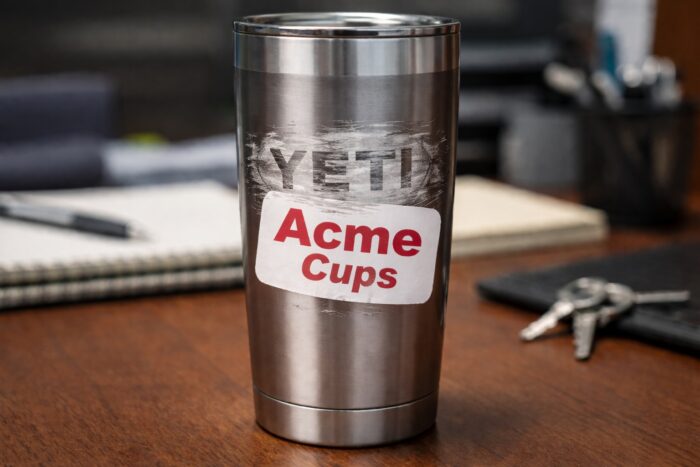
“Reverse passing off” is a form of unfair competition where someone sells another company’s product under their own name or brand. Unlike ordinary “passing off” (or palming off), which involves misrepresenting your goods as someone else’s, reverse passing off occurs when a party misrepresents someone else’s goods or services as its own. This deceptive practice is considered unfair competition under U.S. trademark law and is prohibited by federal law under the Lanham Act’s false designation of origin provisions. In this article, we break down the concept of reverse passing off, how it differs from traditional trademark infringement, legal elements of the claim, and key court decisions.
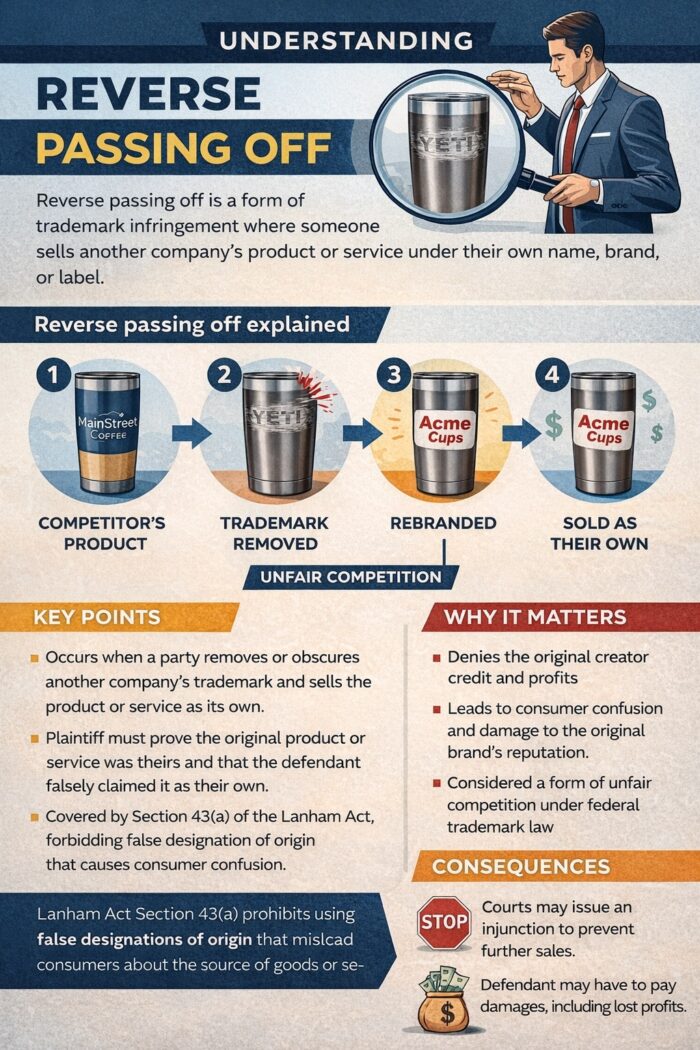
Reverse passing off essentially occurs when one company takes a competitor’s product, removes or obscures the competitor’s trademarks, and then markets the product under a different mark or its own name. In other words, the offender is selling someone else’s goods as if they were the offender’s goods. For example, if Company B buys widgets from Company A, strips off A’s brand labels (if present), and then sells those identical widgets as “B’s” products, B is engaging in reverse passing off. Courts define this as a form of false designation of origin, a type of misrepresentation expressly covered by the Lanham Act.
To better understand reverse passing off, it helps to compare it to traditional passing off. Passing off (also called “palming off”) is the classic trademark infringement scenario: a business tries to pass its own products or services off as if they came from another brand. For instance, a company or individual might sell counterfeit goods bearing someone else’s trademark, like selling knock-off yoga pants as Lululemon pants. By contrast, reverse passing off flips the scenario. The wrongdoer uses the plaintiff’s actual product, but presents it as their own product by rebranding or removing the original mark. In both cases the intended harm is similar: consumers are misled about the product’s true origin, which can cause confusion in the market and harm the rightful producer’s reputation and sales.
Reverse passing off is prohibited by federal law. Section 43(a) of the Lanham Act (15 U.S.C. § 1125(a)) forbids using any false designation of origin in connection with goods or services if it is likely to cause confusion about the origin of those goods. This law is a federal unfair competition statute that applies to all goods and services in commerce. Notably, a reverse passing off claim does not require that the original trademark be registered with the U.S. Patent and Trademark Office. Unregistered trade names or product configurations are protected from false origin claims. The key question under the Lanham Act is whether the public is likely to be misled or confused about who actually produced the product or service. In short, the law aims to protect the integrity of the marketplace by ensuring consumers are not deceived about a product’s origin or maker.
To succeed in a reverse passing off claim, a plaintiff (the source of the goods) generally must prove that:
Crucially, unlike typical trademark infringement, reverse passing off does not require the plaintiff to show the defendant’s mark is similar to the plaintiff’s mark. The gravamen of the claim is the false designation of origin: that the defendant falsely presented the plaintiff’s goods as its own, causing consumer confusion about who deserves credit for the product. This kind of misrepresentation can damage the plaintiff’s goodwill and deny the plaintiff the profits and recognition associated with its product.
Reverse passing off can take various forms. Express reverse passing off is when the wrongdoer not only removes the original manufacturer’s name or logo but rebrands the product with a different mark, often the defendant’s own brand. An example would be peeling off the nameplate of a competitor’s device and replacing it with your company’s label before sale.
Implied reverse passing off occurs when the wrongdoer simply removes or obscures the plaintiff’s name or mark and sells the product unlabeled, effectively presenting it as generic or self-produced. In both scenarios, the result is that customers don’t see the plaintiff’s mark. They either see the defendant’s mark or no brand at all, leading them to believe the defendant is the source. Both forms are actionable as false designation of origin under the Lanham Act. Courts have consistently found that selling someone else’s goods misbranded as one’s own is “a false designation of origin” under federal law.
Reverse passing off is a relatively rare form of trademark infringement. Most trademark cases involve the more common scenario of a junior user trying to copy or mimic the senior user’s mark to sell its own products. In contrast, reverse passing off arises with unauthorized rebranding of a manufacturer’s goods, distributors mislabeling products, or intellectual property disputes over attribution. One reason it’s uncommon is that it’s often easier for an infringer to benefit from another’s reputation by using the plaintiff’s mark (traditional infringement) rather than by hiding it.
Nonetheless, when reverse passing off does occur, it can be very damaging. The original producer is deprived of recognition and market credit for its product’s quality, and consumers are denied the knowledge of the product’s true source. This lack of transparency can harm the marketplace integrity and consumer confidence in knowing what brand they’re actually buying.
To illustrate, consider a real-world example: Liz Claiborne (a fashion brand) once discovered that one of its overseas sweater manufacturers had secretly sold extra sweaters that were originally made for Liz Claiborne, but the manufacturer replaced Liz Claiborne’s label with its own “Mademoiselle” brand and sold them without authorization. Liz Claiborne, Inc. v. Mademoiselle Knitwear, Inc., 13 F. Supp. 2d 430 (S.D.N.Y. 1998). This meant identical sweaters marked with the Mademoiselle brand ended up on the same store rack. This is a textbook case of reverse passing off: the manufacturer took the plaintiff’s product and passed it off as its own, a practice the law forbids.
Other examples include a company buying a competitor’s product, lightly modifying it (or not at all), and then repackaging it under the company’s brand for sale. In one case, a defendant was found liable for reverse passing off after it obtained a competitor’s grain trailer, removed the competitor’s labels, and marketed the trailer as its own product, conduct the court said was “of the same economic nature as trademark infringement”. Truck Equipment Service Company v. Fruehauf Corporation, 536 F.2d 1210 (8th Cir. 1976). The harm in such cases is clear: the originator loses sales and the goodwill associated with its name, while the infringer capitalizes on the originator’s talents and workmanship without permission.
Reverse passing off has been recognized by courts as a viable claim for decades. For instance, the Ninth Circuit Court of Appeals acknowledged this cause of action in Smith v. Montoro, where a film distributor removed the lead actor’s name from movie credits and substituted another name. Smith v. Montoro, 648 F.2d 602 (9th Cir. 1981). The court found this misattribution stated a valid Lanham Act claim for reverse passing off.
Various other circuits have similarly held that purchasing a competitor’s goods and selling them under one’s own name or a different mark is a form of false designation of origin under Section 43(a). However, the most significant decision is the U.S. Supreme Court’s ruling in Dastar Corp. v. Twentieth Century Fox Film Corp., 539 U.S. 23 (2003). In that case, Dastar copied and edited a series of public domain videos originally produced by Fox, then sold them as Dastar’s own product (with Dastar’s branding and no credit to Fox). The Ninth Circuit had found this to be reverse passing off, calling Dastar’s uncredited copying a “bodily appropriation” of Fox’s work. But the Supreme Court unanimously reversed that decision, significantly narrowing the scope of reverse passing off claims.
In Dastar, the Supreme Court clarified what “origin” means under the Lanham Act. The Court held that the “origin of goods” in a reverse passing off claim refers only to the producer of the tangible goods that are offered for sale, not the creator of any idea, concept, or content within those goods. In practical terms, this means if a company legitimately produces or manufactures a physical product, even if it incorporates someone else’s unbranded content or design, that company is deemed the origin of the goods for trademark purposes.
The Lanham Act does not require attribution to the author of any underlying creative work or idea: it is not a “credit” or plagiarism law. The Supreme Court emphasized that extending trademark law to require attribution for creative ideas would effectively create a “species of mutant copyright law” that interferes with the public’s right to copy and use public domain (unprotected) works. After Dastar, reverse passing off claims are generally limited to scenarios where the defendant is literally reselling the plaintiff’s physical products under a false label. Simply copying someone’s product and selling it under your own brand without using their actual goods typically won’t be actionable under trademark law. Unless other intellectual property rights (like patents or copyrights) are involved, no legal claim for copying another's concept, design, or content will be available. In short, Dastar ensures that trademark law remains focused on preventing confusion about a product’s physical source or manufacturer, while preserving free access to ideas and information in the public domain.
Business owners should also be aware that reverse passing off can involve foreign manufacturing relationships. For example, a company might contract with a foreign manufacturer to produce its goods. If that manufacturer, without authorization, takes the company’s products and sells them under the manufacturer’s own name, it could constitute reverse passing off. The earlier Liz Claiborne case is one illustration. Another scenario is an importer buying genuine products overseas, removing the original manufacturer’s branding, and then selling them in the U.S. under the importer’s brand. This kind of misrepresentation is related to actionable sales of gray market goods.
U.S. courts have indeed enjoined former distributors from covering a foreign manufacturer’s label with their own label after a distribution contract ended. The federal law applies so long as the goods are entering U.S. commerce with false origin information. The bottom line is that using a foreign manufacturer’s goods without proper branding or permission is risky: if you intended to deceive customers about who made the product, you could be facing an unfair competition claim.
Reverse passing off is not just an academic concept; it carries legal consequences that can be costly for businesses. If a plaintiff proves reverse passing off, courts can award remedies under the Lanham Act similar to those in other trademark infringement cases. These include injunctions (court orders stopping the defendant from selling the misbranded goods) and monetary damages.
A plaintiff may recover the defendant’s profits earned from the sales, any provable lost sales or damage to the plaintiff’s market and reputation, and possibly additional damages or attorney’s fees in exceptional cases. For instance, before Dastar reached the Supreme Court, the trial court had ordered Dastar to disgorge its profits. While that specific award was nullified when the Supreme Court found no Lanham Act violation, it illustrates the potential financial cost of a reverse passing off claim. In essence, a company caught relabeling someone else’s goods as its own may have to pay back money it made from those sales and might also suffer damage to its credibility.
Reverse passing off occurs when one party sells another’s product under its own branding, thereby falsely claiming the product’s origin. This practice undermines fair competition and can confuse consumers, so U.S. law provides a cause of action for affected companies to protect their interests. Although such cases are uncommon, the concept has seen renewed attention in scenarios like supply chain shortages or unauthorized overseas dealings.
The Lanham Act’s false designation provisions under Section 43(a) are the backbone of these claims. Businesses should be careful to avoid any branding strategies that could be seen as reverse passing off. If they are on the receiving end of such misconduct, they have legal recourse. By understanding reverse passing off and the legal standards involved, companies can better navigate their branding practices and ensure they remain on the right side of trademark law.
If you are facing an unfair competition situation or you need assistance with another intellectual property matter, contact our office for a free consultation.
© 2026 Sierra IP Law, PC. The information provided herein does not constitute legal advice, but merely conveys general information that may be beneficial to the public, and should not be viewed as a substitute for legal consultation in a particular case.

"Mark and William are stellar in the capabilities, work ethic, character, knowledge, responsiveness, and quality of work. Hubby and I are incredibly grateful for them as they've done a phenomenal job working tirelessly over a time span of at least five years on a series of patents for hubby. Grateful that Fresno has such amazing patent attorneys! They're second to none and they never disappoint. Thank you, Mark, William, and your entire team!!"
Linda Guzman


Sierra IP Law, PC - Patents, Trademarks & Copyrights
FRESNO
7030 N. Fruit Ave.
Suite 110
Fresno, CA 93711
(559) 436-3800 | phone
BAKERSFIELD
1925 G. Street
Bakersfield, CA 93301
(661) 200-7724 | phone
SAN LUIS OBISPO
956 Walnut Street, 2nd Floor
San Luis Obispo, CA 93401
(805) 275-0943 | phone

SACRAMENTO
180 Promenade Circle, Suite 300
Sacramento, CA 95834
(916) 209-8525 | phone
MODESTO
1300 10th St., Suite F.
Modesto, CA 95345
(209) 286-0069 | phone
SANTA BARBARA
414 Olive Street
Santa Barbara, CA 93101
(805) 275-0943 | phone
SAN MATEO
1650 Borel Place, Suite 216
San Mateo, CA, CA 94402
(650) 398-1644. | phone
STOCKTON
110 N. San Joaquin St., 2nd Floor
Stockton, CA 95202
(209) 286-0069 | phone
PORTLAND
425 NW 10th Ave., Suite 200
Portland, OR 97209
(503) 343-9983 | phone
TACOMA
1201 Pacific Avenue, Suite 600
Tacoma, WA 98402
(253) 345-1545 | phone
KENNEWICK
1030 N Center Pkwy Suite N196
Kennewick, WA 99336
(509) 255-3442 | phone
2023 Sierra IP Law, PC - Patents, Trademarks & Copyrights - All Rights Reserved - Sitemap Privacy Lawyer Fresno, CA - Trademark Lawyer Modesto CA - Patent Lawyer Bakersfield, CA - Trademark Lawyer Bakersfield, CA - Patent Lawyer San Luis Obispo, CA - Trademark Lawyer San Luis Obispo, CA - Trademark Infringement Lawyer Tacoma WA - Internet Lawyer Bakersfield, CA - Trademark Lawyer Sacramento, CA - Patent Lawyer Sacramento, CA - Trademark Infringement Lawyer Sacrament CA - Patent Lawyer Tacoma WA - Intellectual Property Lawyer Tacoma WA - Trademark lawyer Tacoma WA - Portland Patent Attorney - Santa Barbara Patent Attorney - Santa Barbara Trademark Attorney
