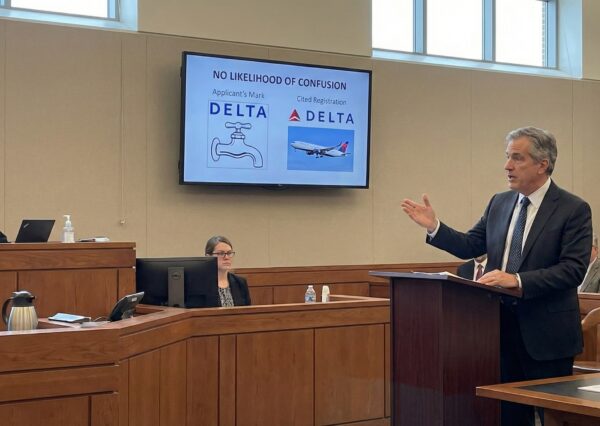
When a trademark application faces a final refusal from the United States Patent and Trademark Office (USPTO), the applicant isn’t out of options. U.S. trademark law provides a process to appeal such refusals to a specialized administrative tribunal called the Trademark Trial and Appeal Board (TTAB). A trademark appeal in this context refers to requesting TTAB review of an examining attorney’s final refusal to register a mark. The TTAB is the USPTO’s appeal board for trademark matters. It is a venue where business owners and trademark applicants can challenge an examining attorney’s decision or resolve certain disputes over trademark registrations. This article discusses trademark appeals before the TTAB, explains how the appeal process works, and discusses the options after a TTAB decision.
The Trademark Trial and Appeal Board (TTAB) is a neutral administrative body within the USPTO that functions like a court for trademark matters. It is composed of administrative trademark judges (ATJs) appointed for their expertise in trademark law. These judges sit in panels of three to decide cases. The TTAB’s authority is limited to determining a party’s right to federal trademark registration. The TTAB does not decide whether someone can use a mark in commerce, nor does it handle trademark infringement disputes or award damages. In other words, the Board can affirm or overturn decisions about registration (such as refusals by USPTO examiners or outcomes of oppositions), but it cannot stop someone from using a trademark or resolve unfair competition claims.
The TTAB’s role is strictly about the federal registration of trademarks with the USPTO. Any matter beyond the right to registration, like injunctions or monetary remedies, a party would have to go to a court, not the TTAB. The TTAB acts as an appeal board for applicants who have been denied a registration, and as a trial tribunal for certain disputes involving trademark applications or registrations. It operates under the Lanham Act (Trademark Act of 1946, 15 U.S.C. § 1051 et seq.) and the USPTO’s Trademark Rules (37 C.F.R. Parts 2 and 7), with procedures outlined in the Trademark Trial and Appeal Board Manual of Procedure (TBMP).
These are appeals by a trademark applicant against a final refusal issued by a USPTO examining attorney. “Ex parte” means only one party (the applicant) is formally involved opposite the USPTO. Common reasons for refusals include a finding that the proposed mark is descriptive, generic, confusingly similar to an existing mark, or otherwise barred by the Trademark Act. Each year, the TTAB decides hundreds of such appeals from final refusals issued by USPTO examining attorneys. If an applicant receives a final refusal, they may appeal that decision to the TTAB as a matter of right, under Trademark Act § 20 (15 U.S.C. § 1070).
These are adversarial cases between two or more parties (“inter partes” meaning between parties) before the TTAB. The most common types are oppositions and cancellation proceedings. In an opposition, a party files a notice opposing another’s application after it has been published for opposition, arguing that the applied-for mark should not register, for example, due to likelihood of confusion with the opposer’s mark.
In a cancellation proceeding, a party petitions to cancel an existing trademark registration for reasons such as the mark has become generic, has been abandoned, or was obtained by fraud. The TTAB also handles concurrent use proceedings resolving situations where two parties seek rights to use similar marks in different geographic areas. There are also new expungement and reexamination proceedings recently created by the Trademark Modernization Act in 2020. The proceedings can be used to remove registrations for non-use.
These inter partes cases resemble litigation. They involve pleadings, discovery, submission of evidence, and trial briefs, though usually no live courtroom testimony. An interlocutory attorney at the TTAB may oversee the preliminary stages of such cases, handling motions and managing the case schedule. All parties should be mindful that TTAB trial proceedings are governed by many of the same principles as civil litigation. The TTAB adapts the Federal Rules of Civil Procedure to its practice, albeit with the focus solely on the right to register a trademark.
In summary, ex parte appeals involve an applicant appealing a USPTO refusal with the examining attorney on the other side, defending the refusal, whereas inter partes TTAB proceedings involve two private parties disputing rights to registration: e.g. whether a mark should be registered or a registration should be canceled. Both fall under the TTAB’s jurisdiction.
If you’re a trademark applicant who has received a final refusal from a USPTO trademark examining attorney, an ex parte appeal to the TTAB is the next available avenue to pursue a registration. A final refusal (a “Final Office Action”) typically follows an initial refusal and the applicant’s response. It indicates that the examiner is maintaining the refusal and considers the matter closed at the examination level. Common grounds for final refusals include the mark is confusingly similar to a registered mark, the mark is merely descriptive or generic for the goods/services, the mark is a surname or geographically descriptive, the specimen was deficient, and other bases. Whatever the grounds, a final refusal means the USPTO will not register the mark as-is.
At this point, the applicant has options: they can file a Request for Reconsideration with the examiner to attempt one more time to overcome the refusal, and/or file an appeal to the TTAB. Importantly, filing a request for reconsideration does not extend the deadline to appeal. Trademark Rule 2.141 and the Lanham Act provide that an applicant must file the appeal within six months from the date of the final action, along with payment of the required appeal fee. You must pay the prescribed fee for each class of goods or services in the application that you wish to appeal. Missing this deadline or failing to pay the fee will result in losing the right to appeal, and the application will go abandoned after six months.
To file the appeal, the applicant submits a Notice of Appeal through the USPTO’s electronic filing system (ESTTA) under the application serial number. The Notice of Appeal is a simple document indicating the applicant’s intent to appeal the examiner’s decision. Once the TTAB receives the notice and fee, it will institute the appeal and set the schedule for briefs.
It’s worth noting that ex parte appeals to the TTAB are only for substantive issues (e.g., whether the law was correctly applied to refuse the mark). If the issue is a purely procedural one or a requirement of form, such an issue should be pursued through a petition to the Director rather than an appeal. For most final refusals on substantive grounds, however, an appeal is the proper course.
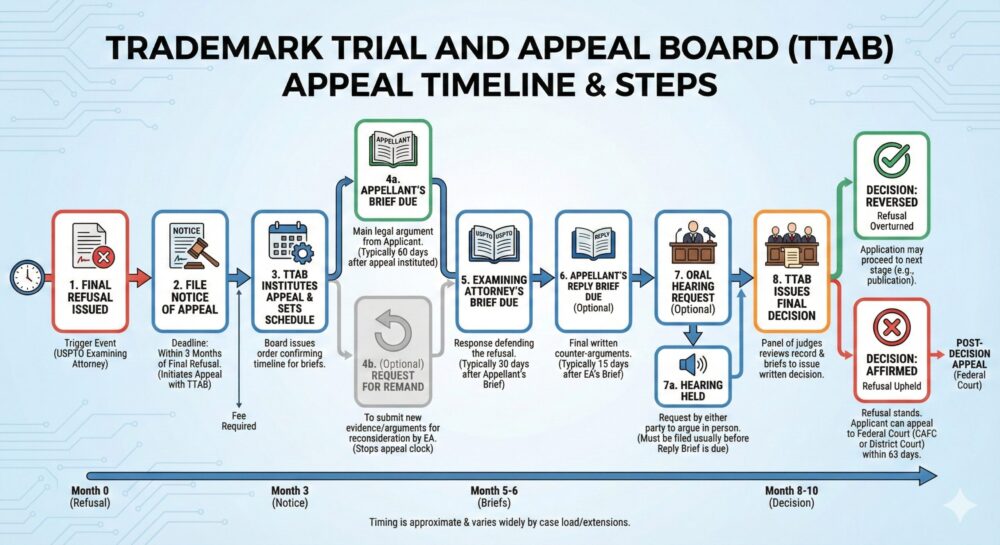
Once an ex parte appeal is underway, the process before the TTAB unfolds in a series of steps. Here is a step-by-step overview of a typical trademark appeal before the TTAB:
Throughout the appeal process, the TTAB is acting as an administrative appellate tribunal reviewing the examining attorney’s decision. It is crucial to present a thorough and persuasive brief, as that is the primary basis on which the TTAB will make its decision.
A TTAB decision isn’t necessarily the final word. If a party is unhappy with the Board’s decision, they have the right to seek further review in court. The Lanham Act § 21 (15 U.S.C. § 1071) provides two alternative routes for appealing a TTAB decision:
This is a direct appeal to a federal appellate court in Washington, D.C. The Federal Circuit has nationwide jurisdiction over patent and trademark appeals. An appeal to the Federal Circuit of an ex parte appeal must be filed within the prescribed time (60 days from the TTAB decision). This route is essentially an appellate review on the existing record; no new evidence is allowed. The Federal Circuit will review the TTAB’s legal conclusions de novo for legal issues and factual findings with deference if supported by substantial evidence. The appeal is decided on legal briefs and oral argument in front of a panel of Federal Circuit judges. This option is often chosen when the record made at the TTAB is strong and the appellant believes the TTAB made an error of law, an unreasonable factual finding, or other extraordinary circumstances. It is generally a faster and more streamlined process than a new lawsuit, but it offers no opportunity to introduce additional evidence.
The other option is to file a civil action in a U.S. District Court in lieu of a direct appeal. The lawsuit for ex parte appeal cases is filed against the USPTO to obtain a judgment on entitlement to registration. The applicant files suit against the USPTO Director in the Eastern District of Virginia, where the USPTO is based. This route, provided by 15 U.S.C. § 1071(b), allows the case to be heard as a new civil lawsuit. New evidence can be introduced, and the normal civil litigation process (discovery, live testimony, etc.) is available. One strategic advantage of the civil action route is the ability to strengthen the evidentiary record. For example, an applicant can bring in new consumer surveys or other evidence that wasn’t available during the TTAB case. The case is heard by a district court judge, and the court will make its own findings, effectively treating the matter as a new case though the TTAB record is usually submitted and considered by the court. Discovery can be conducted by the parties in the civil action, something not available in a direct appeal.
Choosing the civil action route in lieu of a direct appeal to the Federal Circuit is mutually exclusive. If you go to district court, you forego the direct appellate route. The Lanham Act was designed this way to give disappointed parties a chance to have a full trial if they want, but not to allow two bites at the apple. Also, note that if you file a civil action, you will bear the cost of what can be a full litigation process, and the USPTO can seek reimbursement of its expenses if it prevails under 15 U.S.C. § 1071(b)(3). By contrast, a Federal Circuit appeal is generally limited to attorney’s fees and costs for the briefs. So the choice between an appeal and a lawsuit in district court may depend on how important the registration is, whether you have new evidence that could change the outcome, the resources at your disposal, and sometimes which forum might be more favorable for the legal issues at hand. Consulting with a trademark attorney is wise at that juncture to make the optimal choice.
In summary, a TTAB appeal or proceeding is a critical juncture in the life of a trademark application or registration. By understanding the process and rules you can make informed decisions to protect your brand. Being proactive and knowledgeable will serve you well. Most importantly, don’t hesitate to seek professional guidance; trademark appeals involve nuanced law and procedure, but with the right approach, many applicants and brand owners have success in the process and secure their trademarks. If you are considering a trademark appeal or need assistance with another intellectual property matter, contact our office for a consultation.
© 2025 Sierra IP Law, PC. The information provided herein does not constitute legal advice, but merely conveys general information that may be beneficial to the public, and should not be viewed as a substitute for legal consultation in a particular case.

"Mark and William are stellar in the capabilities, work ethic, character, knowledge, responsiveness, and quality of work. Hubby and I are incredibly grateful for them as they've done a phenomenal job working tirelessly over a time span of at least five years on a series of patents for hubby. Grateful that Fresno has such amazing patent attorneys! They're second to none and they never disappoint. Thank you, Mark, William, and your entire team!!"
Linda Guzman


Sierra IP Law, PC - Patents, Trademarks & Copyrights
FRESNO
7030 N. Fruit Ave.
Suite 110
Fresno, CA 93711
(559) 436-3800 | phone
BAKERSFIELD
1925 G. Street
Bakersfield, CA 93301
(661) 200-7724 | phone
SAN LUIS OBISPO
956 Walnut Street, 2nd Floor
San Luis Obispo, CA 93401
(805) 275-0943 | phone

SACRAMENTO
180 Promenade Circle, Suite 300
Sacramento, CA 95834
(916) 209-8525 | phone
MODESTO
1300 10th St., Suite F.
Modesto, CA 95345
(209) 286-0069 | phone
SANTA BARBARA
414 Olive Street
Santa Barbara, CA 93101
(805) 275-0943 | phone
SAN MATEO
1650 Borel Place, Suite 216
San Mateo, CA, CA 94402
(650) 398-1644. | phone
STOCKTON
110 N. San Joaquin St., 2nd Floor
Stockton, CA 95202
(209) 286-0069 | phone
PORTLAND
425 NW 10th Ave., Suite 200
Portland, OR 97209
(503) 343-9983 | phone
TACOMA
1201 Pacific Avenue, Suite 600
Tacoma, WA 98402
(253) 345-1545 | phone
KENNEWICK
1030 N Center Pkwy Suite N196
Kennewick, WA 99336
(509) 255-3442 | phone
2023 Sierra IP Law, PC - Patents, Trademarks & Copyrights - All Rights Reserved - Sitemap Privacy Lawyer Fresno, CA - Trademark Lawyer Modesto CA - Patent Lawyer Bakersfield, CA - Trademark Lawyer Bakersfield, CA - Patent Lawyer San Luis Obispo, CA - Trademark Lawyer San Luis Obispo, CA - Trademark Infringement Lawyer Tacoma WA - Internet Lawyer Bakersfield, CA - Trademark Lawyer Sacramento, CA - Patent Lawyer Sacramento, CA - Trademark Infringement Lawyer Sacrament CA - Patent Lawyer Tacoma WA - Intellectual Property Lawyer Tacoma WA - Trademark lawyer Tacoma WA - Portland Patent Attorney - Santa Barbara Patent Attorney - Santa Barbara Trademark Attorney
