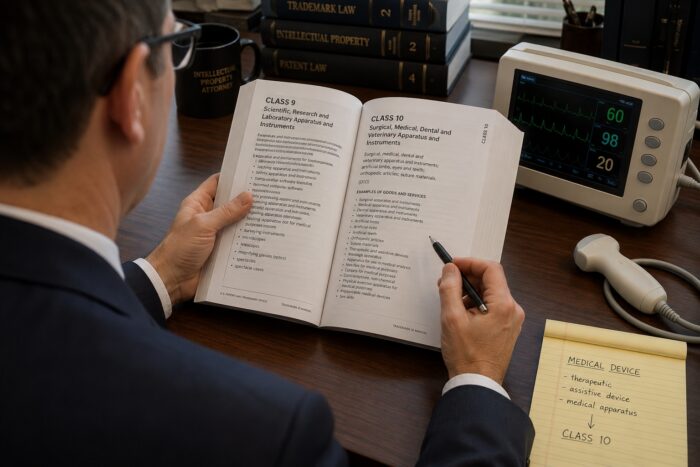
Trademark classes are the numbered categories used in trademark registration to describe the goods and services sold under a mark. They are a critical feature of the trademark application process because the applicant's goods and services must be placed in the proper classes at the time the trademark application is filed. The trademark class(es) also affect filing costs, trademark search strategy, the risk of refusal by the trademark examiner, and the practical scope of protection.
A trademark application must identify the goods or services for which the mark is used or will be used. Goods are tangible products customers buy and use, such as clothing, software sold as downloadable products, food items, or machinery. Services are intangible activities performed for the benefit of others, such as online retail store services, business consulting, entertainment, education, medical care, or legal services. The USPTO uses trademark classes to organize goods and services, assess fees, and aid searching its database of registered and pending marks. They help applicants describe their commercial activity, help the USPTO assess fees, and aid searching its database of registered and pending marks.
Choosing the correct class matters because a registration generally protects the mark only for the identified goods or services, not for every possible product or business activity. A company may need one class or multiple classes if the same brand is used across different offerings. Class selection also affects clearance searching, because similar marks in related or coordinated classes may still create a likelihood of confusion even if they are not in the same class. In short, trademark classes define the commercial context in which trademark rights are examined, registered, and enforced.
The Nice Classification system, established by the Nice Agreement in 1957 and administered through the World Intellectual Property Organization (WIPO), is the global framework for grouping trademark-related goods and services into standardized international trademark classes. Instead of requiring every country to create its own incompatible class labels, the system uses a shared classification system that allows applicants, trademark offices, and searchers to describe products and services in a consistent way. For business owners, that consistency matters because it makes international trademark filing, Madrid-based international registration, and cross-border clearance more predictable. A company seeking protection for computer software, medical devices, clothing, or business services can often begin with the same international classes when evaluating filings in different jurisdictions. The class number does not decide by itself whether trademark infringement occurred, but it helps organize searches, compare competitors’ filings, identify related goods or services, and reduce avoidable errors when expanding a brand internationally.
How many trademark classes are there? There are 45 international classes in the Nice Classification system. Classes 1–34 cover goods, meaning tangible products such as clothing, software, food, machinery, chemicals, and building materials. Classes 35–45 cover services, meaning activities performed for others, such as advertising, business management, education, legal services, medical services, and retail store services. The system began with 34 goods classes and later expanded to include 11 services class categories. Each trademark application must identify at least one class, and protection generally tracks the selected goods or services listed in the application.
Choosing the appropriate class matters because a trademark application must explain exactly how the mark is or will be used. The United States Patent and Trademark Office (USPTO) requires at least one class, and 37 C.F.R. § 2.32 requires the application to include a list of the particular goods or services and the fee for each class. A registration generally protects the trademark only in the class or classes identified in the application and only for the listed goods and services, not for every possible business activity. For example, a mark registered for clothing does not automatically protect unrelated software, food products, or legal services. The class also affects USPTO filing fees because each class requires a separate fee. Selecting the wrong class can lead to an Office Action, delays, added costs, or a narrower registration than expected. Careful classification helps define the trademark’s commercial scope and supports stronger trademark registration strategy.
The first 34 trademark classes cover goods, meaning physical products that customers buy, use, consume, wear, install, or otherwise receive as tangible items. These classes are organized partly by product function and partly by material composition. For example, some classes focus on chemicals, cosmetics, foods, machines, electronics, clothing, or building products, while others group products based on whether they are made of metal, paper, textile, synthetic materials, or other materials.
The class should match the actual product sold under the mark. A company selling fertilizer, for example, will likely look at a different class than a company selling cosmetics, metal hardware, or automatic vending machines. The following examples illustrate how the goods classes begin to operate in practice:
While goods classes cover tangible products, services classes cover intangible activities performed for the benefit of others. In the trademark context, a service is performed for customers, clients, members, or the public, such as advertising, consulting, banking, construction, education, healthcare, or legal services. However, advertising for your own business is not providing services you are providing in commerce under trademark law, and does not support any trademark rights or registration. Services have to be provided to another.
Selecting the correct services class is important because the trademark application must accurately describe how the mark is used in commerce. A company that offers consulting, education, professional, healthcare, or other services should identify the class that best matches the actual customer-facing service. Common services classes include:
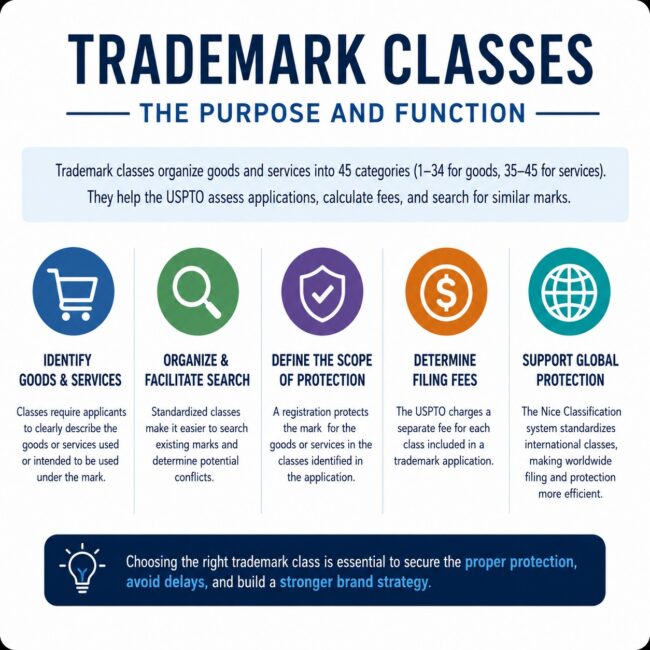
Searching the USPTO trademark ID manual for similar products can help identify class choices and reveal how examiners may view related goods or services. It is also important to search the USPTO trademark search system and use the coordinated classes options in your trademark search because certain products may fall into classes that are closely related even when they are not in the same class. For example, clothing in Class 25 may be related to jewelry in Class 14 or retail services in Class 35 if consumers would expect them to come from the same brand. Searching for similar marks in these coordinated classes helps applicants identify potential conflicting trademark filings and avoid potential likelihood of confusion issues.
A single trademark application may cover multiple classes when a brand is used for different goods or services, but the USPTO charges filing fees separately for each class. Under the USPTO’s current electronic filing framework in the Trademark Center, which recently replaced many functions of the Trademark Electronic Application System (TEAS), the base application fee is $350 per class for Section 1 and Section 44 applications that meet base requirements. That means a two-class application generally starts at $700, and a three-class application starts at $1,050. Additional USPTO fees may apply for incomplete information, custom identifications, or later use-related filings, so class selection directly affects total cost.
Using the Trademark ID Manual facilitates finding pre-approved descriptions of goods and services, which can lower filing fees, and expedite approval. Filing also requires use in commerce or a bona fide intent to use the mark in the near future. 15 U.S.C. § 1051(b) expressly permits an intent-to-use application based on a bona fide intention to use the mark in commerce. Selecting the wrong class or using vague wording can trigger an Office Action, which may require amendment, added-class fees, or refiling if the problem cannot be corrected within the application.
A registration in one class does not automatically prevent another party from registering the same trademark in a different class, or even in the same class, if the respective goods or services are sufficiently unrelated and consumers are unlikely to believe they come from the same source. For example, Delta Airlines and Delta faucets coexist because of the unrelatedness of their respective services and goods. The controlling question under 15 U.S.C. § 1052(d) is whether the applicant’s mark, as used with the identified goods or services, is likely to cause confusion, mistake, or deception. For example
The leading case, In re E.I. du Pont de Nemours & Co., 476 F.2d 1357 (C.C.P.A. 1973), identifies the multi-factor likelihood-of-confusion test used by the USPTO and courts. The du Pont factors show why two identical marks can sometimes coexist: the analysis considers not only the similarity of the marks, but also the relatedness of the goods or services, trade channels, purchasers, market conditions, and evidence of actual confusion.
In In re 1729 Investments LLC, Serial No. 90694523 (TTAB Apr. 24, 2023), the TTAB reversed a likelihood-of-confusion refusal and allowed the applicant to pursue registration of RAO’S for wine in Class 33 despite existing RAO’S registrations for restaurant and bar services in Classes 42/43. The Board found the marks identical, but held that the USPTO had not shown the required relatedness between the identified wine and restaurant/bar services, particularly in view of the applicant’s trade-channel restrictions and the sophistication of purchasers.
Accordingly, the same mark may be simultaneously registered when the records show commercially distinct goods or services, different trade channels, and no likely consumer confusion.
Trademark classes are more than filing categories. Trademark classes help business owners and entrepreneurs describe what they sell, compare competitors, budget filing fees, and avoid preventable refusals. Best practices include searching the USPTO database, reviewing coordinated classes, and checking the Trademark ID Manual for proper classification of goods and services and choosing the appropriate class or multiple classes that match actual use or bona fide intent. Careful class selection can reduce filing mistakes, avoid unnecessary USPTO fees, lower the risk of an Office Action, and help ensure that the resulting registration reflects the real scope of the business’s brand use.
If you need assistance with a trademark application or other trademark matter, please contact our office to work with our skilled trademark attorneys.
© 2026 Sierra IP Law, PC. The information provided herein does not constitute legal advice, but merely conveys general information that may be beneficial to the public, and should not be viewed as a substitute for legal consultation in a particular case.

"Mark and William are stellar in the capabilities, work ethic, character, knowledge, responsiveness, and quality of work. Hubby and I are incredibly grateful for them as they've done a phenomenal job working tirelessly over a time span of at least five years on a series of patents for hubby. Grateful that Fresno has such amazing patent attorneys! They're second to none and they never disappoint. Thank you, Mark, William, and your entire team!!"
Linda Guzman


Sierra IP Law, PC - Patents, Trademarks & Copyrights
FRESNO
7030 N. Fruit Ave.
Suite 110
Fresno, CA 93711
(559) 436-3800 | phone
BAKERSFIELD
1925 G. Street
Bakersfield, CA 93301
(661) 200-7724 | phone
SAN LUIS OBISPO
956 Walnut Street, 2nd Floor
San Luis Obispo, CA 93401
(805) 275-0943 | phone

SACRAMENTO
180 Promenade Circle, Suite 300
Sacramento, CA 95834
(916) 209-8525 | phone
MODESTO
1300 10th St., Suite F.
Modesto, CA 95345
(209) 286-0069 | phone
SANTA BARBARA
414 Olive Street
Santa Barbara, CA 93101
(805) 275-0943 | phone
SAN MATEO
1650 Borel Place, Suite 216
San Mateo, CA, CA 94402
(650) 398-1644. | phone
STOCKTON
110 N. San Joaquin St., 2nd Floor
Stockton, CA 95202
(209) 286-0069 | phone
PORTLAND
425 NW 10th Ave., Suite 200
Portland, OR 97209
(503) 343-9983 | phone
TACOMA
1201 Pacific Avenue, Suite 600
Tacoma, WA 98402
(253) 345-1545 | phone
KENNEWICK
1030 N Center Pkwy Suite N196
Kennewick, WA 99336
(509) 255-3442 | phone
2023 Sierra IP Law, PC - Patents, Trademarks & Copyrights - All Rights Reserved - Sitemap Privacy Lawyer Fresno, CA - Trademark Lawyer Modesto CA - Patent Lawyer Bakersfield, CA - Trademark Lawyer Bakersfield, CA - Patent Lawyer San Luis Obispo, CA - Trademark Lawyer San Luis Obispo, CA - Trademark Infringement Lawyer Tacoma WA - Internet Lawyer Bakersfield, CA - Trademark Lawyer Sacramento, CA - Patent Lawyer Sacramento, CA - Trademark Infringement Lawyer Sacrament CA - Patent Lawyer Tacoma WA - Intellectual Property Lawyer Tacoma WA - Trademark lawyer Tacoma WA - Portland Patent Attorney - Santa Barbara Patent Attorney - Santa Barbara Trademark Attorney
