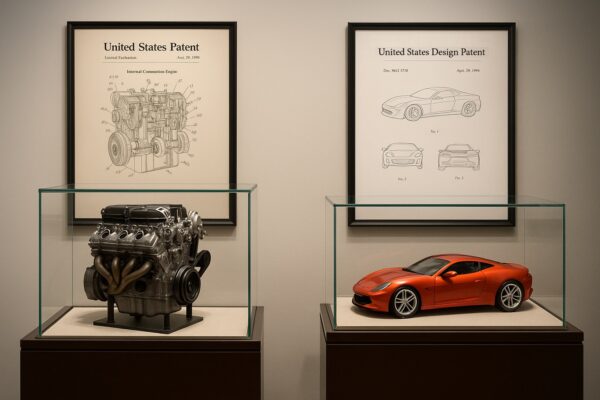
It is generally known that patents are forms of intellectual property that provide exclusive rights to innovations. However, it is less commonly known that there are different patent types that protect different types of innovation. In the United States, inventors can seek utility patents or design patents, as well as the less common plant patents, depending on what type of innovation they wish to protect. A utility patent protects an invention: a functional device, composition, or method. A design patent protects a novel ornamental design. To put it simply, a utility patent protects how something works and a design patent protects how something looks.
Each type of patent is granted by the United States Patent and Trademark Office (USPTO) and gives the patent holder exclusive rights to prevent others from making, using, selling, or importing the patented product or process. This article breaks down utility patents vs. design patents, explaining the differences in scope, application process, costs, and legal effect under U.S. patent law.
U.S. patent law provides for three primary types of patents: utility patents, design patents, and plant patents. The vast majority of patent applications filed are utility patent applications, reflecting their broad use in protecting functional inventions. Utility patents cover new and useful processes, machines, manufactures, compositions of matter, and methods: essentially the functional or technical innovations (35 U.S.C. § 101). Design patents, by contrast, cover any new, original, and ornamental design for an article of manufacture (35 U.S.C. § 171). There is also the plant patent for new varieties of plants that are asexually reproduced (e.g. by grafting or cloning), which protects distinct new plant varieties, including cultivated sports and mutants, under 35 U.S.C. § 161.
Utility patents may be obtained for inventions or discoveries in any field of technology, covering new and useful processes, machines, articles of manufacture, or compositions of matter. For example, a utility patent could cover a new engine design, a pharmaceutical composition, a software algorithm, or any improvement that is useful and meets the legal requirements of novelty and non-obviousness. In order to get a utility patent, the invention must be novel (not "anticipated" by prior art) and non-obvious (not an obvious variation of existing technology) under patent law.
The utility patent application is typically a detailed document that includes a written description, drawings, and a set of patent claims defining the scope of the invention’s protection. Unlike design patents, utility patent applications can contain multiple claims, including independent and dependent claims, to cover different aspects or embodiments of the invention. These claims delineate the legal boundaries of the invention’s functional monopoly.
Once granted, a utility patent lasts for 20 years from its filing date for applications filed since June 8, 1995 (subject to limited extensions or adjustments), and periodic maintenance fees are required to keep the patent in force at 3.5, 7.5, and 11.5 years after issuance. Failure to pay maintenance fees will cause a utility patent to expire before the end of its term. Utility patents can provide broad protection over how a product or process functions. A competitor’s product that performs the same function in the same way may infringe a utility patent even if the competitor’s product looks different or doesn't perform all of the functions the patentee's product.
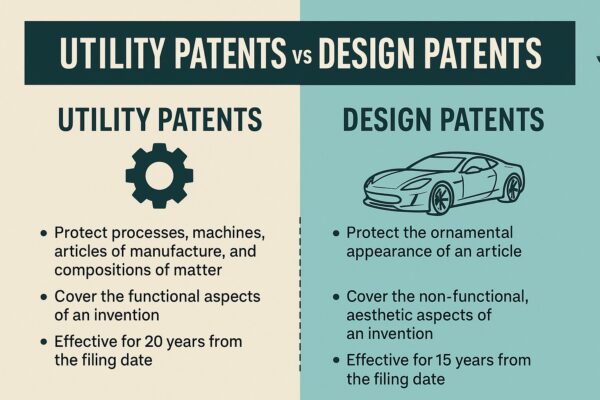
A design patent protects the ornamental design of an article of manufacture: essentially the product’s aesthetic appearance or surface ornamentation, not its utilitarian function. In simpler terms, a design patent safeguards how a product looks, as opposed to how it works. For example, the unique shape of a beverage bottle, the decorative pattern on a shoe, or the GUI icon design for an app could be protected by a design patent, so long as the design is new, original, and not dictated by purely functional considerations. If a design is “primarily functional” rather than ornamental, it is not eligible for a design patent.
The design must be embodied in or applied to an actual article of manufacture and cannot exist independently as a mere artistic concept. A design patent application consists mostly of drawings or photographs illustrating the article’s appearance from various views, and it includes only a single claim that defines the ornamental design for the article as shown and described. Unlike utility patents, there is no provision for multiple claims or multiple distinctly different designs in one design patent – if multiple distinct designs are disclosed, the USPTO will require restriction to one design per application.
Design patent applications also do not allow for a provisional application as a priority filing. This contrasts with utility patents, which can claim the benefit of a provisional patent application. If granted, a design patent gives its owner the exclusive right to the ornamental design, and it lasts for 15 years from the date of grant for design applications filed on or after May 13, 2015. Notably, no maintenance fees are required to maintain a design patent once issued. This makes design patents relatively low-cost to keep in force.
Design patent protection is narrower in scope than utility protection: it covers only the specific visual design shown in the drawings and colorable imitations thereof, and no functional features of the article. However, design patents are powerful in preventing look-alike products. If an infringing product has an appearance that is substantially similar to the patented design to the eye of an ordinary observer, it will infringe the design patent. In litigation, courts apply the “ordinary observer” test for design patent infringement, asking whether an ordinary purchaser, giving the attention usually given, would be deceived into thinking the accused design is the same as the patented design.
This test was established in Gorham Co. v. White, 81 U.S. 511 (1871), and was later modified to specify that any functional features or features that are present in the prior art will be considered in evaluating whether the ordinary observer would consider the designs to be substantially the same. Functional features are not considered as part of the design in infringement analysis. OddzOn Products, Inc. v. Just Toys, Inc., 122 F.3d 1396 (Fed. Cir. 1997). Also, the ordinary observer is considered to be aware of similar prior art designs. If there are similar prior art designs to the patented design, even small differences between the patented design and an allegedly infringing design may result in the court finding no infringement. Egyptian Goddess, Inc. v. Swisa, Inc., 543 F.3d 665 (Fed. Cir. 2008).
While both utility and design patents confer exclusive rights to their owners, they differ in fundamental ways. The table below summarizes the key differences between utility patents and design patents under U.S. law:
| Aspect | Utility Patent | Design Patent |
| What it Protects | Functional inventions: the use, operation, or structure of a process, machine, manufacture, or composition of matter (how an invention works). Protects utility or functionality, not appearance. | Ornamental designs: the visual design and ornamental characteristics of an article of manufacture. Protects aesthetic features only, not function or use. |
| Subject Matter Examples | Must have utility (practical use). A novel processes, machines, articles of manufacture, compositions of matter, or method. E.g., new engine mechanism, chemical formula, electronic circuit, software process. | Any new, original, ornamental design applied to a product. Must be primarily aesthetic, not dictated by functional features. E.g. new product shape, decorative pattern, user-interface icon design. |
| Claims | Can have multiple claims defining different aspects or embodiments of the invention. Claims describe the functional features in words. | Only a single claim is allowed, generally of the form “the ornamental design for [article] as shown and described”. The scope is defined by the drawings, and the claim covers the overall design shown. |
| Term (Duration) | 20 years from filing date of the application, subject to payment of maintenance fees and any patent term extensions/adjustments. | 15 years from grant date for design applications filed on or after 5/13/2015. Design patents filed earlier last 14 years from grant. |
| Maintenance Fees | Maintenance fees must be paid at 3.5, 7.5, and 11.5 years after issuance to keep patent enforceable. If not paid, the patent expires early. | No maintenance fees are required after a design patent is issued. The patent remains in force for the full 15-year term without additional fees. |
| Application Process | Can start with a provisional patent application (optional) to secure a filing date, followed by a non-provisional utility patent application with a full description, claims, and often many drawings. Utility applications undergo substantive examination on usefulness, novelty (35 U.S.C. § 102) and non-obviousness (35 U.S.C. § 103). Publication usually occurs 18 months after filing. | No provisional applications for designs (design apps must be filed directly as a design application). The design application consists primarily of formal drawings of the article from multiple views and a brief description. Examination focuses on whether the design is new and non-obvious over prior designs. Design applications are not published pre-grant: they remain confidential until the patent is granted. |
| Cost and Complexity | Typically more expensive and complex: attorney fees and USPTO fees are higher, due to longer applications with multiple claims and longer prosecution. Legal costs can be significant, and it may take 2~3 years for patent grant. | Generally less expensive and faster. Design patents often have lower filing and attorney fees. The process is quicker: many design patents issue within 1~2 years. Overall legal costs are lower, and no maintenance fees adds to cost savings. |
| Scope of Protection | Functional scope: The protection of the invention resides in the written claims. Any product or process that performs all of the patented function or uses the patented features infringes the claim. Even if a competitor changes the look, if they appropriate the patented functional elements, it infringes. Allows for broad market exclusion of competing technologies. | Ornamental scope: The protection resides in the aesthetic aspects of the design drawings. Products with an appearance that is substantially similar to the patented design to an ordinary observer. Functional or internal features are not covered. Competitors can copy function, not appearance. |
| Infringement Test | Infringement of a utility patent is determined by comparing the patent’s written claims to the accused product/process: if the product includes each element of at least one claim (either literally or via an equivalent), it infringes. The focus is on functional elements as defined in words by the claims. | Infringement of a design patent is determined by the ordinary observer test: would an ordinary purchaser view the accused design and the patented design as substantially the same, such that they would be confused or deceived into thinking they are the same design? If yes, infringement is found. |
| Examples | A new type of smartphone battery that lasts longer (functional improvement), a new manufacturing process for steel, a pharmaceutical drug formula: all protect how something works or is made. | The unique shape of a smartphone’s edge or its icon layout, the pattern of a sneaker’s sole, the ornamental design of a lamp: all protect the appearance only, and not the function of the item. Often used to protect product styling and brand-specific product designs. |
The process of obtaining a utility vs. design patent also differs. For a utility patent application, inventors often begin with a patentability search (patent search) to identify prior art and evaluate if the invention is novel and non-obvious. One may first file a provisional patent application to secure an early filing date and the term “patent pending,” then file a full non-provisional application within 12 months. The provisional itself is not examined and will lapse if not followed by a full application.
The non-provisional utility application must include a thorough written description of the invention, any necessary drawings, and at least one claim. It is examined by the USPTO for compliance with legal requirements: patent eligible subject matter (35 U.S.C. § 101), novelty (35 U.S.C. § 102), non-obviousness (35 U.S.C. § 103), and adequacy of disclosure (35 U.S.C. § 112). The patent examination process (patent prosecution) can involve back-and-forth with the patent examiner through office actions and responses, and may take a few years before a patent is granted. It is recommended that Applicants hire a registered patent attorney to draft and prosecute a utility patent application, given the complexity of patent drafting and prosecution.
For a design patent application, the process is generally simpler. A design application typically consists of a title, a description of the figures, one claim, and a set of formal drawings (or photographs) showing the article from multiple perspectives (e.g., front, rear, top, bottom, left, right, and any perspective views needed) in accordance with USPTO drawing rules.
Because design patents protect only the ornamental appearance, the drawings are crucial. The drawings define the scope of what the design patent protects. The drawings must capture every ornamental feature, present the design consistently throughout, and conform with all design requirements under the US patent law and the USPTO's design rules. The drawings have highly specialized form, and thus it is recommended that the applicant utilize the services of a patent attorney or law firm with experience in the design patent field.
The design application is examined mostly for novelty and non-obviousness over prior art designs. The same statutory standards of patentability apply, with 35 U.S.C. § 102 and § 103 requiring the design to be new and non-obvious. Often the examination of design applications is faster and more straightforward, though examiners may issue rejections if they find similar prior designs or if the drawings have any formal issues.
It’s worth noting that effective January 2024, the USPTO established a separate design patent practitioner bar for practitioners specializing only in design patent matters. A person with the appropriate background can become a registered patent agent in the design patent specialty without an engineering or science background. This underscores that design patent practice is a highly defined and specialized field. While sharing some fundamentals with utility patent practice, design patent practice has its own nuances, such as drawing requirements and restriction practices.
Cost considerations are often a deciding factor in choosing between utility and design patent protection. A utility patent generally involves higher legal costs due to the length and complexity of the application. Drafting a solid utility patent and prosecuting it through potential rejections can cost several thousands to tens of thousands of dollars in attorney fees, depending on complexity. The USPTO filing, search, and examination fees for a utility application are also higher than for a design application.
In contrast, a design patent application is shorter and focused on drawings, which typically makes it significantly less expensive in terms of preparation and prosecution fees. Many design applications might cost on the order of a few thousand dollars total, including professional drawing preparation. As noted earlier, maintenance fees apply only to utility and plant patents, not to design patents. Utility patent maintenance fees add to the long-term cost of a utility patent. Design patent owners do not face this ongoing expense, as once a design patent is granted, it remains in force for its entire 15-year term without additional payments.
The patent term also differs: a utility patent lasts 20 years from the effective filing date. This term can provide long-lasting protection but note that the effective enforceable term is less than the full 20 years because the patent term is not tolled during application examination. Design patent term is 15 years from issuance. While shorter in number, the design patent term is counted from grant.
You can, of course, obtain both utility and design patents for any product that has both functional and ornamental features that are novel and non-obvious. The utility patent protects the functional concept for 20 years from filing, and the design patent protects the product’s appearance for 15 years from issue.
Both utility and design patents give the owner the right to exclude others from making, using, selling, or importing the patented invention in the United States, but what constitutes infringement differs between the two. With a utility patent, infringement is determined by analyzing the patent’s claims to determine whether an accused product or process contains every element of a patent claim or an equivalent thereto, under the doctrine of equivalents. If all the claim elements are met literally or by equivalents, then that product infringes the utility patent. This means a competitor cannot avoid infringement simply by making a product look different or by trivial changes. If the underlying functionality as defined in the claims is taken, it’s an infringement. For example, if a utility patent claim covers a machine with elements A, B, and C in combination, any machine that has those elements or equivalents thereof arranged as described will likely infringe, regardless of its outward appearance. Utility patent enforcement often involves technical analysis and possibly expert testimony to show how the accused device meets the claim limitations.
For a design patent, enforcement is more about visual comparison than technical analysis. The scope of a design patent is defined by the patented drawings, and an accused design must be compared to those drawings. In practice, courts and juries will often compare images of the patented design and the accused product side-by-side. If the overall aesthetic impression of the accused design is substantially the same as the patented design, such that an ordinary purchaser would likely confuse the two, infringement is found.
Remedies for infringement are similar for both types of patents. The patent holder can sue in federal court and seek an injunction to stop sales of the infringing product and monetary damages. Monetary damages can be the plaintiff's lost profits, or at least a reasonable royalty for the infringing use. One difference is that design patent infringement gives rise to the additional remedy of disgorgement of the infringer’s profits attributable to the design under 35 U.S.C. § 289. This is a powerful remedy. However, its scope was somewhat curtailed in the Apple v. Samsung design patent case. The court limited the disgorgement of profits remedy to the particular article of manufacture claimed in the design patent, rather than a complete product that incorporates the claimed article of manufacture. See Samsung Elecs. Co. v. Apple Inc., 137 S. Ct. 429 (2016).
Utility patent damages are typically based on patent holder’s lost profits or reasonable royalties, not the infringer’s total profits. The key takeaway is that a utility patent is a stronger tool against competing products that perform the same function, whereas a design patent is a precise tool against knock-offs that look the same. In many cases, if an invention has both novel functional and ornamental aspects, obtaining both types of patents can provide complementary protection.
If you plan to pursue international patent rights, you should understand how utility and design patents are treated internationally. Utility patents can be pursued in foreign countries by filing corresponding applications in each country or via the Patent Cooperation Treaty (PCT), which allows a unified international patent application that can later enter national phases in various countries. The PCT process is available for utility and plant inventions, not for designs. Under the Paris Convention, if you first file a U.S. utility patent application, you have 12 months to file corresponding foreign patent applications claiming that priority.
For designs, there is a separate international system under the Hague Agreement for Industrial Designs, which the U.S. has joined. The Hague system permits filing a single international Hague System design application to seek design protection in multiple member countries, simplifying the process of global design protection. If you first file a U.S. design patent application, you have 6 months to file design applications in other countries claiming priority.
It’s wise to consult with patent counsel about an international filing strategy. A registered patent attorney experienced in international filings can coordinate Patent Cooperation Treaty filings for utility inventions and Hague or direct filings for designs, helping ensure you meet all deadlines and requirements across jurisdictions. Keep in mind that patent rights are territorial. A U.S. patent (utility or design) only gives rights in the United States. To stop infringements in Europe or Asia, for example, you would need to have obtained the corresponding European or Asian patents/design protections.
Both utility and design patents are valuable tools in a company’s intellectual property arsenal, but they serve different purposes. In summary, utility patents protect functional innovations, the technical solutions and functional features that allow your product or process to operate, while design patents protect ornamental innovations, the aesthetic design and visual appeal that make your product look unique. Understanding the difference is crucial for developing a robust patent strategy: if you have invented a new product, you should consider whether there are novel functional aspects, ornamental aspects, or both.
Given the complexity of patent law and the importance of proper filings, you should strongly consider consulting with a registered patent attorney for guidance on patent searches, application preparation, and prosecution. Ultimately, securing the right type of patent protection will help safeguard your competitive advantage. If you need assistance with pursuing a patent application or other intellectual property matter, contact our office for a free consultation.
© 2025 Sierra IP Law, PC. The information provided herein does not constitute legal advice, but merely conveys general information that may be beneficial to the public, and should not be viewed as a substitute for legal consultation in a particular case.

"Mark and William are stellar in the capabilities, work ethic, character, knowledge, responsiveness, and quality of work. Hubby and I are incredibly grateful for them as they've done a phenomenal job working tirelessly over a time span of at least five years on a series of patents for hubby. Grateful that Fresno has such amazing patent attorneys! They're second to none and they never disappoint. Thank you, Mark, William, and your entire team!!"
Linda Guzman


Sierra IP Law, PC - Patents, Trademarks & Copyrights
FRESNO
7030 N. Fruit Ave.
Suite 110
Fresno, CA 93711
(559) 436-3800 | phone
BAKERSFIELD
1925 G. Street
Bakersfield, CA 93301
(661) 200-7724 | phone
SAN LUIS OBISPO
956 Walnut Street, 2nd Floor
San Luis Obispo, CA 93401
(805) 275-0943 | phone

SACRAMENTO
180 Promenade Circle, Suite 300
Sacramento, CA 95834
(916) 209-8525 | phone
MODESTO
1300 10th St., Suite F.
Modesto, CA 95345
(209) 286-0069 | phone
SANTA BARBARA
414 Olive Street
Santa Barbara, CA 93101
(805) 275-0943 | phone
SAN MATEO
1650 Borel Place, Suite 216
San Mateo, CA, CA 94402
(650) 398-1644. | phone
STOCKTON
110 N. San Joaquin St., 2nd Floor
Stockton, CA 95202
(209) 286-0069 | phone
PORTLAND
425 NW 10th Ave., Suite 200
Portland, OR 97209
(503) 343-9983 | phone
TACOMA
1201 Pacific Avenue, Suite 600
Tacoma, WA 98402
(253) 345-1545 | phone
KENNEWICK
1030 N Center Pkwy Suite N196
Kennewick, WA 99336
(509) 255-3442 | phone
2023 Sierra IP Law, PC - Patents, Trademarks & Copyrights - All Rights Reserved - Sitemap Privacy Lawyer Fresno, CA - Trademark Lawyer Modesto CA - Patent Lawyer Bakersfield, CA - Trademark Lawyer Bakersfield, CA - Patent Lawyer San Luis Obispo, CA - Trademark Lawyer San Luis Obispo, CA - Trademark Infringement Lawyer Tacoma WA - Internet Lawyer Bakersfield, CA - Trademark Lawyer Sacramento, CA - Patent Lawyer Sacramento, CA - Trademark Infringement Lawyer Sacrament CA - Patent Lawyer Tacoma WA - Intellectual Property Lawyer Tacoma WA - Trademark lawyer Tacoma WA - Portland Patent Attorney - Santa Barbara Patent Attorney - Santa Barbara Trademark Attorney
