
An invention must be nonobvious to qualify for a patent. This means a patent cannot be granted “if the differences between the claimed invention and the prior art are such that the claimed invention as a whole would have been obvious… to a person having ordinary skill in the art”. 35 U.S.C. § 103. Determining obviousness involves comparing the invention to earlier technology (prior art) and assessing what an ordinary skilled practitioner would find obvious.
However, even when prior art seems to suggest an invention, secondary considerations of nonobviousness, also known as objective evidence or objective indicia, can tip the balance by showing the real-world significance of the invention. Such objective evidence of non-obviousness can overcome a rejection of the claimed invention. Secondary considerations can mean the differences between patentability and rejection in a patent application. This article explains secondary considerations, outlining what they are, why they matter, and how they are used.
Obviousness is a core patentability test codified in 35 U.S.C. § 103, which bars patents on inventions that “would have been obvious” in light of earlier technology. In practice, patent examiners and courts evaluate obviousness by considering the differences between the prior art and the patent claim, the scope of relevant prior art references, and the level of ordinary skill in the field. This framework was established by the U.S. Supreme Court in Graham v. John Deere Co., which set forth factors to guide obviousness determination. Under the Graham factors, the decision-maker looks at (1) the scope and content of the prior art; (2) the differences between the prior art and the claimed invention; and (3) the level of ordinary skill in the art. 383 U.S. 1 (1966). Once these primary factors are analyzed, the obviousness or nonobviousness of the invention “is determined” against that backdrop. Notably, the Supreme Court acknowledged that “[s]uch secondary considerations as commercial success, long felt but unsolved needs, failure of others, etc., might be utilized to give light to the circumstances surrounding the origin of the subject matter sought to be patented.” Ibid. In other words, beyond the technical comparison of elements, the law invites consideration of real-world objective indicia that an invention is not obvious.
Secondary considerations of nonobviousness are facts about how an invention fared in the real world, offered as objective evidence that the invention was not obvious. They are “secondary” in the sense that they are considered after establishing a prima facie (at first glance) case of obviousness based on the prior art. Unlike subjective arguments or theoretical comparisons, these factors rely on tangible outcomes and reactions to the invention: hence also called “objective indicia of nonobviousness.” Courts have emphasized that such evidence must always be considered when present, and it can be highly probative. In fact, the Federal Circuit noted that:
In short, secondary considerations help ground the obviousness inquiry in real-world facts, guarding against hindsight and highlighting the invention’s unique characteristics or impact.
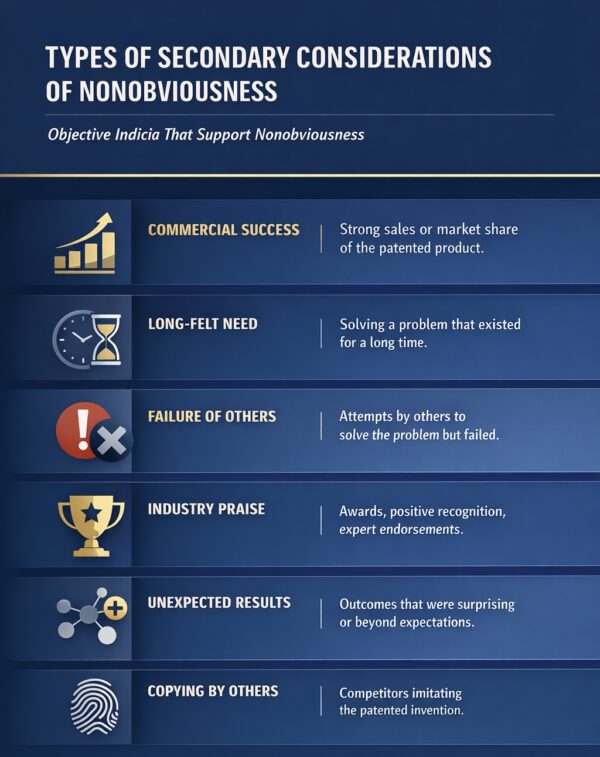
Patent law recognizes many objective factors that can serve as secondary considerations. Some of the most common secondary considerations (sometimes called objective evidence of nonobviousness) include:
Commercial success of a product embodying the invention. Strong sales or market share attributable to the invention’s features can demonstrate that invention disclosed is more likely to be innovative and nonobvious.
Long-felt but unsolved need that the invention finally addressed can indicate patentability. If industry had a longstanding problem that the invention solved, the invention may be patentable.
Failure of others to find a solution: if others tried and failed to invent what the patent claims, it is an indication that the invention was not obvious.
Industry praise or recognition: Awards and professional accolades for the invention, such as winning industry awards or positive press, signal it is a patentable advance.
Copying by competitors: If others in the market copied the invention, it suggests the idea was not obvious to them beforehand.
Unexpected results achieved by the invention, such as the results or properties go far beyond what the prior art or routine skill would predict, indicate nonobviousness.
Skepticism of experts: If experts initially thought the idea would not work, the invention's success indicates an inventive step.
Licensing of the patented invention: Competitors taking licenses or investors investing due to the invention’s merits can indicate its nonobvious value.
Industry adoption or widespread use: If the invention’s features are widely adopted in the field, displacing older technology, the invention may be patentable.
Each of these factors is a form of objective indicia: evidence stemming from the real-world impact of the invention. Not every patent will have all (or any) of these, but such evidence, when available, can strongly support a patent owner’s position that the invention was not obvious.
Crucially, for any secondary considerations evidence to carry weight, there must be a “nexus” between the evidence and the claimed features of the invention. The term nexus means a legally and factually sufficient connection. The evidence must actually be due to the merits of the claimed invention, not other factors. The Federal Circuit has explained that when a patentee asserts that secondary considerations support a finding that a patent claim is nonobviousness and valid, there must be a sufficient relationship or "nexus" between the secondary considerations and the patented invention. Demaco Corporation v. F. Von Langsdorff Licensing Limited and F. Von Langsdorffbauverfahren Gmbh, 851 F.2d 1387 (Fed. Cir. 1988).
In practical terms, this nexus requirement ensures that the success or praise arises from what is specifically claimed in the patent (the inventive combination or feature), rather than from extraneous factors like marketing, superior quality, or features already known in the prior art.
Establishing nexus can be done in two ways. First, if the product that achieved commercial success or praise is coextensive with the patent’s claims, then a presumption of nexus arises: i.e., the product’s core features are included in the patent claims and it has no significant unclaimed features. For instance, if a patented drug has only active ingredient, the ingredient is claimed, and the drug achieves great success, one can presume the success is due to the claimed invention.
However, if the product includes additional unclaimed features or improvements, or if external factors, like aggressive advertising or price might explain its success, then no automatic presumption applies. In that case, the patent owner must prove nexus with specific evidence tying the positive outcome to the unique characteristics of the claimed invention. The patent owner can do this by showing, for example, that customers or experts specifically credit the invention’s claimed feature for the product’s success or that the success would not have been possible without the claimed combination.
Without a nexus, even compelling evidence (sales figures, awards, etc.) will be given little or no weight. For example, simply showing high sales is not enough if those sales might be due to marketing or to features not covered by the patent. The Federal Circuit has held that a mere showing of a licensing deal or industry acclaim must be connected to the patent’s specific innovation. In one case, a patent owner pointed to a lucrative licensing agreement as evidence of nonobviousness, but the court found no nexus because “the mere existence of the license is insufficient to overcome the conclusion of obviousness” absent proof that the license stemmed from the merits of the claimed invention. Sibia Neurosciences, Inc. v. Cadus Pharm. Corp., 225 F.3d 1349 (Fed. Cir. 2000).
In another example, a company’s patent on a recording and processing audio system for wireless microphones received industry praise, including an Engineering Emmy award, for solving the long-felt problem of fixing dropouts (signal loss). Lectrosonics, Inc. v. Zaxcom, Inc., Case No. IPR2018-01129 (PTAB Jan. 24, 2020). However, the broad patent claims did not actually require the dropout-repair feature, they were written broadly to cover any combining of local and remote audio data. Because the offered secondary consideration (industry awards and praise) was primarily directed at the dropout-fixing capability and the challenged claims did not include that feature, the PTAB found a lack of nexus because the evidence couldn’t be clearly attributed to the claimed invention. As a result, the patent trial decision discounted the industry praise as a secondary consideration. The patent owner in that case had more success only after amending the claims to include the dropout-repair element explicitly, thereby aligning the evidence of praise with the claimed invention’s unique characteristics. This illustrates that secondary consideration arguments will only persuade if a nexus exists between the evidence and what is actually claimed.
During patent examination, secondary considerations can be a powerful tool for applicants to overcome an obviousness rejection. Typically, a patent examiner first establishes a prima facie case that the invention would have been obvious based on prior art. The patent applicant (or patent owner in a reexamination) may then rebut that case by submitting objective evidence. For example, sales data showing commercial success, declarations from experts about a long-felt need, or other evidence of secondary considerations. The USPTO’s examination guidelines instruct examiners to consider all such objective evidence of nonobviousness in the record before reaching a final determination. Secondary considerations can provide a strong patent prosecution strategy for overcoming patent rejections based on obviousness.
In fact, examiners are reminded to consider all objective evidence that has been properly made of record and is relevant to the issue of obviousness. M.P.E.P. § 2142. This means that if an applicant provides affidavits or documents demonstrating real-world success or failure of others, the examiner must weigh that along with the prior art. Importantly, even if the examiner thinks the prior art makes the invention prima facie obvious, secondary considerations must be analyzed together with the other Graham factors, not just after a conclusion is already drawn. Neglecting to consider such evidence is legal error.
The Federal Circuit has cautioned that an examiner “must not stop until all pieces of evidence on that issue have been fully considered and each has been given its appropriate weight,” including any secondary indicia. Stratoflex, Inc. v. Aeroquip Corp., 713 F.2d at 1539. Thus, an applicant can establish nonobviousness by successfully demonstrating that, on balance, the invention’s proven benefits or industry recognition outweigh what the prior art seemed to suggest, especially if a strong nexus to the claimed features is shown.
Secondary considerations frequently come into play in patent litigation, such as in validity challenges before the Patent Trial and Appeal Board (PTAB) or in court. In inter partes review (IPR) proceedings at the PTAB, which is a type of patent trial focused on obviousness and other validity issues, the patent owner often introduces secondary consideration evidence in its response to an obviousness challenge. For example, the patent owner might present evidence of the invention’s commercial success, industry praise, or that competitors failed and then copied the invention, all to reinforce that the invention would not “have been obvious” to try or develop earlier. The PTAB and courts must weigh this alongside the prior art evidence.
As noted, the Appeal Board will scrutinize the nexus requirement carefully in these cases. The Federal Circuit (the court that hears appeals from patent office decisions) has consistently held that secondary considerations lacking a nexus to the claimed invention cannot overcome a strong showing of obviousness. In Fox Factory, Inc. v. SRAM, LLC, for instance, the PTAB initially found a patent nonobvious due to evidence of commercial success and industry praise for the product. No. 18-2024 (Fed. Cir. 2019). But the Federal Circuit vacated that decision because the Board erred in presuming nexus without adequate proof that the success was due to the claimed combination of features. The case underscored that secondary considerations are given “substantial weight” only when tied to the specific claimed combination of elements, not just the product in general.
Similarly, in Teva Pharm. v. Eli Lilly & Co., the court affirmed an obviousness finding where the patent owner’s asserted objective evidence (a third-party license agreement) was not shown to have any nexus to the claimed invention’s merits, calling the license evidence “insufficient to overcome the conclusion of obviousness” in that case. No. 20-1749 (Fed. Cir. 2021). These cases demonstrate that while objective indicia are an integral part of an obviousness analysis, success in using them depends on clearly connecting the patent owner’s objective evidence to the inventive aspects of the patent claim at issue.
Ultimately, the determination of obviousness is a case-by-case judgment, considering all evidence. Secondary consideration evidence does not automatically trump a strong prior art case, but it can make the difference in a close call or even overcome a weak obviousness showing. The Graham factors (primary criteria and secondary indicia) must be weighed together on a case-by-case basis, with no single factor being dispositive. If an invention was truly obvious, one would not expect to see significant objective evidence of innovation like unmet needs solved or acclaim from experts. Thus, when a patent owner presents robust secondary considerations with a proven nexus, they are entitled to “substantial weight”.
In fact, secondary considerations can be the most compelling evidence of nonobviousness, especially when technical comparisons alone are debatable. On the other hand, if no secondary considerations are present for a given invention, that absence does not by itself prove obviousness – it simply means the decision rests on the prior art and other factors. All relevant factors must be analyzed and given appropriate weight before concluding obviousness or nonobviousness.
Secondary considerations of nonobviousness provide real-world validation that an invention was a nonobvious leap. They can strengthen a patent application during patent examination or serve as crucial evidence in a patent trial to uphold a patent’s validity. However, one must also ensure a nexus between the evidence and the specific claimed features of the invention. Courts and the USPTO will give substantial weight to secondary considerations if they genuinely stem from the patented invention itself.
By gathering and presenting relevant factors on these secondary considerations, a patent applicant can significantly bolster their case that an invention “would not have been obvious” to create beforehand. Such evidence helps ensure that truly innovative advancements receive the legal protection they deserve.
Subtle issues in patent law like secondary considerations are best handled by an experienced patent attorney. If you are considering pursuing a patent or you have other patent matters you need to address, contact our office for a free consultation.
© 2025 Sierra IP Law, PC. The information provided herein does not constitute legal advice, but merely conveys general information that may be beneficial to the public, and should not be viewed as a substitute for legal consultation in a particular case.

"Mark and William are stellar in the capabilities, work ethic, character, knowledge, responsiveness, and quality of work. Hubby and I are incredibly grateful for them as they've done a phenomenal job working tirelessly over a time span of at least five years on a series of patents for hubby. Grateful that Fresno has such amazing patent attorneys! They're second to none and they never disappoint. Thank you, Mark, William, and your entire team!!"
Linda Guzman


Sierra IP Law, PC - Patents, Trademarks & Copyrights
FRESNO
7030 N. Fruit Ave.
Suite 110
Fresno, CA 93711
(559) 436-3800 | phone
BAKERSFIELD
1925 G. Street
Bakersfield, CA 93301
(661) 200-7724 | phone
SAN LUIS OBISPO
956 Walnut Street, 2nd Floor
San Luis Obispo, CA 93401
(805) 275-0943 | phone

SACRAMENTO
180 Promenade Circle, Suite 300
Sacramento, CA 95834
(916) 209-8525 | phone
MODESTO
1300 10th St., Suite F.
Modesto, CA 95345
(209) 286-0069 | phone
SANTA BARBARA
414 Olive Street
Santa Barbara, CA 93101
(805) 275-0943 | phone
SAN MATEO
1650 Borel Place, Suite 216
San Mateo, CA, CA 94402
(650) 398-1644. | phone
STOCKTON
110 N. San Joaquin St., 2nd Floor
Stockton, CA 95202
(209) 286-0069 | phone
PORTLAND
425 NW 10th Ave., Suite 200
Portland, OR 97209
(503) 343-9983 | phone
TACOMA
1201 Pacific Avenue, Suite 600
Tacoma, WA 98402
(253) 345-1545 | phone
KENNEWICK
1030 N Center Pkwy Suite N196
Kennewick, WA 99336
(509) 255-3442 | phone
2023 Sierra IP Law, PC - Patents, Trademarks & Copyrights - All Rights Reserved - Sitemap Privacy Lawyer Fresno, CA - Trademark Lawyer Modesto CA - Patent Lawyer Bakersfield, CA - Trademark Lawyer Bakersfield, CA - Patent Lawyer San Luis Obispo, CA - Trademark Lawyer San Luis Obispo, CA - Trademark Infringement Lawyer Tacoma WA - Internet Lawyer Bakersfield, CA - Trademark Lawyer Sacramento, CA - Patent Lawyer Sacramento, CA - Trademark Infringement Lawyer Sacrament CA - Patent Lawyer Tacoma WA - Intellectual Property Lawyer Tacoma WA - Trademark lawyer Tacoma WA - Portland Patent Attorney - Santa Barbara Patent Attorney - Santa Barbara Trademark Attorney
