
This page explains what trade secrets are, provides practical trade secret examples, summarizes the legal definitions that apply under trade secret law, and outlines basic protection strategies for keeping valuable business information confidential. It is intended for business owners, legal professionals, students, and others who want to understand how trade secret protection works in real-world settings.
A trade secret is a type of intellectual property that consists of information, such as a formula or process, that derives economic value from not being generally known or readily ascertainable, and is subject to reasonable efforts to maintain its secrecy.
In other words, a trade secret is business information that stays valuable because competitors do not know it. For many businesses, trade secrets play a crucial role in protecting intellectual property, preserving a competitive advantage, and keeping a long-term competitive edge. Trade secrets can protect proprietary information indefinitely if they remain secret. Unlike patents, trade secret protection does not require public disclosure, examination, registration, renewal, or formal registration costs. Trade secrets are not applied for or registered, and that protection can be unlimited if legal secrecy requirements are met.
That makes trade secrets attractive for a comprehensive IP strategy, especially for companies that continuously refine proprietary systems, software, formulas, or manufacturing processes.
Under federal trade secret law, a trade secret includes financial, business, scientific, technical, economic, or engineering information, such as formulas, methods, techniques, processes, programs, or codes, if the owner takes reasonable efforts to keep the information secret and the information has independent economic value because it is not generally unknown or readily ascertainable. See 18 U.S.C. § 1839(3).
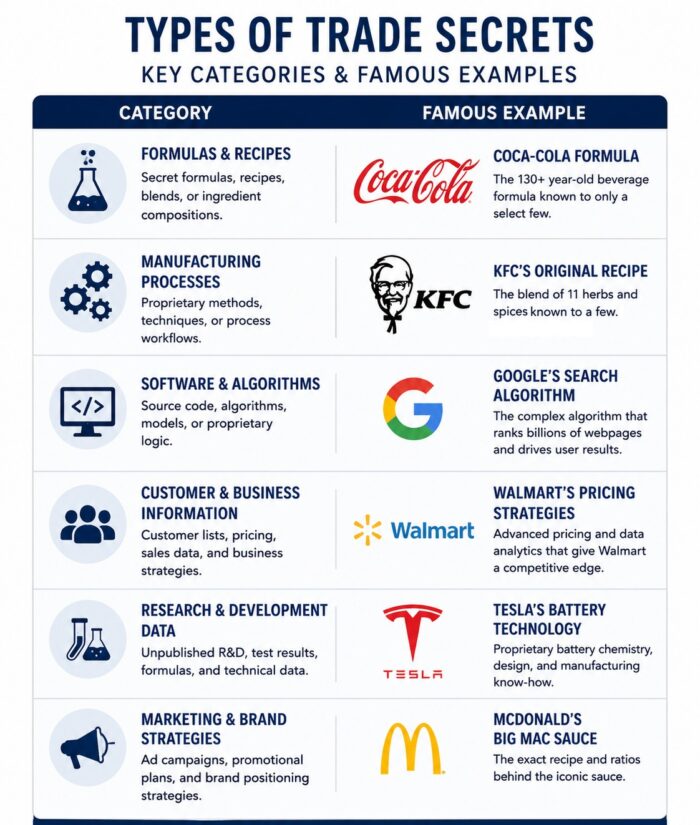
In plain English, a trade secret is commercially valuable confidential information that gives your business an advantage because competitors do not have it. Common trade secret examples include:
For example, a food company may treat a sauce recipe, spice blend, or production method as a trade secret if the exact ingredients, measurements, and preparation steps are not publicly disclosed.
A technology company may protect proprietary systems, algorithms, training data, or code that improve search results, recommendations, automation, or user engagement. A manufacturer may protect a process that lowers costs, improves durability, increases speed, or produces a better product than competitors can easily replicate.
The key point is that legal protection does not apply merely because the "trade secret" information is useful. The information must derive value from being secret. A customer list copied from a public directory usually will not qualify. But a curated list containing customer needs, purchasing history, pricing preferences, renewal dates, decision-makers, and relationship notes may qualify because it reflects proprietary knowledge developed through time, expense, and business experience.
Trade secrets also differ from patent protection. Unlike patents, trade secrets do not require public disclosure, registration, or renewal fees. They can remain protected indefinitely as long as they remain secret and the owner continues taking reasonable measures to preserve confidentiality. Those measures may include non-disclosure agreements, confidentiality provisions in employment and other contracts, access controls, password protection, employee training, limited distribution, vendor restrictions, and clear internal policies for sensitive information.
For many businesses, trade secrets are a practical form of intellectual property protection because they safeguard information that supports a competitive edge, helps preserve strategic advantages, and strengthens the company’s ability to compete.
Some of the most famous trade secrets are in the food industry, where a secret formula, secret recipe, or unique manufacturing method can become central to a company’s brand identity and long-term competitive advantage. The Coca-Cola formula is the classic example. The Coca-Cola Company states that the formula has been protected for more than 130 years, and that the formula is kept secret, placed in a vault, and safeguarded as one of the company’s most closely guarded assets. Because the exact details of the formula are not publicly disclosed, the company can preserve the mystique and market value associated with one of the world’s best-known beverages.
Kentucky Fried Chicken is another notable example. KFC’s Original Recipe uses 11 herbs and spices, and KFC has described the recipe as housed in a guarded vault, with suppliers split so no one supplier can recreate the exact mix of secret ingredients. This is a practical example of trade secret protection: the company does not merely claim the recipe is confidential; it uses physical security, limited disclosure, and divided access to help the recipe remain secret.
Other examples often discussed include a secret recipe for sauces, such as McDonald’s Big Mac sauce. While consumers may know the general flavor profile of a sauce, the precise ingredient ratios, sourcing decisions, preparation steps, shelf-stability methods, and internal quality-control specifications may still be confidential information if they are not generally known and are subject to reasonable efforts to maintain secrecy.
In the fragrance industry, perfume formulas are commonly treated as trade secrets because the commercial value often lies in the exact blend of natural and synthetic compounds, concentrations, stabilizers, and production methods. Chanel No. 5 and Dior J’adore are famous perfume formulas guarded by trade secret protection. The formula’s value depends on maintaining secrecy and preventing competitors from copying the precise scent profile. Although a competitor may attempt reverse engineering to create a “dupe,” the original brand’s exact formula, sourcing information, and manufacturing know-how may remain confidential information.
Health supplements provide another practical category of trade secret examples. In Caudill Seed & Warehouse Co. v. Jarrow Formulas, Inc., 53 F.4th 368 (6th Cir. 2022), the Sixth Circuit upheld a substantial trade secret misappropriation verdict involving proprietary research and development related to a broccoli-seed extract ingredient used in dietary supplements. The case shows that a supplement company’s commercially valuable know-how may include not only a finished formula, but also testing data, extraction methods, ingredient standardization techniques, supplier knowledge, and research showing how to achieve a desired concentration or biological effect.
Technology companies often rely on trade secrets to protect algorithms, models, source code, training data, chip designs, robotics workflows, cybersecurity methods, product roadmaps, internal analytics, and battery or manufacturing know-how. These assets can be just as important as patents because they often involve proprietary knowledge that is continuously improved and not available to competitors.
Google’s search algorithm is frequently cited as one of the world’s famous trade secrets. Google’s algorithm clearly provides a competitive advantage, as it is the most valuable asset of the search engine giant. Google's ranking systems use many factors and signals to rank hundreds of billions of web pages and generate search results quickly, but the full details of those systems are not publicly disclosed. Google's algorithm resulted in the top search engine, and facilitated Google's growth to the second highest market capitalization in history. It is clear that the secret nature of the search algorithm has resulted in immense advertising revenue and user engagement.
Apple is well known for maintaining secrecy around unreleased products, hardware designs, software features, supply-chain information, prototype devices, and internal development processes. In a consumer technology business where timing, design, and launch strategy can shape market demand, confidential information about a future iPhone, Mac, Apple Watch, chip design, or software feature provides a significant competitive edge over competitors like Samsung seeking to take some of Apple's market share. Apple’s proprietary knowledge includes exact design specifications, testing data and other sensitive data, manufacturing tolerances, supplier details, production schedules, and internal product roadmaps. Those details are commercially valuable because competitors, component suppliers, accessory makers, and market analysts may all benefit from early access to the information. Apple uses access controls, employee confidentiality obligations, restricted labs, device tracking, and need-to-know disclosure practices, to protect its confidential information and maintain trade secret status.
Tesla’s battery technology includes numerous trade secrets. Tesla has publicly discussed innovations such as 4680 battery cells, structural battery packs, tabless cell design, dry-electrode manufacturing, thermal management, and battery management software, but the exact production parameters, materials tolerances, supplier specifications, quality-control data, formation cycling protocols, and manufacturing yield improvements are not publicly disclosed. Those details are highly valuable because small differences in coating thickness, electrolyte formulation, heat control, charge-discharge calibration, pack architecture, and automated assembly workflows can affect range, charging speed, safety, durability, and cost. Tesla’s advantage is also dependent on proprietary testing data, factory automation settings, and software that manages cell performance across thousands of battery cells. Competitors may understand the general battery architecture, but not the exact details that make the system commercially efficient at scale.
In the semiconductor industry, NVIDIA publicly promotes its GPUs, AI accelerators, networking products, and software platforms, but the commercially sensitive details behind those technologies include confidential chip layouts, circuit-design choices, process optimizations, firmware, interconnect techniques, testing protocols, packaging methods, thermal-management data, and yield-improvement techniques. NVIDIA’s ability to deliver powerful GPUs for artificial intelligence workloads depends not only on the visible chip architecture, but also on proprietary know-how developed through extensive engineering, fabrication coordination, validation, and failure analysis. Internal troubleshooting data, manufacturing tolerances, supplier-specific specifications, and performance-tuning methods are highly valuable because competitors could save years of development effort if they obtained them. Those exact details provide NVIDIA with a competitive edge if they remain confidential and are protected through security measures.
In the artificial intelligence industry, Anthropic is a prominent player and the purveyor of the Claude AI services. Anthropic's commercially valuable confidential information includes the exact details of its model-training methods, curated datasets, reinforcement learning procedures, Constitutional AI techniques, safety filters, evaluation benchmarks, red-team testing results, prompt-ranking systems, and deployment infrastructure. While Anthropic publicly discusses its general approach to AI safety and alignment, the precise implementation details behind Claude’s performance, refusal behavior, reliability, and user experience are not disclosed. Those exact details provide independent economic value because competitors could use them to improve competing models, reduce development costs, or avoid costly experimentation. Anthropic’s internal safety processes, model weights, training pipelines, and evaluation data therefore function as proprietary trade secret information so long as the company takes reasonable efforts to keep them confidential through access controls, employee confidentiality obligations, and restrictions on business partners.
These examples show why trade secrets are especially important in technology. Many valuable systems are not a single invention, but a constantly changing collection of confidential data, software, and operational know-how that helps the company outperform competitors.
The federal Defend Trade Secrets Act provides federal protection and a private cause of action for trade secret misappropriation involving products or services used in interstate or foreign commerce. See 18 U.S.C. § 1836(b)(1). The DTSA is important because it allows a trade secret owner to file a civil lawsuit in federal court when someone improperly acquires, uses, or discloses protected confidential information. It also authorizes remedies such as injunctions, damages, exemplary damages for willful and malicious misappropriation, and attorneys' fees in certain cases. See 18 U.S.C. § 1836(b)(3).
The Uniform Trade Secrets Act (UTSA) provides a state-law framework for uniform trade secrets protection. Most states have adopted some version of the UTSA, although state laws can vary in wording and application. The UTSA generally defines what qualifies as a trade secret, what conduct amounts to misappropriation, and what remedies may be available, including injunctive relief, damages, and attorneys fees.
Trade secret protection also has roots in common law. Before modern statutes such as the UTSA and DTSA, courts protected trade secrets through doctrines involving confidential relationships, unfair competition, breach of confidence, fiduciary duties, and improper acquisition or use of confidential business information. Although statutes now govern most trade secret claims, common law principles may still inform how courts evaluate secrecy, improper conduct, employee duties, and related claims that arise from misuse of confidential information.
The DTSA does not generally displace other federal, state, commonwealth, or territorial remedies, so state laws still matter. See 18 U.S.C. § 1838. For many businesses, this means a trade secret case may involve both federal DTSA claims and state trade secret law claims. In litigation, Federal Rule of Civil Procedure 26(c)(1)(G) allows protective orders so trade secrets or other confidential commercial information are not revealed, or are revealed only in a specified way. These rules are especially important because filing a lawsuit should not require a company to expose the very secret information it is trying to protect.
Trade secret misappropriation is the improper acquisition, disclosure, or use of another’s trade secret without consent. Under 18 U.S.C. § 1839(5), improper acquisition and unauthorized disclosure or use can qualify. Under § 1839(6), “improper means” includes theft, bribery, misrepresentation, breach of a secrecy duty, and espionage, but not independent derivation or lawful reverse engineering.
Trade secret theft can also trigger criminal exposure under 18 U.S.C. § 1832. Remedies can include injunctions, damages, unjust enrichment, reasonable royalties, exemplary damages for willful and malicious conduct, and attorneys fees, as defined in 18 U.S.C. § 1836(b)(3).
In E.I. duPont deNemours & Co. v. Christopher, 431 F.2d 1012 (5th Cir. 1970), the court ruled that aerial photography of a plant under construction was an improper means of discovering trade secrets. The defendants had photographed DuPont’s facility from the air while the company was building a process plant, allegedly to learn confidential aspects of DuPont’s methanol production process. The court emphasized that trade secret law does not require a company to guard against every extreme or unusual method of espionage. Even though the plant was partly visible from above, using aerial surveillance to obtain secret process information could still constitute improper acquisition.
In PepsiCo, Inc. v. Redmond, 54 F.3d 1262 (7th Cir. 1995), the court recognized that strategic business plans can fall within trade secret protection where they are particularized, unknown to competitors, and competitively useful. The case also illustrates that pricing, marketing, and distribution plans may be protectable when disclosure would likely harm the company’s competitive position.
Patent protection generally requires public disclosure in exchange for exclusive rights to an invention for a limited period. Utility patents and plant patents last up to 20 years from the first non-provisional filing date, meaning patent owners receive a time-limited monopoly in exchange for disclosing the invention to the public. That bargain can be valuable when an invention is easy to inspect, copy, or reverse engineer from a finished product.
Trade secrets, by contrast, can be protected indefinitely, but only while secrecy lasts. Unlike patents, trade secrets do not require public registration, examination, or disclosure. If competitors could lawfully discover the information by reverse engineering, independent development, or observing a publicly available product, patent protection is the better option. But when competitors would struggle to discover the process because of complexity, accumulated know-how, internal testing, proprietary data, or specialized manufacturing steps, trade secret protection may provide stronger long-term strategic advantages.
However, you don't necessarily need to choose between trade secrets versus patents. More commonly, trade secrets and patents coexist around a particular technology. A technology may be patented without the disclosure of know-how related to, e.g., the most efficient way to manufacture the technology. Thus, the patentee can keep certain information related to an invention secret while still patenting the invention. The Supreme Court addressed this relationship in Kewanee Oil Co. v. Bicron Corp., 416 U.S. 470 (1974). The Court held that state trade secret law was not preempted by federal patent law, confirming that trade secrets and patents can coexist within a broader IP strategy. The Court reasoned that trade secret law protects different interests: it encourages commercial ethics, protects confidential relationships, and rewards businesses that develop valuable secret information. The Court also noted that trade secret law does not conflict with the patent system because it does not prevent others from independently inventing, using publicly available information, or lawfully reverse engineering a product.
Protecting trade secrets requires more than calling information confidential. Companies should use non-disclosure agreements, written policies and confidentiality rules for employees, employee training, access controls, secure file permissions, visitor controls, vendor restrictions, offboarding procedures, and monitoring for unusual downloads or transfers. A strong trade secret program also depends on organizational culture: employees and business partners must understand what is sensitive information, why it is highly valuable, and how to protect it. The law does not require that only one person know the secret, but it does require reasonable steps toward maintaining secrecy that can be demonstrated to a court.
Trade secrets range from technical data and proprietary systems to customer lists, formulas, algorithms, sales data, and manufacturing methods. They can give a company a durable competitive edge because competitors struggle to replicate what they cannot lawfully access. But trade secret protection is fragile: once information is publicly disclosed, casually shared, or left unprotected, the secret protection may be lost. Business owners should identify their valuable confidential information, which can be in any of the several different categories discussed above. Once identified, the trade secrets should be properly and confidentially documented and incorporated into an IP strategy, in which the trade secrets are protected through restricted access, confidentiality agreements, and internal training to control trade secret use and handling.
© 2026 Sierra IP Law, PC. The information provided herein does not constitute legal advice, but merely conveys general information that may be beneficial to the public, and should not be viewed as a substitute for legal consultation in a particular case.

"Mark and William are stellar in the capabilities, work ethic, character, knowledge, responsiveness, and quality of work. Hubby and I are incredibly grateful for them as they've done a phenomenal job working tirelessly over a time span of at least five years on a series of patents for hubby. Grateful that Fresno has such amazing patent attorneys! They're second to none and they never disappoint. Thank you, Mark, William, and your entire team!!"
Linda Guzman


Sierra IP Law, PC - Patents, Trademarks & Copyrights
FRESNO
7030 N. Fruit Ave.
Suite 110
Fresno, CA 93711
(559) 436-3800 | phone
BAKERSFIELD
1925 G. Street
Bakersfield, CA 93301
(661) 200-7724 | phone
SAN LUIS OBISPO
956 Walnut Street, 2nd Floor
San Luis Obispo, CA 93401
(805) 275-0943 | phone

SACRAMENTO
180 Promenade Circle, Suite 300
Sacramento, CA 95834
(916) 209-8525 | phone
MODESTO
1300 10th St., Suite F.
Modesto, CA 95345
(209) 286-0069 | phone
SANTA BARBARA
414 Olive Street
Santa Barbara, CA 93101
(805) 275-0943 | phone
SAN MATEO
1650 Borel Place, Suite 216
San Mateo, CA, CA 94402
(650) 398-1644. | phone
STOCKTON
110 N. San Joaquin St., 2nd Floor
Stockton, CA 95202
(209) 286-0069 | phone
PORTLAND
425 NW 10th Ave., Suite 200
Portland, OR 97209
(503) 343-9983 | phone
TACOMA
1201 Pacific Avenue, Suite 600
Tacoma, WA 98402
(253) 345-1545 | phone
KENNEWICK
1030 N Center Pkwy Suite N196
Kennewick, WA 99336
(509) 255-3442 | phone
2023 Sierra IP Law, PC - Patents, Trademarks & Copyrights - All Rights Reserved - Sitemap Privacy Lawyer Fresno, CA - Trademark Lawyer Modesto CA - Patent Lawyer Bakersfield, CA - Trademark Lawyer Bakersfield, CA - Patent Lawyer San Luis Obispo, CA - Trademark Lawyer San Luis Obispo, CA - Trademark Infringement Lawyer Tacoma WA - Internet Lawyer Bakersfield, CA - Trademark Lawyer Sacramento, CA - Patent Lawyer Sacramento, CA - Trademark Infringement Lawyer Sacrament CA - Patent Lawyer Tacoma WA - Intellectual Property Lawyer Tacoma WA - Trademark lawyer Tacoma WA - Portland Patent Attorney - Santa Barbara Patent Attorney - Santa Barbara Trademark Attorney
