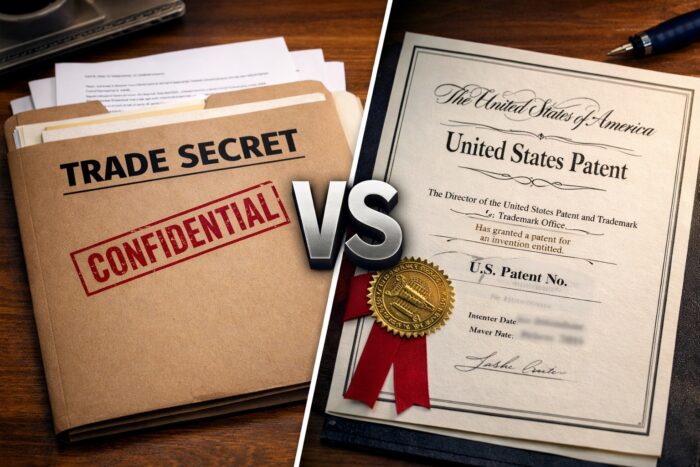
When a company develops valuable technology, processes, or business information, one of the most important considerations is how to protect it. Both trade secret protection and patent protection are powerful tools for protecting intellectual property, but their applicability and benefits vary for different kinds of innovations. Understanding how each form of IP protection works helps business owners determine the best strategy for protecting technology, methods, or other commercially valuable information. The choice between trade secret vs patent protection can significantly affect your competitive advantage, your intellectual property rights, and the long-term value of your business. We explain herein the key differences between trade secrets and patents, the legal framework behind them, and how to determine which option may be right for your business.
A trade secret is confidential information that derives economic value from not being generally known and is subject to reasonable efforts to maintain secrecy. Trade secret law is primarily governed by the Defend Trade Secrets Act at the federal level, 18 U.S.C. § 1836, and the Uniform Trade Secrets Act at the state level, which has been adopted in many states.
Under these laws, information qualifies as a trade secret if it:
Trade secrets can protect a wide range of information, including: manufacturing processes, proprietary technology, algorithms, customer lists, chemical formulas, and pricing and business strategies. Because trade secrets can protect commercially valuable information that is not publicly known, they can cover a broader range of information than just patentable inventions.
Patent protection grants the inventor exclusive rights to an invention for a limited period. Under 35 U.S.C. § 154, utility patents generally provide protection for 20 years from the filing date of the patent application, although certain adjustments may apply. During that period, the patent owner receives the legal right to stop others from making, using, selling, offering to sell, or importing the patented invention without permission.
To obtain a utility patent, an inventor must submit a patent application to the United States Patent and Trademark Office (USPTO). The patent application is then placed in the examination system for assignment to a patent examiner. There is a significant backlog of patent applications with the USPTO, and assignment to an examiner will take several months. Once the application is assigned, the examiner will conduct a search of the prior art (relevant public information that was available before the application was filed) and examine the application to determine whether it meets the statutory requirements of an invention.
Here is a general overview of the steps of the patent application process:
The applicant must provide a detailed written description of the invention. The patent specification must explain the invention clearly enough that a person skilled in the relevant field could understand and practice the invention without undue experimentation. This disclosure requirement is set out in 35 U.S.C. § 112 and is a central requirement of a patent application because it ensures that the public receives the technical knowledge contributed by the inventor. That is what is provided by the inventor in exchange for the patent protection provided to the inventor. This is the quid pro quo of the US patent system.
After the application is filed, the examiner evaluates whether the invention satisfies several statutory requirements for a United States patent, including:
If the examiner finds issues with the patent application, the USPTO issues an office action explaining the objections or rejections. The applicant then has an opportunity to respond by amending claims or presenting legal arguments. Multiple rounds of examination may occur before the application is allowed or finally rejected.
The patent process can be time consuming and often takes several years from the initial filing date to issuance. Successful patent applications can cost many thousands of dollars when attorney fees, government application fees, and examination expenses are included. In addition, once a patent is granted, the patent owner must pay periodic maintenance fees to keep the patent protection in force.
One of the most important factors in choosing between trade secret and patent protection is disclosure. A patent application requires the inventor to disclose the invention to the United States Patent and Trademark Office (USPTO), describing the technology, method, or process in enough detail that others skilled in the field can understand and practice it. Once a patent is granted, the invention becomes publicly disclosed, if it is not early disclosed in the application phase. By contrast, a trade secret depends on keeping valuable information secret. Businesses must take reasonable steps, such as using nondisclosure agreements and limiting access, to maintain trade secret protection and preserve the competitive advantage created by confidential information.
To obtain a United States patent, an inventor must disclose the invention to the public through a patent application filed with the United States Patent and Trademark Office. The application typically becomes publicly disclosed about 18 months after the effective filing date. See 35 U.S.C. § 122(b).
This means the patent process requires inventors to reveal how their technology, method, or process works in detail. The disclosure must be sufficient for someone skilled in the relevant field to understand and practice the patented invention. See 35 U.S.C. § 112(a). Once the patent is granted, the information remains public permanently.
In contrast, trade secrets are kept confidential rather than publicly disclosed. Trade secret protection depends on maintaining trade secrets and ensuring the information is not publicly disclosed or readily available to the public or competitors. To preserve trade secret status, a company must take reasonable steps to protect the secret, such as limiting access to the information, using nondisclosure agreements, and implementing security policies designed to maintain the information secret. These measures help ensure the information is not readily ascertainable through proper means. If the secret becomes public through disclosure or loss of confidentiality, the trade secret status is lost and the information generally cannot regain trade secret protection.
Another major factor in selecting trade secret vs patent protection is how long the protection lasts and how that affects a company’s long-term intellectual property rights and competitive advantage.
Under 35 U.S.C. § 154, patent protection lasts about 20 years from the filing date for most utility patents. The clock generally runs from the effective filing date of the patent application filed with the United States Patent and Trademark Office. Once that period expires, the patented invention enters the public domain, meaning competitors are free to make and sell the technology without permission from the patent owner.
During the life of the patent, however, the owner receives powerful patent rights. A granted patent provides exclusive rights to prevent others from making, using, selling, or importing the invention.
Patent owners must also pay maintenance fees under 35 U.S.C. § 41(b) to keep the patent in force. If those fees are not paid at required intervals, the patent may lapse before the full term expires.
By contrast, trade secret protection lasts indefinitely as long as the information remains confidential and the company takes reasonable steps and reasonable effort to maintain secrecy. See 18 U.S.C. § 1839(3). These steps may include limiting access, using nondisclosure agreements, and carefully maintaining trade secrets within the business.
The famous Coca Cola formula is a classic example. The company chose secret protection instead of pursuing a patent, allowing the formula to maintain trade secret status for more than a century while continuing to deliver a lasting competitive advantage.
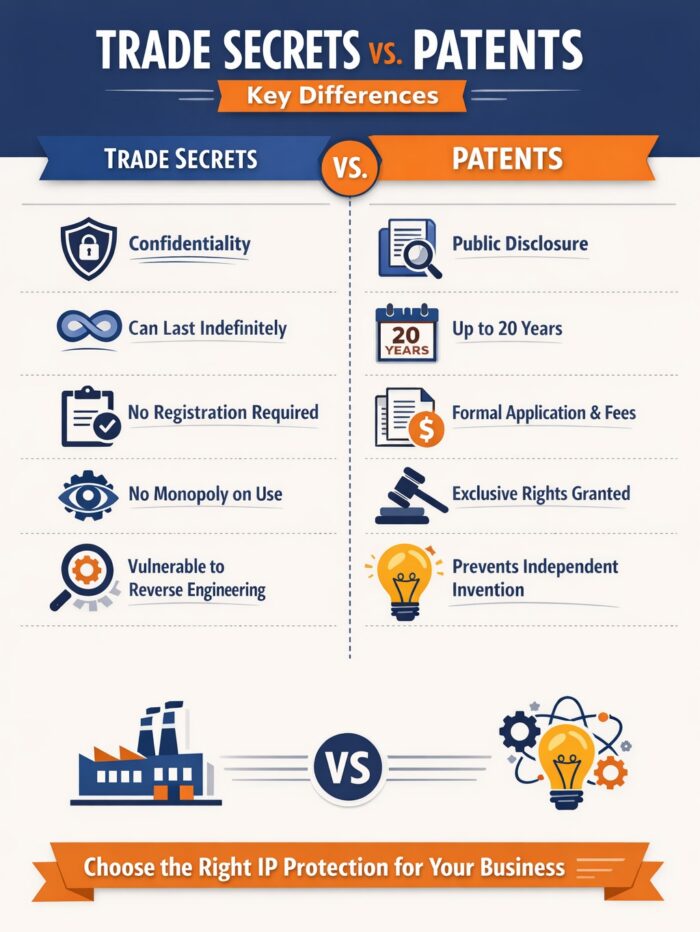
Unlike patents, trade secrets do not require a formal patent application process or approval from a government agency. There are no filing forms, application fees, or patent examination procedures involved. Instead, a company obtains trade secret rights automatically under trade secret law if the information qualifies as a trade secret and the company takes steps to keep it confidential.
In general, a company establishes trade secret protection by doing two things:
This approach reflects the definition of a trade secret under federal law, which requires that the information derive economic value from not being generally known and that the owner make reasonable efforts to maintain its secrecy under 18 U.S.C. § 1839(3).
Because trade secret protection lasts only as long as the information remains secret, businesses must actively manage trade secrets confidentiality. If the information becomes publicly disclosed, or is no longer treated as confidential, the trade secret status may be lost.
Common methods for maintaining trade secrets and demonstrating reasonable steps to protect confidential business information include:
Courts evaluating whether a company has valid trade secret rights often focus on whether the company made a reasonable effort to keep the information secret. In Rockwell Graphic Systems, Inc. v. DEV Industries, 925 F.2d 174 (7th Cir. 1991), the court explained that absolute secrecy is not required, but a business must demonstrate that it took practical steps to preserve the confidentiality of the information.
Another major consideration in choosing between trade secret and patent is whether competitors can reverse engineer your product. Under trade secret law, competitors may legally obtain information through proper means, including reverse engineering. Courts have repeatedly recognized that reverse engineering is a lawful way to learn how a product works. For example, the Supreme Court explained that discovery of a trade secret by “fair and honest means,” including reverse engineering of a publicly available product, is perfectly legal assuming there are no applicable patent rights. Kewanee Oil Co. v. Bicron Corp., 416 U.S. 470, 476 (1974).
This means a competitor may purchase a product on the open market, analyze its technology, and develop a competing product without violating trade secret rights, so long as they do not rely on improper means such as theft or breach of confidentiality. Because of this rule, if an invention can be easily reverse engineered, patent protection is often the stronger strategy for protecting technology. Trade secrets are generally more effective when the underlying method, process, or technical information cannot be readily discovered from the finished product.
Another key difference between patents and trade secrets involves independent discovery by competitors. A patent gives the patent owner enforceable patent rights that can be used to prevent competitors from making, using, or selling the patented invention during the patent term. This is true even if competitors independently invent the same technology or method without copying the original invention. In other words, independent development does not avoid infringement when valid patent protection exists.
By contrast, trade secret protection does not create a monopoly over information. If competitors independently develop the same information secret, process, or technology, they are generally free to use it in their business.
Courts recognize liability under trade secret law only when a trade secret is obtained through improper means, such as theft, espionage, or breach of nondisclosure agreements or other confidentiality obligations. See 18 U.S.C. § 1839(6). If a competitor discovers the information through lawful research and independent development, using it is typically perfectly legal.
In some situations, trade secret protection may be the better strategy for protecting intellectual property, particularly when the value of the technology comes from keeping the information secret rather than publicly disclosing it. For example, trade secret protection may be preferable when the invention secret can realistically be kept confidential within the company. If the information can be restricted to a limited group of employees and partners and safeguarded through reasonable steps such as nondisclosure agreements, access controls, and internal policies, maintaining trade secret status may be a practical approach.
Trade secret protection may also make sense when the technology or process is not easily reverse engineered. If competitors cannot readily analyze a competing product to determine how it works, keeping the method or technical information confidential may provide long-term secret protection. This is particularly common with manufacturing techniques, algorithms, and internal business processes.
Another factor is product lifespan. If the product has a short market life or operates in a fast-moving competitive landscape, the lengthy and time consuming patent process may not align with business goals. In these situations, the cost of preparing a patent application, paying application fees, and waiting for approval may outweigh the benefit of patent protection.
Trade secrets can also protect valuable information that may not qualify as patentable inventions under patent law. Many forms of technology, business know-how, and proprietary process improvements may not meet the legal requirements for patentable subject matter, or they may be difficult to describe in a way that satisfies the disclosure rules of the patent application process. In those situations, trade secret protection can still provide meaningful intellectual property protection. For example, a company may protect proprietary data, internal methods, formulas, algorithms, pricing strategies, and customer lists as a trade secret, as long as the information is not readily ascertainable and the company takes reasonable steps to maintain its secrecy.
In other situations, it may be better to seek patent protection or pursue patent protection rather than rely on trade secret protection. The decision often depends on how the invention will be used in the marketplace and whether competitors could realistically discover the technology on their own. Patent protection may be advantageous when:
When a product or method can be easily analyzed by competitors, maintaining the invention secret may be unrealistic. In those situations, a patent application may provide stronger intellectual property protection because the resulting patent gives the patent owner enforceable patent rights against competing businesses that attempt to commercialize the same technology or process.
Once a patent is granted, the patent owner gains legally enforceable rights that can prevent competitors from manufacturing, using, importing, or selling a competing product based on the patented invention during the patent term.
The choice between trade secret vs patent protection is one of the most important decisions for businesses developing new technology. Trade secrets and patents are mutually exclusive pathways with distinct pros and cons. Patents provide a government-granted monopoly that typically lasts 20 years from the filing date, but they require significant costs and public disclosure of the invention. Trade secrets, on the other hand, protect confidential information indefinitely as long as the company takes reasonable steps to maintain secrecy. However, they do not prevent competitors from independently developing the same technology or obtaining it through proper means such as reverse engineering.
Choosing the right form of IP protection can determine whether you extract the highest value from an innovation. An understanding of both patent and trade secret fundamentals is needed. Because the best strategy depends on the nature of the invention, the technology, and the business environment, it is recommended that you consult an intellectual property attorney when deciding how to protect valuable innovations.
If you need assistance in protecting your new innovation or need assistance with other intellectual property matters, please contact our office for a consultation.
© 2026 Sierra IP Law, PC. The information provided herein does not constitute legal advice, but merely conveys general information that may be beneficial to the public, and should not be viewed as a substitute for legal consultation in a particular case.

"Mark and William are stellar in the capabilities, work ethic, character, knowledge, responsiveness, and quality of work. Hubby and I are incredibly grateful for them as they've done a phenomenal job working tirelessly over a time span of at least five years on a series of patents for hubby. Grateful that Fresno has such amazing patent attorneys! They're second to none and they never disappoint. Thank you, Mark, William, and your entire team!!"
Linda Guzman


Sierra IP Law, PC - Patents, Trademarks & Copyrights
FRESNO
7030 N. Fruit Ave.
Suite 110
Fresno, CA 93711
(559) 436-3800 | phone
BAKERSFIELD
1925 G. Street
Bakersfield, CA 93301
(661) 200-7724 | phone
SAN LUIS OBISPO
956 Walnut Street, 2nd Floor
San Luis Obispo, CA 93401
(805) 275-0943 | phone

SACRAMENTO
180 Promenade Circle, Suite 300
Sacramento, CA 95834
(916) 209-8525 | phone
MODESTO
1300 10th St., Suite F.
Modesto, CA 95345
(209) 286-0069 | phone
SANTA BARBARA
414 Olive Street
Santa Barbara, CA 93101
(805) 275-0943 | phone
SAN MATEO
1650 Borel Place, Suite 216
San Mateo, CA, CA 94402
(650) 398-1644. | phone
STOCKTON
110 N. San Joaquin St., 2nd Floor
Stockton, CA 95202
(209) 286-0069 | phone
PORTLAND
425 NW 10th Ave., Suite 200
Portland, OR 97209
(503) 343-9983 | phone
TACOMA
1201 Pacific Avenue, Suite 600
Tacoma, WA 98402
(253) 345-1545 | phone
KENNEWICK
1030 N Center Pkwy Suite N196
Kennewick, WA 99336
(509) 255-3442 | phone
2023 Sierra IP Law, PC - Patents, Trademarks & Copyrights - All Rights Reserved - Sitemap Privacy Lawyer Fresno, CA - Trademark Lawyer Modesto CA - Patent Lawyer Bakersfield, CA - Trademark Lawyer Bakersfield, CA - Patent Lawyer San Luis Obispo, CA - Trademark Lawyer San Luis Obispo, CA - Trademark Infringement Lawyer Tacoma WA - Internet Lawyer Bakersfield, CA - Trademark Lawyer Sacramento, CA - Patent Lawyer Sacramento, CA - Trademark Infringement Lawyer Sacrament CA - Patent Lawyer Tacoma WA - Intellectual Property Lawyer Tacoma WA - Trademark lawyer Tacoma WA - Portland Patent Attorney - Santa Barbara Patent Attorney - Santa Barbara Trademark Attorney
