A statement of use is a filing made in a trademark application submitted with an intent-to-use filing basis under Lanham Act Section 1(b). A statement of use demonstrates that the applicant is actually using the trademark in commerce and changes the filing basis of a trademark application from an intent-to-use to an actual use application. The intent-to-use filing basis allows businesses to file a trademark application before they begin using the trademark if they have a bona fide intention to use the mark in commerce. The United States Patent and Trademark Office (USPTO) cannot issue a trademark registration from a Section 1(b) application until the applicant demonstrates use in commerce under 15 U.S.C. § 1051(d) by filing a statement of use.
A trademark statement of use (SOU) is a verified, formal legal document filed with the U.S. Patent and Trademark Office after a notice of allowance (i.e., approval of the application by the trademark examiner). The statement of use identifies the specific goods or services listed in the application for which the trademark is actually being used and creates an evidentiary record supporting that claim. The filing must identify the applicant and the mark, state the date of first use anywhere and the date of first use in commerce, include a specimen showing the mark as encountered by customers, provide a declaration attesting to the accuracy of the use allegations, and include the required filing fee. See 37 C.F.R. § 2.88.
U.S. trademark rights generally arise from real marketplace use. “Use in commerce” requires bona fide use in the ordinary course of trade, not token use merely to reserve a mark. Goods generally must bear the mark on products, packaging, or associated displays and be sold or transported in federally regulated commerce. For services, the mark must appear in sales or advertising, and services must actually be rendered in commerce. See 15 U.S.C. § 1127.
In Couture v. Playdom, Inc., 778 F.3d 1379 (Fed. Cir. 2015), Couture’s 2008 use-based application relied on a website advertising writing and production services, but he provided no entertainment services until 2010. The court affirmed cancellation of Couture's trademark registration because the applied-for services were not yet rendered at the time he asserted use of the service mark, and thus there was no established use in commerce at the time he asserted commercial use.
A statement of use provides sworn evidence that a brand is operational through qualifying use in commerce, and mere promotional activity does not qualify as use in commerce under 15 U.S.C. § 1127.
An intent-to-use trademark application filed under Lanham Act Section 1(b) permits the applicant to establish trademark rights before the trademark is actually used in commerce. An application filed under an intent-to-use basis requires the applicant’s good-faith bona fide intention to use the mark in commerce for each identified good or service listed in the application at the time of filing. The Lanham Act prohibits any attempt to reserve a right in a mark without a bona fide intent to use the mark in commerce. A mere hope or desire to use the mark in commerce is insufficient. A bona fide intent is judged based on concrete facts and actions, not solely upon subjective intent of the applicant. Objective evidence may include dated product-development records, market research, correspondence with manufacturers, suppliers and distributors, product prototypes, domain name registrations and website development, and branding and marketing development.
In M.Z. Berger & Co. v. Swatch AG, 787 F.3d 1368 (Fed. Cir. 2015), the Federal Circuit affirmed denial of “iWatch” registration for lack of a bona fide intent at the time of filing. M.Z. Berger could not demonstrate any firm decision to commercialize the watch. Conflicting testimony about prototypes and buyer discussions further undermined M.Z. Berger's attempt to show any bona fide intention. The court found that the objective evidence did not show a firm intention to use the mark in commerce, and the trademark registration was denied.
The applicant can establish use in commerce during the trademark application process before the examiner approves the mark for publication by submitting an amendment to allege use or after a notice of allowance by submission of a statement of use. Regardless of which type of use filing is submitted, legitimate use in commerce is required in order to lawfully advance the application to a trademark registration.
Once the trademark registration issues from the intent-to-use application, constructive-use priority generally reaches back to the original filing date. Thus, a successfully submitted statement of use establishes nationwide priority over competitors who begin using conflicting marks after the filing date of the intent-to-use application, but before the applicant’s use of the applied-for goods and services in commerce. However, the applicant's rights do not supersede the rights of owners of confusingly similar marks that were in use prior to the application filing date, earlier-filed trademark applications, and earlier qualifying foreign-priority claims.
A complete statement of use filing must identify the goods or services that have been used in commerce; identify the first-use-anywhere and first-use-in-commerce dates for such goods or services; provide proof of the use in commerce by providing an acceptable specimen of use for each class of goods or services; pay the USPTO fee for submitting a statement of use; and include a signed declaration under penalty of perjury that attests to the use in commerce of the goods or services identified in the statement of use and that the applicant believes that they are the owner of the mark. See 15 U.S.C. § 1051(d). Under the USPTO rules, the sworn statement may be signed by the owner, someone with legal authority, a person with firsthand knowledge and actual or implied authority, or an authorized qualified practitioner. See 37 C.F.R. § 2.193(e)(1).
A specimen is essentially an image of an example of the applied-for goods or services being used in actual commerce. The image is submitted electronically with the statement of use through the USPTO's Trademark Electronic Application System (TEAS) filing system available through the USPTO's website. For goods, acceptable specimens include product labels, tags, packaging, and qualifying point-of-sale displays, which may be a store endcap, a sales booth, a website screenshot of an online storefront or other point of sale featuring the mark. Service specimens may include advertising or webpages directly associating the mark with services actually rendered. A specimen must clearly show actual trademark commercial use. Webpage specimens need to be submitted with the relevant URL and access date. Mockups and digitally altered specimens are unacceptable. See 37 C.F.R. § 2.56.
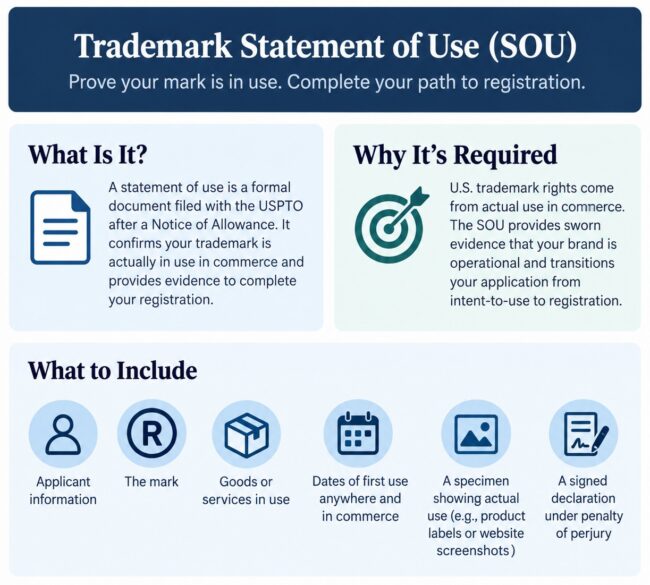
The SOU must be filed within six months from the date a notice of allowance issued. If additional time is needed to file a statement of use, applicant can request extension of the SOU deadline by six months. Applicants may take up to five six-month extension requests, allowing up to three years from the allowance date to begin using the mark in commerce and file a statement of use. Extension requests require a verified statement of continuing intent to use the mark in commerce and, after the first extension request, the applicant's ongoing efforts to begin using the mark in commerce. See 37 C.F.R. § 2.89.
Failure to file a statement of use or an extension of time before the SOU deadline results in abandonment of the trademark application. Revival may be available for unintentional delay under 37 C.F.R. § 2.66, but note that an SOU will not be accepted more than 36 months after allowance.
As of August 2026, the current USPTO filing fee for a statement of use is $150 per class when filed electronically and $250 per class when filed on paper. Each request for an extension of time costs $125 per class when filed electronically and $225 per class when filed on paper. Each class has a separate fee, so one-class costs exceed $100 before attorney review or additional fees.
After the filing is submitted, the USPTO reviews the declaration, use dates, specimen, and remaining goods or services. If the examining attorney finds that the statement of use fails to meet all of the requirements, they may issue an office action. For example, the examiner may find that the specimen does not properly show use of the applied-for goods or services in commerce. The applicant will then have three months (extendable to six months for a fee) to respond to the office action to correct the defect in the statement of use (e.g., by filing a proper specimen). If the statement of use is accepted, the application will proceed to a trademark registration within a few weeks.
If the applicant can demonstrate use of some, but not all of the goods or services listed in the trademark application, the applicant may delete unused goods or services, or request a division of the application under 37 C.F.R. § 2.87. If a division of the application is made, a registration will issue for the goods or services for which the statement of use was submitted in a second divisional application, and the original application will remain pending for the goods or services that were not covered by the statement of use. The divisional application is separate from the original application and has its own trademark application serial number. The applicant has to pay separate application filing fees and additional division fees for the second trademark application.
Turning a trademark application based on intent to use the applied-for trademark into a registered mark requires a proper statement of use. This is the final substantive step in the registration process. However, it must be understood that acceptance of the statement of use depends on careful of observance of the requirements. Accurate dates, an acceptable specimen, a valid declaration, and timely filing are required to move the trademark registration process to completion.
A trademark attorney can determine the appropriate filing type, review evidence of use in commerce, and address any office actions that the may USPTO issue. Assistance of trademark counsel and careful preparation helps prevent avoidable delays, submit a timely and proper statement of use, and protect the opportunity to secure a trademark registration.
© 2026 Sierra IP Law, PC. The information provided herein does not constitute legal advice, but merely conveys general information that may be beneficial to the public, and should not be viewed as a substitute for legal consultation in a particular case.

"Mark and William are stellar in the capabilities, work ethic, character, knowledge, responsiveness, and quality of work. Hubby and I are incredibly grateful for them as they've done a phenomenal job working tirelessly over a time span of at least five years on a series of patents for hubby. Grateful that Fresno has such amazing patent attorneys! They're second to none and they never disappoint. Thank you, Mark, William, and your entire team!!"
Linda Guzman


Sierra IP Law, PC - Patents, Trademarks & Copyrights
FRESNO
7030 N. Fruit Ave.
Suite 110
Fresno, CA 93711
(559) 436-3800 | phone
BAKERSFIELD
1925 G. Street
Bakersfield, CA 93301
(661) 200-7724 | phone
SAN LUIS OBISPO
956 Walnut Street, 2nd Floor
San Luis Obispo, CA 93401
(805) 275-0943 | phone

SACRAMENTO
180 Promenade Circle, Suite 300
Sacramento, CA 95834
(916) 209-8525 | phone
MODESTO
1300 10th St., Suite F.
Modesto, CA 95345
(209) 286-0069 | phone
SANTA BARBARA
414 Olive Street
Santa Barbara, CA 93101
(805) 275-0943 | phone
SAN MATEO
1650 Borel Place, Suite 216
San Mateo, CA, CA 94402
(650) 398-1644. | phone
STOCKTON
110 N. San Joaquin St., 2nd Floor
Stockton, CA 95202
(209) 286-0069 | phone
PORTLAND
425 NW 10th Ave., Suite 200
Portland, OR 97209
(503) 343-9983 | phone
TACOMA
1201 Pacific Avenue, Suite 600
Tacoma, WA 98402
(253) 345-1545 | phone
KENNEWICK
1030 N Center Pkwy Suite N196
Kennewick, WA 99336
(509) 255-3442 | phone
2023 Sierra IP Law, PC - Patents, Trademarks & Copyrights - All Rights Reserved - Sitemap Privacy Lawyer Fresno, CA - Trademark Lawyer Modesto CA - Patent Lawyer Bakersfield, CA - Trademark Lawyer Bakersfield, CA - Patent Lawyer San Luis Obispo, CA - Trademark Lawyer San Luis Obispo, CA - Trademark Infringement Lawyer Tacoma WA - Internet Lawyer Bakersfield, CA - Trademark Lawyer Sacramento, CA - Patent Lawyer Sacramento, CA - Trademark Infringement Lawyer Sacrament CA - Patent Lawyer Tacoma WA - Intellectual Property Lawyer Tacoma WA - Trademark lawyer Tacoma WA - Portland Patent Attorney - Santa Barbara Patent Attorney - Santa Barbara Trademark Attorney
