
This article explains what a service mark is, how a service mark differs from a trademark, and why service mark registration can matter for businesses that provide services rather than physical products.
Service marks serve to identify the source of a service, i.e., the business offering the service. Some companies offer goods (e.g., Nike offers shoes and sports goods), some companies offer services (e.g., Bank of America offers banking services), and some companies offer both (e.g., car dealerships offer both vehicles and vehicle maintenance services). Service marks, like trademarks, function to prevent others from using a business’s name, logo, slogan, phrase, sound, shape, design, or other branding elements in ways that create confusion among consumers. Under the Lanham Act, a “mark” can include trademarks and service marks. See 15 U.S.C. § 1127. A service mark differs from a trademark, but people often use the word “trademark” to refer to both trademarks and service marks.
Service marks serve to identify services and distinguish one provider’s services from those of another. A service mark can be a company name, brand name, logo, phrase, symbol, sound, design, trade dress, sign, or any combination thereof. Under the Lanham Act, a service mark is a mark used, or intended to be used, to identify and distinguish the services of one person from the services of others and to indicate the source of the services, even if that source is not known by name to the consumer. See 15 U.S.C. § 1127. A service mark helps customers recognize the company, distinguish it from competitors, and connect a particular level of quality with a particular brand identity.
That definition is broad. A service mark may protect the name of a consulting firm, the logo for a restaurant chain, the slogan used by an airline, a sound used in broadcasting, or the distinctive look of a service environment when that look functions as a source identifier. Section 1127 also recognizes that titles, character names, and other distinctive features of radio or television programs may be registered as service marks.
A service must be more than an internal business activity. In general, a registrable service is an intangible activity performed for the benefit of another party. For example, a cleaning company performs cleaning services for customers, a bank provides financial services to account holders, and a software-as-a-service (SAAS) company may provide online business tools to users. By contrast, a company that merely advertises its own goods is usually promoting itself, not providing a separate service to others. The Federal Circuit applied that principle in In re Dr. Pepper Co., 836 F.2d 508 (Fed. Cir. 1987), where a contest used to promote the applicant’s own soft drinks was not treated as a registrable service independent of the goods.
A service mark can consist of letters, words, logos, sounds, colors, designs, trade dress, signs, or a combination of those elements. Consumers do not always need to read a full company name to recognize a brand. A symbol, phrase, sound, layout, or other distinctive features can create an immediate association in the customer’s mind. That association is part of the goodwill of the business. The mark does not protect the service idea itself. It protects the business and branding that consumers recognize in association with the service.
Here are some examples of famous service marks:
A trademark identifies the source of goods. If a company sells shoes, coffee, software installed on a device, packaged food, or another physical product, the name or logo used on those goods may function as a trademark. A trademark may appear on the product itself, on product packaging, on a label, on a tag, in a product listing, or on a point-of-sale display. For example, Nike's famous phrase "Just Do It" is a trademark for its athletic apparel that is recognized in the absence of the swoosh mark and the Nike name.
There are differences between trademarks and services marks: a trademark identifies goods, while a service mark identifies services. In practice, the same brand may function as both a trademark and a service mark when a company sells goods and provides services. A restaurant name, for example, is generally a service mark for restaurant services. A brand name printed on a bottle of sauce sold by that restaurant may be a trademark for the bottled sauce. A hotel logo may be a service mark for lodging services, while the same logo on robes or branded merchandise may also function as a trademark for goods.
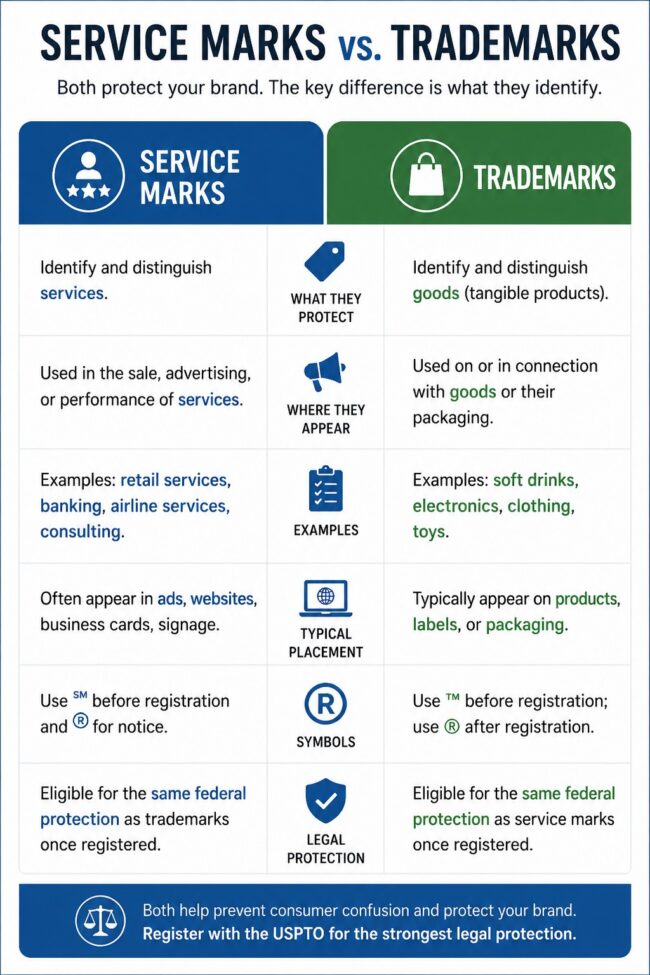
Although the service mark vs. trademark distinction matters when identifying goods and services, service marks and trademarks receive the same type of federal protection once registered. Service marks are registrable with the United States Patent and Trademark Office (USPTO) “in the same manner and with the same effect” as trademarks. See 15 U.S.C. § 1053.
That means a registered service mark carries significant legal standing. A federal registration on the Principal Register is prima facie evidence of the validity of the registered mark, the registration, the owner’s ownership, and the owner’s exclusive right to use the mark in commerce for the goods or services listed in the registration. See 15 U.S.C. §§ 1057(b), 1115(a). Registration also creates constructive notice of the registrant’s claim of ownership, which helps prevent a later user from claiming it was unaware of the mark. See 15 U.S.C. § 1072.
A service mark registration can transform limited local common law rights into nationwide rights tied to the listed services. The USPTO explains that using a mark creates rights, but those unregistered rights are geographically limited. Applying for federal registration creates stronger nationwide rights. A registered mark therefore provides public notice, deters competitors from adopting a similar name, and can make it easier to enforce rights if another party uses a confusingly similar mark.
A service mark application must include the applicant’s legal information, a clear identification of services, a specimen showing the mark in use when use is claimed, and the proper filing fee. An incomplete application may result in additional fees, delay, or an Office Action. The application process may take anywhere from six months to 18 months. The application will first wait in a queue for examination to begin. The average wait time for an initial review by an examining attorney is often described as around six months, depending on the current volume of submissions and application complexity. The USPTO’s current processing page reports that, as of March 31, 2026, the average time from filing to first examining action was 4.4 months, with an average of 10 months from filing to registration or abandonment.
The examination process involves the examiner search prior trademark filings to determine whether the applied-for mark is confusingly similar to any prior filing. The examiner will also analyze the application for other formal issues, such as whether the mark is descriptive of the goods or services, whether the mark is generic, whether the goods and services are properly identified, and whether a proper specimen of use has been submitted. If the examining attorney issues an Office Action, the process can take longer.
A service mark application accurately identifies the specific services connected with the mark. A specimen of use showing the mark used in the sale, rendering, or advertising of those services must be submitted in the service mark application prior to registration. Under 37 C.F.R. § 2.56, a service mark specimen must show the mark as used in the sale or advertising of the services and must show a direct association between the mark and the services.
That specimen rule is a common source of problems for service mark applications. A web page may work if it displays the service mark and describes the services. Advertising, brochures, business cards, signage, invoices, or screenshots of a service platform may work if they show a direct association between the mark and the service. But a mockup, internal document, or vague display of a logo with no service description may lead the examining attorney to issue an Office Action refusing the application and allowing for correction by submission of a proper specimen.
The cost of a service mark application depends primarily on the number of classes and whether the application satisfies current USPTO requirements. Under the current USPTO fee schedule, the base application fee for a Section 1 or Section 44 application is $350 per class. Current USPTO rules also impose additional fees for insufficient information, custom identifications of goods or services, and lengthy identifications.
Service mark registration is not required to use a mark, but it is often a strategic step for a growing business. Without federal registration, rights are generally based on use and may be limited to the geographic area where the service is actually provided. Registration with the USPTO can provide nationwide legal protection, stronger service mark enforcement tools, and a public record that others can find when conducting a service mark search.
Registering a service mark provides a legal presumption of ownership and exclusive rights in all 50 states for the services listed in the registration, subject to the limitations in the registration and the rights of certain prior users. A registered mark creates a legal presumption that can shift the burden to an accused infringer to challenge validity, ownership, or the scope of rights in a lawsuit. That presumption can be especially valuable when a competitor adopts the same type of mark for the same type of service or for closely related services.
Registration also supports commercial credibility. Using the ® symbol indicates that the mark is federally registered. The registered trademark symbol can enhance professional credibility, signal that the business takes brand protection seriously, and warn competitors that the owner may enforce its rights. The SM symbol for services can be used before registration, but ® may be used only after the mark is registered and only for the goods or services listed in the federal registration.
Before filing, a business should conduct a service mark search. A thorough search of the USPTO database is recommended to determine whether a proposed mark conflicts with an existing mark, because likelihood of confusion is a common cause of rejection or refusal. The trademark search should not be limited to identical wording. It should look for marks that are similar in sound, appearance, meaning, or commercial impression, especially where the services are related. The USPTO provides a trademark search database that applicants can use to search existing federal trademark and service mark records.
A good search also goes beyond the USPTO database. State trademark records, secretary of state filings, domain names, company name databases, social media handles, industry directories, and ordinary marketplace use can matter. A party may have common law rights even without federal registration. The goal is to recognize conflict risk before the business invests heavily in advertising, signage, a website, packaging, uniforms, menus, software, or customer-facing communications.
For example, if a new financial consulting company wants to use a brand name that sounds almost identical to an existing mark for financial planning services, the USPTO examining attorney may refuse the application under Section 2(d) of the Lanham Act, 15 U.S.C. § 1052(d), based on likelihood of confusion. A search can identify that problem early and help the business choose a more distinctive mark.
Service marks and trademarks are enforced under the same Lanham Act provisions, including 15 U.S.C. § 1114 for trademark infringement of a federally registered mark and 15 U.S.C. § 1125(a) for false designation of origin or unfair competition. In a service mark dispute, the key issue is whether the defendant’s use of a similar mark in connection with services is likely to cause consumers to believe that the services come from, are sponsored by, or are affiliated with the service mark owner. For example, in Park ’N Fly, Inc. v. Dollar Park & Fly, Inc., 469 U.S. 189 (1985), the dispute involved directly overlapping services: both parties used similar names in connection with airport parking services for air travelers. The plaintiff owned the federally registered service mark PARK ’N FLY for its airport parking business, while the defendant operated an airport parking lot under the name Dollar Park & Fly. That overlap mattered because likelihood of confusion is strongest when similar marks are used for the same or closely related services, especially where the same types of customers encounter the marks in the same commercial context.
In Two Pesos, Inc. v. Taco Cabana, Inc., 505 U.S. 763 (1992), Taco Cabana operated Mexican fast-food restaurants with a distinctive overall presentation. Taco Cabana offered its restaurant services in connection with signage, interior layout, décor, menu, serving equipment, uniforms, colors, awnings, umbrellas, and related visual features (i.e., its trade dress) that were themed, distinctive, and unique to Taco Cabana. Two Pesos opened competing Mexican restaurants using a similar overall décor and motif in the same market, and the jury found that the similarity created a likelihood of confusion among ordinary customers as to the source or association of the restaurants’ services. Taco Cabana's trade dress was distinctive and found to be associated with its restaurant services in the mind of the consumer. The competitor’s use of similar décor and theme in connection with overlapping services resulted in a trade dress infringement.
A service mark owner must maintain the registration. That means continuing to use the mark in commerce, monitoring for misuse, and filing required maintenance documents. Under 15 U.S.C. § 1058, a declaration of continued use is due between the fifth and sixth anniversaries of registration, with later filings tied to ten-year periods. Under 15 U.S.C. § 1059, registrations may be renewed for successive ten-year periods if the statutory requirements are met.
A U.S. registration can also support broader protection. A U.S. trademark registration or pending U.S. application may serve as a basis for seeking international trademark protection through the Madrid Protocol. These benefits can matter if the business sells internationally, licenses its brand, expands across the country, or wants to prevent counterfeit or infringing products from entering the United States.
A service mark is a most important brand asset to a services business. It is a symbol that allows customers recognize the business as the source of the service, distinguishes the business from competitors, and protects the goodwill built through advertising, customer experience, and consistent quality. Before committing to a mark, a business should choose a distinctive mark, complete a careful service mark search, and register the mark with the USPTO (if the mark is eligible - see our article on federal registration). A registered service mark can become a long-term asset that helps secure brand identity, support customer loyalty, and protect the company’s reputation across the country.
If you need assistance with protecting your service mark or other intellectual property law matters, please contact our law firm for a consultation with one of our experienced trademark attorneys. We are experienced intellectual property attorneys in the trademark field.
© 2026 Sierra IP Law, PC. The information provided herein does not constitute legal advice, but merely conveys general information that may be beneficial to the public, and should not be viewed as a substitute for legal consultation in a particular case.

"Mark and William are stellar in the capabilities, work ethic, character, knowledge, responsiveness, and quality of work. Hubby and I are incredibly grateful for them as they've done a phenomenal job working tirelessly over a time span of at least five years on a series of patents for hubby. Grateful that Fresno has such amazing patent attorneys! They're second to none and they never disappoint. Thank you, Mark, William, and your entire team!!"
Linda Guzman


Sierra IP Law, PC - Patents, Trademarks & Copyrights
FRESNO
7030 N. Fruit Ave.
Suite 110
Fresno, CA 93711
(559) 436-3800 | phone
BAKERSFIELD
1925 G. Street
Bakersfield, CA 93301
(661) 200-7724 | phone
SAN LUIS OBISPO
956 Walnut Street, 2nd Floor
San Luis Obispo, CA 93401
(805) 275-0943 | phone

SACRAMENTO
180 Promenade Circle, Suite 300
Sacramento, CA 95834
(916) 209-8525 | phone
MODESTO
1300 10th St., Suite F.
Modesto, CA 95345
(209) 286-0069 | phone
SANTA BARBARA
414 Olive Street
Santa Barbara, CA 93101
(805) 275-0943 | phone
SAN MATEO
1650 Borel Place, Suite 216
San Mateo, CA, CA 94402
(650) 398-1644. | phone
STOCKTON
110 N. San Joaquin St., 2nd Floor
Stockton, CA 95202
(209) 286-0069 | phone
PORTLAND
425 NW 10th Ave., Suite 200
Portland, OR 97209
(503) 343-9983 | phone
TACOMA
1201 Pacific Avenue, Suite 600
Tacoma, WA 98402
(253) 345-1545 | phone
KENNEWICK
1030 N Center Pkwy Suite N196
Kennewick, WA 99336
(509) 255-3442 | phone
2023 Sierra IP Law, PC - Patents, Trademarks & Copyrights - All Rights Reserved - Sitemap Privacy Lawyer Fresno, CA - Trademark Lawyer Modesto CA - Patent Lawyer Bakersfield, CA - Trademark Lawyer Bakersfield, CA - Patent Lawyer San Luis Obispo, CA - Trademark Lawyer San Luis Obispo, CA - Trademark Infringement Lawyer Tacoma WA - Internet Lawyer Bakersfield, CA - Trademark Lawyer Sacramento, CA - Patent Lawyer Sacramento, CA - Trademark Infringement Lawyer Sacrament CA - Patent Lawyer Tacoma WA - Intellectual Property Lawyer Tacoma WA - Trademark lawyer Tacoma WA - Portland Patent Attorney - Santa Barbara Patent Attorney - Santa Barbara Trademark Attorney
