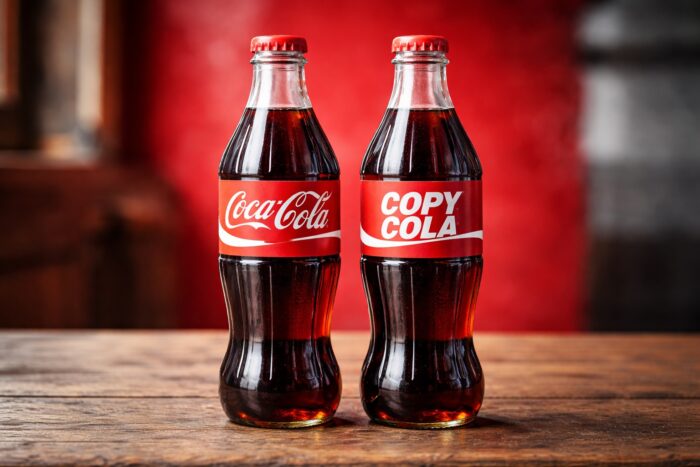
Trade dress is protectable under US law as a form trademark protection. Trade dress is generally the overall appearance, commercial image, and commercial impression that identify the source of the product or service under federal law. Trade dress rights are violated under the Lanham Act (federal trademark law) when a competitor adopts a confusingly similar look and feel, causing consumers to believe the goods or services come from the same source. Violations often involve copied product packaging, storefront decor, or product design used as a brand signal rather than mere ornamentation. The focus is the total impression on ordinary buyers.
Trade dress refers to the visual appearance customers recognize as coming from a particular company, a distinctive combination of design elements and design features that becomes instantly recognizable in the consumer's mind. In practical terms, it is the overall appearance and commercial impression of a product, product packaging, store layout, decor, color scheme, or other presentation that signals source without using words. When this consistent look causes the average consumer to associate the appearance with one business, it can function like a trademark. The key is the total “look and feel,” not any single feature viewed in isolation.
A claimed trade dress may be product packaging, store distinctive decor, or a product configuration: i.e., product trade dress. It can also include a website “look and feel,” such as a consistent layout, color palette, typography, and arrangement of visual elements that create a recognizable commercial image. In retail and restaurant settings, claimed trade dress often involves interior and exterior decor, furniture style, lighting, signage, and spatial layout that together form a cohesive commercial impression. Some plaintiffs attempt to include even particular sales techniques or marketing techniques as part of the claimed trade dress, arguing that these elements contribute to brand identity. Courts, however, are cautious in this area and typically limit trade dress protection to non-functional visual features, emphasizing the overall look and feel rather than business methods or abstract concepts. The analysis centers on whether the combined elements create a distinctive appearance that consumers associate with a single source.

A leading case illustrating this principle is Two Pesos, Inc. v. Taco Cabana, Inc., 505 U.S. 763 (1992). In that case, the Supreme Court upheld trade dress protection for the festive decor of a Mexican restaurant chain, including its bright colors, patio-style seating, distinctive outdoor umbrellas and awnings, interior layout, and decorative features. The Court emphasized that the protectable trade dress was the restaurant’s distinctive overall appearance, the total visual impression experienced by customers, not Taco Cabana’s food, pricing, service style, or marketing techniques.
A trade dress infringement claim is an infringement suit brought under federal law when a competitor’s use of a similar overall appearance is likely to mislead consumers about the source of the product or service. The primary statutory basis is Section 43(a) of the Lanham Act (15 U.S.C. §1125(a)), which prohibits the use of any word, symbol, or design, including trade dress, that is likely to cause consumer confusion as to origin, sponsorship, or approval. Claims for infringement are also available under 15 U.S.C. §1114 if the trade dress has been registered with the United States Patent and Trademark Office (USPTO). The registration process is discussed in more detail below.
To succeed on a trade dress infringement claim, the plaintiff must first prove the existence of a valid trade dress. This requires showing that the claimed trade dress is distinctive, either inherently distinctive or having acquired secondary meaning, and non functional. Functional elements, functional features, and functional aspects that provide utilitarian advantages or affect cost or quality cannot support a trade dress infringement claim. This requirement ensures that trade dress law does not improperly restrict competition by granting trademark rights over useful product features.
Second, the plaintiff must show a likelihood of confusion among consumers. Courts assess this using multi-factor tests designed to evaluate how the average consumer perceives the competing products or services. One of the most influential frameworks is the Sleekcraft test, established in AMF, Inc. v. Sleekcraft Boats, 599 F.2d 341 (9th Cir. 1979). Although the specific factors vary by jurisdiction, they typically include the strength of the trade dress, similarity of the overall appearance and commercial impression, proximity of the products or services, evidence of actual confusion, defendant’s intent, and the sophistication of buyers.
The Two Pesos case is a good example of how courts perform the likelihood of confusion analysis in trade dress infringement cases:
Taco Cabana alleged trade dress in the overall look of its restaurants, including a festive Mexican decor, bright colors, patio-style seating, interior layout, and decorative artifacts. The Court agreed this was a specific, well-defined trade dress consisting of a distinctive combination of visual elements, not a vague concept or marketing idea.
The jury found Taco Cabana’s trade dress to be inherently distinctive, meaning it immediately signaled source without needing proof of secondary meaning. The Supreme Court affirmed that restaurant decor and packaging-style trade dress can be inherently distinctive, unlike product design trade dress.
The decor elements were aesthetic and not essential to operating a Mexican restaurant. They did not provide utilitarian advantages, reduce costs, or affect quality. As a result, the trade dress qualified as non-functional and eligible for protection.
Evidence showed that Two Pesos deliberately copied Taco Cabana’s look to compete directly. The restaurants targeted the same customers, offered similar services, and created a nearly identical commercial impression. The jury concluded that ordinary consumers were likely to be confused as to source, sponsorship, or affiliation.
Because Taco Cabana proved a valid, distinctive, non-functional trade dress and likely consumer confusion, the Court upheld the finding of trade dress infringement under the Lanham Act. The case remains a foundational example of how courts analyze trade dress claims element by element, focusing on overall appearance rather than isolated features.
The Two Pesos case illustrates how courts focus on the totality of the circumstances, rather than any single design element, when evaluating consumer confusion. Even when individual design features differ, a defendant may still be liable if the overall look and feel creates a confusingly similar commercial image.
Remedies for trade dress infringement are largely the same as those available for trademark infringement, reflecting the close relationship between trademark and trade dress under federal law. Under 15 U.S.C. §§1116, 1117, a prevailing plaintiff may obtain injunctive relief, monetary damages, disgorgement of the defendant’s profits, and, in exceptional cases, an award of attorneys’ fees. Courts frequently issue injunctions to stop ongoing infringement, and in urgent situations may grant a preliminary injunction to prevent continued consumer confusion while the case is litigated. Federal Rule of Civil Procedure 65 governs injunction practice and sets the standards for obtaining temporary and preliminary relief.
As is true for litigation generally, trade dress litigation costs can be substantial due to the need for consumer surveys, expert testimony, and other market data. This should be taken into consideration in evaluation of trade dress infringement cases. The strength of the trade dress protection and the extent of the infringement should be considered with the guidance of a trademark attorney, and should inform the decision on whether to pursue litigation.
In addition to traditional infringement, famous brands may bring claims for dilution under 15 U.S.C. §1125(c). Dilution protects against uses that blur or tarnish a famous trade dress even without proof of direct consumer confusion, recognizing that repeated imitation can weaken a brand’s distinctiveness over time. This protection is particularly important for iconic designs that function as powerful source identifiers, such as Tiffany & Co.’s distinctive blue color and packaging design or the contour bottle with the "hobble-skirt" silhouette shape of the coca cola bottle.
Numerous trade dress infringement cases illustrate these principles. In Qualitex Co. v. Jacobson Products Co., 514 U.S. 159 (1995), the Supreme Court confirmed that a single color, the green-gold color of cleaning press pads, can serve as protectable trade dress if it is non-functional and distinctive. Courts have also recognized trade dress in environments and experiences, such as the Apple Store design with its glass storefronts and minimalist decor, the overall design and distinctive decor of Dunkin’ Donuts restaurants, and the Mexican restaurant chain’s decor in the Two Pesos case.
For protectable trade dress that can be enforced in court, trade dress must be sufficiently distinct and non functional. This means the overall appearance must be capable of identifying and distinguishing a single source in the consumer’s mind, rather than merely describing the product or serving a utilitarian purpose. Trademark and trade dress standards and remedies are largely similar, but trade dress demands more exacting proof of distinctiveness and non-functionality because it often involves product design or configuration. Under trademark law, functional elements, functional features, and functional aspects that provide utilitarian advantages or are essential to the product’s use cannot be protected. Instead, courts examine whether the claimed trade dress, viewed as a whole, creates a unique commercial impression unrelated to function. If a design is functional, it must remain available for competitors to use.
Trade dress may be inherently distinctive, meaning its appearance is so unusual or unique that consumers immediately perceive it as identifying a single source without prior exposure. If trade dress is not inherently distinctive, the owner must prove that it has acquired secondary meaning (also called acquired distinctiveness), showing that consumers have come to associate the trade dress with one particular company over time.
The Supreme Court drew an important distinction between types of trade dress in Two Pesos, Inc. v. Taco Cabana, Inc. and the later Wal-Mart Stores, Inc. v. Samara Bros., Inc., 529 U.S. 205 (2000). In Two Pesos, the Court held that restaurant décor and packaging-style trade dress can be inherently distinctive and protected without proof of secondary meaning. By contrast, in Wal-Mart, the Court ruled that product design trade dress, the shape or configuration of the product itself, is never inherently distinctive and therefore generally requires secondary meaning to obtain protection.
The Wal-Mart decision is critical because it reflects judicial concern about granting trademark rights too easily over product designs that competitors may need to use. As a result, businesses claiming product design trade dress must present evidence that the design has acquired distinctiveness in the minds of consumers and functions as a source identifier rather than mere decoration.
To establish secondary meaning, it must be shown that the average consumer associates the trade dress with one source rather than viewing it as mere decoration or product design. In other words, the trade dress must have acquired distinctiveness such that, in the consumer’s mind, the overall appearance signals who makes or provides the product or service. Courts evaluate secondary meaning using multiple forms of evidence, with particular emphasis on sales success, length and manner of use, advertising that promotes the appearance as a brand identifier, and consumer surveys directed to the product’s intended consumers within a particular class of purchasers.
A plaintiff asserting trade dress claims based on product configuration or other trade dress that is not considered to be inherently distinctive faces a higher evidentiary burden. Consumer surveys are often the most persuasive evidence, as they directly measure whether consumers associate the trade dress with a single source. Without such proof, courts are reluctant to grant trade dress rights that could improperly limit competition by removing common or attractive designs from the marketplace.
Non functional trade dress is a strict requirement for protection under trademark law. Functional features, functional elements, and functional aspects are excluded from trade dress protection if they deliver utilitarian advantages, are essential to the product’s use or purpose, or affect the cost or quality of the article. This includes a necessary basic shape or any product feature that competitors must be free to use to effectively compete. Trade dress law is not meant to substitute for patent law or extend monopoly rights over useful articles covered by utility patents beyond the patent term.
The Supreme Court’s decision in TrafFix Devices, Inc. v. Marketing Displays, Inc., 532 U.S. 23 (2001) is central to this analysis. In TrafFix, the Court held that the existence of an expired utility patent covering certain design features was strong evidence that those features were functional and therefore not eligible for trade dress protection. The Court emphasized that once functionality is shown, there is no need to consider alternative designs. This ruling prevents businesses from using trade dress claims to re-capture exclusivity over functional inventions after a utility patent has expired, but not a design patent. In contrast to a utility patent, a design patent protects ornamental features only and does not automatically establish nonfunctionality for trade dress purposes.
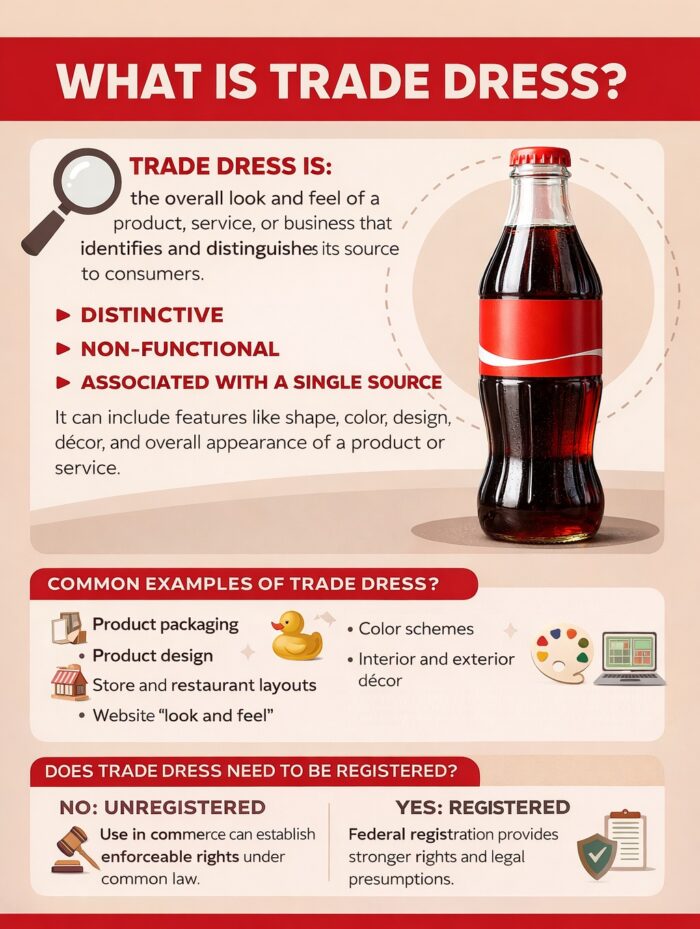
To register trade dress, a business may file a trade dress registration application with the U.S. Patent and Trademark Office (USPTO). Although trade dress rights can arise through use alone, federal registration provides significant advantages, including nationwide priority, statutory remedies, and enhanced enforcement options. Trade dress is typically examined by the USPTO for accurate depiction of the claimed trade dress, distinctiveness, and non-functionality, and registration often requires substantial evidence because trade dress claims are closely scrutinized.
Under 15 U.S.C. §1052(f), an applicant to register trade dress that is not inherently distinctive by proving evidence of acquired distinctiveness, such as long-term use, advertising, and consumer recognition. If it is found that the trade dress lacks sufficient distinctiveness, the trade dress may be registered on the supplemental register under 15 U.S.C. §1091. Federal rule 37 C.F.R. §2.41 sets out the procedural requirements for claiming acquired distinctiveness, including the types of evidence the USPTO may accept. Depending on the strength of the evidence, applicants may seek registration on the principal register or, as an interim step, the United States supplemental register.
Use in commerce can create common law rights in trademarks and trade dress, even without federal registration, a concept commonly referred to as common law protection. When a business consistently uses a distinctive, non-functional trade dress in connection with its goods or services, enforceable rights can arise based solely on consumer recognition in the relevant market. These common law trade dress rights are generally limited to the geographic areas where the trade dress is actually used and recognized, but they can still be powerful tools in stopping copycats engaging in unfair competition.
It should be understood that common law rights are only established and maintained if the trade dress is used continuously in commerce and is not abandoned. 15 U.S.C. §1127 defines “use in commerce” and “abandonment”. Under §1127, a mark or trade dress is deemed abandoned if its use has been discontinued with intent not to resume, or if the owner’s conduct causes the trade dress to lose its significance as a source identifier. Failure to enforce trade dress rights, such as tolerating widespread imitation, can lead to a loss of exclusivity because the trade dress no longer distinguishes a single source in the consumer’s mind. As a result, active monitoring and enforcement are essential to preserve common law protection and long-term trade dress rights.
Trade dress protects the distinctive, non-functional features that make a product or service immediately recognizable to consumers, whether those features appear in product packaging, product configuration, store design, or other elements that create a consistent overall appearance. Importantly, trade dress can be protectable whether it is registered or unregistered. Businesses may obtain federal registration through the U.S. Patent and Trademark Office, but enforceable trade dress rights can also arise through use in commerce under common law, so long as the trade dress is sufficiently distinctive and serves as a source identifier.
When valid trade dress rights are infringed, trademark law provides meaningful remedies. Courts may issue injunctions to stop confusingly similar use, award monetary damages and disgorgement of profits, and in exceptional cases grant attorneys’ fees. For well-known, protected trade dress, dilution claims may also be available even without direct consumer confusion. Together, these protections allow businesses to preserve the commercial value of their brand identity and prevent competitors from trading on their hard-earned goodwill.
Trade dress is a valuable form of brand protection and intellectual property. Consumer-oriented brands should consider distinctive trade dress to differentiate and protect their branding.
If you have a trade dress issue or other intellectual property matter, contact our office for a free consultation.
© 2026 Sierra IP Law, PC. The information provided herein does not constitute legal advice, but merely conveys general information that may be beneficial to the public, and should not be viewed as a substitute for legal consultation in a particular case.

"Mark and William are stellar in the capabilities, work ethic, character, knowledge, responsiveness, and quality of work. Hubby and I are incredibly grateful for them as they've done a phenomenal job working tirelessly over a time span of at least five years on a series of patents for hubby. Grateful that Fresno has such amazing patent attorneys! They're second to none and they never disappoint. Thank you, Mark, William, and your entire team!!"
Linda Guzman


Sierra IP Law, PC - Patents, Trademarks & Copyrights
FRESNO
7030 N. Fruit Ave.
Suite 110
Fresno, CA 93711
(559) 436-3800 | phone
BAKERSFIELD
1925 G. Street
Bakersfield, CA 93301
(661) 200-7724 | phone
SAN LUIS OBISPO
956 Walnut Street, 2nd Floor
San Luis Obispo, CA 93401
(805) 275-0943 | phone

SACRAMENTO
180 Promenade Circle, Suite 300
Sacramento, CA 95834
(916) 209-8525 | phone
MODESTO
1300 10th St., Suite F.
Modesto, CA 95345
(209) 286-0069 | phone
SANTA BARBARA
414 Olive Street
Santa Barbara, CA 93101
(805) 275-0943 | phone
SAN MATEO
1650 Borel Place, Suite 216
San Mateo, CA, CA 94402
(650) 398-1644. | phone
STOCKTON
110 N. San Joaquin St., 2nd Floor
Stockton, CA 95202
(209) 286-0069 | phone
PORTLAND
425 NW 10th Ave., Suite 200
Portland, OR 97209
(503) 343-9983 | phone
TACOMA
1201 Pacific Avenue, Suite 600
Tacoma, WA 98402
(253) 345-1545 | phone
KENNEWICK
1030 N Center Pkwy Suite N196
Kennewick, WA 99336
(509) 255-3442 | phone
2023 Sierra IP Law, PC - Patents, Trademarks & Copyrights - All Rights Reserved - Sitemap Privacy Lawyer Fresno, CA - Trademark Lawyer Modesto CA - Patent Lawyer Bakersfield, CA - Trademark Lawyer Bakersfield, CA - Patent Lawyer San Luis Obispo, CA - Trademark Lawyer San Luis Obispo, CA - Trademark Infringement Lawyer Tacoma WA - Internet Lawyer Bakersfield, CA - Trademark Lawyer Sacramento, CA - Patent Lawyer Sacramento, CA - Trademark Infringement Lawyer Sacrament CA - Patent Lawyer Tacoma WA - Intellectual Property Lawyer Tacoma WA - Trademark lawyer Tacoma WA - Portland Patent Attorney - Santa Barbara Patent Attorney - Santa Barbara Trademark Attorney
