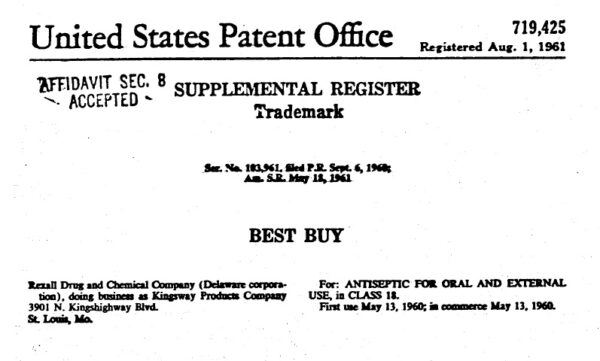
The United States Patent and Trademark Office (USPTO) has two trademark registers: the Principal Register and the Supplemental Register. The Principal Register is the primary registry, offering the strongest protection for trademark owners, while the Supplemental Register is an alternative for marks that are not yet eligible for the Principal Register. The Supplemental Register is the only option for brand names that are deemed too descriptive or non-distinctive for the Principal Register. This article explains the Supplemental Register, the benefits and limitations of a supplemental registration, and how a mark on the Supplemental Register can eventually graduate to the Principal Register.
A trademark must be distinctive to qualify for the Principal Register. Distinctiveness means the mark can identify the source of goods or services and distinguish them from others. Marks are categorized by their inherent distinctiveness. Fanciful, arbitrary, or suggestive marks are made-up brand names or unrelated words (e.g., XEROX for copiers or Apple for computers), which are considered inherently distinctive and are eligible for principal registration.
By contrast, descriptive marks directly describe a quality, feature, or characteristic of the product or service, and are not inherently distinctive. For example, the term “Bed and Breakfast Registry” was found to be merely descriptive of lodging reservation services. Such a phrase describes the service’s purpose and does not inherently distinguish one business’s services from another’s. Under the Lanham Act, a merely descriptive or indistinctive trademark cannot be registered on the Principal Register unless the applicant proves the mark has acquired secondary meaning (also called acquired distinctiveness) in the minds of consumers.
Generic terms (common names of products/services) are never registrable on either register, since no one can own exclusive rights to a generic name. The key difference between descriptive and generic marks is that a generic word is the common name of the good or service, whereas a descriptive mark is descriptive of a quality or characteristic of the good or service. For example, the word CARS could never be registered for use in connection with the sale of automobiles. It is the actual word that names the goods. This is distinct from descriptive terms, such as luxury, reliable, fuel-efficient, and other terms that describe a feature, quality, or characteristic of the automobiles.
The Supplemental Register is essentially a fallback option when the applicant seeks a principal registration, but the applied-for mark lacks the necessary distinctiveness to be on the Principal Register. Section 23 of the Lanham Act (15 U.S.C. § 1091) provides that any mark capable of distinguishing an applicant’s goods or services, but that fails to qualify for the Principal Register, may be registered on the Supplemental Register if it is already in lawful use in commerce. In practice, this means marks that are merely descriptive, primarily geographically descriptive, or primarily merely a surname can be listed on the Supplemental Register when they cannot yet show the secondary meaning required for principal registration.
The Supplemental Register gives businesses a way to obtain a federal trademark registration for a mark that is non-distinctive now, with the hope that over time the mark will acquire distinctiveness through use. For instance, many surnames or descriptive marketing terms start out on the Supplemental Register and later become eligible for the Principal Register once consumers come to associate the term with a single source: i.e., the mark gains “secondary meaning”.
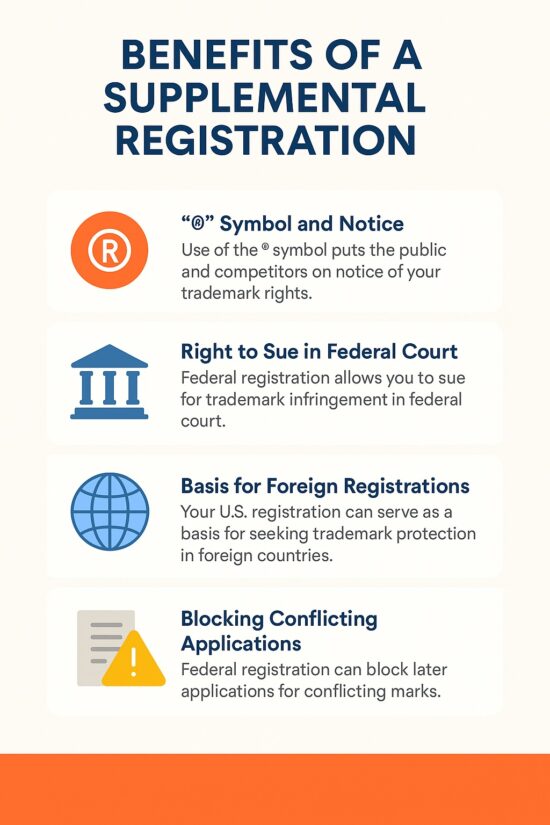
Even a federal trademark registration on the Supplemental Register provides some important benefits compared to having no federal registration at all. Marks registered on the supplemental register share a few of the advantages with the principal register:
Once your mark is federally registered, you can use the ® symbol with the mark. This puts the public and competitors on notice that you claim nationwide trademark rights in that name or logo. It can deter others from adopting a confusingly similar mark and signals that you, as the trademark owner, are serious about protecting your brand.
A federal registration (whether principal or supplemental) gives you the ability to sue for trademark infringement in federal court under the Lanham Act. In fact, 15 U.S.C. § 1121 and § 1111 allow registrants to bring infringement actions in federal court (and to recover certain remedies) even if the parties are in different states. While even unregistered marks can sometimes be protected under common law or §43(a) of the Lanham Act, owning a federal registration streamlines litigation and jurisdiction.
A U.S. registration on the Supplemental Register can serve as a basis for seeking trademark protection in foreign countries. Under international agreements like the Paris Convention, a U.S. trademark owner can use their U.S. application or registration to priority-file in other countries. Similarly, a U.S. registration can be used as the home registration for an international application through Madrid Protocol to extend protection abroad. This is a useful benefit for businesses planning to expand globally.
Importantly, any federal registration will be cited by the USPTO to refuse later applications for the same mark or a confusingly similar mark in related goods/services. In other words, once your mark is on the federal register (principal or supplemental), it can block others from registering a similar mark on either register. This can help protect your brand name from being registered by someone else and effectively “reserves” your place in line for the Principal Register once your mark becomes distinctive.
A trademark registered on the Supplemental Register does not carry all the benefits of a principal registration. Principal registrations have additional powerful rights granted by the Trademark Act. A Principal Register registration is considered “full” federal protection, and it offers trademark owners these key advantages that are not provided by a supplemental registration:
A principal registration grants the owner a nationwide exclusive right to use the mark on the goods/services listed, as of the filing date of the application. Under Lanham Act §7(c), the application’s filing date becomes the mark’s constructive use date, giving the registrant priority over others who started using the mark after that date. Additionally, once registered, the mark is listed in the USPTO database, which serves as constructive notice to the public of the registrant’s claim of ownership. This means no junior user can defend an infringement case by claiming they didn’t know of your mark.
A mark on the Principal Register comes with a statutory presumption that the trademark is valid, that the registrant is the lawful owner of the mark, and that the registrant has the exclusive right to use the mark nationwide for the identified goods or services. This is codified in 15 U.S.C. § 1057(b). In court, the burden of proof shifts to anyone challenging the mark to show it is not valid. For example, if you sue for infringement, the court will accept your registration as prima facie evidence that your mark is protectable and you have the superior rights, without you having to prove distinctiveness from scratch. This presumption can make enforcement easier and strengthen your negotiating position in disputes.
Incontestability after 5 Years of Trademark Registration
If a Principal-registered mark remains in continuous use for five years, the owner can file a Section 15 affidavit to declare the mark incontestable (15 U.S.C. § 1065). An incontestable status means the registration becomes conclusive evidence of your exclusive rights, and certain challenges can no longer be made by third parties. Notably, once a mark is incontestable, others cannot claim the mark is invalid because it’s merely descriptive. This principle affirmed by the U.S. Supreme Court in Park ‘N Fly, Inc. v. Dollar Park & Fly, Inc., where a descriptive mark’s incontestable status barred a competitor from arguing it was just descriptive. 469 U.S. 189 (1985). Incontestability can thus solidify rights in a mark that might have been borderline descriptive. Exceptions remain for challenges like the mark becoming generic, functional, or obtained by fraud.
Principal Register owners have access to certain benefits not available to Supplemental registrations. For instance, only a Principal Register registration can be recorded with U.S. Customs and Border Protection to block importation of counterfeit or infringing goods under 15 U.S.C. § 1124. Principal registration is also a prerequisite for achieving an incontestable trademark as noted above. In an infringement lawsuit, a Principal Register owner may be eligible for statutory damages or enhanced damages for counterfeiting under 15 U.S.C. § 1117 and even attorney’s fees in certain cases. Overall, the Principal Register is the gold standard of federal trademark registration, giving trademark owners the full arsenal of rights and presumptions under the Trademark Act.
Despite these limitations, a Supplemental Register entry is far better than no federal registration. It can dissuade others from adopting similar names and serve as a stepping stone in building necessary distinctiveness for your mark.
The good news is that registration on the Supplemental Register is often temporary on the path to full protection. Trademark law allows a mark on the supplemental list to be re-registered on the Principal Register once it acquires distinctiveness (secondary meaning). In fact, the law explicitly states that having a mark on the Supplemental Register does not bar the owner from later obtaining a principal registration for the same mark, nor does it constitute an admission that the mark lacks distinctiveness. Many entrepreneurs secure a supplemental registration early, build up brand recognition through continuous use, and then “graduate” to the Principal Register by proving acquired distinctiveness.
To move to the Principal Register, you must show that your formerly descriptive mark has become distinctive of your goods or services in commerce. Under §2(f) of the Lanham Act (15 U.S.C. § 1052(f)), one accepted method is proof of five years’ continuous and substantially exclusive use of the mark, which can create a presumption or at least a strong inference of secondary meaning. For example, the retailer name “Best Buy” was initially considered descriptive and thus unregistrable on the Principal Register until it had been used extensively nationwide. After years of use, the USPTO was convinced that Best Buy had acquired distinctiveness and allowed it on the Principal Register. Other evidence of acquiring distinctiveness can include large sales figures, advertising expenditures, consumer surveys, and any proof that the public associates the mark with your company and not just as a descriptive term.
When you believe your mark has gained the requisite distinctiveness, you can file a new trademark application for the Principal Register, claiming acquired distinctiveness under Section 2(f). In some cases, if the original application was still pending on the supplemental, an amendment to the application might be possible, but typically a fresh application is filed to switch registers once distinctiveness is achieved. The USPTO examining attorney will review the evidence. If convinced, your mark will be published and registered on the Principal Register, giving you all the enhanced rights discussed above. Crucially, your effective filing date for the principal registration will be the date of that new application or the date you amend from supplemental to principal, so timing your move can be important.
Note that if you filed an Intent To Use (ITU) application for a descriptive mark, you cannot actually register on the Supplemental Register until you start using the mark in commerce. An ITU application may be amended to the Supplemental Register only after an acceptable allegation of use with a specimen of use in commerce (i.e., a Statement of Use) is filed. This also means you might lose the benefit of your original filing date as the priority date. In practice, amending an application from Principal to Supplemental before registration will push your filing/priority date to the date of the amendment to use, which could open a window of vulnerability. For this reason, some applicants choose to initially seek registration on the Supplemental Register if they know their mark is descriptive and they have begun using it rather than filing ITU on the Principal Register and facing a possible downgrade later. It is a strategic decision best made with advice from a trademark attorney, considering the specifics of your situation.
In the principal and supplemental registers of the USPTO, we have a two-tier system balancing the need for trademarks to be distinctive with the reality that some names start off merely descriptive. A registration on the Supplemental Register is a valuable tool for businesses with marks that haven’t yet achieved distinctiveness. Once a mark develops the secondary meaning required, the owner can seek registration on the Principal Register to obtain the full suite of trademark rights and protections.
A Supplemental Register trademark registration can safeguard your brand while you build consumer recognition. Over time, with continuous use and marketing, you may achieve the distinctiveness required to upgrade to a Principal Register registration and enjoy the additional benefits and exclusive rights it confers. Always consider consulting a trademark professional to assist you in securing your brand. If you are seeking trademark registration or need assistance with other intellectual property matters, contact our office for a consultation.
© 2025 Sierra IP Law, PC. The information provided herein does not constitute legal advice, but merely conveys general information that may be beneficial to the public, and should not be viewed as a substitute for legal consultation in a particular case.

"Mark and William are stellar in the capabilities, work ethic, character, knowledge, responsiveness, and quality of work. Hubby and I are incredibly grateful for them as they've done a phenomenal job working tirelessly over a time span of at least five years on a series of patents for hubby. Grateful that Fresno has such amazing patent attorneys! They're second to none and they never disappoint. Thank you, Mark, William, and your entire team!!"
Linda Guzman


Sierra IP Law, PC - Patents, Trademarks & Copyrights
FRESNO
7030 N. Fruit Ave.
Suite 110
Fresno, CA 93711
(559) 436-3800 | phone
BAKERSFIELD
1925 G. Street
Bakersfield, CA 93301
(661) 200-7724 | phone
SAN LUIS OBISPO
956 Walnut Street, 2nd Floor
San Luis Obispo, CA 93401
(805) 275-0943 | phone

SACRAMENTO
180 Promenade Circle, Suite 300
Sacramento, CA 95834
(916) 209-8525 | phone
MODESTO
1300 10th St., Suite F.
Modesto, CA 95345
(209) 286-0069 | phone
SANTA BARBARA
414 Olive Street
Santa Barbara, CA 93101
(805) 275-0943 | phone
SAN MATEO
1650 Borel Place, Suite 216
San Mateo, CA, CA 94402
(650) 398-1644. | phone
STOCKTON
110 N. San Joaquin St., 2nd Floor
Stockton, CA 95202
(209) 286-0069 | phone
PORTLAND
425 NW 10th Ave., Suite 200
Portland, OR 97209
(503) 343-9983 | phone
TACOMA
1201 Pacific Avenue, Suite 600
Tacoma, WA 98402
(253) 345-1545 | phone
KENNEWICK
1030 N Center Pkwy Suite N196
Kennewick, WA 99336
(509) 255-3442 | phone
2023 Sierra IP Law, PC - Patents, Trademarks & Copyrights - All Rights Reserved - Sitemap Privacy Lawyer Fresno, CA - Trademark Lawyer Modesto CA - Patent Lawyer Bakersfield, CA - Trademark Lawyer Bakersfield, CA - Patent Lawyer San Luis Obispo, CA - Trademark Lawyer San Luis Obispo, CA - Trademark Infringement Lawyer Tacoma WA - Internet Lawyer Bakersfield, CA - Trademark Lawyer Sacramento, CA - Patent Lawyer Sacramento, CA - Trademark Infringement Lawyer Sacrament CA - Patent Lawyer Tacoma WA - Intellectual Property Lawyer Tacoma WA - Trademark lawyer Tacoma WA - Portland Patent Attorney - Santa Barbara Patent Attorney - Santa Barbara Trademark Attorney
