
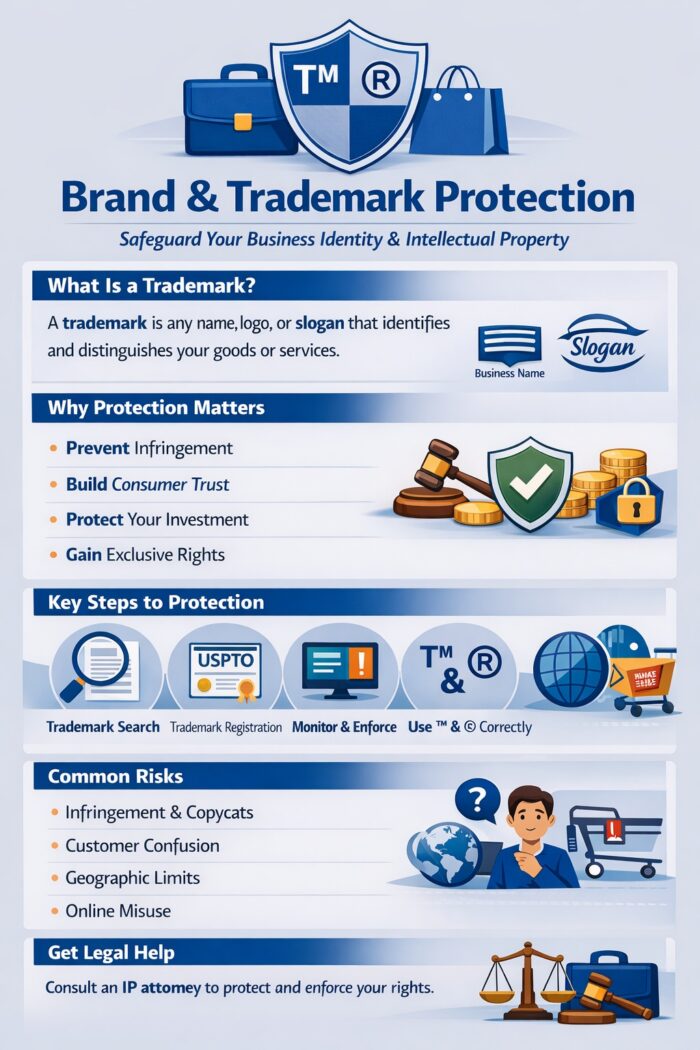
Integrating brand and trademark protection into your overall business strategy is one of the smartest investments you can make to support your long-term success. Your brand is more than marketing; it is the symbol of the public perception of your company, including its reputation, voice, customer experience, and commitment to quality. By contrast, a trademark (or service mark for services) is a specific legal tool within that broader brand strategy. A trademark can include your business name, logo, slogan, or distinctive product word or phrase that identifies and distinguishes the source of your goods or services. See 15 U.S.C. § 1127.
Strong brand recognition depends on maintaining a consistent and well-defined brand identity. Trademarks serve as both a visual and conceptual anchor in the marketplace, creating a direct link in the minds of consumers between your business and the goods and services you provide. Without deliberate trademark protection, even a well-developed brand can become vulnerable to misuse, imitation, and customer confusion.
Below we discuss trademark basics and a roadmap to help you protect the brand equity you have worked hard to build, before competitors turn inaction into an expensive cleanup effort.
A trademark is not just a name; it is the mark customers rely on to recognize your brand in a crowded marketplace. In legal terms, a trademark is a form of intellectual property that may be in the form of a brand name, logo, tagline, or other distinctive identifier used in connection with goods and services. A trademark functions as a source identifier. It tells consumers who stands behind the product or service and what level of quality they can expect.
Trademarks exist to reduce customer confusion and to prevent consumers from mistakenly purchasing one company’s products believing they come from another. By clearly distinguishing the source of goods and services, a trademark creates a mental link between a business and its offerings. Over time, that connection builds trust, strengthens brand recognition, and reinforces a company’s reputation.
Building trademark rights begins with choosing a distinctive mark that can be registered and not similar to existing trademarks. This early decision is crucial because the strength of your trademark directly affects the scope of your legal protection, your ability to enforce exclusive rights, and the long-term value of your brand. Before investing in packaging, marketing, or a logo, a business should evaluate whether its proposed mark is capable of functioning as a source identifier for its goods or services.
Distinctiveness matters. Courts generally classify marks along a spectrum: generic terms, which provide no protection; descriptive terms, which are harder to protect absent acquired distinctiveness; and suggestive, arbitrary, or fanciful marks, which are considered strong marks. See Abercrombie & Fitch Co. v. Hunting World, Inc., 537 F.2d 4 (2d Cir. 1976). The more distinctive the mark, the easier it is to protect and enforce against competitors using similar marks that could cause confusion in the marketplace.
A strong brand identity often starts with an inherently distinctive mark. Such marks are easier to register, easier to protect, and more valuable as a long-term investment in brand recognition and overall business success.
Conducting a trademark search is an essential step to take before you commit to a particular mark. If your mark or a similar mark is already in use by someone else, you will not be able to establish exclusive rights in the mark. A proper search helps determine whether your proposed trademark is already in use or registered by another party, and whether it could create confusion in the marketplace. Skipping this step can expose your business to infringement claims, costly rebranding, and loss of investment.
A thorough trademark clearance search should include review of the federal database at the United States Patent and Trademark Office (USPTO), to identify existing registrations and pending applications. It should also cover common-law sources such as websites, social media platforms, app stores, and trade publications, since unregistered users may still hold priority in a geographic area. Finally, industry- and channel-specific searches for related goods or related goods or services are critical.
This diligence is crucial because similar marks can block your application or form the basis of trademark infringement claims under 15 U.S.C. §§ 1114(1), 1125(a), if they create confusion among customers. As an example, “NOVA” for energy drinks could conflict with “NOVA” for sports supplements, depending on market overlap and consumer perception.
A common law trademark can arise automatically through bona fide trademark use in commerce, even without formal registration. Under the Lanham Act, rights are tied to use in commerce. See 15 U.S.C. § 1127. This means a business that consistently uses a mark in connection with its goods or services may acquire enforceable common law rights by operating in the marketplace.
However, those rights are typically limited to the specific geographic area where the mark is actually used and where it has developed recognition among consumers. The Supreme Court has long recognized this territorial limitation. In Hanover Star Milling Co. v. Metcalf, 240 U.S. 403 (1916), the Supreme Court addressed competing claims to the trademark “Tea Rose” for flour. The plaintiff had used the mark in certain states, while the defendant adopted the same mark in a geographically distinct area without knowledge of the plaintiff’s prior use. The Court held that trademark rights arise from actual use and are limited to the territory where the mark has established goodwill and recognition among consumers. Because the defendant adopted the mark in good faith in a remote market, it could continue using the mark in that territory. This case established what is often called the “Tea Rose” doctrine, under which common law trademark rights are territorial and tied to market penetration.
In United Drug Co. v. Theodore Rectanus Co., 248 U.S. 90 (1918), the dispute involved the trademark “Rex” for medicinal products. The plaintiff had prior use in the Northeast, while the defendant later adopted the same mark in Kentucky, also without knowledge of the plaintiff’s use. The Court reaffirmed that trademark rights depend on actual use and reputation in a specific market. Because the defendant built goodwill in a separate geographic area before the plaintiff expanded there, the defendant retained rights in its territory. Without a federal registration, priority does not automatically confer exclusive rights. If another company independently adopts the same or a similar mark in a different region, both parties may hold concurrent rights within their respective territories.
Without a federal trademark registration, a growing company may discover that its claimed exclusive rights are limited, and another user may control the mark in other geographic areas. For businesses planning meaningful growth, relying solely on common law trademark protection often leaves critical brand assets exposed.
A federal trademark registration is one of the most powerful tools available for meaningful brand and trademark protection. While limited rights may arise through use alone, federal registration under the Lanham Act provides significantly stronger legal protection than an unregistered mark. Among the most important benefits are nationwide priority tied to the filing date, constructive notice to the public of the registrant’s claim of ownership, and a presumption of validity and exclusive ownership under 15 U.S.C. §§ 1057(c), 1072.
These statutory advantages substantially strengthen an owner’s position when asserting exclusive rights against infringers. In practical terms, federal registration streamlines enforcement, reduces disputes over priority, and enhances credibility in negotiations. It also provides access to federal remedies, including injunctive relief and monetary damages in appropriate cases under 15 U.S.C. §§ 1116, 1117.
In other words, trademarks provide legal protection that does more than simply confirm ownership: they function as a deterrent. Competitors are far less likely to adopt similar branding when a mark is federally registered and publicly searchable. For growing businesses, this predictability and leverage are central to a comprehensive brand protection strategy, helping secure market position while preserving long-term brand value.
A trademark application filed with the United States Patent and Trademark Office (USPTO) must clearly set out three core elements: the mark itself, a precise identification of the relevant goods or services, and the legal basis for filing, either current use in commerce or a bona fide intent to use the mark in commerce under 15 U.S.C. § 1051(a)–(b). Whether you are protecting a business name, logo, slogan, or other brand identifier, the application must accurately reflect how the mark appears and how it is used in the marketplace.
Careful drafting of the identification of goods or services is especially important. Trademark rights are defined in large part by the scope of the goods and services listed in the application, and the listed goods and services must align with how the mark is actually used in the real market. If the listed goods or services do not match what you are actually selling, a registration issuing from your application will be partially or fully invalid.
After filing a trademark application with the patent and trademark office, a USPTO examining attorney reviews the submission for compliance with federal law and USPTO rules. During this stage, the trademark office evaluates whether the mark conflicts with existing trademarks, whether the mark is merely descriptive, whether the mark functions properly as a source identifier, and whether the trademark application includes an acceptable specimen of use showing the trademark in actual use in commerce.
If problems are identified, the USPTO issues an office action under 15 U.S.C. § 1062(b) explaining the refusals or requirements that must be addressed. Common issues include likelihood of confusion with similar marks, improper identification of goods or services, technical filing errors, or insufficient evidence of use. In order to overcome the refusals in the office action, a timely response must be filed, providing remarks and arguments explaining why the refusals are improper. Failure to respond to an office action can result in abandonment of the application. See 37 C.F.R. § 2.65.
If the application is approved by the trademark examiner, the trademark will be published in the Official Gazette so third parties have an opportunity to oppose registration. By statute, the opposition period is 30 days, although challengers may request extensions of time to oppose. See 15 U.S.C. §§ 1062(a), 1063. This stage is a critical checkpoint in the trademark registration process because it allows third party owners of existing trademarks to challenge registration of the applied-for mark based likelihood of confusion, trademark dilution, or other bases for preventing registration.
Oppositions are administrative proceedings that function much like litigation before the Trademark Trial and Appeal Board, requiring evidence and legal argument. The opposition process underscores the importance of conducting a thorough trademark search before filing an application, including surveying unregistered, common law use of the proposed mark and similar marks. If no opposition is filed, or if you successfully defend against it, the application proceeds toward registration.
After the opposition period, the path forward depends on your filing basis. For applications filed under Section 1(a) with use in commerce established prior to filing, the trademark will proceed directly to registration, and you will receive a certificate of registration confirming your status as the owner of a federally registered trademark under 15 U.S.C. § 1057. At that point, your federal trademark registration provides nationwide priority benefits and strengthens your overall trademark protection strategy.
For intent-to-use applications filed under Section 1(b) with no use in commerce established at the time of filing, the process includes an additional step. After publication, the USPTO issues a notice of allowance, which does not grant registration yet but confirms the mark is entitled to register once actual use begins. You have six months from the mailing date of the notice of allowance to file a statement of use, with the option to extend the time for filing the statement of use to a total period of three years . See 15 U.S.C. § 1051(d). Failure to timely file the statement of use results in abandonment of the trademark application under 37 C.F.R. § 2.65.
There are rules and differences between the use of the ™ for an unregistered mark and ® for a federally registered trademark. The ™ symbol signals a claim of common law rights, while ® provides public notice of federal registration and the enhanced legal protection that accompanies it. These symbols should be used properly and consistently in order to establish and maintain your trademark rights. Under 15 U.S.C. § 1111, failure to use the ® symbol properly can limit available damages in an infringement action, and improper use of ® without a valid registration can result in false marking claims and potentially deceptive trade practice or fraud claims. Clear and consistent trademark use puts the public on notice of your rights and helps to preserve the distinctiveness of your mark in the marketplace.
Trademark infringement generally occurs when a third party uses your trademark, or a confusingly similar mark, without authorization on related goods or services in a manner that is likely to cause confusion among consumers. See 15 U.S.C. §§ 1114(1), 1125(a). The core question is whether ordinary purchasers would mistakenly believe the accused goods or services originate from, are affiliated with, or are sponsored by your business. When infringement takes hold, the fallout can be significant: damage to brand reputation, diversion of sales, lost revenue, and long-term erosion of consumer trust. The risk of damage to your trademark rights and brand is heightened by the threat of online infringement in digital marketplaces and social media, where misleading listings and knock-off products and services can be created and spread quickly.
A proactive approach to trademark protection and enforcement includes:
This kind of comprehensive approach can mitigate the challenges manufacturers and growing businesses face when brand protection measures are inadequate. It is recommended that businesses consult with an experienced trademark attorney to carry out these processes. The foregoing steps (at least 3-5) should not be carried out without the assistance of an experienced trademark attorney.
Without trademark protection, a business’s valuable assets are left vulnerable. Effective brand and trademark protection is critical to protecting the reputation and customer perception upon which a business is built. Proper trademark strategy combines careful selection of a distinctive mark, clearance searching, trademark registration, disciplined trademark use, and consistent monitoring and enforcement.
Businesses should practice disciplined trademark use, including consistent branding, proper use of symbols, and quality control over trademark licensing. Brands should be diligently protected through ongoing monitoring of the market and online platforms to detect potential trademark infringement early. When necessary, enforcement tools such as cease and desist letters and formal proceedings should be employed to protect your exclusive rights and preserve consumer trust. A proactive, structured approach protects reputation, strengthens market position, and secures the long-term value of your brand.
If you need assistance with establishing your brand and trademark protection, or protecting other intellectual property rights, contact our offices for a consultation.
© 2026 Sierra IP Law, PC. The information provided herein does not constitute legal advice, but merely conveys general information that may be beneficial to the public, and should not be viewed as a substitute for legal consultation in a particular case.

"Mark and William are stellar in the capabilities, work ethic, character, knowledge, responsiveness, and quality of work. Hubby and I are incredibly grateful for them as they've done a phenomenal job working tirelessly over a time span of at least five years on a series of patents for hubby. Grateful that Fresno has such amazing patent attorneys! They're second to none and they never disappoint. Thank you, Mark, William, and your entire team!!"
Linda Guzman


Sierra IP Law, PC - Patents, Trademarks & Copyrights
FRESNO
7030 N. Fruit Ave.
Suite 110
Fresno, CA 93711
(559) 436-3800 | phone
BAKERSFIELD
1925 G. Street
Bakersfield, CA 93301
(661) 200-7724 | phone
SAN LUIS OBISPO
956 Walnut Street, 2nd Floor
San Luis Obispo, CA 93401
(805) 275-0943 | phone

SACRAMENTO
180 Promenade Circle, Suite 300
Sacramento, CA 95834
(916) 209-8525 | phone
MODESTO
1300 10th St., Suite F.
Modesto, CA 95345
(209) 286-0069 | phone
SANTA BARBARA
414 Olive Street
Santa Barbara, CA 93101
(805) 275-0943 | phone
SAN MATEO
1650 Borel Place, Suite 216
San Mateo, CA, CA 94402
(650) 398-1644. | phone
STOCKTON
110 N. San Joaquin St., 2nd Floor
Stockton, CA 95202
(209) 286-0069 | phone
PORTLAND
425 NW 10th Ave., Suite 200
Portland, OR 97209
(503) 343-9983 | phone
TACOMA
1201 Pacific Avenue, Suite 600
Tacoma, WA 98402
(253) 345-1545 | phone
KENNEWICK
1030 N Center Pkwy Suite N196
Kennewick, WA 99336
(509) 255-3442 | phone
2023 Sierra IP Law, PC - Patents, Trademarks & Copyrights - All Rights Reserved - Sitemap Privacy Lawyer Fresno, CA - Trademark Lawyer Modesto CA - Patent Lawyer Bakersfield, CA - Trademark Lawyer Bakersfield, CA - Patent Lawyer San Luis Obispo, CA - Trademark Lawyer San Luis Obispo, CA - Trademark Infringement Lawyer Tacoma WA - Internet Lawyer Bakersfield, CA - Trademark Lawyer Sacramento, CA - Patent Lawyer Sacramento, CA - Trademark Infringement Lawyer Sacrament CA - Patent Lawyer Tacoma WA - Intellectual Property Lawyer Tacoma WA - Trademark lawyer Tacoma WA - Portland Patent Attorney - Santa Barbara Patent Attorney - Santa Barbara Trademark Attorney
