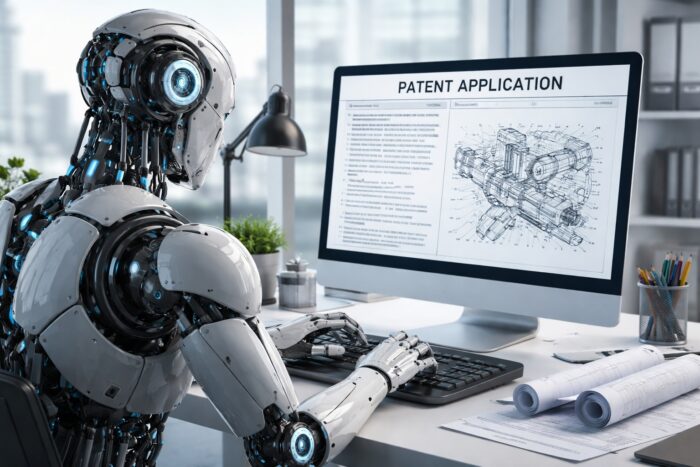
AI for patents is no longer a niche topic. Artificial intelligence, machine learning, neural networks, large language models, and other AI technology (generally referred to as "AI") are changing how practitioners search prior art, analyze data, prepare patent applications, and manage patent prosecution. But the question remains of whether AI is an effective and lawful tool for patent work. In the U.S. patent system, the key issues surrounding the use of AI in connection with patents are inventorship, patent eligibility, disclosure, claim quality, and security.
This is a new era for patents, but AI is not a game changer by itself. It is a tool that can improve efficiency, productivity, and patent intelligence in software, electronics, medical imaging, life sciences, and other fields. The United States Patent and Trademark Office (USPTO) says patent examiners have already conducted more than 1.3 million searches using AI tools, including patent searches that surface foreign prior art from over 60 countries, and the office’s ASAP! pilot system is testing automated pre-examination search notices. That shows how seriously the USPTO is treating AI-assisted analysis.
AI can be used as a tool for developing and refining an invention that was conceived by a human inventor. If the subject matter of a patent application is purely AI output, it is not a patentable invention under US patent law. The USPTO’s current guidance (USPTO Inventorship Guidance for AI-Assisted Inventions) makes clear that AI systems, including generative AI, are treated as instruments used by human inventors, not inventors themselves. The guidance emphasizes that there is no separate legal standard for AI-assisted inventions and that traditional inventorship law still applies, meaning only natural persons can be named as inventors and must have conceived the claimed invention.
In practice, that means AI may provide services, analyze data, and generate ideas, but it does not become an inventor. AI can help move inventors from a rough idea to a more specific solution. But patent law still asks who conceived the claimed invention, not who generated the first draft or suggestion. The human contribution remains the controlling factor.
Under current U.S. law, the answer remains no, AI cannot be an inventor. Title 35 defines an “inventor” as an “individual,” and courts have interpreted that term to mean a natural person. In Thaler v. Vidal, 43 F.4th 1207 (Fed. Cir. 2022), the applicant, Stephen Thaler, filed patent applications naming an artificial intelligence system (DABUS) as the sole inventor of two inventions: a "neural flame" and a "fractal container". The United States Patent and Trademark Office rejected the applications for failing to identify a human inventor, and the Federal Circuit affirmed. The court held that the statutory language of 35 U.S.C. § 100(f), which defines an inventor as an “individual,” unambiguously requires a human being. Because no natural person was named, the applications were defective and could not proceed.
Consistent with that holding, the USPTO’s revised 2025 guidance confirms that artificial intelligence, including generative AI, cannot be listed as an inventor or joint inventor in patent applications, even where AI systems play a significant role in generating ideas or assisting with the invention process. As a result, any patent application that identifies an AI system instead of a human inventor risks rejection or other corrective action under 35 U.S.C. §§ 100 and 115. In addition, each named inventor must properly execute or support an oath or declaration under 37 C.F.R. § 1.63, affirming their role in the conception of the claimed invention. This remains a core legal principle in the patent system: regardless of advances in artificial intelligence, inventorship, and the associated rights and obligations, must trace back to a human individual before a patent application can be validly filed.
The current rule in the patent system remains the traditional conception test, even in the age of artificial intelligence. The United States Patent and Trademark Office’s 2025 revised guidance confirms that there is no separate or modified legal standard for AI-assisted inventions. The key question is still whether a human inventor formed a “definite and permanent idea of the complete and operative invention,” which is the longstanding definition of conception in patent law.
If a human uses generative AI or large language models as tools, the analysis focuses on whether that individual exercised enough technical expertise and control over the process to form the invention. The AI system may assist with data processing, patent drafting, or generating options, but it cannot supply the required inventive contribution under current law.
This principle is illustrated by Burroughs Wellcome Co. v. Barr Laboratories, Inc., 40 F.3d 1223 (Fed. Cir. 1994), where the court held that conception requires a specific, settled idea, not just a general research plan or wish. In that case, the inventors identified AZT as a treatment for HIV based on prior research and testing, and the court found they had achieved conception because they could describe the invention with sufficient detail. Applied to AI technology, this means that simply prompting a system or reviewing outputs from machine learning or neural networks is not enough, there must be human intellectual contribution that rises to the level of a complete invention.
Where multiple humans collaborate, whether directly or through AI-assisted workflows, joint inventorship is governed by 35 U.S.C. § 116 and clarified by Pannu v. Iolab Corp., 155 F.3d 1344 (Fed. Cir. 1998). In Pannu, the court held that a joint inventor must (1) contribute in some significant manner to the conception of the invention, (2) make a contribution that is not insignificant in quality, and (3) do more than merely explain well-known concepts or follow instructions. The case involved intraocular lens technology, where one contributor’s role was evaluated to determine whether it rose above routine assistance. The court emphasized that joint inventorship requires meaningful participation in the inventive concept, not just execution or support.
Together, these authorities reinforce a consistent rule across AI-related inventions, software, life sciences, and other fields: inventorship turns on human contribution to conception of the novel elements of the invention, not on who operated the tools. Whether using an artificial neural network, a computer program, or other AI tools, the named inventors must have the knowledge, ability, and involvement necessary to articulate the invention with particularity in the patent application, including its patent claims and detailed descriptions.
Often yes, but AI for patents operates within the same legal framework as any other technology. AI-related inventions and AI-related patents must satisfy patent eligibility under 35 U.S.C. § 101, novelty under 35 U.S.C. § 102, non-obviousness under 35 U.S.C. § 103, and written description and enablement under 35 U.S.C. § 112. These requirements apply regardless of whether the invention involves artificial intelligence, machine learning, neural networks, or other advanced software tools.
Patent eligibility under § 101 is often the most contested issue for AI-related inventions. The Alice Corp. v. CLS Bank International, 573 U.S. 208 (2014) decision remains central. In Alice, the patents claimed a computerized scheme for mitigating settlement risk using a third-party intermediary. The Supreme Court of the United States held that merely implementing an abstract idea (intermediated settlement) on a generic computer does not make it patentable. The Court established the now-familiar two-step test: (1) determine whether the claims are directed to an abstract idea, and if so, (2) determine whether the claims include an “inventive concept” sufficient to transform the abstract idea into patent-eligible subject matter. This framework frequently applies to AI-related patents, especially where claims resemble data processing, prediction models, or algorithmic outputs performed on conventional computing systems.
That said, not all AI inventions are treated as abstract. Courts and the patent office have recognized that claims directed to specific technological improvements, rather than generalized data analysis, may satisfy § 101. For example, in Enfish, LLC v. Microsoft Corp., 822 F.3d 1327 (Fed. Cir. 2016), the Federal Circuit upheld claims directed to a self-referential database structure because they improved the way computers operate, rather than simply using computers as tools. Similarly, in McRO, Inc. v. Bandai Namco Games America Inc., 837 F.3d 1299 (Fed. Cir. 2016), the Federal Circuit found claims patent-eligible where they used specific rules to automate lip synchronization in animation, improving a technical process rather than claiming a broad abstract idea.
Consistent with these cases, the United States Patent and Trademark Office has issued guidance clarifying how examiners should evaluate AI technology. The USPTO’s 2024 subject matter eligibility guidance update explains that AI-related inventions are more likely to be patentable when the claims recite a specific improvement to computer functionality or another technical field, such as medical imaging, signal processing, or specialized hardware implementations of an artificial neural network.
In practice, this means that AI-related inventions framed as concrete technological solutions, rather than generalized data manipulation or mathematical concepts, stand a stronger chance of obtaining patent protection.
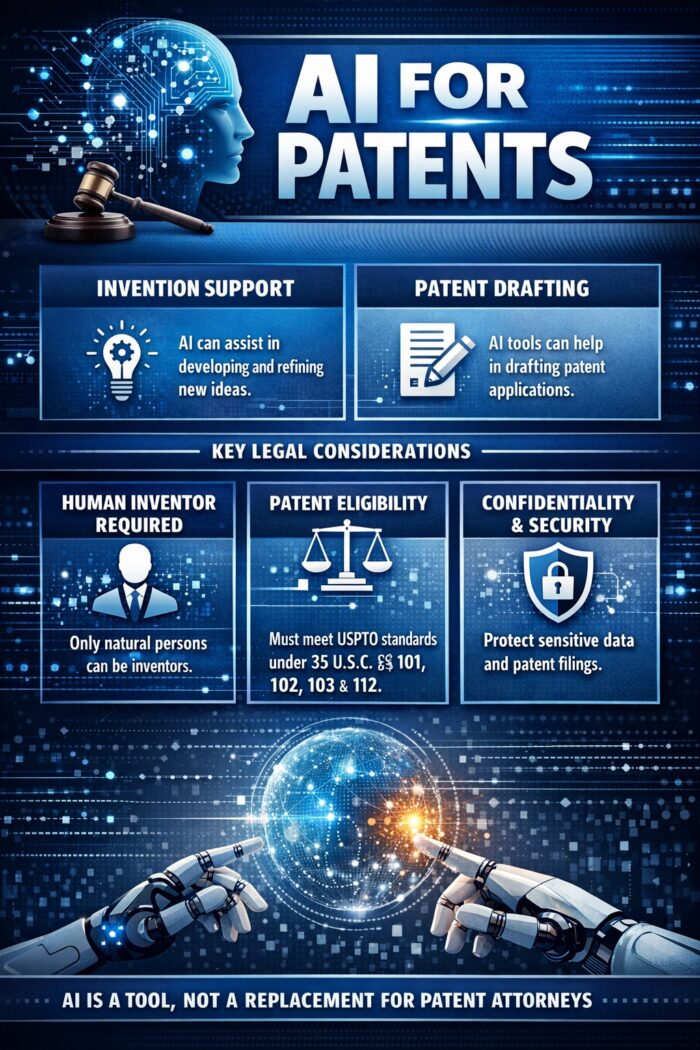
The best use of AI for patents is not replacing a patent attorney but improving early analysis. AI tools can use semantic search, natural language processing (NLP), and machine learning to review prior art, compare an invention disclosure to the field, identify related patents, and map competitive landscapes much faster than manual work alone. AI can assist as a patent drafting tool, but is generally not effective for single-prompt, one-shot drafting. It can be helpful in drafting certain sections (e.g., background sections) with effective prompting, but it is not a substitute for a professional patent drafter. AI is a valuable support tool for patent attorneys and patent practitioners handling repetitive tasks, but it cannot handle all patent tasks and matters.
AI can also help in patent prosecution, including office action responses. USPTO guidance recognizes that tools may be used to draft responses, but the signer still must review the paper, verify the facts, check citations, and ensure the arguments are warranted by law. Patent practitioners also remain subject to 37 C.F.R. § 11.303 and cannot make false statements of fact or law. That matters because office action responses can affect claim scope, estoppel, validity, and later enforcement. A polished AI draft with a bad citation can result in significant issues in the application and potential disciplinary action for the practitioner.
The biggest pitfalls are predictable: hallucinated prior art, incorrect case citations, overbroad claims, unsupported limitations, and invented technical detail. Under 37 C.F.R. § 1.56, people involved in filing and prosecution owe the patent office a duty of candor and good faith. Under 37 C.F.R. § 11.18, anyone presenting a paper certifies that the factual and legal contentions have evidentiary support after a reasonable inquiry. The USPTO specifically warns that parties cannot simply assume that output by an AI system is accurate. Specifications and drawings prepared with AI may not meet § 112 compliance. Before an application prepared using an AI tool is filed, the draft should be thoroughly reviewed for accuracy, completeness, and compliance with the disclosure requirements of 35 U.S.C. § 112.
Security is a concern when using AI for patents, particularly when handling unpublished inventions, patent applications, and sensitive intellectual property. If users input confidential invention disclosures into poorly governed AI tools, they risk unintended access, data leakage, or even loss of patent protection. The United States Patent and Trademark Office has expressly warned that some artificial intelligence systems may retain user inputs, use them to train models, or share them with third parties, raising serious concerns under 37 C.F.R. § 11.106, which imposes strict confidentiality obligations on patent practitioners.
In response, several AI companies have developed platforms specifically tailored for patent drafting, patent prosecution, and patent intelligence workflows with an emphasis on security. For example, DeepIP markets its system as offering highest security standards, including end-to-end encryption, strict data segregation, and controlled access environments. It also emphasizes seamless integration with tools like Microsoft Word while maintaining isolated processing pipelines to prevent cross-client data exposure.
Similarly, Solve Intelligence promotes secure collaboration features for drafting and office action responses, with safeguards designed to ensure that user data is not reused for model training without authorization. Rowan Patents and IP Author also highlight security-focused architectures, including sandboxed environments, jurisdiction-specific data handling, and compliance with standards such as SOC 2 and GDPR, features that are increasingly expected when dealing with global patent portfolios across various fields like life sciences, medical imaging, and software.
Inventors and patent attorneys should conduct careful diligence before using any AI system. This includes reviewing how the platform handles data retention, who has access to the data, whether the system uses inputs for training purposes, and what contractual support is provided in the event of a breach.
Conclusion
Inventors and patent practitioners will be using AI for patents more as the technology develops. AI can improve efficiency in invention development, prior art review, patent drafting, and patent prosecution. However, the law still requires human inventors, human responsibility, and human review. AI is not a replacement for inventors or patent attorneys. It is a tool that improves efficiency and reduces some of the tedious aspects of innovation and patent drafting.
If you have a patent matter or other intellectual property matter with which you need assistance, contact for a consultation.
© 2026 Sierra IP Law, PC. The information provided herein does not constitute legal advice, but merely conveys general information that may be beneficial to the public, and should not be viewed as a substitute for legal consultation in a particular case.
"Mark and William are stellar in the capabilities, work ethic, character, knowledge, responsiveness, and quality of work. Hubby and I are incredibly grateful for them as they've done a phenomenal job working tirelessly over a time span of at least five years on a series of patents for hubby. Grateful that Fresno has such amazing patent attorneys! They're second to none and they never disappoint. Thank you, Mark, William, and your entire team!!"
Linda Guzman


Sierra IP Law, PC - Patents, Trademarks & Copyrights
FRESNO
7030 N. Fruit Ave.
Suite 110
Fresno, CA 93711
(559) 436-3800 | phone
BAKERSFIELD
1925 G. Street
Bakersfield, CA 93301
(661) 200-7724 | phone
SAN LUIS OBISPO
956 Walnut Street, 2nd Floor
San Luis Obispo, CA 93401
(805) 275-0943 | phone

SACRAMENTO
180 Promenade Circle, Suite 300
Sacramento, CA 95834
(916) 209-8525 | phone
MODESTO
1300 10th St., Suite F.
Modesto, CA 95345
(209) 286-0069 | phone
SANTA BARBARA
414 Olive Street
Santa Barbara, CA 93101
(805) 275-0943 | phone
SAN MATEO
1650 Borel Place, Suite 216
San Mateo, CA, CA 94402
(650) 398-1644. | phone
STOCKTON
110 N. San Joaquin St., 2nd Floor
Stockton, CA 95202
(209) 286-0069 | phone
PORTLAND
425 NW 10th Ave., Suite 200
Portland, OR 97209
(503) 343-9983 | phone
TACOMA
1201 Pacific Avenue, Suite 600
Tacoma, WA 98402
(253) 345-1545 | phone
KENNEWICK
1030 N Center Pkwy Suite N196
Kennewick, WA 99336
(509) 255-3442 | phone
2023 Sierra IP Law, PC - Patents, Trademarks & Copyrights - All Rights Reserved - Sitemap Privacy Lawyer Fresno, CA - Trademark Lawyer Modesto CA - Patent Lawyer Bakersfield, CA - Trademark Lawyer Bakersfield, CA - Patent Lawyer San Luis Obispo, CA - Trademark Lawyer San Luis Obispo, CA - Trademark Infringement Lawyer Tacoma WA - Internet Lawyer Bakersfield, CA - Trademark Lawyer Sacramento, CA - Patent Lawyer Sacramento, CA - Trademark Infringement Lawyer Sacrament CA - Patent Lawyer Tacoma WA - Intellectual Property Lawyer Tacoma WA - Trademark lawyer Tacoma WA - Portland Patent Attorney - Santa Barbara Patent Attorney - Santa Barbara Trademark Attorney
