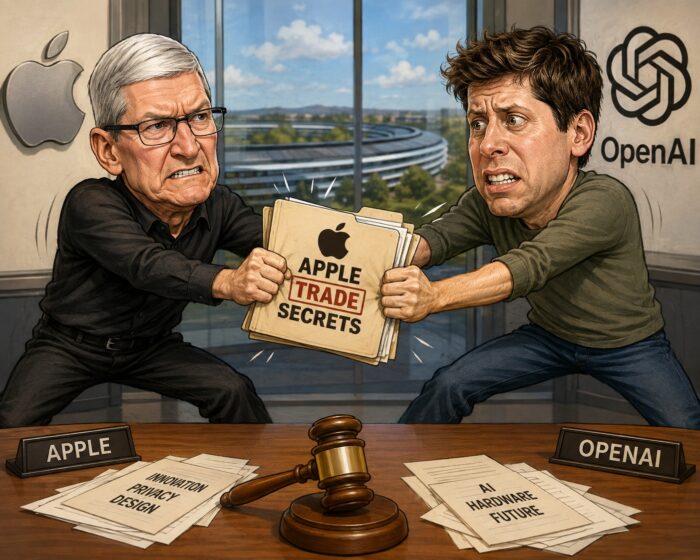
Apple filed a 41-page complaint on July 10, 2026, in the U.S. District Court for the Northern District of California. The Apple-OpenAI trade secret lawsuit names OpenAI, io Products, and two former Apple employees, Chang Liu and Tang Yew Tan. An Apple spokesperson said, “significant evidence has emerged suggesting individuals employed by OpenAI wrongfully took Apple’s secret and confidential information.” The allegations are claims, not court findings.
This article is provided for non-attorneys to explain the Apple-OpenAI trade secret lawsuit and the bases for Apple's claims against OpenAI and related parties in plain language.
The complaint states that former employees stole Apple’s trade secrets to advance OpenAI’s efforts to enter the consumer hardware market. The iPhone maker claims OpenAI orchestrated a coordinated pattern of action to acquire Apple's trade secrets, involving OpenAI employees, Apple insiders, job candidates, and trusted suppliers.
Although more than 400 former Apple employees allegedly now work for OpenAI, Apple’s lawsuit is not based on employee recruiting alone. Apple alleges OpenAI crossed the line by exploiting Apple’s confidential information rather than independently building innovative technology. Apple also says it raised concerns with OpenAI in February of 2026, requested an investigation, and received no response.
A trade secret can include technical, engineering, business, or manufacturing information. Apple identifies five categories: hardware engineering and product design, including circuit architecture, unreleased products, roadmaps, and engineering data; manufacturing and process-engineering information, including custom machinery, metal-finishing techniques, materials, and manufacturability expertise; component technologies and supplier specifications; testing, validation, and development methods, including failure analyses and “negative know-how”; and supply-chain, supplier-relationship, logistics, and systems-integration information.
Under the Defend Trade Secrets Act, Apple must show that the information is not generally known or readily ascertainable through proper means, is derived independent economic value from secrecy, and that Apple took reasonable measures to keep it confidential. Apple alleges competitors could bypass years of research and capital investment, reduce development costs, and accelerate market entry. It cites confidentiality agreements, training, need-to-know access, secure repositories, encryption, physical security, supplier restrictions, code names, and chain-of-custody controls.
Apple must also prove trade secret misappropriation: acquisition by improper means, or unauthorized use or disclosure by someone who knew the information was acquired by improper means. Confidential information is not automatically a trade secret, so economic value and secrecy evidence will be central to Apple’s case.
Chang Liu, a former Apple iPhone engineer, allegedly kept an internal computer owned by Apple after leaving the company and used an authentication bug to access Apple’s shared network folders. Apple alleges Liu downloaded dozens of confidential files while working for OpenAI, including more than 1,000 pages of engineering material.
The files allegedly covered unreleased products, technical specifications, manufacturing and testing workflows, and proprietary project data. Apple also claims Liu coached another employee on copying confidential Apple information while avoiding security scrutiny.
Tang Tan spent over two decades at Apple, including serving as vice president of product design for the iPhone and Apple Watch. Here thereafter became OpenAI’s chief hardware officer. Apple claims Tan used internal project names to question Apple employees about unreleased products and directed job candidates to bring “actual parts,” batteries, logic boards, and other components to OpenAI interviews.
The theory is that OpenAI’s recruiting process encouraged disclosure of proprietary information, not merely discussion of general skills and experience.
Apple’s complaint also alleges misuse of confidential information concerning manufacturing processes and supply-chain relationships. It claims the corporate defendants, OpenAI and io Products caused an Apple partner to perform a confidential metal-finishing technique for OpenAI after misleading the partner into believing it had Apple’s permission.
Apple further alleges OpenAI used confidential terminology and supplier knowledge to ask targeted questions about batteries and components. These allegations extend the claimed trade secret misappropriation to Apple’s confidential partner network and supply chain.
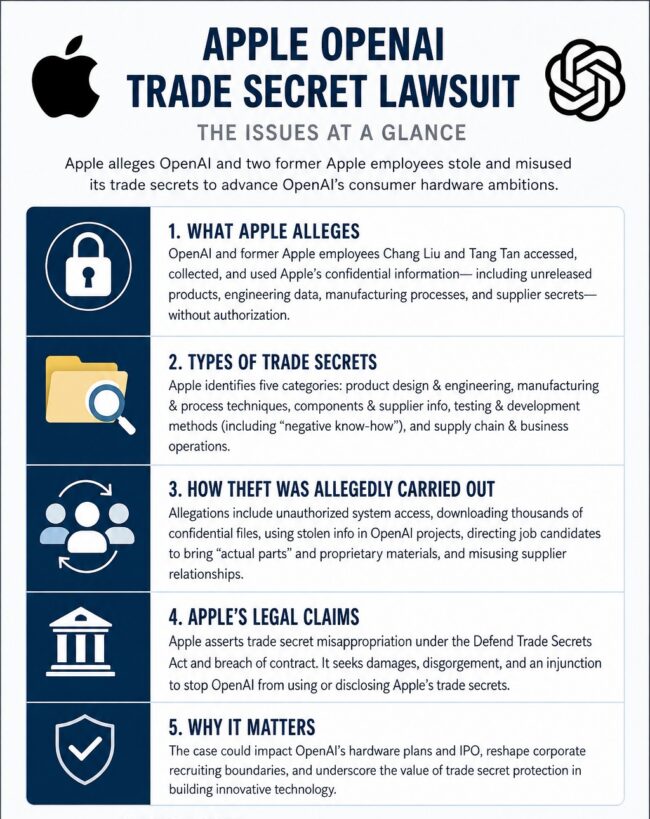
In the lawsuit, Apple asserts four federal misappropriation claims: one each against Liu, Tan, OpenAI, and io Products. It also asserts breach of contract claims against the two former Apple employees based on their intellectual property agreements.
The Apple lawsuit alleges willful and malicious conduct and seeks actual-loss damages, unjust enrichment, a reasonable royalty, exemplary damages, attorneys’ fees, and interest. The contract claims provide an alternative path for proprietary information that might not satisfy every statutory requirement for trade secret status.
Apple seeks preliminary and permanent injunctions preventing the defendants from possessing, using, or disclosing Apple’s trade secrets and confidential information. It also requests preservation of evidence, return of Apple property, and an end to unauthorized access.
If successful, an injunction could hinder development of an OpenAI hardware device by restricting allegedly tainted information, workflows, or supplier interactions. The statute generally does not permit an injunction based only on what an employee knows or bar lawful employment without evidence of threatened misappropriation. However, there can be an injunction that places protective conditions on the employment to prevent the use of the plaintiff's trade secrets by the defendant company.
The two companies partnered in 2024 to integrate ChatGPT into Apple Intelligence, and the complaint says that agreement is not at issue. However, the case may signal a significant shift in the relationship between the companies. OpenAI CEO Sam Altman expanded into hardware and recruited former Apple designer Jony Ive for the project through the io Products transaction.
Apple’s complaint states that “OpenAI’s nascent hardware business now rests on the shakiest of foundations, rotten to its core by its illegal reliance on misappropriated trade secrets.” The trade secret litigation could complicate OpenAI’s hardware plans and potential IPO preparations.
OpenAI has denied wrongdoing, expressing in a prepared statement: “We have no interest in other companies’ trade secrets. We remain focused on building innovative technology that empowers people everywhere.”
The Apple-OpenAI trade secret lawsuit is ultimately about where lawful employee experience ends and misappropriated trade secrets begin. Apple alleges illegal reliance on confidential information to accelerate OpenAI’s consumer hardware entry; OpenAI says it remains focused on its own innovative technology. The district court will determine whether Apple proves protectable secrets, improper acquisition or use, breach of contract, and entitlement to an injunction.
For companies constantly developing breakthrough technologies, the case highlights that appropriate steps should be taken to protect trade secrets and prevent trade secret theft: prohibit candidates from presenting another company’s confidential information, train interviewers not to request proprietary work, audit departing employees network and computer activity, monitor and recover company devices, and terminate internal credentials promptly. Protecting a team’s hard work requires controls at the recruiting, offboarding, and vendor-management stages.
© 2026 Sierra IP Law, PC. The information provided herein does not constitute legal advice, but merely conveys general information that may be beneficial to the public, and should not be viewed as a substitute for legal consultation in a particular case.
"Mark and William are stellar in the capabilities, work ethic, character, knowledge, responsiveness, and quality of work. Hubby and I are incredibly grateful for them as they've done a phenomenal job working tirelessly over a time span of at least five years on a series of patents for hubby. Grateful that Fresno has such amazing patent attorneys! They're second to none and they never disappoint. Thank you, Mark, William, and your entire team!!"
Linda Guzman


Sierra IP Law, PC - Patents, Trademarks & Copyrights
FRESNO
7030 N. Fruit Ave.
Suite 110
Fresno, CA 93711
(559) 436-3800 | phone
BAKERSFIELD
1925 G. Street
Bakersfield, CA 93301
(661) 200-7724 | phone
SAN LUIS OBISPO
956 Walnut Street, 2nd Floor
San Luis Obispo, CA 93401
(805) 275-0943 | phone

SACRAMENTO
180 Promenade Circle, Suite 300
Sacramento, CA 95834
(916) 209-8525 | phone
MODESTO
1300 10th St., Suite F.
Modesto, CA 95345
(209) 286-0069 | phone
SANTA BARBARA
414 Olive Street
Santa Barbara, CA 93101
(805) 275-0943 | phone
SAN MATEO
1650 Borel Place, Suite 216
San Mateo, CA, CA 94402
(650) 398-1644. | phone
STOCKTON
110 N. San Joaquin St., 2nd Floor
Stockton, CA 95202
(209) 286-0069 | phone
PORTLAND
425 NW 10th Ave., Suite 200
Portland, OR 97209
(503) 343-9983 | phone
TACOMA
1201 Pacific Avenue, Suite 600
Tacoma, WA 98402
(253) 345-1545 | phone
KENNEWICK
1030 N Center Pkwy Suite N196
Kennewick, WA 99336
(509) 255-3442 | phone
2023 Sierra IP Law, PC - Patents, Trademarks & Copyrights - All Rights Reserved - Sitemap Privacy Lawyer Fresno, CA - Trademark Lawyer Modesto CA - Patent Lawyer Bakersfield, CA - Trademark Lawyer Bakersfield, CA - Patent Lawyer San Luis Obispo, CA - Trademark Lawyer San Luis Obispo, CA - Trademark Infringement Lawyer Tacoma WA - Internet Lawyer Bakersfield, CA - Trademark Lawyer Sacramento, CA - Patent Lawyer Sacramento, CA - Trademark Infringement Lawyer Sacrament CA - Patent Lawyer Tacoma WA - Intellectual Property Lawyer Tacoma WA - Trademark lawyer Tacoma WA - Portland Patent Attorney - Santa Barbara Patent Attorney - Santa Barbara Trademark Attorney
