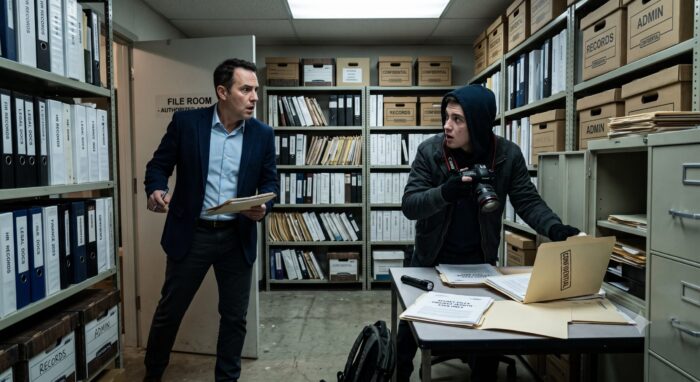
Trade secret litigation involves legal action to protect confidential business information from misappropriation. For a company, trade secrets can be valuable intellectual property, sometimes constituting a large proportion of the business value, because they may include customer lists, business plans, data compilations, manufacturing methods, chemical formulations, source code, processes, pricing, technology, and other proprietary information.
Under federal trade secret law, a trade secret includes financial, business, scientific, technical, economic, or engineering information if the owner has taken reasonable measures to keep it secret and the information derives independent economic value from not being generally known or readily ascertainable through proper means. See 18 U.S.C. § 1839(3). Courts often focus on two key elements: whether the information was actually secret and valuable, and whether the company made reasonable efforts to protect trade secrets through confidentiality agreements, access controls, policies, employee training, and careful disclosure practices.
The two major federal statutes are the Economic Espionage Act of 1996 (EEA) and the Defend Trade Secrets Act of 2016. The federal Defend Trade Secrets Act (DTSA) allows a trade secret misappropriation lawsuit if the trade secret relates to a product or service used in interstate or foreign commerce. See 18 U.S.C. § 1836(b)(1). At the state level, the Uniform Trade Secrets Act provides the model framework for trade secret protection. The Uniform Trade Secrets Act (UTSA) has been adopted by most states, though New York is a non-UTSA jurisdiction with its own approach.
A trade secret dispute may involve departing employees, industrial espionage, breach of contract, or inadvertent or unauthorized disclosure to competitors. These disputes frequently arise when employees leave for competitors and are accused of taking sensitive trade secret information. Examples of such trade secret information includes clients’ data, customer lists, pricing information, product roadmaps, business plans, source code, manufacturing methods, or other confidential information stored on laptops, cloud accounts, email systems, thumb drives, or personal devices.
In trade secret litigation matters, the central issue is not whether the former employee had knowledge of the company’s business, but whether the employee engaged in trade secret misappropriation by improperly acquiring, copying, retaining, or using information that qualifies as a trade secret. The employee is generally not restricted from using the knowledge they gained at their former employer. They are only restricted from using specific trade secrets owned by the former employer. The former employer must demonstrate that the employee shared trade secret material or knowledge or otherwise utilized the former employer's trade secrets. That is, the information must be secret and maintained as secret by reasonable precautions and measures, and derive independent economic value to the former employer from the secrecy of the information.
To demonstrate trade secret status of the information at issue, employers often point to confidentiality agreements, non-disclosure agreements, invention assignment agreements, computer-use policies, and exit certifications to show that the employee had a duty to protect confidential information. These are all indicia of "reasonable efforts" to maintain secrecy of the information. The accused employee or new employer may defend themselves against trade secret misappropriation claims by asserting and demonstrating that they did not share or utilize any trade secret information, and/or that the information they allegedly used or shared was generally known, readily ascertainable, independently developed, or obtained through proper means.
Trade secret cases can also arise between business partners, vendors, contractors, manufacturers, consultants, or joint venture participants. For example, a company may share proprietary information during a potential transaction or development project, only to later suspect that the recipient used the information for its own benefit. Because trade secrets often include valuable intellectual property and business information, early investigation is critical. Companies typically review access logs, device activity, downloads, cloud transfers, and communications to determine whether misappropriation occurred and whether emergency court relief may be needed.
In trade secret litigation, a central question is whether the defendant obtained or used the plaintiff’s trade secrets through trade secret misappropriation, or whether the same knowledge was acquired through proper means. Under the DTSA, “misappropriation” includes acquisition, disclosure, or use by someone who knew or had reason to know the trade secret was acquired improperly through "improper means”, such as theft, bribery, misrepresentation, or breach of a duty of secrecy. Proper means include independent development, independent derivation, reverse engineering, and other lawful acquisition. See 18 U.S.C. § 1839(5)–(6). This distinction matters in disputes involving departing employees and competitors, because trade secret law protects secret business information, not general skill, experience, or public knowledge.
Taking proprietary information by knowingly transferring files, taking images and video, and receiving secret information from an employee are obviously improper means. However, there are some edge cases that one may question and debate. The key issue is whether the defendant breached reasonable measures of secrecy in order to gain access to the information. The following case is an illustrative example of such an edge case. In E.I. duPont deNemours & Co. v. Christopher, 431 F.2d 1012 (5th Cir. 1970), DuPont was constructing a methanol plant using a confidential manufacturing process. Because the facility was not yet enclosed, parts of the process were visible from above. Photographers, allegedly hired by an unknown third party, flew over the site and took aerial photographs that DuPont claimed would allow a skilled person to deduce the secret process. The Fifth Circuit held that aerial surveillance could be an improper means of acquiring trade secrets even without physical trespass and even if the flight itself complied with aviation law. The court reasoned that competitors may not bypass reasonable secrecy measures through industrial espionage. The case shows that lawful competition permits independent development and reverse engineering, but not calculated efforts to capture valuable confidential information.
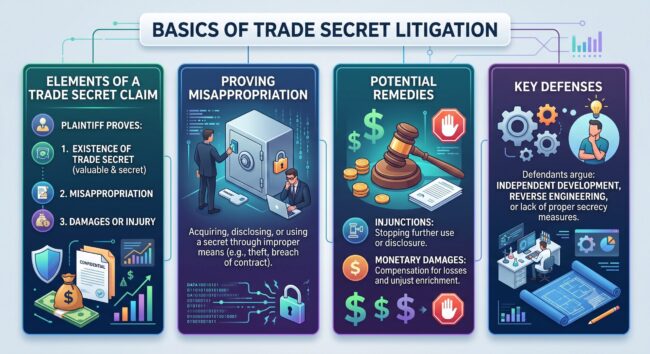
Emergency relief is often one of the first major steps in trade secret litigation, especially where a company believes trade secret misappropriation is ongoing or imminent. In many trade secret cases, the plaintiff may ask the court for a Temporary Restraining Order (TRO) followed by a preliminary injunction. These forms of relief are designed to preserve the status quo and stop the defendant from further using, disclosing, copying, transferring, or benefiting from the alleged trade secret before the case reaches final judgment.
Injunctions are court orders prohibiting the defendant from further using or disclosing the trade secret. Injunctions can be issued by a court to prevent specific conduct, such as using confidential source code, contacting customers from a stolen customer list, manufacturing a product using protected processes, or sharing proprietary information with competitors. Federal Rule of Civil Procedure 65 governs TROs and preliminary injunctions, including notice requirements, the need for specificity, and potential security bonds. To obtain emergency relief, a plaintiff typically must show a likelihood of success on the merits, irreparable harm, that the balance of equities favors relief, and that an injunction serves the public interest. See Winter v. Natural Resources Defense Council, Inc., 555 U.S. 7 (2008).
Under the DTSA, federal courts may grant injunctions to prevent actual or threatened misappropriation. See 18 U.S.C. § 1836(b)(3)(A). However, it should be noted that the DTSA limits injunctions that would prevent a person from accepting employment based merely on information the person knows, rather than evidence of threatened misuse. This makes early evidence, such as forensic findings, downloads, deleted files, suspicious access, or confidentiality agreement breaches, critical in emergency trade secret disputes.
Procedures in trade secret litigation often move quickly because the alleged harm may involve ongoing use or disclosure of sensitive information. Early in a trade secret dispute, a company may seek forensic investigation of laptops, phones, cloud accounts, email systems, USB activity, downloads, and file-transfer records to determine whether departing employees copied confidential information, customer lists, business information, data compilations, processes, manufacturing methods, or other proprietary information. These forensic issues are often central to proving or defending against claims of trade secret misappropriation.
Discovery may include expedited discovery, document requests under Federal Rule of Civil Procedure 34, depositions under Federal Rule of Civil Procedure 30, subpoenas to third parties under Federal Rule of Civil Procedure 45, expert analysis, and motions for injunctive relief under Federal Rule of Civil Procedure 65. In many trade secret cases, the plaintiff must identify the alleged trade secrets with enough specificity to allow the defendant to understand the claims and to separate alleged trade secrets from general knowledge, independent development, reverse engineering, or information that is readily ascertainable through proper means.
Because litigation itself can create a risk of inadvertent disclosure, courts routinely enter protective orders. Federal Rule of Civil Procedure 26(c)(1)(G) permits courts to restrict disclosure of “a trade secret or other confidential research, development, or commercial information.” Similarly, 18 U.S.C. § 1835 requires courts to preserve secrecy in proceedings involving federal trade secret law. Protective orders may limit access to attorneys, experts, company representatives, or outside consultants; require secure handling of source code or technical files; and control how confidential information may be filed, reviewed, or used in court.
When a trade secret is misappropriated, courts may impose injunctive relief and award damages. Monetary damages can include the plaintiff’s actual loss, the defendant’s unjust enrichment, or a reasonable royalty. See 18 U.S.C. § 1836(b)(3)(B). The court may award court costs and fees to the prevailing party, but the prevailing litigant may recover reasonable attorney’s fees only for bad-faith claims or willful and malicious misappropriation under the DTSA and under state law where the UTSA has been adopted.
Individuals convicted of criminal trade secret theft under the EEA can face severe fines and up to ten years in prison under current 18 U.S.C. § 1832.
Trade secret litigation can be expensive and disruptive. Trade secret litigation can cost in the millions of dollars due to the painstaking nature of the investigation and discovery process. Trade secret cases can be high stakes because the misappropriated trade secrets often relate to critical technology and products. In 2020, federal trade secret cases reportedly produced about $3 billion in damages, with the five largest awards exceeding $100 million each. Federal lawsuits involving trade secret disputes can also take several years to resolve. See Stout’s 2020 Trade Secrets Research Report.
Trade secrets and patents are both forms of intellectual property, but they differ significantly in terms of protection duration and requirements. Patents provide a limited monopoly for a specific period, while trade secrets can be protected indefinitely as long as they remain confidential.
Despite the distinctions, trade secrets and patents are often asserted in the same litigation when a dispute involves both patent infringement and trade secret misappropriation. For example, a company may allege that a competitor copied patented technology while also stealing related proprietary information, such as manufacturing methods, source code, customer data, testing protocols, or business processes that were never disclosed in the patent.
These claims protect different interests. Patent protection covers inventions claimed in official patent rights issued by the United States Patent and Trademark Office and may support infringement claims under federal patent law, including 35 U.S.C. § 271. Unlike patents, trade secrets do not require registration, patent applications, or full disclosure to the public. Instead, trade secret law protects confidential information that has economic value because of its secrecy, provided the owner used reasonable measures to keep it confidential. See 18 U.S.C. §§ 1836, 1839.
In combined cases, courts often examine whether the alleged trade secrets are truly separate from what was publicly disclosed in patents or published patent applications. If the information is already publicly available or readily ascertainable, it may not qualify for trade secret protection. But confidential know-how surrounding a patented product can still be protected.
Trade secret litigation can affect the core value of a business because it often concerns confidential information that drives revenue, customer relationships, product development, and competitive advantage. For business owners, the strongest position is usually built before a dispute arises: clear confidentiality agreements, careful employee onboarding and exits, limited access to sensitive information, documented reasonable measures, and prompt forensic investigation when misuse is suspected. Once litigation begins, the case may move quickly through requests for emergency relief, discovery, protective orders, damages analysis, and disputes over whether the information was truly secret or obtained through proper means. Understanding this process helps companies respond decisively to trade secret theft, protect valuable trade secrets, and reduce the risk that confidential business information will be lost through disclosure, employee departures, or competitor misuse.
© 2026 Sierra IP Law, PC. The information provided herein does not constitute legal advice, but merely conveys general information that may be beneficial to the public, and should not be viewed as a substitute for legal consultation in a particular case.

"Mark and William are stellar in the capabilities, work ethic, character, knowledge, responsiveness, and quality of work. Hubby and I are incredibly grateful for them as they've done a phenomenal job working tirelessly over a time span of at least five years on a series of patents for hubby. Grateful that Fresno has such amazing patent attorneys! They're second to none and they never disappoint. Thank you, Mark, William, and your entire team!!"
Linda Guzman


Sierra IP Law, PC - Patents, Trademarks & Copyrights
FRESNO
7030 N. Fruit Ave.
Suite 110
Fresno, CA 93711
(559) 436-3800 | phone
BAKERSFIELD
1925 G. Street
Bakersfield, CA 93301
(661) 200-7724 | phone
SAN LUIS OBISPO
956 Walnut Street, 2nd Floor
San Luis Obispo, CA 93401
(805) 275-0943 | phone

SACRAMENTO
180 Promenade Circle, Suite 300
Sacramento, CA 95834
(916) 209-8525 | phone
MODESTO
1300 10th St., Suite F.
Modesto, CA 95345
(209) 286-0069 | phone
SANTA BARBARA
414 Olive Street
Santa Barbara, CA 93101
(805) 275-0943 | phone
SAN MATEO
1650 Borel Place, Suite 216
San Mateo, CA, CA 94402
(650) 398-1644. | phone
STOCKTON
110 N. San Joaquin St., 2nd Floor
Stockton, CA 95202
(209) 286-0069 | phone
PORTLAND
425 NW 10th Ave., Suite 200
Portland, OR 97209
(503) 343-9983 | phone
TACOMA
1201 Pacific Avenue, Suite 600
Tacoma, WA 98402
(253) 345-1545 | phone
KENNEWICK
1030 N Center Pkwy Suite N196
Kennewick, WA 99336
(509) 255-3442 | phone
2023 Sierra IP Law, PC - Patents, Trademarks & Copyrights - All Rights Reserved - Sitemap Privacy Lawyer Fresno, CA - Trademark Lawyer Modesto CA - Patent Lawyer Bakersfield, CA - Trademark Lawyer Bakersfield, CA - Patent Lawyer San Luis Obispo, CA - Trademark Lawyer San Luis Obispo, CA - Trademark Infringement Lawyer Tacoma WA - Internet Lawyer Bakersfield, CA - Trademark Lawyer Sacramento, CA - Patent Lawyer Sacramento, CA - Trademark Infringement Lawyer Sacrament CA - Patent Lawyer Tacoma WA - Intellectual Property Lawyer Tacoma WA - Trademark lawyer Tacoma WA - Portland Patent Attorney - Santa Barbara Patent Attorney - Santa Barbara Trademark Attorney
