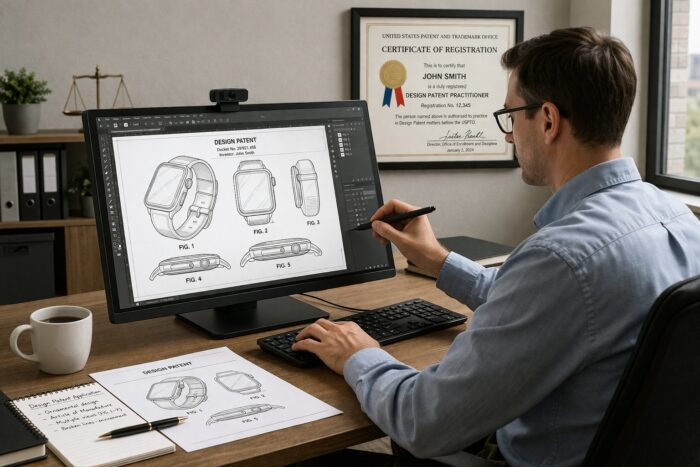
As of January 2, 2024, the United States Patent and Trademark Office (USPTO) is accepting applications for the newly created design patent practitioner bar. The design patent practitioner bar is a new form of patent agent license to practice before the USPTO in design patent applications. This new registration system under 35 U.S.C. § 2(b)(2)(D) and 37 C.F.R. Part 11 provides a new area of patent practice that allows for specialists in visual and graphic arts to provide their skills to clients. The agency says the new design patent bar is meant to open the USPTO’s doors more broadly, bring more people into the innovation ecosystem, and improve the robustness and reliability in the specific area of design patents.
A design patent protects the ornamental design of an article of manufacture (examples include clothing, vehicle designs, electronic device designs, beverage containers, etc.), not the way the item works. See 35 U.S.C. § 171. In other words, design patent law is concerned with how a product looks, not how it functions, making it especially important in industries driven by industrial design, graphic design, and other applied arts.
The leading design patent cases clarify how courts evaluate ornamental appearance. In Gorham Co. v. White, 81 U.S. 511 (1871), the Supreme Court considered competing designs for silverware handles. The accused products were not identical, but the Court held that infringement exists if, in the eyes of an ordinary observer, the two designs are substantially the same such that the resemblance would deceive a purchaser into buying one thinking it was the other. This case established the foundational “ordinary observer” test that still governs design patent matters today.
More than a century later, the Federal Circuit reaffirmed and refined that standard in Egyptian Goddess, Inc. v. Swisa, Inc., 543 F.3d 665 (Fed. Cir. 2008) (en banc). That case involved competing nail buffer designs used in the beauty industry. The court rejected earlier, more rigid point of novelty test and confirmed that the ordinary observer test, viewing the design as a whole in light of prior art, is the proper framework for determining infringement in design patent infringement cases. The decision emphasized that small differences do not avoid infringement if the overall visual impression remains substantially the same.
The above cases underscore a practical point: a design patent practitioner focuses on protecting the overall visual impression of a product. That role is distinct from a utility patent practitioner handling a utility patent, which protects how an invention works rather than how it looks.
Before this final rule, there was effectively only one patent bar for practice in patent matters before the Office. The USPTO published Representation of Others in Design Patent Matters Before the United States Patent and Trademark Office, 88 Fed. Reg. 78644 (Nov. 16, 2023), creating a separate design patent bar effective January 2, 2024 for practice in design patent proceedings only. In the rulemaking, supporters argued that this separate design patent practitioner pathway could improve design patent practitioner quality, enlarge the pool of qualified practitioners, and aid design patent prosecution, while opponents warned that a divided bar could create confusion and increase the costs of identifying appropriate counsel.
Applicants do not need a law degree to qualify for the new design patent bar. Instead, the USPTO requires a bachelor’s, master’s, or doctorate of philosophy from an accredited college or university in fields such as industrial design, product design, architecture, applied arts, graphic design, fine art, studio arts, or art teacher education, or an equivalent degree. The agency expressly tied these admission criteria to the backgrounds of those in the visual arts and design field, and noted that the same design-centered degrees are used when hiring design patent examiners. That means individuals seeking registration may qualify without the scientific and technical qualifications usually associated with the traditional patent bar.
The process is straightforward in concept, even if the paperwork matters. Applicants must submit a complete USPTO Office of Enrollment and Discipline (OED) application, official transcripts, and fees; pass a registration examination on patent legal process and procedure; and undergo a moral character evaluation. The USPTO chose the current registration examination rather than creating a separate design patent practitioner bar exam, explaining that design bar applicants still need the rules-and-procedure knowledge tested by the current registration exam. Once admitted, they receive a registration number and may begin practicing in design patent matters.
Under 37 C.F.R. § 11.6(d), a lawyer admitted through this pathway is a design patent attorney, and a non-lawyer is a design patent agent. That is different from a registered patent attorney or registered patent agent admitted under 37 C.F.R. § 11.6(a)-(c), who may practice in all patent matters. In practical terms, a business that needs help with design filings only may hire a design patent practitioner, while a company with utility patents, plant patents, and design patent work may need a full patent lawyer with the broader licensing and registration.
The USPTO’s rules define practice before the Office in design patent matters broadly. Under 37 C.F.R. § 11.5(b)(2), a design patent practitioner may prepare and prosecute a design patent application, advise a client about filing strategy, draft the specification or claim, respond to Office communications, and handle petitions, appeals, and other design patent proceedings before the Patent Trial and Appeal Board (PTAB). The rule also permits work reasonably incident to prosecution, including certain assignment drafting and advice about alternative protection under state law. This is patent-side practice at the USPTO, but not trademark office practice, which is separately defined by USPTO rules.
The most important limit is also the easiest one to miss. Under 37 C.F.R. § 1.32(a)(1), an attorney or agent registered under § 11.6(d) may take action and file applications and other documents only in design patent applications, design patent matters, or design patent proceedings. The MPEP states that such a practitioner cannot sign papers in a utility or plant application. The competence rule, 37 C.F.R. § 11.101, still applies, so practitioners must properly explain those practice limitations to clients. That is one reason the USPTO took seriously comments about malpractice, public confusion, and other ethical concerns raised during rulemaking.
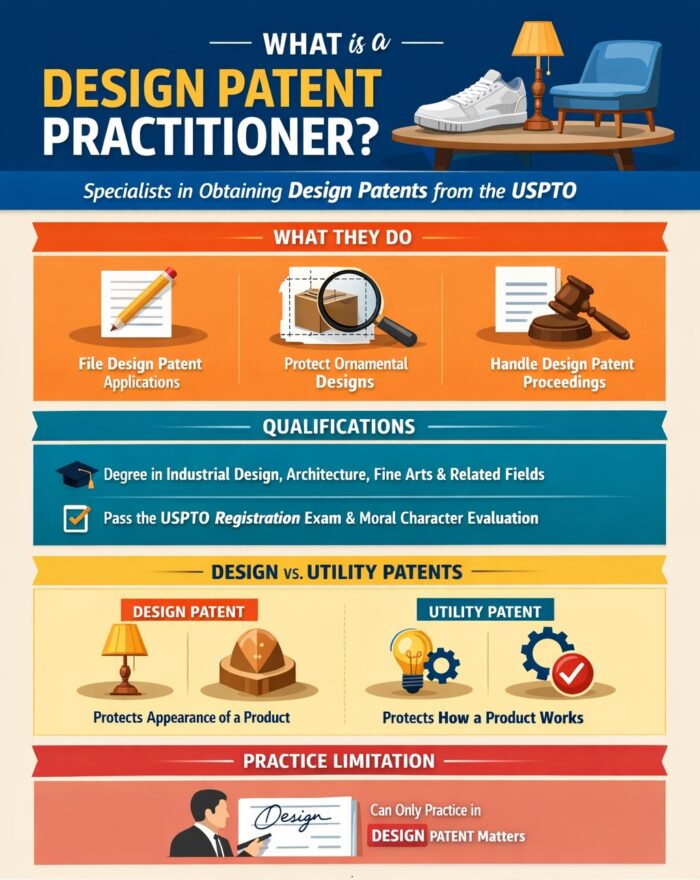
The USPTO built disclosure rules into daily practice. Rule 37 C.F.R. § 1.4(d) requires design patent practitioners to indicate design patent practitioner status by placing the word “design” adjacent to a handwritten, S-signature, or electronic signature when signing USPTO documents. The Office also said these practitioners will receive a particular registration number series to distinguish them from full patent practitioners. For a company reviewing correspondence, that labeling helps confirm whether the signer is authorized only in design patent matters.
Design patent prosecution turns on the visuals. Under 37 C.F.R. §§ 1.152 and 1.153 and MPEP Chapter 1500 of the Manual of Patent Examining Procedure, a design application has a single patent claim, and the drawing or photograph is the entire visual disclosure of that claim. The rules require enough views to disclose appearance completely, and design filings often rise or fall on details such as broken lines, straight-line shading, stippling, and specialized surface shading. For businesses in graphic design, industrial design, packaging, furniture, or other applied arts, that specialized drafting work is exactly where a strong design patent practitioner adds value.
If you are hiring a practitioner to assist with design patents, do not rely on practitioner and law firm marketing. The USPTO’s OED register distinguishes practitioners authorized in all patent matters from those admitted in design patent matters only. The OED Register can be searched for any particular practitioner, including admitted design patent practitioners. It also distinguishes registered patent attorneys, registered patent agents, registered design patent attorneys, registered design patent agents, and individuals granted limited recognition. The Office will not recommend counsel, so potential design patent applicants should verify whether the professional can handle only design filings or broader patent matters as well.
One of the policy arguments for allowing design patent practitioners was broader access. Commenters expressed that the rule could help more under-represented groups practice design patent law and assist more under-represented inventors in acquiring patents. Additionally, for companies or creators seeking lower-cost professional services, the USPTO’s Patent Pro Bono Program matches volunteer patent attorneys and patent agents with financially under-resourced inventors and small businesses. Programs like Volunteer Lawyers for the Arts (VLA) also provide assistance to artists, creators, and independent inventors interested in a design patent or utility patent.
The new design patent practitioner pathway is a limited, separate registration system for practice in USPTO design patent proceedings, created by the USPTO to align with design-focused educational backgrounds. The registration requires the same current registration exam, moral character review, and competence obligations that govern other patent practitioners. Thus, these new practitioners are held to the same procedural, professional, and moral standards as other registered practitioners.
If you need assistance with design patent matters or other intellectual property matters, please contact our office for a consultation.
© 2026 Sierra IP Law, PC. The information provided herein does not constitute legal advice, but merely conveys general information that may be beneficial to the public, and should not be viewed as a substitute for legal consultation in a particular case.
"Mark and William are stellar in the capabilities, work ethic, character, knowledge, responsiveness, and quality of work. Hubby and I are incredibly grateful for them as they've done a phenomenal job working tirelessly over a time span of at least five years on a series of patents for hubby. Grateful that Fresno has such amazing patent attorneys! They're second to none and they never disappoint. Thank you, Mark, William, and your entire team!!"
Linda Guzman


Sierra IP Law, PC - Patents, Trademarks & Copyrights
FRESNO
7030 N. Fruit Ave.
Suite 110
Fresno, CA 93711
(559) 436-3800 | phone
BAKERSFIELD
1925 G. Street
Bakersfield, CA 93301
(661) 200-7724 | phone
SAN LUIS OBISPO
956 Walnut Street, 2nd Floor
San Luis Obispo, CA 93401
(805) 275-0943 | phone

SACRAMENTO
180 Promenade Circle, Suite 300
Sacramento, CA 95834
(916) 209-8525 | phone
MODESTO
1300 10th St., Suite F.
Modesto, CA 95345
(209) 286-0069 | phone
SANTA BARBARA
414 Olive Street
Santa Barbara, CA 93101
(805) 275-0943 | phone
SAN MATEO
1650 Borel Place, Suite 216
San Mateo, CA, CA 94402
(650) 398-1644. | phone
STOCKTON
110 N. San Joaquin St., 2nd Floor
Stockton, CA 95202
(209) 286-0069 | phone
PORTLAND
425 NW 10th Ave., Suite 200
Portland, OR 97209
(503) 343-9983 | phone
TACOMA
1201 Pacific Avenue, Suite 600
Tacoma, WA 98402
(253) 345-1545 | phone
KENNEWICK
1030 N Center Pkwy Suite N196
Kennewick, WA 99336
(509) 255-3442 | phone
2023 Sierra IP Law, PC - Patents, Trademarks & Copyrights - All Rights Reserved - Sitemap Privacy Lawyer Fresno, CA - Trademark Lawyer Modesto CA - Patent Lawyer Bakersfield, CA - Trademark Lawyer Bakersfield, CA - Patent Lawyer San Luis Obispo, CA - Trademark Lawyer San Luis Obispo, CA - Trademark Infringement Lawyer Tacoma WA - Internet Lawyer Bakersfield, CA - Trademark Lawyer Sacramento, CA - Patent Lawyer Sacramento, CA - Trademark Infringement Lawyer Sacrament CA - Patent Lawyer Tacoma WA - Intellectual Property Lawyer Tacoma WA - Trademark lawyer Tacoma WA - Portland Patent Attorney - Santa Barbara Patent Attorney - Santa Barbara Trademark Attorney
