
The United States patent system includes design patents, which protect the unique way that a product looks (its ornamental appearance), rather than how it works. In simple terms, a design patent safeguards the visual design of an item, such as the shape, surface ornamentation, and overall look. A design patent provides the owner exclusive rights to protect the design from third party usage. This article provides an overview of design patent protection in the U.S., explaining its scope, requirements, and how it compares to utility patents and other forms of intellectual property.
A design patent is a form of legal protection granted by the U.S. Patent and Trademark Office (USPTO) for “any new, original and ornamental design for an article of manufacture” under 35 U.S.C. § 171. In other words, it covers the visual ornamental characteristics of a product. The design can be embodied in or applied to an article of manufacture, meaning a tangible item made by humans. Notably, a design patent protects the design itself, not the underlying article or any technical invention. For example, if an inventor creates a new chair shape, a design patent could protect that specific aesthetic design, assuming it is novel and non-obvious. The inventor would then have the right to exclude others from making, using, or selling any product with that same ornamental design.
It is important to distinguish design patents from utility patents, which are patents for "inventions”. A utility patent protects how an invention works or is used: its functional and structural features. In contrast, a design patent protects how an article looks. For instance, a new smartphone may be protected by a utility patent for its innovative electronic circuitry or functionality, while a design patent could protect the distinctive shape or surface decoration of the phone. Both design and utility patents are issued by the USPTO as part of the United States patent system, but they cover different aspects of innovation. In short, utility patents cover functional features and processes, whereas design patents cover the ornamental appearance of an item. Because they protect different aspects, it is possible and sometimes advisable for a company to seek both utility and design patents for the same product: one guarding the product’s function and the other guarding its aesthetic design. Keep in mind that a design patent never covers functional or mechanical aspects of an invention.
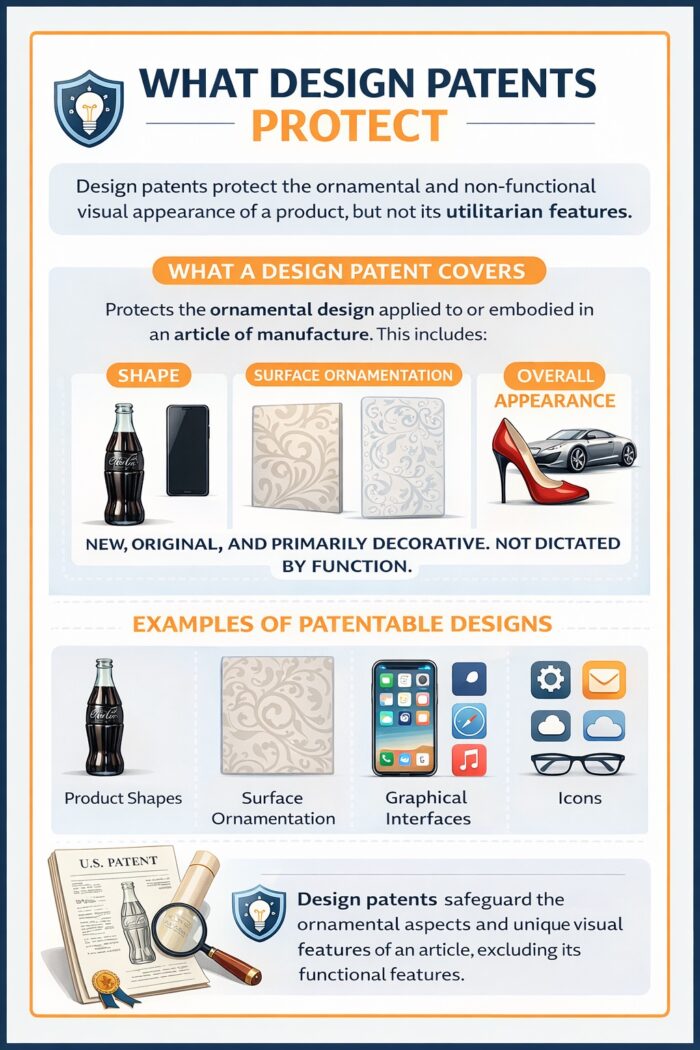
What does a design patent protect? In essence, it protects the ornamental design of an article of manufacture, meaning the visual appearance or decorative design as shown in the patent’s drawings. The claimed design may encompass the shape or configuration of the article, the surface ornamentation applied to the article, or a combination of both. For example, a design patent could cover the unique shape of a beverage bottle, the pattern engraved on a piece of jewelry, or the GUI layout of a smartphone app icon, provided these designs are new and non-functional. The patent rights granted allow the owner to stop others from making or selling any product that embodies a substantially similar design without permission.
By law, a protectable design must be primarily aesthetic and “not dictated by function”. If the appearance of a product is dictated by functional necessity (i.e. a purely functional design), it cannot be protected by a design patent. The U.S. Supreme Court has explained that to qualify for design patent protection, a design should have an aesthetic appearance that is not driven solely by functionality. Bonito Boats, Inc. v. Thunder Craft Boats, Inc., 489 U.S. 141 (1989). In sum, a design patent protects the ornamental features that decorate or shape an article, as opposed to any functional aspects of the article.
Another aspect of scope is that a design patent can cover all or part of an article. The law permits claiming just a portion of a product’s design. For instance, the design of a product’s handle or interface, rather than the entire product. In such cases, the patent drawings will show the claimed portion in solid lines and omit or show other parts in broken lines, indicating those parts are not claimed. This allows inventors to obtain patent protection on unique ornamental components or portions of a product without claiming the whole item.
Design patents are used across many industries to protect a wide range of visual designs. Some examples of things that design patents cover include:
The distinctive shape of a consumer product or article of manufacture can be patented. Famous examples include the contour of a beverage bottle or the casing design of a smartphone. Even a portion thereof, like the frame of a pair of eyeglasses or the tread pattern on a tire, can be protected, as long as it is a new ornamental design.
Two-dimensional visual designs applied to products, such as an embossed pattern on wallpaper or a decorative graphic on a handbag, are eligible for design patents. Any original pattern can be patented as long as it is applied to an article of manufacture.
Computer screen graphics and GUI designs are also patentable. For example, the layout of a smartphone’s app icons or a unique animated GUI can be protected by a design patent as an ornamental design on a display. The USPTO considers a computer icon or GUI shown on a display panel or portion thereof to be a patentable design, since it is viewed as part of a physical display device. By contrast, a design patent would not cover a digital image in the abstract. The GUI or icon must be shown as integrated into a screen or other article to qualify. Many software companies obtain design patents for computer icons and screen designs to protect the look and feel of their user interfaces.
Virtually any industrial or consumer product with a novel ornamental appearance may be eligible. This includes furniture designs, fashion accessories, vehicle parts, packaging designs, lamp designs, and more. For instance, car manufacturers often patent the ornamental design of car parts, including grilles, lights, and wheel designs. As long as the design is new, non-obvious, and not based on function, a broad array of visual characteristics can potentially receive design patent protection.
Obtaining a design patent is generally easier and faster than obtaining a utility patent, but it still requires following a formal application process with the USPTO. Here is an overview of the steps to obtain patent protection for a design:
The applicant prepares a design patent application that includes a specification having a brief description of the design, a single design claim, and high-quality drawings of the design from various views. The claim is typically very short, merely stating the article name and that the design is as shown in the drawings. Unlike utility patents, design applications do not require extensive written descriptions or multiple claims. The drawings are the most critical part, as they define the scope of the claimed invention, i.e., the design. It’s common to hire a patent firm that specializes in design patents and utilizes a professional draftsperson to ensure the drawings meet USPTO formal requirements for design patents.
The design application is filed with the USPTO, including the required filing fee, search fee, and examination fee. The filing date is important, as U.S. patent law generally follows a first-to-file system. Also note, if the design has been publicly disclosed, the application must be filed within 1 year of that public disclosure to avoid losing U.S. rights.
A USPTO examiner will review the design application for compliance with formalities and patentability. They will ensure the drawings adequately show the design and that the design is novel and non-obvious over any prior art, which can be any prior public disclosure of a design. In practice, many design applications are allowed without substantive rejections, but an examiner may cite prior art patents or products if the design is too similar to an existing design. The design must be sufficiently distinct and non-obvious in the eyes of an ordinary designer skilled in the art, meaning it shouldn’t just be a trivial variation of known designs.
If the application meets all formal and patentability requirements, the USPTO will issue a Notice of Allowance. The applicant then pays an issue fee. Once the issue fee is paid, the patent will issue. A U.S. design patent is identified with a patent number preceded by “D” (for example, D1234567).
Unlike utility patents, design patents require no maintenance fees to keep them in force. After issuance, the patent remains valid for its full term without additional fee payments. For comparison, utility patent applications can optionally start with a provisional application and granted utility patents require periodic maintenance fees to stay in force, but these aspects do not apply to design patents.
Throughout this process, it can be beneficial to work with experienced patent practitioners (patent attorneys or agents) familiar with design patent practice. They can help navigate drawing requirements, respond to any USPTO objections, and craft a filing strategy that might include multiple design embodiments or related applications if needed.
The drawings in a design patent application are crucial because they define the scope of what the design patent covers. By rule, a design patent may contain only a single claim, and that claim is defined entirely by the drawings with minimal verbal description. The drawings must show the design from enough angles (e.g., front, rear, sides, top, bottom, perspective) to completely disclose the ornamental appearance of the article. Here are some key points about design patent drawings:
Elements of the design that are shown in solid lines in the drawings are the claimed design defining the ornamental features for which legal protection is sought. In contrast, any parts of the drawings shown in broken lines (dashed lines) are not claimed; they are included only to show context or environment. Broken lines can illustrate portions of the article that form no part of the claimed design or show the surrounding environment in which the design resides. For example, if you are patenting the ornamental design of a chair’s backrest, you might show the chair’s seat and legs in broken lines, indicating that only the backrest’s design is claimed, not the rest of the chair. The patent will typically include a written statement clarifying that the broken-line portions form no part of the claimed design. Using broken lines effectively allows claiming just a partial design or specific element of a product.
A single design patent application may include multiple embodiments (variations) of a design only if those embodiments are patentably indistinguishable and look very similar overall. All embodiments must be clearly shown and consistent. If the embodiments are too different, the USPTO may issue a design restriction requirement dividing them into separate applications. Generally, most design patents focus on one design. However, closely related variants can sometimes be included in one filing to cover them in a single patent.
The drawings must meet strict formal standards: high resolution, proper shading to show contour, and identical features aligning across views. There should be no inconsistencies between views. If a feature is shown in solid line in one view, it must appear in solid line in all views where visible, and likewise for broken lines. The USPTO’s formal requirements found in rules and the Manual of Patent Examining Procedure require that the scope of the claimed design is clear and unambiguous. It is often said that in design patents, “the drawings are the claim,” so precision in drawings is paramount.
By carefully using solid and broken lines, applicants can carve out what the design patent protects, while excluding any unclaimed portions or functional elements.
U.S. design patents have a term of 15 years from the date of grant for design applications filed on or after May 13, 2015. This term is shorter than the 20-year term from filing for utility patents, but an advantage of design patents is that no maintenance fees are required to keep them in force. Once granted, a design patent remains in effect for the full 15-year term without additional payments. By contrast, utility patents require maintenance fee payments at 3.5, 7.5, and 11.5 years after issuance or they lapse. The absence of maintenance fees makes design patent protection relatively cost-effective over the life of the patent. You pay the application and issue fees up front, and then no further fees to maintain the patent rights.
During its term, a design patent gives the owner the exclusive right to make, use, sell, or import the patented design in the United States. After expiration, the design falls into the public domain. However, 15 years of exclusivity for the product’s design can be very valuable in industries where aesthetic design is a key product differentiator.
Design patent infringement occurs when an unauthorized party makes, uses, sells, or imports a product that embodies the patented design or a design that is substantially similar to it. The courts apply the “ordinary observer” test to determine infringement: would an ordinary observer, familiar with the prior art designs, be deceived into thinking the accused product is the same as the patented design? If the overall visual appearance of the accused design is so close to the patented design that an ordinary purchaser would likely confuse the two, then infringement can be found. It’s not necessary that every detail be identical; rather, the overall impression on the eye is key. Notably, this test comes from a 1871 U.S. Supreme Court case, Gorham Co. v. White, which remains the foundation of design patent infringement analysis. Gorham Co. v. White, 81 U.S. 511 (1871).
In enforcing a design patent, one does not have to prove copying or intent. Independent development that results in a similar-looking product can infringe, because design patent rights are absolute for the claimed design. However, the accused design will be compared to prior art as well, since subtle differences might avoid infringement if the patented design itself is narrowly distinguished from prior designs.
Legal protection for a design patent can be quite strong. Remedies for infringement include monetary damages and injunction, which are court orders to stop making or selling the infringing product. Uniquely, U.S. law provides that a design patent owner may recover the total profit the infringer made from selling the infringing products under 35 U.S.C. § 289. For example, if a competitor copied a patented shoe design and sold 100,000 shoes, the patent owner could sue to recover all the profit from those sales. The U.S. Supreme Court has refined how infringing profits remedy is calculated in the case of multi-component products, such as a smartphone. In the Samsung v. Apple case, the U.S. Supreme Court held that for design patent infringement, the statutory “total profits” remedy under 35 U.S.C. § 289 does not automatically mean profits from the entire end product, but instead may be limited to profits attributable to the specific “article of manufacture” to which the patented design is applied when that design is embodied in a multi-component product. The Court explained that determining the relevant article of manufacture is a fact-specific inquiry, requiring courts to evaluate whether the patented design applies to the whole product (e.g., a smartphone) or only to a particular component (e.g., a screen or casing), before calculating infringing profits.
This “total profit” remedy is a powerful enforcement tool that does not exist for utility patents, which typically only allow damages calculated as lost profits or a reasonable royalty.
When protecting the appearance of a product, design patents are one tool among several in intellectual property (IP) law. It is useful to understand how design patents differ from or complement other forms of protection:
Product designs can sometimes be protected under trademark law as trade dress if the design functions as a brand identifier. The shape of a famous Coca-Cola bottle, can function like a trademark by immediately signaling its source. Trade dress protection requires that the design has acquired distinctiveness (consumer recognition) and is non-functional. Trademark law, like design patent law, will not protect functional product features. Trade dress can potentially last indefinitely, as long as the product is sold and the design signifies source, whereas a design patent is limited to 15 years. However, trade dress can be harder to obtain. The owner of the trade dress must prove that consumers associate the trade dress with the source of the goods and services.
Design patent protection is often easier and faster to get, and it doesn’t require showing consumer recognition, it simply grants a monopoly on the design itself for a term, regardless of branding or consumer confusion. Many companies use a design patent to get immediate protection for a new product’s look, and later rely on trade dress for long-term protection once the design becomes iconic. These protections can overlap without “double patenting” issues because they arise from different laws (patent vs trademark) and serve different purposes.
Copyright law protects original artistic and creative works. Generally, the design or shape of useful articles is not eligible for copyright unless the design has elements that can be conceptually separated as pure art. For example, a sculptural lamp base might have copyrightable artistic elements. But most industrial designs are covered by design patents or trade dress rather than copyright. Notably, getting a design patent on a product’s appearance does not give copyright protection, and copying a patented design after the patent expires is not “copyright infringement”. Conversely, a copyrighted artistic design like a graphic might be used on a product, but without a design patent that specifically covers it on the product, protection would be reliant on copyright law. In summary, copyright and design patents are distinct. Copyright is rarely used for industrial product configurations, whereas design patents are tailor-made for that.
As discussed, utility patents cover functional inventions. Sometimes an invention is both aesthetically unique and functionally novel. In such cases, both a utility patent and a design patent might be pursued. There is generally no conflict in having both, since they protect different aspects. The law even explicitly allows simultaneous design and utility patents in separate applications for the same subject in appropriate circumstances, as long as one is not used to extend the other’s term improperly. Issues of double patenting are usually avoided because the claims are not coextensive. A strategic filing strategy can involve using all applicable IP protections: utility patents for new functional features, design patents for the product’s appearance, and trademarks for names/logos or even product configuration trade dress once it gains recognition.
Design patent (or “industrial design”) protection is available in many countries worldwide. Notably, the U.S. is part of the Hague Agreement on industrial designs, which provides a mechanism to file an international design application. Through the Hague system, an applicant can file a single international design application and designate multiple member countries in which to seek protection. This system is administered by the World Intellectual Property Organization (WIPO) and can significantly streamline obtaining design rights abroad. Under 35 U.S.C. § 172, a U.S. company that patents a product’s design domestically can, within six months of the U.S. filing, file via the Hague Agreement to cover key foreign markets in one application. Each designated country will then examine and grant protection according to its own laws, but the initial filing is centralized.
It is important to remember that design patents are territorial. A U.S. design patent protects the design only in the United States. If your business markets products in foreign countries, you would need to secure design protection in those countries separately, either via direct national filings or the Hague Agreement. Many jurisdictions (Europe, China, Japan, etc.) have their own form of design patents or registrations, with varying terms in a range of 10–25 years. If international protection is important, consult a patent attorney with experience in registering designs to devise a global design filing strategy. Most countries protect industrial designs that are new and original, and they likewise exclude purely functional designs from design patentability. Using the U.S. patent system as a springboard, one can obtain patent protection for a product’s design across the world, ensuring a comprehensive shield for the product’s unique features and look in the global marketplace.
A United States design patent protects the ornamental design that makes a product look unique. It does not cover how the product functions or any functional aspects of the design. For business owners, design patents are a valuable form of intellectual property protection to consider, especially for consumer products where appearance matters. They provide a relatively fast, affordable way to secure exclusive rights to a product’s appearance, preventing competitors from selling look-alike products. Often, the best approach is layered protection: use design patents for the ornamental design, utility patents for new functions, and trademarks/trade dress for brand identity. This ensures that both the functional and visual characteristics of your innovations are well-guarded under U.S. law. With proper guidance and a solid filing strategy, securing a design patent can be an effective and valuable process that safeguards your product.
If you need assistance with protecting your designs or other intellectual property matters, contact our office for a free consultation.
© 2025 Sierra IP Law, PC. The information provided herein does not constitute legal advice, but merely conveys general information that may be beneficial to the public, and should not be viewed as a substitute for legal consultation in a particular case.

"Mark and William are stellar in the capabilities, work ethic, character, knowledge, responsiveness, and quality of work. Hubby and I are incredibly grateful for them as they've done a phenomenal job working tirelessly over a time span of at least five years on a series of patents for hubby. Grateful that Fresno has such amazing patent attorneys! They're second to none and they never disappoint. Thank you, Mark, William, and your entire team!!"
Linda Guzman


Sierra IP Law, PC - Patents, Trademarks & Copyrights
FRESNO
7030 N. Fruit Ave.
Suite 110
Fresno, CA 93711
(559) 436-3800 | phone
BAKERSFIELD
1925 G. Street
Bakersfield, CA 93301
(661) 200-7724 | phone
SAN LUIS OBISPO
956 Walnut Street, 2nd Floor
San Luis Obispo, CA 93401
(805) 275-0943 | phone

SACRAMENTO
180 Promenade Circle, Suite 300
Sacramento, CA 95834
(916) 209-8525 | phone
MODESTO
1300 10th St., Suite F.
Modesto, CA 95345
(209) 286-0069 | phone
SANTA BARBARA
414 Olive Street
Santa Barbara, CA 93101
(805) 275-0943 | phone
SAN MATEO
1650 Borel Place, Suite 216
San Mateo, CA, CA 94402
(650) 398-1644. | phone
STOCKTON
110 N. San Joaquin St., 2nd Floor
Stockton, CA 95202
(209) 286-0069 | phone
PORTLAND
425 NW 10th Ave., Suite 200
Portland, OR 97209
(503) 343-9983 | phone
TACOMA
1201 Pacific Avenue, Suite 600
Tacoma, WA 98402
(253) 345-1545 | phone
KENNEWICK
1030 N Center Pkwy Suite N196
Kennewick, WA 99336
(509) 255-3442 | phone
2023 Sierra IP Law, PC - Patents, Trademarks & Copyrights - All Rights Reserved - Sitemap Privacy Lawyer Fresno, CA - Trademark Lawyer Modesto CA - Patent Lawyer Bakersfield, CA - Trademark Lawyer Bakersfield, CA - Patent Lawyer San Luis Obispo, CA - Trademark Lawyer San Luis Obispo, CA - Trademark Infringement Lawyer Tacoma WA - Internet Lawyer Bakersfield, CA - Trademark Lawyer Sacramento, CA - Patent Lawyer Sacramento, CA - Trademark Infringement Lawyer Sacrament CA - Patent Lawyer Tacoma WA - Intellectual Property Lawyer Tacoma WA - Trademark lawyer Tacoma WA - Portland Patent Attorney - Santa Barbara Patent Attorney - Santa Barbara Trademark Attorney
