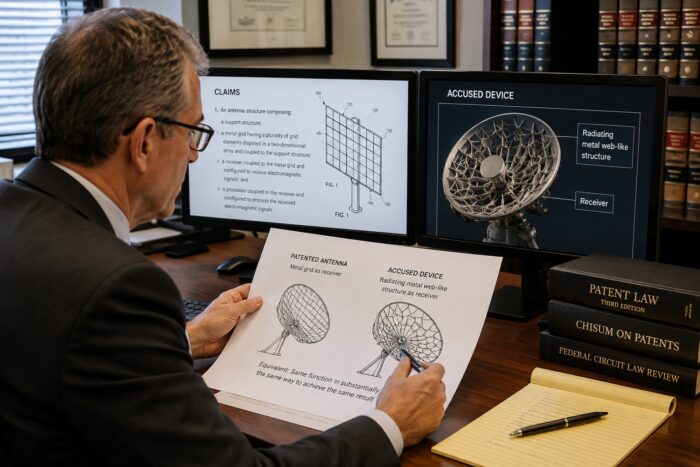
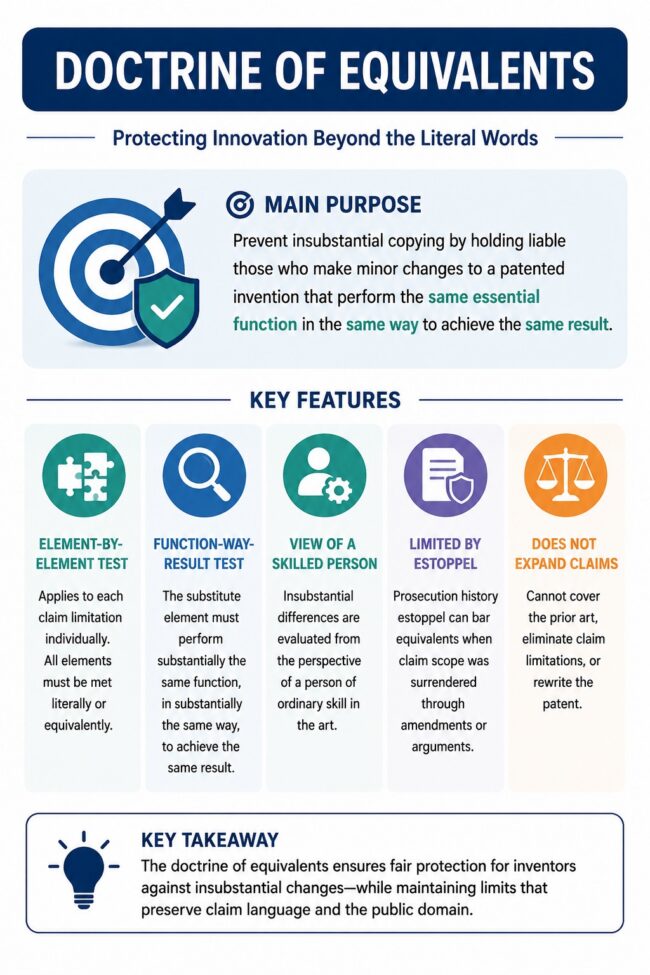
The Doctrine of Equivalents is a U.S. patent law rule that can make an accused product, accused device, or accused process infringe a patent even when it does not literally infringe the exact claim language of the asserted patent. The doctrine limits the available design-around options for products and services that are similar to the claimed invention. It is not enough to simply avoid the literal wording of a specific patent claim. A similar product, technology, or service may still infringe the patent if the substitute technology performs the same function in substantially the same way to achieve substantially the same result. This article provides an explanation of what the doctrine of equivalents is and how it affects patent infringement.
This article is intended for business owners, patent professionals, and anyone interested in understanding how the doctrine of equivalents affects patent infringement.
Patent infringement is defined by statute. 35 U.S.C. § 271(a) prohibits making, using, selling, offering to sell, or importing a patented invention within the United States, or importing it into the United States, without authority from the patent owner. In practice, the patent infringement analysis usually starts with the patent claim, often an independent claim, because the claims, not the abstract, drawings, or general description, define the legal boundaries of the patent rights. A court first performs claim construction to determine the meaning of the claim language from the perspective of a person of ordinary skill in the art. This is a formal process referred to as a Markman hearing under Markman v. Westview Instruments, 517 U.S. 370 (1996)(which is explained in more detail in our Markman hearing article). The court studies the claim language, the patent’s specification, the prosecution history, and sometimes extrinsic evidence to determine the claim construction. The literal meaning of the claim matters because the doctrine of equivalents extends only beyond, not instead of, the literal claim. The court then compares the properly construed claim to the accused product or process.
For literal infringement, every claim limitation must be found in the accused product or process. If even one claimed element is missing, there is no literal infringement of that particular claim. Conversely, if every claimed element is present within the literal scope of the patent claim, the accused product or process infringes literally. This claim-by-claim and element-by-element framework is also important when considering the doctrine of equivalents, because equivalents cannot be used to ignore or eliminate a specific claim limitation.
The doctrine of equivalents addresses the situation where an accused infringer changes one feature of a product or process but keeps the practical substance of the invention. In other words, a business cannot always avoid patent infringement simply by replacing a component with a slightly different version if the replacement does the same work in the same practical manner. Equivalent infringement can establish infringement even without elements identical to the claims recited in the patent.
The key issue is whether an accused element or substitute element is equivalent to the claimed element in the relevant patent claim. Courts do not ask whether the accused product generally resembles the patented invention as a whole. Instead, the analysis focuses on each claim limitation individually. If a claimed element is missing literally, the patent owner may argue that the substitute element performs the same function, in substantially the same way, to achieve the same result.
This doctrine is important because patent claims are written in words, but technology often evolves through minor changes in form, materials, software logic, or mechanical arrangement. Without the doctrine of equivalents, an accused infringer could sometimes avoid liability through an insubstantial design change that captures the benefit of the claimed invention while avoiding the literal wording of the claim. At the same time, the doctrine is limited. It cannot expand a patent to cover the prior art, erase meaningful claim language, or recapture subject matter surrendered during patent prosecution through prosecution history estoppel.
In Graver Tank & Manufacturing Co. v. Linde Air Products Co., 339 U.S. 605 (1950), the Supreme Court gave the doctrine of equivalents its classic modern formulation. The case involved welding-flux claims in the Jones patent. The claimed composition used a combination of alkaline earth metal silicate and calcium fluoride. The accused Lincolnweld flux used calcium and manganese silicates instead of calcium and magnesium silicates, meaning the accused composition did not literally track the patent claim language. The district court nonetheless found infringement, and the Supreme Court affirmed because the substitution was insubstantial in light of the technology and prior art. The Court explained that equivalence depends on context: the patent, the prior art, the purpose of the ingredient, its qualities in combination, its function, and whether persons reasonably skilled in the art would have known the materials were interchangeable.
The resulting “function-way-result” or triple identity test asks whether a substitute element performs substantially the same function, in substantially the same way, to achieve the same result as the claimed element. In practical terms, the Graver Tank test assesses function, way, and result. If a substitute element matches those points, and the differences are not substantial when viewed through the eyes of a person skilled in the art, a court may find equivalence even without literal infringement. The takeaway is that changing a material, component, or step may not avoid patent infringement if the change is merely colorable and preserves the practical operation of the claimed invention.
In Warner-Jenkinson Co. v. Hilton Davis Chemical Co., 520 U.S. 17 (1997), the Supreme Court reaffirmed the doctrine of equivalents while limiting how it may be used to prove patent infringement. The Hilton Davis patent concerned an ultrafiltration process for purifying dyes. The relevant claim required the process to operate at a pH between 6.0 and 9.0. The accused process used a pH of 5.0, so Hilton Davis conceded there was no literal infringement and relied on equivalence. The Court preserved the doctrine, but rejected any free-ranging comparison between the overall accused process and the patented invention. Instead, the Warner-Jenkinson test emphasizes the insubstantial differences test and requires an objective, element-by-element inquiry focused on each claimed element. The Court also made clear in 1997 that the “all elements” test applies to each claim element individually, meaning the doctrine cannot erase or ignore a limitation from the relevant claim. The decision also tied equivalence to prosecution history estoppel: when the reason for a narrowing amendment is unclear, the patentee bears the burden to show the amendment was not made for patentability reasons.
A patentee cannot establish infringement under the Doctrine of Equivalents by arguing that “our invention is close enough overall.” In Warner-Jenkinson, the Supreme Court emphasized that the equivalents analysis must be applied to each claim limitation individually. Each claimed element must be either literally present in the accused product or accused process, or equivalently present through an accused feature that differs only insubstantially. This “all elements” rule prevents the doctrine from expanding a patent claim so broadly that a limitation disappears from the claim language. Courts therefore compare the accused feature with the claimed feature and ask whether it performs substantially the same function, in substantially the same way, to achieve the same result, or whether the differences are meaningful.
The doctrine cannot let a patentee capture what already existed in the prior art or what the patentee disclosed but chose not to claim. In Wilson Sporting Goods Co. v. David Geoffrey & Assocs., 904 F.2d 677 (Fed. Cir. 1990), Wilson asserted doctrine of equivalents infringement against Dunlop golf balls that used a similar icosahedral dimple pattern but did not meet the literal claim limitation requiring that no dimples intersect the ball’s “great circles.” The Federal Circuit held that a court may test the asserted range of equivalents by drafting a hypothetical claim broad enough to cover the accused product and asking whether that claim would have been patentable over the prior art. Because Wilson’s hypothetical claim would have ensnared the prior-art Uniroyal ball, the claim could not reach Dunlop’s balls under equivalents.
In Johnson & Johnston Assocs. Inc. v. R.E. Serv. Co., Inc., 285 F.3d 1046 (Fed. Cir. 2002), the patent claimed copper foil laminated to aluminum, while the patent’s specification disclosed stainless steel as an alternative substrate. The accused products used steel. The Federal Circuit held that, under the disclosure dedication rule, disclosed but unclaimed subject matter is dedicated to the public and cannot be recaptured through the doctrine of equivalents.
Prosecution history estoppel limits doctrine of equivalents application by preventing a patentee from using equivalents to recapture claim scope surrendered during patent prosecution. In Festo Corp. v. Shoketsu Kinzoku Kogyo Kabushiki Co., 535 U.S. 722 (2002), Festo owned patents for a magnetically coupled rodless cylinder; after amendment, the asserted claims required sealing rings and a magnetizable sleeve. The defendant sold a similar accused device using a single two-way sealing ring and a nonmagnetizable sleeve, and Festo alleged infringement under the doctrine of equivalents. The Supreme Court held that narrowing claim amendments made to secure allowance can trigger estoppel, whether made to overcome prior art or to satisfy other Patent Act requirements, including formal matters such as the written description, enablement, and definiteness requirements under 35 U.S.C. § 112.
The Court also rejected the Federal Circuit’s complete-bar rule, holding instead that estoppel creates a presumption of surrender that may be rebutted when the equivalent was unforeseeable, the amendment’s rationale bore only a tangential relation to the equivalent, or another reason shows the patentee could not reasonably have described it. Patent prosecutors should draft claims, amendment remarks, and arguments carefully because avoiding prosecution history estoppel often depends on preserving a clear record that no relevant subject matter was surrendered. USPTO replies and amendments can be properly filed under 37 C.F.R. § 1.111 without excess arguments or claim limitations. A response to an office action should address each issue in an office action succinctly and create as little prosecution history as possible.
Estoppel can arise not only from amendments but also from arguments. Argument-based estoppel occurs when the patentee makes a clear and unmistakable surrender of claim scope to the USPTO. In Amgen Inc. v. Coherus BioSciences Inc., 931 F.3d 1154 (Fed. Cir. 2019), Amgen asserted the doctrine of equivalents against Coherus for a protein-purification process using a salt combination not literally recited in the patent claims. During prosecution, however, Amgen had distinguished prior art by emphasizing the “particular” salt combinations in the claims. The Federal Circuit affirmed dismissal, holding that Amgen’s prosecution arguments surrendered unclaimed salt combinations and barred equivalence.
Statements made in foreign patent offices can also affect the analysis. In Tanabe Seiyaku Co. v. U.S. International Trade Commission, 109 F.3d 726 (Fed. Cir. 1997), the patent covered a process for making diltiazem using specific base-solvent combinations, while the accused process substituted butanone for acetone. The court held that foreign prosecution statements to the EPO, Finland, and Israel did not create a separate “foreign prosecution estoppel,” but were relevant to whether a skilled person would view the substitute element as interchangeable.
Prosecution history estoppel may also affect related patents. In Elkay Manufacturing Co. v. Ebco Manufacturing Co., 192 F.3d 973 (Fed. Cir. 1999), the court held that prosecution history for a claim limitation in one patent can apply to later related patents containing the same relevant subject matter.
When asserting infringement under the doctrine of equivalents, a patent owner must do more than show general similarity between the accused product and the patented invention. U.S. courts generally require particularized testimony and a linking argument tying each accused feature or substitute element to a specific claim limitation. See AquaTex Industries, Inc. v. Techniche Solutions, 479 F.3d 1320 (Fed. Cir. 2007). This proof must address the legal test element by element, often using technical expert evidence to explain why any differences are insubstantial. A jury verdict on equivalence must be supported by substantial evidence, and a district court may test the sufficiency of that proof.
The U.S. is unique in how it approaches determining infringement by equivalents. German courts use a three-step test, asking whether the variant has the same effect, whether that would have been discoverable to the skilled person, and whether the reasoning remains oriented to the claim’s technical teaching. UK courts apply their own framework, including whether a variant achieves substantially the same result in substantially the same way, whether that would be obvious to a person having ordinary skill in the art (PHOSITA) at the priority date, and whether a PHOSITA would think the patentee nonetheless intended strict compliance with the literal meaning of the claim. These approaches are not entirely different, but there are important variances.
The Doctrine of Equivalents is a flexible but limited legal rule. It protects the inventive concept captured in a patent against insubstantial copying, but it does not rewrite the claim, erase the all elements test, recapture surrendered territory, or cover the prior art. Business owners need to understand this aspect of patent law because it expands the scope of a patent claim beyond the literal words in the patent claim. The infringement analysis is not limited to whether an accused product falls within the literal scope of one claim, but also whether each substitute element performs substantially the same function, in substantially the same way, to reach the same result.
© 2026 Sierra IP Law, PC. The information provided herein does not constitute legal advice, but merely conveys general information that may be beneficial to the public, and should not be viewed as a substitute for legal consultation in a particular case.

"Mark and William are stellar in the capabilities, work ethic, character, knowledge, responsiveness, and quality of work. Hubby and I are incredibly grateful for them as they've done a phenomenal job working tirelessly over a time span of at least five years on a series of patents for hubby. Grateful that Fresno has such amazing patent attorneys! They're second to none and they never disappoint. Thank you, Mark, William, and your entire team!!"
Linda Guzman


Sierra IP Law, PC - Patents, Trademarks & Copyrights
FRESNO
7030 N. Fruit Ave.
Suite 110
Fresno, CA 93711
(559) 436-3800 | phone
BAKERSFIELD
1925 G. Street
Bakersfield, CA 93301
(661) 200-7724 | phone
SAN LUIS OBISPO
956 Walnut Street, 2nd Floor
San Luis Obispo, CA 93401
(805) 275-0943 | phone

SACRAMENTO
180 Promenade Circle, Suite 300
Sacramento, CA 95834
(916) 209-8525 | phone
MODESTO
1300 10th St., Suite F.
Modesto, CA 95345
(209) 286-0069 | phone
SANTA BARBARA
414 Olive Street
Santa Barbara, CA 93101
(805) 275-0943 | phone
SAN MATEO
1650 Borel Place, Suite 216
San Mateo, CA, CA 94402
(650) 398-1644. | phone
STOCKTON
110 N. San Joaquin St., 2nd Floor
Stockton, CA 95202
(209) 286-0069 | phone
PORTLAND
425 NW 10th Ave., Suite 200
Portland, OR 97209
(503) 343-9983 | phone
TACOMA
1201 Pacific Avenue, Suite 600
Tacoma, WA 98402
(253) 345-1545 | phone
KENNEWICK
1030 N Center Pkwy Suite N196
Kennewick, WA 99336
(509) 255-3442 | phone
2023 Sierra IP Law, PC - Patents, Trademarks & Copyrights - All Rights Reserved - Sitemap Privacy Lawyer Fresno, CA - Trademark Lawyer Modesto CA - Patent Lawyer Bakersfield, CA - Trademark Lawyer Bakersfield, CA - Patent Lawyer San Luis Obispo, CA - Trademark Lawyer San Luis Obispo, CA - Trademark Infringement Lawyer Tacoma WA - Internet Lawyer Bakersfield, CA - Trademark Lawyer Sacramento, CA - Patent Lawyer Sacramento, CA - Trademark Infringement Lawyer Sacrament CA - Patent Lawyer Tacoma WA - Intellectual Property Lawyer Tacoma WA - Trademark lawyer Tacoma WA - Portland Patent Attorney - Santa Barbara Patent Attorney - Santa Barbara Trademark Attorney
