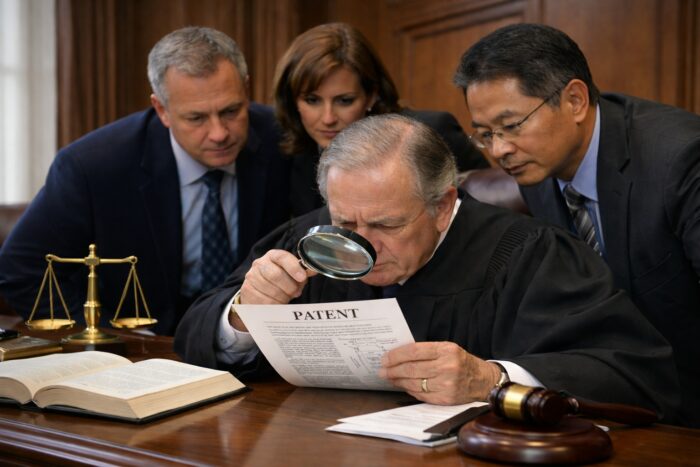
Patent claim construction is the process by which a court determines the meaning of patent claims, which are the words that define the scope and rights of a United States patent. Claim construction therefore shapes the outcome of a patent infringement lawsuit. In plain terms, before anyone can decide infringement or validity, the judge must decide what the patent claim language actually covers.
Because so much rides on a few disputed words, uncertainty over how a given court will construe a claim term is one of the main issues facing patent professionals in enforcing a patented invention. Claim interpretation and construction is a crucial issue that affects patent licensing value and the odds of winning or losing a patent infringement trial.
We provide below an explanation of what happens in claim construction, what evidence matters, and why outcomes can be hard to predict.
A United States patent is not enforced based on its general disclosure or drawings. It is enforced based on its claim language. In litigation, patent claim construction is a pivotal process where the court determines what the words of each claim mean, within the context of the patent's description of the claimed technology and in light of the written record of the patent's examination before the United States Patent and Trademark Office (USPTO). In other words, claim construction answers the central question: what is the legal scope of the patent?
That determination is determinative of whether you can stop others from making, using, or selling a product. It dictates whether an accused device meets each claim limitation for literal infringement or possibly under the doctrine of equivalents. It also affects validity, because a construction that reads too broadly may encompass prior art and render the claim invalid.
For these reasons, claim construction is often outcome-determinative. Patent cases are frequently won or lost depending on whether the court adopts the proposed meaning advanced by the patentee or the interpretation urged by the accused infringer.
Claim construction usually takes place fairly early in a patent case, typically after the initial pleadings and a period of focused discovery. At this stage, the court identifies disputed claim terms and conducts a dedicated Markman hearing, named after Markman v. Westview Instruments, Inc., 517 U.S. 370 (1996). During this hearing, the judge, not the jury, decides how the relevant patent claim language should be interpreted. The goal is to establish a clear claim construction framework before the case proceeds to summary judgment, expert reports, and/or trial.
This phase of a patent dispute is often pivotal. Many patent cases reach a private settlement agreement shortly after a Markman ruling because the court’s construction clarifies the likely scope of infringement exposure or patent invalidity risk. Once the judge defines key claim terms, both parties can more accurately predict the outcome and adjust litigation strategy, valuation, and settlement positions accordingly.
Importantly, the Markman hearing is not always the final word on construction. Courts retain flexibility and may revisit a construction as the evidentiary record develops, or if trial testimony sheds additional light on the technology.
The construction of a patent claim, including specialized terms of art, is exclusively within the province of the court, not the jury. In Markman v. Westview Instruments, Inc., the Supreme Court held that interpreting a patent claim is a matter for the judge, not a fact question for jurors. That decision reshaped modern patent litigation practice and made formal claim construction a central phase of every patent case.
This allocation of authority matters because claim construction is treated primarily as a question of law, even though limited factual issues, such as the role of technical evidence, may arise. The judge’s interpretation of disputed claim language establishes the legal boundaries of the invention and directly influences findings of infringement and validity. A broad construction may expand potential liability exposure, while a narrow construction may reduce claim scope and affect damages posture. As a result, the judge’s construction often determines settlement leverage and can effectively decide the outcome of the dispute before trial.
In federal court, the dominant claim construction standard comes from the Federal Circuit’s en banc decision in Phillips v. AWH Corp., 415 F.3d 1303 (Fed. Cir. 2005) (en banc). In Phillips, the Federal Circuit clarified how courts should approach patent claim construction, emphasizing that the starting point for any claim construction analysis is the words of the patent claim itself. Those words are not read in isolation. Instead, they are interpreted through the lens of a hypothetical “person of ordinary skill in the art” at the time of the invention.
Under Phillips, the central question is how such a skilled artisan would understand the claim language in light of the subject matter of the patent as a whole. That includes careful attention to the specification, which the Federal Circuit noted was “the single best guide” to the meaning of a disputed claim term. The court also considers the prosecution history as part of the intrinsic record, particularly where statements made to the USPTO clarify or limit claim scope.
This means the court is not improvising or attempting to guess what the inventor subjectively intended. The court anchors its interpretation in the patent documents themselves, referring to extrinsic evidence outside of the patent application record typically to clarify certain terms that are not defined or seem uncertain based on the intrinsic record of the patent application. This structured methodology is designed to produce predictable and principled outcomes, even though reasonable judges may still disagree in close cases.
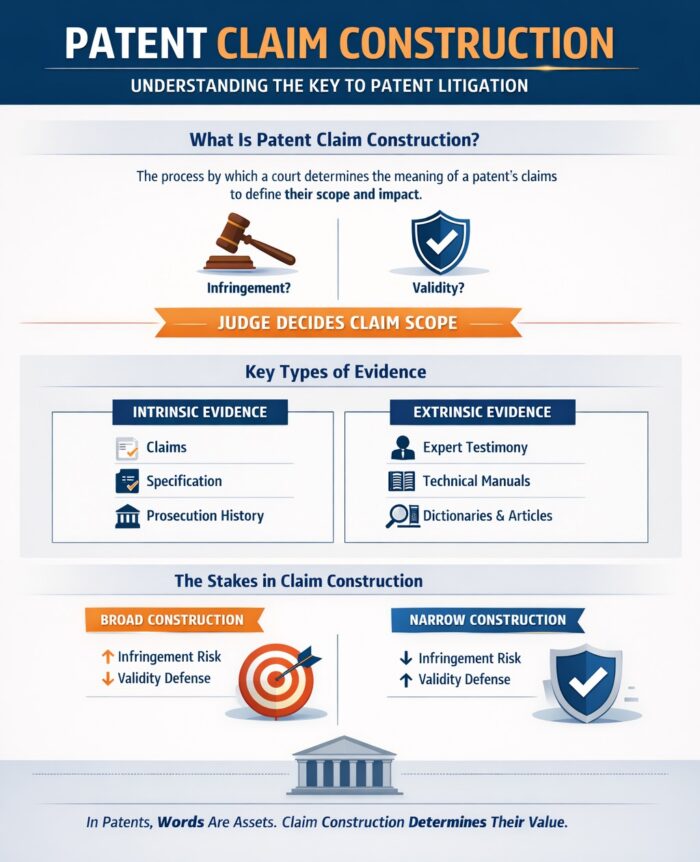
Under Phillips v. AWH Corp., intrinsic evidence is the starting point, and usually the most important evidence, of the meaning of the claims in patent claim construction. Courts look first to the patent’s own record before turning to outside materials. Intrinsic evidence includes:
Together, these materials form the core record the judge relies on to interpret claim scope. These sources help fill gaps in understanding the plain language of the claims, and resolve disputes about meaning without relying heavily on extrinsic sources. Additionally, statements made during prosecution can operate as limits on how broadly a claim may later be construed.
Why it matters: when drafting patents or preparing a response to an office action, you are creating a record that may later define and restrict the enforceable scope of the resulting patent.
Extrinsic evidence is evidence outside the patent’s intrinsic record. It may include dictionaries, technical treatises, expert testimony, and other materials that help the court understand the underlying technology and the real-world usage of a disputed claim term. In patent claim construction, this type of evidence can provide helpful context, particularly where the claim language involves specialized terminology or complex scientific principles.
For example, experts may explain how a person of ordinary skill in the art would interpret certain terms at the time of the invention. Dictionaries and treatises may also shed light on the ordinary and customary meaning of technical language. This can help the judge build an accurate account of how skilled artisans use a term in practice.
However, under the claim construction standard articulated in Phillips v. AWH Corp., extrinsic evidence plays a supporting role. It may clarify, but it cannot override the intrinsic evidence or alter the claim scope in a way that conflicts with the patent’s specification or prosecution history.
A major debate in claim construction often centers on two distinct theories that shape how a court approaches the meaning of a patent claim.
Textualism focuses on the linguistic meaning of the claim text: how the specific words, grammar, and surrounding context point to a particular meaning. Under this approach, the analysis begins and largely remains anchored in the claim language itself, read in light of the specification and prosecution history. The emphasis is on what the words would convey to a person of ordinary skill in the art, not on broader notions of fairness or inventive contribution.
Anti-textualism, by contrast, focuses on construing claims to capture the “true invention,” sometimes pushing past strict textual boundaries to reflect what the inventor actually invented. This approach may give greater weight to the overall disclosure and purpose of the patented invention.
Scholars have argued that this conflict, textualism vs anti-textualism, is a primary driver of claim uncertainty. Different judges can sincerely apply different methodological commitments to the same record and reach different constructions, making outcomes difficult to predict even when the claim language initially appears clear.
Claim construction is not just about dictionary meaning or how a technical term might be used in isolation. It is also deeply influenced by statutory interpretation, especially of 35 U.S.C. § 112. In practice, courts do not interpret a patent claim in a vacuum. They interpret it against the backdrop of the Patent Act’s disclosure requirements, which operate as guardrails on permissible claim scope.
The statutory requirements under 35 U.S.C. § 112 impose minimum standards of disclosure that judges must apply when deciding what a patent’s claims mean. Put differently, the Patent Act sets baseline disclosure rules, and courts apply those rules when deciding whether particular claim language can legitimately support a proposed scope. If a patentee urges a broad construction, the court will ask whether that construction is actually supported by the specification and consistent with the requirements of § 112.
There are three key requirements under § 112 :
§ 112(a):
§ 112(b): The definiteness requirement, which requires that a patent claim “particularly point out and distinctly claim” the invention. In other words, the claim must clearly inform the public of what is claimed. A patent claim is indefinite if it fails to provide reasonably clear boundaries.
The Supreme Court’s decision in Nautilus, Inc. v. Biosig Instruments, Inc., 572 U.S. 898 (2014), is a leading example of how disagreements over statutory interpretation directly shape patent claim construction. The case addressed the definiteness requirement under 35 U.S.C. § 112(b), which requires that a patent’s claims “particularly point out and distinctly claim” the subject matter regarded as the invention. At issue was how much linguistic imprecision the law tolerates when defining claim scope.
Before Nautilus, the Federal Circuit had applied a relatively forgiving definiteness framework, under which a claim was indefinite only if it was “insolubly ambiguous.” The Supreme Court rejected that standard as too lenient. In its place, the Court adopted a stricter test: a patent claim is invalid for indefiniteness if, viewed in light of the specification and prosecution history, it fails to inform those skilled in the art about the scope of the invention with “reasonable certainty.”
That shift has practical consequences for claim construction. A court applying Nautilus may decline to adopt a broad construction if the underlying claim language does not provide clear notice of its limits. In other words, definiteness doctrine now plays a more active role in policing ambiguity. When claim construction disputes are described as being influenced by statutory interpretation, Nautilus provides a concrete illustration: the Supreme Court’s reading of § 112(b) directly reshaped the boundaries of acceptable claim language and, by extension, the constructions courts will permit going forward.
Claim construction affects both infringement and validity, and the direction of the construction, broad or narrow, can dramatically alter the risk on both sides of a dispute.
In patent litigation, a broad construction of a claim can make it easier for a patentee to prove an accused product is infringed. When a court interprets claim language broadly, the claim scope expands, increasing the likelihood that the accused technology falls within the boundaries of the patented invention. From a patent enforcement perspective, this broader construction strengthens leverage in settlement discussions and enhances potential damages exposure.
By contrast, a narrow construction can make it easier for a defendant to escape liability. If the judge defines a claim term in a limited way, the accused product may fall outside the construed scope of the claim. In that scenario, even if the product competes directly in the marketplace, it may not legally infringe the patent as construed by the court.
The issue also cuts the other way on validity. An overly broad construction may cause a claim to cover prior art, increasing the risk of invalidation based on anticipation or obviousness. Expanding claim scope too far can expose the patent to previously undiscovered references that undermine its novelty. On the other hand, a narrower construction may preserve validity by avoiding prior art, but at the cost of reduced enforcement value and diminished commercial reach.
This tradeoff is why claim construction can drive the entire case outcome before trial. For example, summary judgment under Federal Rule of Civil Procedure 56 may be granted if a judge defines a claim term in a way that the accused product does not meet. In that situation, the court’s construction effectively decides non-infringement without a jury. For this reason, defendants typically advocate for narrow constructions, while patentees argue that claim terms should be construed more broadly to protect the full value of their innovation.
A common misconception in patent litigation is that claim construction is a standardized process across courts. Markman hearings are formalized in some courts, but there is no procedure set by the Markman case. In reality, courts retain significant flexibility in addressing claim construction.
Two key principles drive this flexible approach:
The Federal Circuit has made clear that when a genuine dispute about the meaning or scope of a claim term arises, the court, not the jury, must resolve it. In O2 Micro Int’l Ltd. v. Beyond Innovation Tech. Co., 521 F.3d 1351 (Fed. Cir. 2008), the Federal Circuit held that a court has an affirmative duty to decide disputes over claim scope and may not simply characterize them as factual disagreements for the jury. If the parties present competing interpretations that affect infringement or validity, the judge must construe the claim. This reinforces that claim construction remains a core judicial function throughout the case.
Although Markman established that claim construction is a matter for the court, it did not prescribe a mandatory procedure for how or when construction must occur. As several district courts have observed, the Supreme Court did not require a formal, pretrial “Markman hearing” in every case. Instead, trial courts have discretion to decide how to conduct claim construction, including whether to hold an evidentiary hearing, rely solely on briefing, or address disputed claim terms within conventional motion practice.
In practice, this has led to substantial variability. Some courts conduct multi-day evidentiary hearings with expert testimony. Others resolve claim construction on the paper record without live testimony. In certain cases, courts have construed claims in connection with summary judgment motions under Fed. R. Civ. P. 56. In still others, courts have deferred final construction until the eve of jury instructions, or even addressed particular claim terms during the trial itself when the dispute crystallized in light of the evidence. See Johns Hopkins University v. Celpro, 894 F. Supp. 819 (D. Del. 1995).
Courts also have wide latitude to receive aids to interpretation, including expert testimony, so long as extrinsic evidence does not override the intrinsic record (claims, specification, and prosecution history). The practical result is clear: there is no single procedural template for claim construction. The timing, format, and depth of analysis can vary significantly from court to court and case to case, including during the trial phase itself.
Claim construction is frequently appealed to the Federal Circuit, making the standard of appellate review critically important in patent disputes. For many years, the Federal Circuit applied de novo review broadly, effectively reconsidering claim construction “from scratch,” with little deference to the district court’s analysis. That approach reflected the view that construction was purely a question of law.
The Supreme Court altered that framework in Teva Pharm. USA, Inc. v. Sandoz, Inc., 574 U.S. 318 (2015). The Court clarified a split approach to appellate review. The ultimate claim construction, the final interpretation of the patent claim and its legal scope, remains a legal conclusion reviewed de novo. However, subsidiary factual findings made by the district court, often tied to disputed extrinsic evidence such as expert testimony about technology or term usage, are reviewed only for clear error under Fed. R. Civ. P. 52(a)(6).
This distinction can materially affect the outcome of an appeal, especially where credibility determinations or technical facts play a central role in the construction.
For many years, PTAB trials applied a different claim construction standard than federal district courts, creating meaningful differences in how claim scope could be evaluated in parallel proceedings. Historically, the PTAB used the “broadest reasonable interpretation” (BRI) approach, which often resulted in a broader construction of a claim than a district court might adopt.
In 2018, the USPTO issued a final rule changing the claim construction standard applied in inter partes review (IPR), post-grant review (PGR), and covered business method (CBM) proceedings. The rule replaced BRI with the same federal court claim construction standard used to construe a claim in a civil action under 35 U.S.C. § 282(b) and the Phillips framework.
The rule is not retroactive; it applies only to petitions filed on or after November 13, 2018. The change was intended to promote consistency and harmonization among PTAB proceedings, federal courts, and the International Trade Commission (ITC).
This alignment improves predictability when assessing enforcement strategy, acquisition targets, or freedom-to-operate risk, although procedural differences and evidentiary records can still influence outcomes.
While no strategy can eliminate unpredictability in claim construction, disciplined drafting and thoughtful litigation strategy can materially improve the odds of a favorable construction and protect long-term claim scope.
Start with the specification. Use clear terminology and define key terms in a way that supports the intended scope of the patent claim, but avoid accidental over-limiting definitions that unnecessarily narrow the claim language. Courts interpret claims in light of the specification, so clarity in writing directly affects how a judge will later interpret and construe a disputed claim term.
Maintain internal consistency. The same claim term should not quietly shift meaning across the document. Inconsistent usage can create ambiguity that weakens your preferred interpretation and opens the door to a narrow construction. Precision and disciplined patent drafting reduce room for adverse arguments.
Equally important, treat the prosecution history as future litigation evidence. Statements made to overcome prior art rejections, amendments to distinguish the invention, and characterizations of the technology can become binding limits on claim scope. Arguments that seem tactical during patent examination may later restrict how broadly a court is willing to construe the claim.
In a patent trial, identify early which disputed terms truly drive the outcome. Not every word warrants a fight. Focus on the claim terms that determine infringement or validity.
Develop crisp, concise positions anchored in intrinsic evidence before relying on experts. Courts give primacy to the patent record. Extrinsic evidence is most persuasive when it helps the court understand the technology, not when it attempts to override the intrinsic record.
Finally, consider procedural leverage. A favorable claim construction can support early non-infringement or invalidity positions, including Rule 56 summary judgment, and may decisively shape the litigation outcome.
Patent claim construction is the process by which a court decides what a patent claim means, and that decision defines claim scope and often drives the ultimate outcome on infringement and validity. In practical terms, the way a judge interprets key claim language can determine whether a competitor’s product is infringed or whether the patent survives a validity challenge.
Claim construction is often the make-or-break stage of patent litigation because once the court fixes the meaning of disputed terms, the rest of the case frequently follows. Intrinsic evidence (the claims themselves, the specification, and the prosecution history) is usually decisive, while extrinsic evidence such as expert testimony plays a supporting role in helping the court understand the technology. In patents, words define the asset, and claim construction is where a judge determines their true value.
If you need assistance with patent preparation, or another intellectual property matter, please contact our office for a free consultation.
© 2026 Sierra IP Law, PC. The information provided herein does not constitute legal advice, but merely conveys general information that may be beneficial to the public, and should not be viewed as a substitute for legal consultation in a particular case.
"Mark and William are stellar in the capabilities, work ethic, character, knowledge, responsiveness, and quality of work. Hubby and I are incredibly grateful for them as they've done a phenomenal job working tirelessly over a time span of at least five years on a series of patents for hubby. Grateful that Fresno has such amazing patent attorneys! They're second to none and they never disappoint. Thank you, Mark, William, and your entire team!!"
Linda Guzman


Sierra IP Law, PC - Patents, Trademarks & Copyrights
FRESNO
7030 N. Fruit Ave.
Suite 110
Fresno, CA 93711
(559) 436-3800 | phone
BAKERSFIELD
1925 G. Street
Bakersfield, CA 93301
(661) 200-7724 | phone
SAN LUIS OBISPO
956 Walnut Street, 2nd Floor
San Luis Obispo, CA 93401
(805) 275-0943 | phone

SACRAMENTO
180 Promenade Circle, Suite 300
Sacramento, CA 95834
(916) 209-8525 | phone
MODESTO
1300 10th St., Suite F.
Modesto, CA 95345
(209) 286-0069 | phone
SANTA BARBARA
414 Olive Street
Santa Barbara, CA 93101
(805) 275-0943 | phone
SAN MATEO
1650 Borel Place, Suite 216
San Mateo, CA, CA 94402
(650) 398-1644. | phone
STOCKTON
110 N. San Joaquin St., 2nd Floor
Stockton, CA 95202
(209) 286-0069 | phone
PORTLAND
425 NW 10th Ave., Suite 200
Portland, OR 97209
(503) 343-9983 | phone
TACOMA
1201 Pacific Avenue, Suite 600
Tacoma, WA 98402
(253) 345-1545 | phone
KENNEWICK
1030 N Center Pkwy Suite N196
Kennewick, WA 99336
(509) 255-3442 | phone
2023 Sierra IP Law, PC - Patents, Trademarks & Copyrights - All Rights Reserved - Sitemap Privacy Lawyer Fresno, CA - Trademark Lawyer Modesto CA - Patent Lawyer Bakersfield, CA - Trademark Lawyer Bakersfield, CA - Patent Lawyer San Luis Obispo, CA - Trademark Lawyer San Luis Obispo, CA - Trademark Infringement Lawyer Tacoma WA - Internet Lawyer Bakersfield, CA - Trademark Lawyer Sacramento, CA - Patent Lawyer Sacramento, CA - Trademark Infringement Lawyer Sacrament CA - Patent Lawyer Tacoma WA - Intellectual Property Lawyer Tacoma WA - Trademark lawyer Tacoma WA - Portland Patent Attorney - Santa Barbara Patent Attorney - Santa Barbara Trademark Attorney
