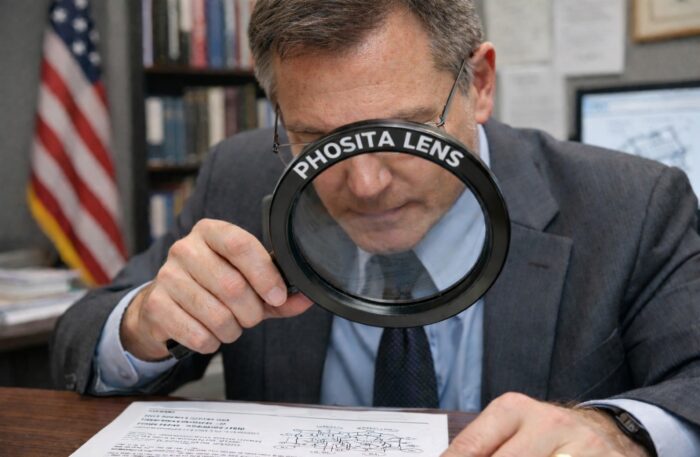
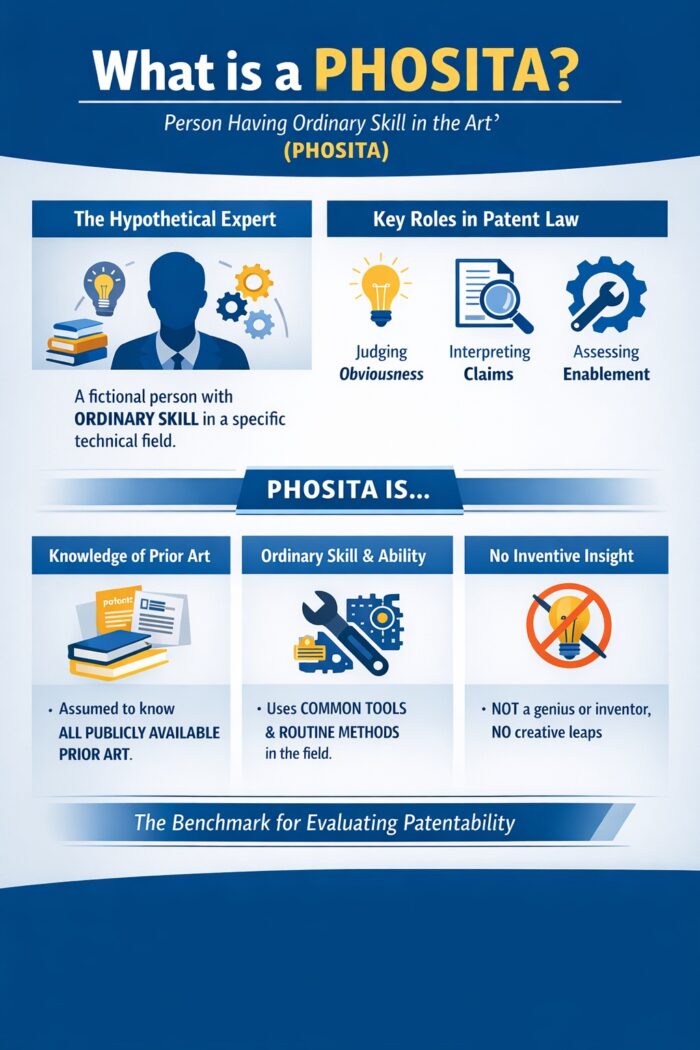
An important term in patent law is the Person Having Ordinary Skill in the Art (PHOSITA or POSITA). A PHOSITA is a “hypothetical person” used to judge obviousness, disclosure, and claim meaning. It is a figurative hurdle for patenting an invention. In the patent system, many critical questions, like non-obviousness, what counts as prior art, and what a claim “means” are evaluated through a legal fiction called the PHOSITA. The PHOSITA standard drives how a patent examiner rejects claims, how companies assess patentability, and how a court might later interpret your patented inventions in federal patent litigation.
A person having ordinary skill in the art (PHOSITA) is not a real employee, consultant, customer, or even a specific inventor. Instead, PHOSITA is a hypothetical person, a legal fiction created by patent law to provide a neutral, objective benchmark for evaluating patentability across industries and technologies. Courts, patent examiners, and judges rely on this construct to avoid hindsight and to ensure that the patent system rewards true innovation rather than routine progress.
At its core, PHOSITA represents the “average skilled practitioner” in a given technical field, possessing ordinary skill, ordinary creativity, and ordinary knowledge at the relevant time, usually before the effective filing date of the patent application. Importantly, PHOSITA is not a genius, is not an inventor, and is not permitted to invent. Instead, this person skilled in the art is expected to follow conventional wisdom, apply known techniques in a predictable manner, and draw upon what was publicly accessible in the prior art.
The Federal Circuit has repeatedly emphasized that the PHOSITA standard is context-specific. In Environmental Designs, Ltd. v. Union Oil Co. of California, 713 F.2d 693 (Fed. Cir. 1983) the court explained that determining ordinary skill in the art depends on several factors, including the educational level of practitioners, the problems encountered in the art, prior art solutions, the sophistication of the technology, and the pace of innovation. This means PHOSITA is not static, it changes depending on the context and the art to which the claimed invention pertains.
For example, in mechanical inventions, such as tools or industrial devices, PHOSITA is often described as a technician or engineer with practical experience rather than advanced theoretical training. In Union Oil, the court noted that PHOSITA was someone familiar with routine experimentation and standard design choices in environmental designs and petroleum-related systems, capable of combining known elements without exercising inventive skill.
By contrast, in pharmaceutical and chemical arts, PHOSITA is typically more highly educated. In Daiichi Sankyo Co., Ltd. v. Apotex, Inc., 501 F.3d 1254 (Fed. Cir. 2007) the Federal Circuit held that PHOSITA in drug formulation was not a general physician but a researcher with advanced training in treating ear pathologies with training in pharmacology. This higher baseline affected the obviousness and inventive step analysis because such a PHOSITA would have deeper familiarity with biochemical references, formulation techniques, and experimental methods.
In software and computer-implemented inventions, courts often describe PHOSITA as a programmer or computer scientist with ordinary experience in the relevant programming environment. In WMS Gaming Inc. v. International Game Technology, 184 F.3d 1339 (Fed. Cir. 1999) claim meaning and disclosure were evaluated from the perspective of a PHOSITA who understood standard programming practices, not from the viewpoint of a lay person or business user. Today, that analysis increasingly includes access to modern development tools, and, in some cases, artificial intelligence systems, when determining what constitutes routine skill.
Across all these examples, one principle remains constant: PHOSITA is presumed to be aware of all relevant prior art, yet is confined to the capabilities of an ordinary practitioner. This balance allows courts to determine whether a claimed invention reflects true innovation or merely an obvious application of existing knowledge, ensuring consistency, fairness, and predictability in patent law. However, it should be noted that the level of ordinary skill in the art can vary greatly in sophistication. Technologies that involve a high level of training have a relatively high level of "ordinary skill".
The concept of PHOSITA is not a judicial add-on; it is embedded directly into the Patent Act itself. 35 U.S.C. § 103 defines obviousness expressly from the perspective of a person having ordinary skill in the art. Under the statute, a patent may not be obtained if, before the effective filing date, the differences between the claimed invention and the prior art would have rendered the invention obvious to a PHOSITA, even if the invention was not identically disclosed in a single reference.
This statutory framing makes PHOSITA the central decision-making concept for non-obviousness and inventive step. The inquiry does not ask whether the invention seems obvious today, or whether it was obvious to the inventor, a judge, or a patent examiner exercising hindsight. Instead, patentability is determined by asking what a hypothetical person skilled in the relevant art would have understood, known, and been capable of doing at the relevant time.
The Supreme Court confirmed this statutory interpretation in Graham v. John Deere, 383 U.S. 1 (1966), where it explained that obviousness analysis must consider (1) the scope and content of the prior art, (2) differences between the prior art and the patent claims, and (3) the level of ordinary skill in the art, explicitly anchoring the analysis to PHOSITA rather than any real-world person. This framework remains the foundation of modern obviousness law applied by the Federal Circuit and the USPTO.
Two statutory details are especially important for business owners.
First, timing: Obviousness is evaluated as of the effective filing date, not the date an idea was conceived, reduced to practice, or commercialized. This matters when provisional applications, continuations, or priority claims shift the relevant date, and therefore shift what prior art the PHOSITA is presumed to know.
Second, the last sentence of § 103. Congress made clear that “[p]atentability shall not be negated by the manner in which the invention was made.” This language rejects the old “flash of genius” approach and reinforces that the opinion or story of how an invention came about is legally irrelevant. Even a breakthrough achieved through persistence, insight, or luck fails if a PHOSITA, armed with ordinary knowledge, ordinary tools, and conventional reasoning, would have found the claim obvious in light of the prior art.
Together, these rules ensure that PHOSITA functions as an objective guardrail in the patent system, separating true innovation from predictable technological progress.
Obviousness analysis is inherently PHOSITA based: it does not focus on what a particular inventor, startup team, or company actually knew or reviewed. Instead, it asks what the art as a whole would have conveyed to a hypothetical person of ordinary skill in the relevant technical field at the relevant time. In USPTO practice, the person skilled in the art is treated as a legal construct “presumed to have known the relevant art at the relevant time,” regardless of whether any real-world person actually located or appreciated every reference.
This presumption is critical to how patent law defines “public knowledge.” The PHOSITA is assumed to have full access to all prior art that is publicly available before the effective filing date, including patents, published applications, and other disclosures. By attributing this complete body of knowledge to a single hypothetical individual, the patent system avoids turning obviousness and non-obviousness into a subjective inquiry based on chance, research skill, or uneven information access.
The Federal Circuit has repeatedly reinforced the principle that the obviousness inquiry must be conducted through the eyes of the hypothetical person of ordinary skill in the art having knowledge of all pertinent, publicly available prior art. Custom Accessories, Inc. v. Jeffrey-Allan Industries, Inc., 807 F.2d 955 (Fed. Cir. 1986). This formulation makes clear that PHOSITA is presumed to know all pertinent prior art, not selectively, and not imperfectly.
Practically, this means that arguments based on a lack of actual knowledge of prior art (“we never saw that paper”) have no weight in an obviousness determination. The law presumes that the PHOSITA knew those teachings and could combine them in an ordinary, predictable manner, even if the combination was never identically disclosed in a single source.
At the same time, this legal presumption does not relieve applicants of real-world obligations. During prosecution of a patent application, applicants and practitioners must still comply with the duty of disclosure under 37 C.F.R. § 1.56, requiring disclosure of information material to patentability.
The PHOSITA standard is not a single, fixed definition that applies across all technology or art. Instead, courts determine the level of ordinary skill in the art on a case-by-case basis, grounded in the context of the claimed invention, the technical field, and the state of the prior art as of the relevant effective filing date. This contextual approach ensures that patentability, obviousness, and inventive step are evaluated realistically rather than through abstract generalizations.
As mentioned above, the framework for analyzing the level of ordinary skill in the art comes from the Federal Circuit’s decision in Environmental Designs v. Union Oil. In that opinion, the court explained that determining the level of skill in the art requires consideration of multiple factors, none of which is dispositive on its own. These criteria include:
This multi-factor analysis underscores that PHOSITA is a hypothetical person, not an abstract average. In mature mechanical or industrial fields, for example, PHOSITA may be a technician or engineer with hands-on experience and familiarity with standard design choices. In contrast, in cutting-edge fields such as biotechnology, semiconductors, or artificial intelligence, a PHOSITA may be assumed to have advanced formal education, familiarity with complex modeling, and routine access to specialized tools and research environments.
Importantly, Environmental Designs also cautioned that PHOSITA is not defined by the most skilled or innovative actors in the field. The PHOSITA has ordinary skill, follows conventional approaches, and does not engage in creative leaps reserved for the inventor. This distinction helps courts determine whether differences between the claimed invention and the prior art reflect true innovation or merely predictable variations that would have been obvious.
The same principles are echoed in USPTO practice. The Manual of Patent Examining Procedure (MPEP) instructs a patent examiner to make an explicit or implicit finding of the level of ordinary skill based on evidence in the record, including the nature of the technology and the problems addressed. See M.P.E.P. § 2141.03. This evidence-driven approach reinforces that PHOSITA is a legal fiction grounded in real-world industry conditions, which aims to align the patent law of obviousness with how innovation actually occurs, while avoiding hindsight and subjective judgment.
The modern doctrine of non-obviousness is inseparable from the PHOSITA standard, and the Supreme Court has made clear that obviousness must be evaluated through a structured, evidence-based inquiry grounded in both the scope of the prior art and the ordinary level of skill in the art. The starting point is the Supreme Court’s decision in the Graham v. John Deere case, which articulated the four factual inquiries, commonly called the Graham factors, that govern an obviousness analysis under 35 U.S.C. § 103.
Under this framework, a court must determine:
The first and third factors (the scope of the prior art and the ordinary level of skill in the art) are especially critical because they define the informational and technical universe attributed to the hypothetical person. As discussed above, the PHOSITA is presumed to have (1) full knowledge of all relevant prior art and (2) the capabilities are limited to ordinary technical ability. If the prior art is broad and the PHOSITA’s skill level is high, more significant differences may be needed to find an invention patentable. Conversely, in a less developed field with slower innovation, fewer differences may support patentability.
In KSR Int'l Co. v. Teleflex Inc., 550 U.S. 398 (2007), the Supreme Court reaffirmed the Graham framework, but rejected rigid rules that insulated claims from obviousness merely because no single reference provided a teaching, suggestion, or motivation to combine prior art or modify existing technology to arrive at the claimed invention. The Court emphasized a flexible, common-sense analysis and famously observed that a PHOSITA is “a person of ordinary creativity, not an automaton.” This language recognizes that the PHOSITA may apply conventional reasoning, combine familiar elements, and pursue known options, yet still may not invent or rely on hindsight reconstruction.
Taken together, Graham and KSR confirm that obviousness turns on a careful calibration between what the prior art teaches and what a PHOSITA of ordinary skill could realistically do at the relevant time.
PHOSITA also plays a critical role in the enablement requirement. Under 35 U.S.C. § 112, a patent specification must include a written description of the invention and must describe the manner and process of making and using the invention in “full, clear, concise, and exact terms” so that any person skilled in the art to which the invention pertains can make and use it. Courts routinely evaluate enablement from the perspective of a person having ordinary skill in the relevant technical field.
The central enablement question is whether practicing the claimed invention would require undue experimentation. The leading case on this point is In re Wands, 858 F.2d 731 (Fed. Cir. 1988), where the Federal Circuit identified a non-exhaustive set of factors for determining whether experimentation is undue, including the quantity of experimentation required, the amount of guidance in the specification, the presence of working examples, the nature and predictability of the art, and the level of skill in the art. Critically, these factors are evaluated through the lens of the ordinary practitioner in the relevant art or field.
It should be understood that the PHOSITA analysis for enablement purposes is not identical to the PHOSITA analysis in obviousness. For patent enablement, the inquiry asks whether a person skilled in the art, equipped with ordinary knowledge and abilities, could make and use the invention across its full scope without excessive trial and error. The PHOSITA is assumed to understand standard techniques and to recognize routine variations, but is not expected to solve open research problems or engage in creative invention to fill gaps in the disclosure.
The undue experimentation standard presumes familiarity with the ordinary materials, software, laboratory equipment, manufacturing processes, or analytical methods commonly used in the field at the relevant filing date. See M.P.E.P. § 2164. As technology evolves, particularly with advances such as artificial intelligence, what counts as “ordinary” tools may expand, but the underlying principle remains the same: the patent must teach enough that a PHOSITA can practice the invention as claimed, without turning the patent into a research assignment.
The PHOSITA concept is also central to evaluating whether a patent application satisfies the written description requirement of 35 U.S.C. § 112. Written description asks a different question than enablement or obviousness: does the application demonstrate that the inventor actually possessed the claimed invention at the time of the filing date? Courts answer that question by asking what a person having ordinary skill in the relevant art would understand from the disclosure in the patent specification.
The Federal Circuit, sitting en banc, made this point explicit in Ariad Pharmaceuticals, Inc. v. Eli Lilly & Co., 560 F.3d 1366 (Fed. Cir. 2009). There, the court held that written description is a distinct statutory requirement, separate from enablement, and requires more than simply stating a desired result. Instead, the specification must convey to a PHOSITA that the inventor had possession of the invention as broadly as it is claimed. This possession can be shown through structure, representative examples, functional relationships, or other concrete definitional content that anchors the scope of the claim.
From the perspective of a person skilled in the art, vague or purely aspirational language is insufficient. A PHOSITA reading the application must be able to determine, based on the language used, that the inventor actually invented what is being claimed, not merely identified a problem or articulated a research plan. This is particularly important in unpredictable or fast-moving fields such as biotechnology, software, and artificial intelligence, where the gap between an idea and a working invention can be substantial.
The closer your technology is to the edge of new technologies, the more carefully the application must be written to reflect real technical possession. Broad claims unsupported by commensurate disclosure risk patent invalidation, even if they might appear non-obvious. The written description requirement ensures that patent protection is granted only for what the inventor actually contributed to the public store of knowledge, preserving the balance at the heart of the patent system.
PHOSITA plays a central role in claim construction, the process by which a court determines the meaning and scope of the words used in a patent claim. Claim construction is not about what the inventor subjectively intended or how a business internally used a term. Instead, courts ask how a person having ordinary skill in the relevant art would understand the claim language at the time of the filing date, in light of the entire patent specification.
The leading authority is Phillips v. AWH, 415 F.3d 1303 (Fed. Cir. 2005), where the Federal Circuit, sitting en banc, held that claim terms must be given the meaning they would have to a person skilled in the art “in the context of the entire patent.” The court emphasized that the specification is the “single best guide” to claim meaning, because it provides the technical context, definitions, and explanations that shape how a PHOSITA would read the language of the claims. While dictionaries and extrinsic evidence may sometimes assist, they cannot override the understanding conveyed by the intrinsic record.
This PHOSITA-centered approach ensures consistency across the patent system. A claim term is not interpreted in isolation, nor is it stretched to cover every possible meaning of a word. Instead, courts determine how an ordinarily skilled practitioner, familiar with the technology, the prior art, and the disclosed invention, would understand the term when reading the patent as a whole.
For business owners, the implication is significant. The enforceable scope of your patent protection is not defined by marketing language or internal usage, but by what a PHOSITA would reasonably understand from the claims and specification, often many years later, during patent infringement litigation or validity challenges. Careful drafting, precise definitions, and alignment between the claims and disclosure are therefore critical to controlling claim meaning and reducing downstream risk.
Recent advances in artificial intelligence have prompted renewed discussion about whether the traditional PHOSITA standard should evolve to reflect modern innovation practices. In particular, commentators have questioned whether patent law should move toward a THOSITA framework, a “Team Having Ordinary Skills in the Arts”, to better capture how inventions are actually developed in collaborative, tool-intensive environments. The idea recognizes that the article “a” in “a person having ordinary skill” can describe not just a single hypothetical individual, but a group of people with complementary expertise working together.
AI has fueled this discussion because “ordinary” technical work increasingly relies on sophisticated computational tools. However, it is important to keep the PHOSITA analysis grounded in existing law. The PHOSITA is already presumed to have complete knowledge of all relevant prior art in the field. As a result, AI does not expand what the PHOSITA is deemed to “know.” That aspect of the analysis is already maximized by legal fiction.
Where AI may matter is in the skill component of the PHOSITA inquiry. If AI tools become standard tools of the trade, they may affect what tasks a person skilled in the art can perform routinely, efficiently, or at scale. But at this stage, AI systems are not considered inventive actors. They do not invent; they generate outputs based on training data and existing information.
For now, it remains unclear whether AI meaningfully changes the PHOSITA standard itself. Instead, AI is best understood as a potential input to the “ordinary skill” analysis, not a replacement for the PHOSITA framework that already anchors obviousness, enablement, and disclosure in the patent system.
The PHOSITA isn’t just a law-school concept, it’s the lens that determines whether you get patent protection, how broad your claim scope is, and how resilient your patents will be against prior art challenges.
The PHOSITA is a reference point that appears at multiple stages of the patent process, and in different roles. During prior art analysis, PHOSITA functions as a stand-in for the collective public knowledge in the relevant art, presumed to have access to all pertinent references regardless of what the inventor actually reviewed. During drafting, PHOSITA becomes the audience for the patent specification, shaping how the written description, disclosure, and level of technical detail are calibrated to allow a person skilled in the field to make and use the invention without undue experimentation. In the obviousness context, PHOSITA serves as the decision-maker against whom differences between the prior art and the claimed invention are measured, applying ordinary reasoning but not inventive insight. And in claim construction, PHOSITA becomes the interpretive lens through which a court determines how claim language would be understood in context, often years after the filing date. Appreciating these different PHOSITA perspectives helps align prosecution strategy, claim scope, and long-term patent enforcement expectations, while reinforcing that the inventor’s subjective intent or path to invention is legally irrelevant under 35 U.S.C. § 103.
If you need assistance with a patent matter or other intellectual property matter, contact our office for a free consultation with one of our skilled patent attorneys.
© 2026 Sierra IP Law, PC. The information provided herein does not constitute legal advice, but merely conveys general information that may be beneficial to the public, and should not be viewed as a substitute for legal consultation in a particular case.
"Mark and William are stellar in the capabilities, work ethic, character, knowledge, responsiveness, and quality of work. Hubby and I are incredibly grateful for them as they've done a phenomenal job working tirelessly over a time span of at least five years on a series of patents for hubby. Grateful that Fresno has such amazing patent attorneys! They're second to none and they never disappoint. Thank you, Mark, William, and your entire team!!"
Linda Guzman


Sierra IP Law, PC - Patents, Trademarks & Copyrights
FRESNO
7030 N. Fruit Ave.
Suite 110
Fresno, CA 93711
(559) 436-3800 | phone
BAKERSFIELD
1925 G. Street
Bakersfield, CA 93301
(661) 200-7724 | phone
SAN LUIS OBISPO
956 Walnut Street, 2nd Floor
San Luis Obispo, CA 93401
(805) 275-0943 | phone

SACRAMENTO
180 Promenade Circle, Suite 300
Sacramento, CA 95834
(916) 209-8525 | phone
MODESTO
1300 10th St., Suite F.
Modesto, CA 95345
(209) 286-0069 | phone
SANTA BARBARA
414 Olive Street
Santa Barbara, CA 93101
(805) 275-0943 | phone
SAN MATEO
1650 Borel Place, Suite 216
San Mateo, CA, CA 94402
(650) 398-1644. | phone
STOCKTON
110 N. San Joaquin St., 2nd Floor
Stockton, CA 95202
(209) 286-0069 | phone
PORTLAND
425 NW 10th Ave., Suite 200
Portland, OR 97209
(503) 343-9983 | phone
TACOMA
1201 Pacific Avenue, Suite 600
Tacoma, WA 98402
(253) 345-1545 | phone
KENNEWICK
1030 N Center Pkwy Suite N196
Kennewick, WA 99336
(509) 255-3442 | phone
2023 Sierra IP Law, PC - Patents, Trademarks & Copyrights - All Rights Reserved - Sitemap Privacy Lawyer Fresno, CA - Trademark Lawyer Modesto CA - Patent Lawyer Bakersfield, CA - Trademark Lawyer Bakersfield, CA - Patent Lawyer San Luis Obispo, CA - Trademark Lawyer San Luis Obispo, CA - Trademark Infringement Lawyer Tacoma WA - Internet Lawyer Bakersfield, CA - Trademark Lawyer Sacramento, CA - Patent Lawyer Sacramento, CA - Trademark Infringement Lawyer Sacrament CA - Patent Lawyer Tacoma WA - Intellectual Property Lawyer Tacoma WA - Trademark lawyer Tacoma WA - Portland Patent Attorney - Santa Barbara Patent Attorney - Santa Barbara Trademark Attorney
