
False designation of origin is a form of trademark unfair competition where a business misrepresents the source of its goods or services. In simple terms, it occurs when someone uses branding or descriptions that confuse consumers about who made a product or where it comes from. U.S. federal law (the Lanham Act) prohibits such false or misleading practices to protect both consumers and honest businesses. This article provides a clear overview of false designation of origin law, explains the relevant legal standards, and outlines the consequences of violating the law.
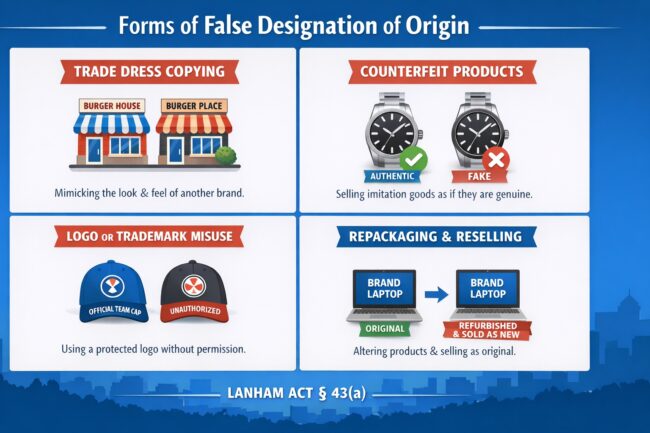
False designation of origin refers to a false or misleading representation about the origin or source of a product or service. It typically involves using a name, mark, symbol, or other branding in a way that is likely to cause consumer confusion about who produced or endorsed the goods or services. For example, if Company A sells handbags with a logo or packaging that makes consumers think the bags were made by Company B, Company A could be liable for false designation of origin. This concept is part of the broader prohibition on false or misleading description and representation in marketing. It aims to prevent businesses from passing off their products as those of another and to ensure consumers are not misled.
The primary federal law governing false designation of origin is § 43(a) of the Lanham Act, codified at 15 U.S.C. § 1125(a). This statute broadly forbids the use of any “word, term, name, symbol, or device, or any combination thereof” that is likely to deceive consumers as to the affiliation, connection, or origin of goods or services. In other words, the law prohibits any false designation or any false or misleading description or representation of fact that misleads consumers. The statute creates a civil action for any person or company who believes they are, or are likely to be damaged by such act of misrepresentation. Additionally, states and state agencies can be held liable for acts of an employee acting in his or her official capacity to the same extent as private entities.
Notably, Congress intended this law to apply very broadly, providing remedies in the case of unfair use of unregistered trademarks, trade dress, and false advertising. Section 43(a) is thus a powerful federal unfair competition law that covers a broader range of unfair business practices than section 15 U.S.C. § 1114, which is limited to covering infringement of federally registered trademarks.
To establish liability under § 43(a) for false designation of origin, a plaintiff generally must show: (1) the defendant used a designation (such as a name, mark, symbol, etc.) in commerce on or in connection with goods or services; (2) the designation is likely to cause confusion, mistake, or deception as to the origin, sponsorship, or approval of the goods or services; and (3) the plaintiff has been or is likely to be harmed by this false designation. This is sometimes called a "passing off" claim: the defendant is passing off their goods as if they came from the plaintiff. Importantly, intent to deceive is not a required element for liability, though willful intent can affect the remedies, as discussed later.
At the heart of a false designation claim is the concept of consumer confusion. The law targets representations “which are likely to cause confusion” about a product’s origin. This confusion can be direct (thinking the defendant’s product is the plaintiff’s product) or confusion as to affiliation or sponsorship (thinking the defendant is associated with or endorsed by the plaintiff). The test is an “actual or likely confusion” standard. The plaintiff need not prove every customer was deceived, only that an appreciable number of typical consumers would likely be confused.
In practice, courts evaluate relevant factors to gauge likelihood of confusion, such as the similarity of the marks or trade dress, the similarity of the goods or services, the channels of trade, the sophistication of consumers, evidence of actual confusion, and the defendant’s intent, among others. No single factor is decisive. It is a holistic analysis of whether consumers are apt to be misled about the product’s true source: i.e., whether association arising in the consumer’s mind is with the wrong source. If such confusion occurs, the law deems it unfair competition.
It is worth noting that confusion can also occur in a reverse manner, the so-called reverse passing off. This is when a party misrepresents someone else’s goods or services as its own. For example, selling a product made by another company but removing or obscuring the original source’s name. The U.S. Supreme Court has addressed this scenario in Dastar Corp. v. Twentieth Century Fox Film Corp., 539 U.S. 23 (2003). In that case, the Court clarified that the “origin” of goods under § 43(a) refers to the producer of the tangible product sold in the marketplace, not, for instance, the creator of any idea or content embodied in the product. In other words, simply selling another’s unbranded product as your own could be false designation of origin, but copying a product that is in the public domain without implying the original producer is involved is not covered by trademark law. This scenario is simply healthy market competition that causes no recognized actual economic injury. The Lanham Act should not be stretched to cover matters that are outside of recognized economic unfairness that is intended to fool consumers to gain an advantage.
Section 43(a) of the Lanham Act also covers false advertising, which is defined as false or misleading descriptions or representations in advertising or promotion. Section 43(a) also forbids misrepresenting the nature, characteristics, qualities, or geographic origin of goods or services in commercial advertising or promotion. For example, making a false claim that “Our product is made in Italy” when it is not or disparaging a competitor’s product with false facts can violate § 43(a)(1)(B).
To succeed in a false advertising claim, a plaintiff generally must prove that the defendant made a false or misleading statement of fact in an advertisement, that the deception is material in that it is likely to influence purchasing decisions, that the product traveled in interstate commerce, and that the plaintiff is or is likely to be injured by the false statement, often through lost sales or reputational harm. The Lanham Act’s false advertising provision aims to ensure a fair marketplace where commercial activities are not driven by false or misleading representation of products. Both consumers and competitors can be harmed by false advertising, so the law provides a remedy for business competitors to sue over false or misleading descriptions that cause actual or likely damage to their business.
If Company X advertises that its juice contains “0g sugar” when it actually contains high sugar content, a competitor whose sales suffer could sue under false advertising, provided the misrepresentation is factual (not mere opinion or “puffery”) and injures the competitor. The plaintiff need not be the only one harmed. The law allows suit by “any person who believes that he or she is or is likely to be damaged” by the false ad, which typically means competitors in the marketplace. Consumers themselves usually rely on consumer protection statutes rather than the Lanham Act for false advertising issues.
The Lanham Act’s false designation provisions apply not only to brand names and logos, but also to trade dress, which is the distinctive overall image or design of a product or its packaging. Trade dress can include things like the shape of a bottle, the design of a restaurant or store, or the look and feel of a product’s packaging, and is protected under the Lanham Act in the same manner that trademarks are protected if the trade dress has inherent or acquired distinctiveness. If a competitor copies a product’s appearance in a way that confuses consumers about the product’s source, that can be trade dress infringement under § 43(a). For instance, if one coffee shop chain adopts a confusingly similar interior décor and color scheme to mimic a famous chain, it could be liable for creating confusion about its affiliation or origin.
To succeed in a trade dress false designation claim, the plaintiff must prove that the claimed trade dress (the design or packaging) is distinctive and non-functional, and that the similarity of the defendant’s trade dress causes likely confusion among consumers. Trade dress distinctiveness can be inherent or acquired through use (also known as secondary meaning).
In a notable case, Two Pesos, Inc. v. Taco Cabana, Inc., the U.S. Supreme Court found that restaurant’s thematic décor (its trade dress) was inherently distinctive and thus protectable without proof of secondary meaning. 505 U.S. 763 (1992). In other words, inherently distinctive trade dress is protectable under § 43(a) without needing to show that consumers already associate it with a source.
However, in Wal-Mart Stores, Inc. v. Samara Brothers, Inc., the Supreme Court later clarified that product design, as opposed to product packaging, cannot be inherently distinctive. 529 U.S. 205 (2000). A product’s design is protectable only upon showing it has acquired secondary meaning, which is public recognition of the design as identifying source. This means if your trade dress is the design of the product itself, you must show it has gained recognition in the market as coming from your company. Demonstrating secondary meaning at trial is required if the claimed trade dress includes the product design itself.
The Lanham Act explicitly places the burden of proof on plaintiffs for certain aspects of trade dress claims. If a trade dress is not registered on the Principal Register, the person who asserts trade dress protection bears the burden to prove the trade dress is not functional. Functionality is a critical issue: trademark law cannot be used to monopolize useful product features. Only non-functional, distinctive design features can be protected. The statute also notes that if the matter sought to be protected as trade dress is unregistered, you must establish it is non-functional (and, by case law, distinctive) to prevail. It is also worth noting that the United States Patent and Trademark Office requires the demonstration of secondary meaning in order to acquire a valid registration for trade dress.
In short, trade dress infringement is treated similarly to a false designation of origin: it is another way a false or misleading representation of a product’s source can occur by copying the look and feel of a competitor’s product in a confusing way.
Any mark or trade dress must have distinctiveness to be protectable in a false designation of origin claim. Distinctiveness means the mark or dress identifies the source of the product in the minds of consumers. There are two types of distinctiveness:
A trademark registration is not required for protectability under § 43(a). A common law (unregistered) trademark can be protected and enforced under section § 43. Distinctiveness (inherent or acquired) is what matters. In evaluating distinctiveness, courts will classify the distinctiveness of the mark (generic, descriptive, suggestive, arbitrary/fanciful) and assess evidence of secondary meaning if needed. If a mark or dress is generic (the common name for a product) or entirely functional, it cannot be protected at all. Descriptive marks or designs need proof of secondary meaning, whereas suggestive, arbitrary, or fanciful ones, and packaging trade dress that is inherently distinctive, are protectable immediately upon use.
Apart from false designation of origin, which is confusion-based, federal law also provides protection against dilution of famous marks in § 43(c) of the Lanham Act. Dilution is a different type of harm that does not require consumer confusion. Instead, it protects famous marks from dilution by blurring (uses that blur the distinctiveness of a trademark or trade name) or tarnishment of their reputation, even if consumers are not confused about source. For example, using a famous mark like “Kodak” on an unrelated product (like “Kodak shoes”) could dilute the mark’s distinct identity, and using a mark in an unwholesome context could tarnish its reputation.
Only an owner of a famous mark can bring a federal dilution claim. A mark is considered famous if it is widely recognized by the general consuming public as a designation of source for the owner’s goods or services. The law provides that in determining whether a mark possesses the requisite degree of recognition, courts may consider all relevant factors, including the duration and geographic extent of the mark’s use and advertising, the volume and geographic extent of sales under the mark, the extent of actual recognition of the mark, and whether the mark was registered (on the Principal Register or under prior trademark acts). Trade dress dilution claims are also available to businesses that have famous trade dress, such as the Tiffany and Co. blue box.
A famous mark is a very well-known mark (think of brands like Coca-Cola, Nike, or Disney that are household names across the country). Courts look at factors such as the degree of similarity between the marks, the distinctiveness of the famous mark (inherent or acquired), how exclusive the famous mark’s use has been (substantially exclusive use by the owner), the degree of recognition of the famous mark, whether the junior user intended to create an association, and any actual association between the two marks or involves an association that harms the reputation of the famous mark. If dilution is shown, the famous mark owner to damages or profits in addition to injunctive relief, subject to the court’s discretion. However, the law also provides some important exclusions to dilution claims. Fair use is protected: using a famous mark in a non-trademark way to describe one’s own product (descriptive fair use) or for parody, commentary, or criticism is not actionable as dilution. For instance, comparative advertising that permits consumers to compare goods or services, news reporting and news commentary are also explicitly protected uses.
Violating the false designation of origin or false advertising provisions can lead to serious consequences. Under the Lanham Act, a plaintiff successfully demonstrates that false designation of origin occurred, the plaintiff may be entitled to injunctive relief, which is a court order stopping the defendant from continuing the false designation or misleading advertising. In fact, the law explicitly authorizes courts to issue injunctions according to principles of equity, which means the court may consider factors like the balance of hardships and the public interest when tailoring an injunction. Injunctive relief is the most common remedy, as it prevents further confusion in the marketplace.
Beyond injunctions, plaintiffs may also recover monetary remedies in appropriate cases. Under 15 U.S.C. § 1117(a), a court can award the plaintiff the defendant’s profits earned from the wrongful act, any actual damages sustained by the plaintiff (e.g., lost sales or harm to goodwill), and the costs of the lawsuit. In cases of deliberate and egregious infringement (e.g., an infringement claim arising from willful use of the plaintiff’s trademark or intentional deception), courts have the discretion to award up to treble (triple) damages or profits, and in “exceptional cases” the plaintiff may also recover attorneys’ fees.
Willfulness is not an absolute prerequisite for monetary relief in a false designation claim. The U.S. Supreme Court in Romag Fasteners, Inc. v. Fossil, Inc., 590 U.S. 212 (2020) clarified that while willful infringement is a significant factor, it is not a strict requirement for an award of profits in a Lanham Act case. However, demonstrating the defendant’s willful intent to deceive or to cause such false description of origin can greatly strengthen the case for getting monetary relief. If the false designation involves use of a counterfeit mark, the Lanham Act provides even higher statutory damages and seizure remedies under related sections, but that is a subset of trademark infringement cases.
Another interesting enforcement aspect involves imports: products marked or labeled with a false designation of origin (for example, falsely indicating a certain geographic origin or brand) can be stopped by U.S. Customs. The Lanham Act provides that goods marked or advertised in violation of § 43(a) shall not be imported into the United States. Customs authorities have the power to refuse entry of goods that carry false designations. This means that if someone tries to import products with misleading branding or origin claims, those goods may be blocked at the border, and the importer might face legal action. The owner or importer of the goods refused entry can protest such exclusion or seizure under the customs revenue laws, or seek relief under the Lanham Act itself for the seizure of those goods.
The focus of this article is federal law, but it is worth noting that state common law and statutory laws also address false designations and unfair competition. Many states have statutes or common law doctrines against “passing off” or deceptive trade practices. For example, at common law, a business could sue for passing off if another business misrepresented its goods as coming from the plaintiff. These state-law unfair competition claims often parallel Lanham Act claims, though they may have some differences in scope or available remedies. Generally, federal law does not preempt state unfair competition laws, so a plaintiff could have both federal and state causes of action for the same wrongful conduct. However, federal registration of a mark can preempt certain state claims like dilution, and the Lanham Act’s savings clause confirms it does not override other laws except where explicitly stated.
The common law of unfair competition historically aimed to prevent the same kind of misleading practices that false designation of origin covers. The Lanham Act was designed to complement, not replace, existing rights, and when it was enacted in 1946 (the Trademark Act of 1946, also known as the Lanham Act), Congress specifically preserved existing trademark rights and pending proceedings under prior acts (the Acts of 1881, 1905, and 1920). The new federal law repealed inconsistent provisions of earlier trademark statutes, but ensured that no one lost rights they already had. There was no “complete bar” to ongoing claims simply because the law changed. In essence, federal and state laws work in tandem to combat false designations. Businesses should be aware that misleading consumers can trigger multiple legal repercussions.
False designation of origin is a serious legal issue that can expose businesses to lawsuits and liability under federal law and state laws. In essence, any false or misleading representation that causes confusion about who is behind a product, or any false description in advertising, can be unlawful. The Lanham Act’s false designation provisions (15 U.S.C. § 1125(a)) protect businesses’ goodwill and consumers’ ability to rely on branding as a source indicator. They require that you not use trademarks, names, or other marketing materials in a way that deceives customers. The legal standards center on whether consumers are likely to be confused or misled. An honest mistake might not be a violation, but deliberate deceit or careless use of similar branding can lead to legal trouble.
You should consult with an experienced trademark attorney before launching new products and businesses in order to determine whether your branding and marketing too closely imitate a competitor’s branding, misuses famous trademarks in a way that could be seen as trading on their fame, or runs other risks under the Lanham Act or state law. Due diligence, including trademark searches and legal reviews are wise steps to take before launching new brands or advertising campaigns. Conversely, the law provides remedies if another business is misleading customers by suggesting an association with your company or by false advertising. If you need assistance with evaluating a potential trademark dispute or have other intellectual property matters to address, contact our office for a free consultation.
© 2025 Sierra IP Law, PC. The information provided herein does not constitute legal advice, but merely conveys general information that may be beneficial to the public, and should not be viewed as a substitute for legal consultation in a particular case.

"Mark and William are stellar in the capabilities, work ethic, character, knowledge, responsiveness, and quality of work. Hubby and I are incredibly grateful for them as they've done a phenomenal job working tirelessly over a time span of at least five years on a series of patents for hubby. Grateful that Fresno has such amazing patent attorneys! They're second to none and they never disappoint. Thank you, Mark, William, and your entire team!!"
Linda Guzman


Sierra IP Law, PC - Patents, Trademarks & Copyrights
FRESNO
7030 N. Fruit Ave.
Suite 110
Fresno, CA 93711
(559) 436-3800 | phone
BAKERSFIELD
1925 G. Street
Bakersfield, CA 93301
(661) 200-7724 | phone
SAN LUIS OBISPO
956 Walnut Street, 2nd Floor
San Luis Obispo, CA 93401
(805) 275-0943 | phone

SACRAMENTO
180 Promenade Circle, Suite 300
Sacramento, CA 95834
(916) 209-8525 | phone
MODESTO
1300 10th St., Suite F.
Modesto, CA 95345
(209) 286-0069 | phone
SANTA BARBARA
414 Olive Street
Santa Barbara, CA 93101
(805) 275-0943 | phone
SAN MATEO
1650 Borel Place, Suite 216
San Mateo, CA, CA 94402
(650) 398-1644. | phone
STOCKTON
110 N. San Joaquin St., 2nd Floor
Stockton, CA 95202
(209) 286-0069 | phone
PORTLAND
425 NW 10th Ave., Suite 200
Portland, OR 97209
(503) 343-9983 | phone
TACOMA
1201 Pacific Avenue, Suite 600
Tacoma, WA 98402
(253) 345-1545 | phone
KENNEWICK
1030 N Center Pkwy Suite N196
Kennewick, WA 99336
(509) 255-3442 | phone
2023 Sierra IP Law, PC - Patents, Trademarks & Copyrights - All Rights Reserved - Sitemap Privacy Lawyer Fresno, CA - Trademark Lawyer Modesto CA - Patent Lawyer Bakersfield, CA - Trademark Lawyer Bakersfield, CA - Patent Lawyer San Luis Obispo, CA - Trademark Lawyer San Luis Obispo, CA - Trademark Infringement Lawyer Tacoma WA - Internet Lawyer Bakersfield, CA - Trademark Lawyer Sacramento, CA - Patent Lawyer Sacramento, CA - Trademark Infringement Lawyer Sacrament CA - Patent Lawyer Tacoma WA - Intellectual Property Lawyer Tacoma WA - Trademark lawyer Tacoma WA - Portland Patent Attorney - Santa Barbara Patent Attorney - Santa Barbara Trademark Attorney
