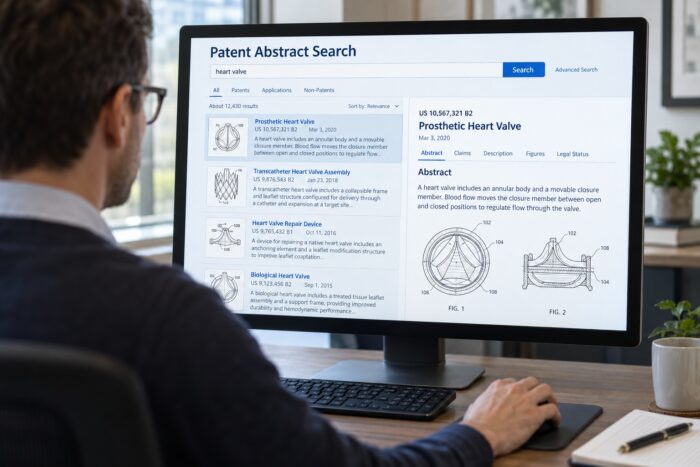
A patent abstract provides a concise, technical summary of the content of the patent application. It gives readers a snapshot of the invention and its core technical contributions, helping them decide whether it is relevant to them and whether to read the full document. This article explains the basic principles, requirements, and purposes of a patent abstract for non-attorneys navigating the patent application process.
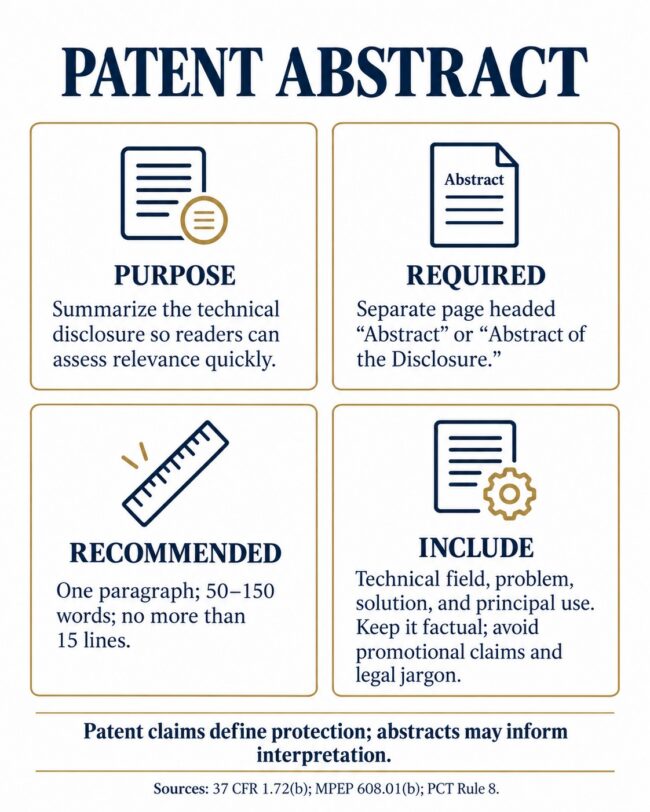
Abstracts support classification, indexing, and prior art searches for a patent application, letting examiners and researchers scan database results. The United States Patent and Trademark Office (USPTO) requires abstracts for nonprovisional utility patent and plant patent applications. See 37 C.F.R. §§ 1.51, 1.163(c)(5). Provisional and design patent applications are excepted from the abstract requirement. See 37 C.F.R. §§ 1.51(c), 1.154.
A missing abstract generally triggers a correction requirement, sometimes in a notice to file missing parts or an office action, rather than substantive claim rejection. Failure to respond can result in abandonment under 35 U.S.C. § 133.
An abstract should be one paragraph on a separate sheet following the claims section of the patent application. USPTO guidelines favor a single paragraph of 50 to 150 words and no more than 15 lines. The disclosure permitted by 150 words is very limited. But, the USPTO rules require a concise explanation of the invention providing the reader with a brief synopsis of the claimed invention. See 37 C.F.R. § 1.72(b).
The patent abstract should identify the technical field to which the invention pertains, the technical problem, the core solution provided by the invention, and principal use. The patent abstract should provide a clear understanding of the technical disclosure to the extent possible in 150 words. The content of the abstract should be purely factual. Filler phrases such as “disclosure concerns,” “disclosure describes,” and “disclosure defined by this invention” should be avoided, as they waste your word budget and add no information. Including promotional statements or legal phraseology such as “means” or “said” should also be avoided. International applications (Patent Cooperation Treaty [PCT] applications) have similar guidelines and rules for PCT abstracts. See PCT Rule 8.
The following is an effective patent abstract adapted from the USPTO’s heart valve example:
The specification, including its detailed description, must sufficiently describe and enable the claimed invention. See 35 U.S.C. § 112. The Abstract is a brief of the invention: a synopsis of the detailed specification.
Patent claims define patent protection. The abstract does not independently establish the scope of the invention, and thus does not affect the patent claims in most instances. However, abstracts can inform claim interpretation in limited situations. In Hill-Rom Co. v. Kinetic Concepts, Inc., 209 F.3d 1337 (2000), the Federal Circuit considered the abstract as intrinsic evidence when interpreting “cushion” in claims covering a hospital bed. The abstract described inflatable layers providing patient support and comfort, reinforcing the term’s ordinary meaning and the specification’s description. This interpretation excluded the accused bladders, which served only to rotate patients, supporting noninfringement. The court explained that the then-existing USPTO rule restricting reliance on abstracts governed patent examination, not judicial claim interpretation.
The discussion of patent abstracts should not be confused with the abstract idea category of judicial exceptions to patent eligibility under 35 U.S.C. § 101. U.S. patent law treats mathematical concepts, mental processes, and certain methods of organizing human activity as judicial exceptions to the categories of patentable subject matter. When the elements of the claims amount to an abstract idea, such as mathematical formulae, the claims may be unpatentable. See MPEP § 2106.
The patent applicant is responsible for preparing and submitting a patent abstract with every utility patent application. A well-written abstract communicates the inventive concept efficiently and effectively. It is important to observe the formal requirements for the patent abstract.
A patent attorney can assist with and ensure that the application, including the specification, drawings, claims, and abstract, are properly drafted and prepared, observing the applicable requirements. If you need assistance with a patent application or other intellectual property matter, please contact our office for a consultation.
© 2026 Sierra IP Law, PC. The information provided herein does not constitute legal advice, but merely conveys general information that may be beneficial to the public, and should not be viewed as a substitute for legal consultation in a particular case.
"Mark and William are stellar in the capabilities, work ethic, character, knowledge, responsiveness, and quality of work. Hubby and I are incredibly grateful for them as they've done a phenomenal job working tirelessly over a time span of at least five years on a series of patents for hubby. Grateful that Fresno has such amazing patent attorneys! They're second to none and they never disappoint. Thank you, Mark, William, and your entire team!!"
Linda Guzman


Sierra IP Law, PC - Patents, Trademarks & Copyrights
FRESNO
7030 N. Fruit Ave.
Suite 110
Fresno, CA 93711
(559) 436-3800 | phone
BAKERSFIELD
1925 G. Street
Bakersfield, CA 93301
(661) 200-7724 | phone
SAN LUIS OBISPO
956 Walnut Street, 2nd Floor
San Luis Obispo, CA 93401
(805) 275-0943 | phone

SACRAMENTO
180 Promenade Circle, Suite 300
Sacramento, CA 95834
(916) 209-8525 | phone
MODESTO
1300 10th St., Suite F.
Modesto, CA 95345
(209) 286-0069 | phone
SANTA BARBARA
414 Olive Street
Santa Barbara, CA 93101
(805) 275-0943 | phone
SAN MATEO
1650 Borel Place, Suite 216
San Mateo, CA, CA 94402
(650) 398-1644. | phone
STOCKTON
110 N. San Joaquin St., 2nd Floor
Stockton, CA 95202
(209) 286-0069 | phone
PORTLAND
425 NW 10th Ave., Suite 200
Portland, OR 97209
(503) 343-9983 | phone
TACOMA
1201 Pacific Avenue, Suite 600
Tacoma, WA 98402
(253) 345-1545 | phone
KENNEWICK
1030 N Center Pkwy Suite N196
Kennewick, WA 99336
(509) 255-3442 | phone
2023 Sierra IP Law, PC - Patents, Trademarks & Copyrights - All Rights Reserved - Sitemap Privacy Lawyer Fresno, CA - Trademark Lawyer Modesto CA - Patent Lawyer Bakersfield, CA - Trademark Lawyer Bakersfield, CA - Patent Lawyer San Luis Obispo, CA - Trademark Lawyer San Luis Obispo, CA - Trademark Infringement Lawyer Tacoma WA - Internet Lawyer Bakersfield, CA - Trademark Lawyer Sacramento, CA - Patent Lawyer Sacramento, CA - Trademark Infringement Lawyer Sacrament CA - Patent Lawyer Tacoma WA - Intellectual Property Lawyer Tacoma WA - Trademark lawyer Tacoma WA - Portland Patent Attorney - Santa Barbara Patent Attorney - Santa Barbara Trademark Attorney
