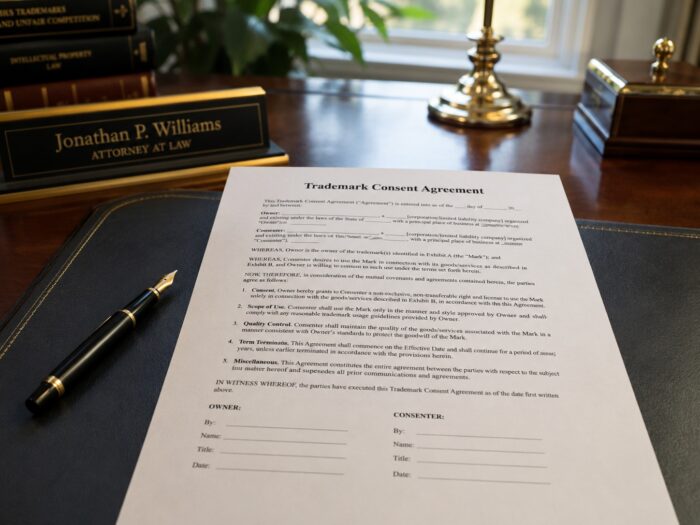
This page explains trademark consent agreements, their role in trademark registration, and how they differ from coexistence agreements. A trademark consent agreement can be especially important when an examining attorney refuses an application based on a likelihood of confusion with a previously registered mark.
A trademark consent agreement is a contract where a trademark owner allows another party to use and register a similar trademark. Businesses often use a consent agreement when the United States Patent and Trademark Office (USPTO) refuses an applied-for mark because it resembles a previously registered mark. Under Lanham Act § 2(d), the USPTO may refuse trademark registration where a mark is likely to cause mistake, deception, or consumer confusion. See 15 U.S.C. § 1052(d).
A consent agreement can be useful when an examining attorney issues a likelihood of confusion refusal under Lanham Act § 2(d) because the applied-for mark appears too similar to a previously registered mark for related goods or services. In that situation, the applicant may submit a trademark consent agreement to support registration by showing that the applicant and the other party to the agreement (the owner of the cited trademark) have assessed the marketplace and believe confusion is unlikely despite concurrent use of the marks by the parties. The Trademark Manual of Examining Procedure (TMEP) recognizes that an applicant may submit a consent agreement either after a refusal or in anticipation of a refusal. See TMEP § 1207.01(d)(viii). To be persuasive, the agreement should do more than grant permission. It should explain the parties’ respective marks, goods and services, trade channels, customer bases, and any restrictions designed to prevent confusion. Evidence that the parties have coexisted without actual confusion can further strengthen the applicant’s response.
A trademark coexistence agreement is a more comprehensive arrangement that provides greater protection than a simple consent agreement, often including limitations on locations, industries, and marketing methods. A simple consent agreement typically focuses on one narrow issue: the senior user consents to the junior user’s trademark use and registration, usually to help overcome a USPTO likelihood-of-confusion refusal. It may confirm that the parties believe confusion is unlikely, but if it contains few operational limits, the Trademark Office may give it less weight.
A trademark coexistence agreement is a comprehensive agreement between the parties that defines the parties' uses of the respective marks in a way that allows the parties to peacefully coexist in the marketplace without consumer confusion. It establishes rules for long-term coexistence, such as who may use particular domain names, social media handles, advertising formats, geographic market restrictions, restrictions on particular goods or services, and restrictions on trade channels. These coexistence agreements are common when two businesses operate in related but distinct sectors and both want federal protection without disrupting legitimate brand growth. A well-drafted agreement may also address future expansion, trademark enforcement, customer inquiries, and procedures for resolving actual confusion. In practice, coexistence agreements usually provide stronger business certainty than a bare consent.
Coexistence and consent agreements should do more than record permission. They should identify the respective marks, the goods and services covered, each party’s ownership position, any additional marks, and the scope of permitted trademark use. The agreement should also state whether the parties agree not to challenge each other’s rights, oppose future applications, or interfere with registration, subject to defined limits. A well-drafted trademark coexistence agreement typically addresses territories, domain names, advertising, social media handles, trade channels, customer bases, and procedures for handling actual confusion if it arises. These provisions can create legal certainty for expansion, particularly where one party has greater bargaining power or the senior user wants to preserve priority. Still, the agreement must protect the public interest in avoiding confusion. The USPTO and courts may discount private consent if the arrangement leaves consumers exposed to materially similar marks in the same channels.
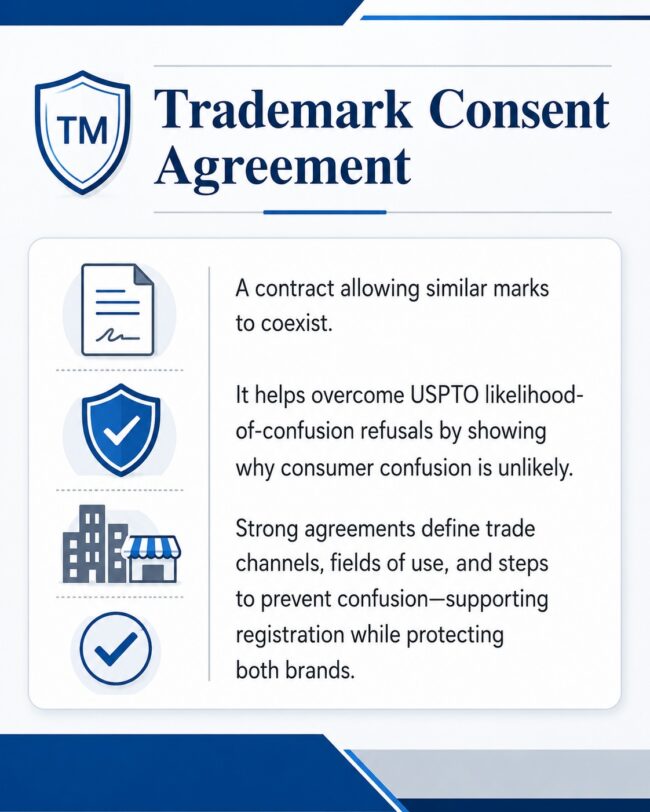
The USPTO gives meaningful weight to consent agreements because the parties typically understand their markets, customers, trade channels, pricing, branding, and day-to-day commercial realities better than the USPTO can from an application record alone. The Federal Circuit has said that consent agreements may carry great weight because the parties are often in the best position to evaluate whether simultaneous use of their respective marks is likely to cause consumer confusion. In In re Four Seasons Hotels Ltd., 987 F.2d 1565 (Fed. Cir. 1993), the court credited a consent agreement that included detailed restrictions on use, location, and cooperation to address confusion.
That said, the USPTO does not automatically accept every consent agreement. The agreement is more persuasive when it contains a reasoned assessment of the relevant factors, such as differences in the parties’ services, separate trade channels, distinct customers, and the absence of actual confusion. It should also include practical provisions requiring the parties to take commercially reasonable steps to avoid confusion if problems arise. A detailed agreement with real evidentiary support is more likely to overcome a likelihood of confusion refusal than a short, naked consent that merely states that one party consents to trademark registration.
The USPTO gives more weight to agreements that contain a reasoned assessment of why confusion is unlikely, rather than a bare statement that the parties consent. A persuasive trademark consent agreement should explain the marketplace facts that reduce the likelihood of confusion, including how the respective marks are used, the nature of the goods and services, and whether customers are likely to encounter the brands in the same channels. Strong provisions include a clear indication of separate trade channels, restrictions on the parties’ fields of use, different marketing methods, limitations on geography or customer types, and procedures for handling mistaken inquiries.
Evidence can also matter. The parties can identify any period of simultaneous use, explain whether there has been actual confusion, and provide factual support for their conclusion that confusion is unlikely. The agreement should also require the parties to take commercially reasonable steps to prevent confusion and avoid confusion if problems arise, such as modifying packaging, clarifying website language, training sales staff, or redirecting misdirected communications. The more detailed and practical the restrictions are, the more likely an examining attorney will view the agreement as meaningful evidence rather than a naked consent.
A naked consent, a consent agreement that merely grants permission, or simply states that confusion is unlikely, is usually given little weight in a likelihood of confusion analysis. The USPTO does not reject consent agreements because they are private contracts. The USPTO must still protect consumers, so the agreement should “show the work.” In In re E.I. du Pont de Nemours & Co., 476 F.2d 1357 (C.C.P.A. 1973), the court distinguished bare consent from more detailed agreements, which may receive substantial weight. In In re Mastic Inc., 829 F.2d 1114 (Fed. Cir. 1987), the Federal Circuit held that a consent is stronger when “clothed” with specific arrangements to avoid confusion, such as limits on products, marketing, or trade channels. In In re Donnay Int’l, S.A., 31 USPQ2d 1953, 1956 (TTAB 1994), the TTAB explained that more evidentiary support for such conclusions produces more weight.
That rule drove In re Ye Mystic Krewe of Gasparilla, 2025 USPQ2d 1291 (TTAB 2025). The TTAB found multiple failings: the marks were highly similar, the goods overlapped, and the agreement did not require separate trade channels or restrict fields of use. Its actual confusion provision required only commercially reasonable steps after confusion arose, so the consent helped only slightly and did not overcome the refusal.
A strong agreement should do more than state that the parties consent to simultaneous use of their marks. It should address how the brands will appear in packaging, websites, invoices, apps, advertising, customer portals, and customer-facing support pages. The agreement should also define permitted goods and services, territories, trade channels, domain names, social media handles, logo usage, and any required disclaimers or house marks. If customer confusion occurs, the agreement should require commercially reasonable steps to investigate and resolve it. A detailed agreement gives the USPTO stronger evidence that confusion is unlikely.
If a likelihood of confusion refusal continues after the applicant submits a trademark consent agreement, the applicant may appeal to the Trademark Trial and Appeal Board (TTAB), the USPTO’s appeal board for ex parte trademark refusals after a final examining attorney decision. 15 U.S.C. § 1070 authorizes trademark appeals from final examiner decisions. Importantly, the appeal record should generally be complete before appeal, so consent evidence should be developed early, not saved for later TTAB proceedings.
In appeal practice, a consent agreement is powerful evidence, but not an automatic win. In In re Four Seasons Hotels Ltd., the Federal Circuit reversed a refusal involving FOUR SEASONS BILTMORE and THE BILTMORE LOS ANGELES because the parties had long coexisted and adopted concrete restrictions, including location-specific use and cooperation if confusion arose. By contrast, in Gasparilla, the TTAB gave little weight to a consent agreement involving highly similar GASPARILLA marks because it lacked meaningful limits on trade channels, fields of use, and evidence of no actual confusion.
A trademark consent strategy can reduce a potential risk and help a business register a mark, but permission alone is not enough. The best agreement explains why the parties’ marks can coexist, restricts use where needed, includes evidence, and gives the USPTO and any court practical reasons to trust the parties’ assessment of likelihood and confusion.
If you need assistance with a potential trademark consent situation or other intellectual property matter, please contact our office for a consultation with one of our experienced trademark attorneys.
© 2026 Sierra IP Law, PC. The information provided herein does not constitute legal advice, but merely conveys general information that may be beneficial to the public, and should not be viewed as a substitute for legal consultation in a particular case.

"Mark and William are stellar in the capabilities, work ethic, character, knowledge, responsiveness, and quality of work. Hubby and I are incredibly grateful for them as they've done a phenomenal job working tirelessly over a time span of at least five years on a series of patents for hubby. Grateful that Fresno has such amazing patent attorneys! They're second to none and they never disappoint. Thank you, Mark, William, and your entire team!!"
Linda Guzman


Sierra IP Law, PC - Patents, Trademarks & Copyrights
FRESNO
7030 N. Fruit Ave.
Suite 110
Fresno, CA 93711
(559) 436-3800 | phone
BAKERSFIELD
1925 G. Street
Bakersfield, CA 93301
(661) 200-7724 | phone
SAN LUIS OBISPO
956 Walnut Street, 2nd Floor
San Luis Obispo, CA 93401
(805) 275-0943 | phone

SACRAMENTO
180 Promenade Circle, Suite 300
Sacramento, CA 95834
(916) 209-8525 | phone
MODESTO
1300 10th St., Suite F.
Modesto, CA 95345
(209) 286-0069 | phone
SANTA BARBARA
414 Olive Street
Santa Barbara, CA 93101
(805) 275-0943 | phone
SAN MATEO
1650 Borel Place, Suite 216
San Mateo, CA, CA 94402
(650) 398-1644. | phone
STOCKTON
110 N. San Joaquin St., 2nd Floor
Stockton, CA 95202
(209) 286-0069 | phone
PORTLAND
425 NW 10th Ave., Suite 200
Portland, OR 97209
(503) 343-9983 | phone
TACOMA
1201 Pacific Avenue, Suite 600
Tacoma, WA 98402
(253) 345-1545 | phone
KENNEWICK
1030 N Center Pkwy Suite N196
Kennewick, WA 99336
(509) 255-3442 | phone
2023 Sierra IP Law, PC - Patents, Trademarks & Copyrights - All Rights Reserved - Sitemap Privacy Lawyer Fresno, CA - Trademark Lawyer Modesto CA - Patent Lawyer Bakersfield, CA - Trademark Lawyer Bakersfield, CA - Patent Lawyer San Luis Obispo, CA - Trademark Lawyer San Luis Obispo, CA - Trademark Infringement Lawyer Tacoma WA - Internet Lawyer Bakersfield, CA - Trademark Lawyer Sacramento, CA - Patent Lawyer Sacramento, CA - Trademark Infringement Lawyer Sacrament CA - Patent Lawyer Tacoma WA - Intellectual Property Lawyer Tacoma WA - Trademark lawyer Tacoma WA - Portland Patent Attorney - Santa Barbara Patent Attorney - Santa Barbara Trademark Attorney
