When you apply for a federal trademark in the United States, you may receive a trademark office action, an official letter from the U.S. Patent and Trademark Office (USPTO) examining attorney that lists any legal problems with your application or proposed trademark. This office action is essentially a response from the trademark examiner after reviewing your trademark filing. It outlines any issues that prevent your mark from registering in its current form, ranging from minor application errors to substantive refusals under trademark law. Office actions are a normal part of the trademark registration process. In this guide, we discuss the types of office actions, common issues raised, and how to respond within the required response period to keep your trademark application on track.
A trademark office action is an official letter sent by the USPTO after an examiner reviews your application. In this letter, the examining attorney details any issues raised with your trademark application. These issues generally fall into two categories: requirements and refusals. A requirement is something procedural or technical that needs to be fixed in the application: for example, clarifying your listed goods or services, correcting the applicant’s name or legal entity, or providing a proper trademark specimen. A refusal, on the other hand, is a substantive legal rejection of the mark under the Lanham Ac, such as a finding that your mark is too similar to an existing registered mark or that it is too descriptive. You must resolve all issues identified, whether by making amendments or by persuading the examiner with legal arguments, before your trademark can proceed to registration. In sum, the office action is the USPTO’s way of communicating asserted “legal problems” with your filing that must be addressed.
Office actions come in different types, and it’s important to determine whether you have a nonfinal or final office action, as this affects your response strategy. A nonfinal office action, sometimes called a “first office action” or non-final office action, is typically the first official letter you receive. It raises the examiner’s objections or issues for the first time and gives you an opportunity to respond. In the office action, the examining attorney lists each of the issues they believe the applicant must address. You must respond to each of the issues raised in the nonfinal office action within the set response deadline three months from the issue date with a possible three-month extension. In the nonfinal action, the examining attorney may list multiple issues.
If you file a trademark office action response resolves each one and does not introduce any new issues, your application can move forward toward approval. If not, or if your response itself raises a new issue (e.g., by amending your goods/services in a way that introduces a new problem), the examiner can issue another nonfinal office action addressing the new or outstanding issues.
A final office action is issued when there are still unresolved issues raised after your response to a nonfinal action. A final office action is essentially the examiner’s final rejection of your application on those grounds. It means the examining attorney has maintained the refusals or requirements despite your previous response, and it is the last chance to respond within the USPTO examination process. You must respond to a final office action within the deadline, which is three months from the issuance date, with an optional extension of three months. However, after a final action, the options to overcome the refusals narrow, you may need to file a response that substantively resolves the issues or pursue an appeal.
If you file a response to a final office action that fully satisfies each remaining issue, the application can proceed to publication and registration. If you fail to timely respond or the response still does not overcome the refusals, the application will be deemed abandoned unless you appeal the final refusal to the Trademark Trial and Appeal Board in a timely manner.
One of the most common substantive refusals in an office action is based on likelihood of confusion under Section 2(d) of the Lanham Act. The examining attorney will conduct a search of the USPTO records for conflicting marks. If your newly applied-for trademark is deemed too similar to a prior registered trademark or pending application, used on related goods or services, the USPTO will refuse registration due to likely consumer confusion. In other words, if the examiner determines that consumers encountering the two marks might believe they come from the same source, you’ll receive a confusion refusal citing Section 2(d).
The statutory basis for this refusal is 15 U.S.C. §1052(d), which bars registration of a mark that “so resembles a mark registered in the Patent and Trademark Office… as to be likely, when used on or in connection with the goods of the applicant, to cause confusion, or to cause mistake, or to deceive.” This means trademark rights are not absolute. The USPTO will not grant you exclusive rights to a mark that is confusingly similar to someone else’s mark already on the Principal Register.
When evaluating likelihood of confusion, the USPTO and courts apply a multi-factor test known as the DuPont factors, named after a famous case In re E.I. du Pont de Nemours & Co., 476 F.2d 1357 (C.C.P.A. 1973). These factors include comparisons of the marks’ appearances, sounds, meanings, the similarity of the goods/services, trade channels, and more, to assess whether consumers would likely be confused by the two marks. No single factor is dispositive, but the overall analysis drives the decision. The key point is that if the examining attorney cites a conflicting registration that is too close to your mark, a 2(d) refusal will be issued.
Overcoming a likelihood of confusion refusal can be challenging, but it is not impossible. You must submit a written response that addresses all issues raised in the office action. In your office action response, you can argue that the marks create different commercial impressions and that the goods or services are unrelated or marketed in different channels, and thus no likelihood of confusion exists. It is important to make specific, fact-based legal arguments: e.g., pointing out that your mark is sufficiently distinct from the cited mark based on differences in spelling or meaning between the two marks, or evidence that the goods listed in the cited registration are in a completely different industry from yours. You may also provide evidence of third-party registrations to show that a shared term is weak or common in your industry, indicating that consumers are used to distinguishing between similar marks in a crowded field. Another strategy is to narrow your identification of goods and services to avoid overlap with the scope of the cited registration, if appropriate.
In some cases, obtaining a consent agreement from the owner of the cited registration can help. A consent agreement is a formal agreement where the other party consents to your registration and both parties detail why they believe confusion will not occur. A consent is usually paired with co-existence agreement that governs the parties rights with respect to use of their respective trademarks. The USPTO gives consent agreements “great weight” if they are thorough and crafted to avoid confusion. However, a bare-bones or “naked” consent without clear terms or explanations may carry little weight. The USPTO’s guidance confirms that a well-drafted consent agreement can facilitate trademark registration, but it does not guarantee an approval if the marks are extremely similar.
Because of the complexity of 2(d) refusals and the legal analysis required, many applicants choose to consult an experienced trademark attorney for help in crafting a response or negotiating agreements. A timely, well-reasoned response with supporting evidence is crucial; otherwise, the refusal will stand and the application will be abandoned.
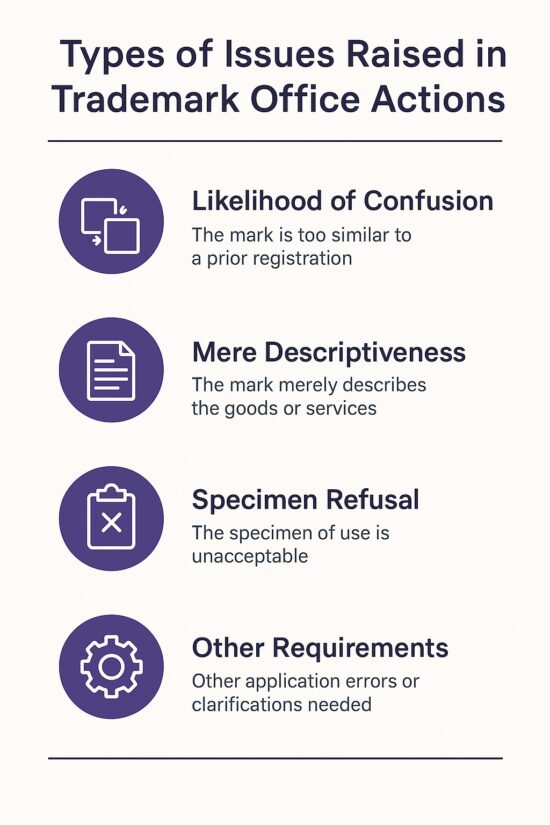
Another common issue is a refusal for merely descriptive trademarks, cited under Lanham Act §2(e)(1). A mark is “merely descriptive” if it simply describes an ingredient, quality, characteristic, function, or feature of the goods or services, without showcasing any distinctive branding. For example, calling your yogurt brand “Creamy Yogurt” or a bagel shop “Crusty & Chewy Bagels” would immediately tell consumers a feature of the product but not its source. Such terms are descriptive. 15 U.S.C. §1052(e)(1) prohibits registration of a mark which, “when used on or in connection with the goods of the applicant, is merely descriptive… of them.”
The rationale is that every business in an industry should be free to use common descriptive words for their products (industry jargon or ordinary terms) without risking a trademark infringement claim. If your trademark is too generic or descriptive of the actual nature of your product/service, the USPTO will issue a descriptiveness refusal. Similarly, marks that are primarily a surname or geographically descriptive fall under related provisions of §2(e) and can be refused on that basis.
To overcome a descriptiveness refusal, you have a few options. First, you could argue that the mark is not really descriptive but rather suggestive or arbitrary in relation to the goods. This involves making legal arguments and sometimes providing evidence that consumers would need imagination or thought to connect the mark to the goods. For instance, if you applied for a mark that the examiner thinks describes a feature, you might show that it is used metaphorically or is a coined term with no direct meaning for the goods.
Second, if the mark truly is descriptive, you might amend the application to the Supplemental Register: an alternative register for descriptive marks that have not acquired distinctiveness yet. The Supplemental Register does not give you full trademark protection or exclusive rights like the Principal Register, but it can be a stepping stone until your mark gains distinctiveness.
Third, you can attempt to show that your mark has acquired distinctiveness (secondary meaning) in the marketplace, under Lanham Act §2(f). If you can prove that through substantially exclusive and continuous use for at least five years or other evidence (e.g., sales figures, advertising, consumer testimonials) your descriptive mark has become recognized as a brand by the public, the USPTO may allow it on the Principal Register. The statute explicitly permits registration of a mark that has “become distinctive” of the applicant’s goods through use under 15 U.S.C. §1052(f). In practice, you would submit a claim of acquired distinctiveness with supporting evidence to overcome the refusal.
Finally, note that the examining attorney might also issue a disclaimer requirement for a descriptive portion of your mark. Under the law, the USPTO can require you to disclaim an “unregistrable component” of an otherwise registrable mark that is generic or descriptive. For example, if your brand is “Sunny Skies Café” for a coffee shop, you might have to disclaim the word “Café” since it is generic with respect to café services. Disclaiming simply means you are not claiming exclusive trademark rights to that specific word, except as part of your whole mark. As long as you comply with the disclaimer request, it will not block the registration. It is considered a minor issue easily resolved in an office action response.
If you filed your application based on actual use of the mark in commerce under Section 1(a) or you are responding after filing a Statement of Use in an intent-to-use application under Section 1(b), the USPTO examining attorney will evaluate your specimen of use. A specimen is a sample that shows your trademark actually being used on the goods or in connection with the services in a way that the public encounters it. Common specimens include product labels or packaging showing the mark, screenshots of webpages selling the goods, or advertisements or brochures for the services.
An office action may include a specimen refusal if the specimen you submitted is deemed unacceptable or insufficient. For instance, one frequent problem is submitting mere advertising material for goods. Advertising material (like a flyer or webpage ad) is acceptable as a specimen for services since services are often sold through ads, but not for goods. Goods generally require a specimen that is a display or label at the point of sale. Another issue arises if the specimen is a mock-up or digitally altered image, not a photo from actual sales. Such ginned up specimens are improper because they fail to show actual use in commerce. If they are submitted with deceptive intent, the trademark application may be invalidated.
An acceptable specimen must also match the mark as applied-for with no material differences and relate to the specific goods and/or services listed in the trademark application. If the specimen does not show the mark functioning as a source indicator for the goods and/or services (e.g., if it is used just ornamentally or as a business name, rather than a brand), that can also result in refusal.
There are generally two ways to fix a specimen refusal. Option 1: Submit a substitute specimen that was in use before the relevant date: the application filing date if filed under Section 1(a) as currently in use, or before the expiration of your deadline to file a Statement of Use if the trademark application was filed as an intent-to-use case under Section 1(b). The substitute specimen should be a proper example of how the mark is used on the goods or in advertising the services: a photo of the product packaging with the mark, a tag or label affixed to the product, or a screenshot of a webpage with ordering information for the goods. You will need to include a declaration verifying the new specimen was in use as of the required date.
Option 2: Argue that the original specimen was acceptable. For example, if the office action says your specimen is “mere advertising” but you believe it actually is a point-of-sale display, you can submit reasoning and possibly evidence to explain why it functions to allow purchases of the goods. You might also point out if the examiner misinterpreted the specimen. Keep in mind that some specimen problems ca not be cured. For example, if your specimen and identified goods and/or services just do not match, the USPTO will not let you substantially alter the listed goods to fit a specimen: you applied for software but your specimen was a photo of a t-shirt. In such cases, the application might have to be abandoned or certain goods deleted. You should investigate and ensure that any specimen you plan to use is a proper specimen for the goods and services you plan to identify in your trademark application.
If you filed an intent-to-use application, you will not need a specimen until later in the process, which gives you time to create acceptable use. But for use-based applicants, double-check that your specimen truly shows the mark as used in commerce on the goods/services. This due diligence can avoid a deadly specimen refusal.
Beyond the major refusals for confusion or descriptiveness and specimen problems, office actions might raise a variety of minor issues or clarifications needed. Here are some common ones:
The examining attorney may find your description of goods or services indefinite or misclassified. For example, saying “software” alone might be too broad, and the USPTO might require you to specify the purpose or type of software. You may need to amend the identification to an acceptable wording from the USPTO’s Trademark ID Manual or based on guidance from the examiner. Clarifying the scope of your goods or services is usually straightforward, and the office action will often suggest an acceptable amendment.
If the applicant’s legal entity (individual, corporation, LLC, etc.) was not correctly listed or has changed, the office action could require correction. For instance, if you mistyped your business entity name or did not clarify the citizenship of an individual, you will have to fix that. Similarly, if the application or response was not signed by a proper party (like a corporate officer or authorized attorney), you might get a notice to submit a proper signature. These are generally procedural and easy to address within the response period.
As mentioned earlier, the USPTO can require a disclaimer of an unregistrable component of a mark. This often happens when your mark contains a generic or descriptive word, a geographic term, or an entity designation (like “Inc.” or “Ltd.”). For example, if your trademark is “Swift Automobiles,” expect to disclaim “Automobiles” because it’s a generic term for the product. Disclaiming means you agree that term is not exclusive to you (others can use it), which is consistent with the trademark policy of not granting monopoly on descriptive language. The office action will explicitly state the disclaimer requirement. You can comply by including the disclaimer text in your response: “No claim is made to the exclusive right to use ‘Automobiles’ apart from the mark as shown.” Once disclaimed, that portion will not impede registration.
Sometimes a mark is refused because it does not function as a trademark. This can occur if your mark is a common slogan, a term that merely provides information about the goods, or a commonplace phrase. office actions in this area might say the mark is ornamental, a generic term, or an informational slogan. Overcoming these refusals often requires evidence that the public perceives the phrase as a mark. This is a more nuanced area of trademark law, often requiring strong arguments or proof of acquired distinctiveness if applicable.
Other issues might include needing a translation for foreign wording in the mark, correcting the mark drawing if it does not match the description, or providing a more precise description of a logo design. If your mark includes non-English words, the USPTO usually requires an English translation. If it includes a design, you might need to amend the “description of the mark” to properly identify all elements. These requirements are typically clearly outlined in the office action and can be satisfied with a simple amendment or addition in your response.
Responding to an office action in a timely manner is crucial. Missing the deadline will result in your application being abandoned, which means you lose that filing unless you successfully petition to revive, which costs extra and is only granted if the delay was unintentional. Under rules implemented in late 2022, you now have 3 months from the issue date of the office action to respond, with a one-time opportunity to request a three-month extension (with a fee) to make it 6 months total. The exact deadline is always stated in the header or body of the office action. The office action will state that a response must be received on or before the particular date of the deadline. Currently, you must either submit your complete response or file an official extension request by that date. If you do the latter, you get an additional three months. As an exception, applications filed through international treaties like the Madrid Protocol still have a 6-month response period with no extensions allowed.
The safest practice is to respond well before the response deadline to avoid missing the deadline as a result of any technical issues. All responses must be filed through the Trademark Electronic Application System (TEAS) online. The USPTO will not accept paper or email responses for regular trademark actions. Also note that the USPTO conducts business in the Eastern Time Zone. A TEAS submission is considered filed based on Eastern Time. So, a response must be filed by 11:59 pm Eastern Time on the deadline.
Failing to respond by the deadline will cause abandonment of your application. The USPTO will send a Notice of Abandonment and your mark will not register. While it is sometimes possible to revive an abandoned application by showing the delay was unintentional and paying a fee, it is far better to meet the original deadlines and keep your application alive.
If you receive a final office action and your response does not convince the examiner to withdraw the refusal, you still have a couple of avenues to pursue. The final action is not necessarily the end of the road, but it is your last chance within the USPTO’s examination process to make your case or escalate the matter.
One option is to request reconsideration from the examining attorney. This is essentially another response to the final office action, usually used if you have new evidence or legal arguments that were not previously made. For example, if you locate new case law supporting your position, or you obtain a consent agreement after the final action, you can submit it with a reconsideration request. You must file this request within the response deadline, and note that it does not extend your time to appeal. The examiner will review it, and if persuaded, can withdraw the final refusal and approve the application or possibly issue another nonfinal action if a new issue arose.
However, because it is already a final action, the bar to changing the outcome is high. Often, applicants will file a Request for Reconsideration and a Notice of Appeal simultaneously. Doing so preserves your rights. The appeal will be initiated, but the Trademark Trial and Appeal Board (TTAB) will usually suspend the appeal and remand the case to the examiner to consider the reconsideration request. If the examiner reverses the refusal, the appeal can be withdrawn. If not, the appeal continues.
The Trademark Trial and Appeal Board is an administrative tribunal within the USPTO that hears appeals of final refusals. Under the law, you have the right to appeal “any final decision of the examiner in charge of the registration of marks” to the TTAB. An appeal is initiated by filing a Notice of Appeal through the USPTO’s ESTTA system and paying the appeal fee, within the allowed time after the final office action. The TTAB will then set a schedule for you to file an appeal brief arguing your case, the examiner to file a brief in response, and possibly an oral hearing.
The TTAB will review the refusal de novo, giving no deference to the examiner’s decision, but relying on the evidence of record and applicable law. The TTAB will then issue a written decision either affirming the refusal or reversing it. If the TTAB reverses the refusal, your application moves forward toward registration. If it affirms the refusal, you still have a further right to appeal that decision to the U.S. Court of Appeals for the Federal Circuit or to file a civil action in federal court, but those are infrequently pursued by most applicants due to cost. The TTAB appeal is the main recourse if the examiner was wrong on a legal point, such as the likelihood of confusion analysis or the descriptiveness finding. The appeal process can take many months, so it is not a quick solution, but it is an effective tool for challenging a final refusal.
Finally, sometimes the most practical option after a final office action is to make practical decisions about your trademark strategy. Perhaps it is feasible to rebrand to a different or modified mark that is more distinctive or less conflicting. An experienced trademark lawyer can advise you on the chances of success on appeal versus the costs.
While not every office action is avoidable, you can minimize the risk by doing a bit of homework before filing. Consider having a trademark search done to catch any obvious conflicts in the USPTO database of prior marks. Think about the distinctiveness of your trademark. If your mark is highly descriptive or generic, understand that it will face an uphill battle and maybe choose a more unique brand name if you are seeking strong trademark protection on the Principal Register. Ensure your application is complete and accurate. Properly identify your goods and services, make sure the applicant is correctly identified, and avoid other minor issues. Keep track of your application status. You can use the USPTO’s TSDR status system or Trademark Status and Document Retrieval in the Trademark Center online to make sure you catch any office action as soon as it is issued.
Trademark office actions are a common hurdle in the trademark registration process, but with a clear understanding of the issues and a prompt, thorough response, they can be overcome. By addressing the USPTO examining attorney’s concerns, you can often turn a initially refused application into a registered trademark. Always pay attention to the response deadlines, and ensure your response leaves no outstanding issue unaddressed.
If you find the process daunting, do not hesitate to seek guidance from an experienced trademark attorney, as their expertise can be invaluable in navigating nuanced legal arguments and procedural rules. If you are seeking a trademark registration or you need assistance with the trademark process, contact our office for a free consultation.
© 2025 Sierra IP Law, PC. The information provided herein does not constitute legal advice, but merely conveys general information that may be beneficial to the public, and should not be viewed as a substitute for legal consultation in a particular case.

"Mark and William are stellar in the capabilities, work ethic, character, knowledge, responsiveness, and quality of work. Hubby and I are incredibly grateful for them as they've done a phenomenal job working tirelessly over a time span of at least five years on a series of patents for hubby. Grateful that Fresno has such amazing patent attorneys! They're second to none and they never disappoint. Thank you, Mark, William, and your entire team!!"
Linda Guzman


Sierra IP Law, PC - Patents, Trademarks & Copyrights
FRESNO
7030 N. Fruit Ave.
Suite 110
Fresno, CA 93711
(559) 436-3800 | phone
BAKERSFIELD
1925 G. Street
Bakersfield, CA 93301
(661) 200-7724 | phone
SAN LUIS OBISPO
956 Walnut Street, 2nd Floor
San Luis Obispo, CA 93401
(805) 275-0943 | phone

SACRAMENTO
180 Promenade Circle, Suite 300
Sacramento, CA 95834
(916) 209-8525 | phone
MODESTO
1300 10th St., Suite F.
Modesto, CA 95345
(209) 286-0069 | phone
SANTA BARBARA
414 Olive Street
Santa Barbara, CA 93101
(805) 275-0943 | phone
SAN MATEO
1650 Borel Place, Suite 216
San Mateo, CA, CA 94402
(650) 398-1644. | phone
STOCKTON
110 N. San Joaquin St., 2nd Floor
Stockton, CA 95202
(209) 286-0069 | phone
PORTLAND
425 NW 10th Ave., Suite 200
Portland, OR 97209
(503) 343-9983 | phone
TACOMA
1201 Pacific Avenue, Suite 600
Tacoma, WA 98402
(253) 345-1545 | phone
KENNEWICK
1030 N Center Pkwy Suite N196
Kennewick, WA 99336
(509) 255-3442 | phone
2023 Sierra IP Law, PC - Patents, Trademarks & Copyrights - All Rights Reserved - Sitemap Privacy Lawyer Fresno, CA - Trademark Lawyer Modesto CA - Patent Lawyer Bakersfield, CA - Trademark Lawyer Bakersfield, CA - Patent Lawyer San Luis Obispo, CA - Trademark Lawyer San Luis Obispo, CA - Trademark Infringement Lawyer Tacoma WA - Internet Lawyer Bakersfield, CA - Trademark Lawyer Sacramento, CA - Patent Lawyer Sacramento, CA - Trademark Infringement Lawyer Sacrament CA - Patent Lawyer Tacoma WA - Intellectual Property Lawyer Tacoma WA - Trademark lawyer Tacoma WA - Portland Patent Attorney - Santa Barbara Patent Attorney - Santa Barbara Trademark Attorney
