
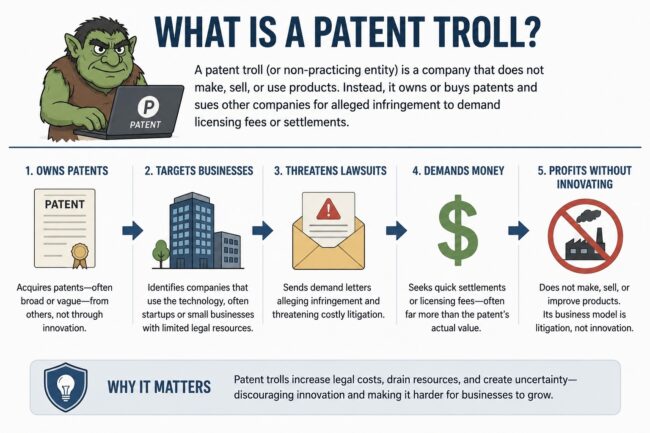
Why would a company that makes no product threaten a patent infringement lawsuit? The US patent system permits patent owners to license and enforce patent rights regardless of whether they manufacture or otherwise provide the patented invention. However, patent trolls acquire patents mainly to collect licensing fees or settlements through aggressive assertion. The label is informal and, of course, does not apply to every owner who seeks to license an invention to an infringer. We explain here what a patent troll is.
Patent trolls are commonly called patent assertion entities or non-practicing entities. They own patents but generally do not manufacture products, sell a patented product, or supply services using a patented technology or method. Instead, the patent holder seeks out patent infringement claims against operating companies that may be making, using, selling, and/or importing an infringing product or offering an infringing service. Under 35 U.S.C. § 271(a), unauthorized making, using, selling, offering to sell, or importing a patented invention can constitute patent infringement. This is the case whether or not the patent owner makes or practices the invention. The licensing or enforcement of patent rights by a non-practicing entity is not inherently misuse.
Universities, research firms, inventors, and other non-practicing entities may sell and license patents legitimately. Some non-practicing entities connect inventors with manufacturers. In the patent world, “patent troll” usually means an entity using bad patents, hidden ownership, or coercive tactics disconnected from the patent’s actual merit and contribution to society. The term typically refers to companies with no products bringing suits that are essentially meritless.
A troll may buy vague or overly broad patents, perhaps from a failing or small company, then assemble a patent portfolio. It may monitor patent applications, new patents, emerging technologies, and possibly infringing technologies for signs that another company is developing infringing or arguably infringing technology. It compares patent claims with the alleged infringer’s product, sends threatening letters asserting alleged infringement, and demands a license.
The demand may be a few thousand dollars, a small sum of money compared with litigation costs, making an early settlement rational, even though there may be weaknesses in the patent due to overly broad patent claims, written description and enablement problems, close prior art that may render the patent invalid, and/or other possible weaknesses. An early victory or settlement by the troll can be used to build momentum and pressure the next company to settle, thereby rewarding the patent troll behavior and causing a detriment to an operating business that may not have engaged in unlawful behavior.
Patent trolls typically target companies with limited legal resources. Patent litigation can span years and cost millions. Median costs for patent infringement litigation may range from $650,000 in smaller cases to more than $5 million in high-value cases. Lawsuits divert focus from core business activities, create financial and operational burdens, and can present significant financial risk, perhaps rising to the level of bankruptcy. They may also block startups from entering markets or discourage companies from developing new products.
Patent trolls filed around 3,000 U.S. lawsuits in 2012. See Colleen Chien’s “Patent Trolls by the Numbers”. Additionally, it was estimated that U.S. businesses incurred $29 billion in direct NPE-dispute costs in 2011. See the Bessen-Meurer study, “The Direct Costs from NPE Disputes”. That estimate was based on defendant survey data and litigation data, and it focused on direct costs such as settlements, licensing fees, and legal expenses. Large companies paid much of the total, but most defendants were small or medium-sized.
MPHJ Technology Investments is an illustrative example of alleged patent troll behavior. The Federal Trade Commission (FTC) filed an administrative complaint against MPHJ, alleging that MPHJ purchased patents covering networked scanning systems and, from September 2012 through June 2013, sent licensing letters to thousands of small businesses in all fifty states and the District of Columbia. The FTC further alleged that recipients were told they likely infringed by using common office equipment, that 9,081 first letters referenced payments of $1,000 or $1,200 per employee, and that later letters threatened legal action for patent infringement. This campaign shows how a patent holder can target more vulnerable technology end users, rather than the manufacturer or other company supplying the equipment, using licensing fees and patent litigation risk to push settlement below expected defense costs.
In Personal Audio, LLC v. Electronic Frontier Foundation, 867 F.3d 1246 (Fed. Cir. 2017), Personal Audio asserted a podcasting patent, U.S. Patent No. 8,112,504. The Electronic Frontier Foundation challenged the patent through inter partes review, an administrative proceeding through the United States Patent and Trademark Office created under the America Invents Act to challenge the validity of patents. It is a faster procedure than patent litigation. The Federal Circuit affirmed the Patent Trial and Appeal Board’s ruling that the challenged claims were unpatentable, due to a lack of novelty in view of the prior art presented to the Patent Trial and Appeal Board during the inter partes review. The case illustrates how prior art challenges can neutralize overly broad or bad patents before they generate additional licensing fees or settlement leverage.
Patent infringement litigation can cause significant harm beyond attorney’s fees and settlement payments because the costs are not limited to the final judgment or settlement. Companies that were in protracted disputes with NPEs were found to experience an average 20% reduction in R&D investment. See Patent Trolls: Evidence from Targeted Firms by Lauren Cohen, Umit Gurun, and Scott Duke Kominers. The same paper reports $163 million less R&D overall in the years following the loss, relative to comparable firms that won.
The research shows that patent troll disputes are correlated with material reductions in R&D. Patent trolls asserting low-quality patents can delay a patented product, chill emerging technology, divert management attention, and reduce innovation by forcing companies to spend on patent litigation instead of developing new products or responding to genuine market demand.
Critics say trolls often buy vague, overly broad, or low-quality patents from failing or small companies and use them to extort settlements. The 2013 Executive Office report, Patent Assertion and U.S. Innovation, identified the following issue: patent assertion entities exploit uncertainty over claim scope and validity, especially where software claims describe a desired function rather than the means for achieving it. Early software patents were leniently issued for technologies that essentially just digitized known processes and methods. Such software patents were commonly exploited by patent trolls.
The June 4, 2013 White House fact sheet, White House Task Force on High-Tech Patent Issues, announced five executive actions and seven legislative recommendations. One action directed the U.S. Patent and Trademark Office (USPTO) to tighten scrutiny of functional claiming, particularly in software patent applications. President Obama essentially directed the USPTO to tighten scrutiny by training examiners on functional claims and improving claim clarity, especially for software. Better examination of patent applications and clearer claims can reduce uncertainty over whether existing uses or new technology infringe.
These initiatives track Patent Act requirements: 35 U.S.C. § 112(b) requires claims that particularly point out and distinctly claim the invention, while § 112(a) requires clear written description and enablement of the invention. Clearer patent applications and stricter examination make it harder to assert a patent’s actual coverage against existing uses or technology that does not infringe.
The America Invents Act, approved September 16, 2011, changed the patent system by creating faster post-grant challenge procedures before the Patent Trial and Appeal Board (PTAB). Inter partes review took effect on September 16, 2012 and became a key defensive tool in patent litigation involving patent trolls because alleged infringers can test weak patent claims by petitioning the PTAB to review a patent without waiting for a trial in district court. A petitioner other than the patent owner may ask the PTAB to cancel (invalidate) claims based on prior art consisting of patents or printed publications that render the claimed invention anticipated (lacking novelty) or obvious to a person of ordinary skill in the relevant art or technology (PHOSITA). See 35 U.S.C. § 311.
Under 35 U.S.C. § 312, the petition must identify the real parties in interest, challenged patent claims, grounds, evidence, and fees. The defendant in a patent infringement lawsuit must act promptly. An IPR must be filed within one year of being served with the complaint under 35 U.S.C. § 315(b). After institution, the Board normally issues a final written decision within one year, extendable six months for good cause. See 35 U.S.C. § 316(a)(11). An IPR can pressure patent trolls by exposing bad patents.
In 2015, over 40% of U.S. patent filings were filed in the Eastern District of Texas, making it a favored forum for patent trolls, patent assertion entities, and other patent plaintiffs. Plaintiffs chose the Eastern District of Texas because the district had developed a reputation as a plaintiff-friendly patent litigation forum. Specifically, the Eastern District had a reputation for experienced patent judges, local patent rules, relatively firm trial schedules, early and expensive discovery obligations, reluctance to transfer cases or stay litigation for Patent Office proceedings, and juries viewed as receptive to patent rights all increased settlement pressure on alleged infringers. Those procedural and practical features made the district especially attractive to patent holders, including patent trolls, seeking licensing fees or early settlement from companies facing potentially high litigation costs. Before 2017, the procedural hook was VE Holding Corp. v. Johnson Gas Appliance Co., 917 F.2d 1574 (Fed. Cir. 1990), where the Federal Circuit held that the general corporate venue definition in 28 U.S.C. § 1391(c) supplemented the patent venue statute, 28 U.S.C. § 1400(b). Because § 1391(c) treated a corporate defendant as residing wherever it was subject to personal jurisdiction, a patent holder could often file a patent infringement lawsuit in any district where accused products were sold, offered for sale, shipped, or supported. For national companies, that meant almost anywhere. Eastern District of Texas complaints therefore often alleged infringement resulting from sales to or use by Texas customers, retailers, or other local acts of infringement.
In 2017, TC Heartland LLC v. Kraft Foods Group Brands LLC, 581 U.S. 258 (2017) rejected that expansive residence theory and held that domestic corporations “reside” only in the state of incorporation for purposes of 28 U.S.C. § 1400(b). Patent cases may still be filed where the defendant committed acts of patent infringement and has a “regular and established place of business.” 28 U.S.C. § 1400(b). That generally requires a physical place in the district that is regular, established, and the defendant’s own place of business. See In re Cray Inc., 871 F.3d 1355 (Fed. Cir. 2017). This changed the game for plaintiffs because potential defendant companies do not reside in the largely rural Eastern District of Texas. These rulings reduced patent plaintiffs' abilities to file in the Plaintiff-friendly forum in the ED of Texas.
Federal Rule of Civil Procedure 11 does not bar patent plaintiffs from enforcing patent rights, but it does require every filed complaint to have a reasonable legal and factual basis. By signing a patent infringement complaint, counsel certifies that the lawsuit is not being filed for an improper purpose, such as harassment or needlessly increasing litigation costs. The legal theories must be warranted by existing law or a nonfrivolous argument to change the law, and that the factual allegations must have evidentiary support or likely will after reasonable discovery. In patent litigation, that means the patent owner’s counsel must conduct a reasonable pre-suit investigation, including interpreting the asserted patent claims and conducting a thorough infringement analysis of the alleged infringer’s product to determine whether the infringement claims are supported. Rule 11 is enforced through a separately filed sanctions motion or, in some circumstances, by a court’s own order to show cause. For party-filed motions, Rule 11 includes a 21-day “safe harbor” requiring that the motion must first be served on the opposing party and prohibiting the filing of the motion if the challenged complaint is withdrawn or corrected within that period. Sanctions may include nonmonetary relief, penalties, or attorney’s fees limited to deterrence.
The proposed Patent Litigation Integrity Act of 2013 would have shifted reasonable lawsuit costs to a losing party unless substantially justified and allowed bonding. It was introduced, but not enacted. Vermont’s May 2013 law prohibits bad-faith infringement threats, including demand letters lacking claim-specific infringement allegations or demanding unreasonable licensing fees. These “loser pays” and demand-letter reforms show the frustration that businesses have toward the disruptive impact of patent trolls and the existing support for patent reform. However, patent reform is slow moving, and there is no likely near term reforms contemplated in the US Congress to address patent trolls.
Patent trolls acquire (e.g., through patent assignment) and assert patents to generate revenue through licensing campaigns or litigation rather than manufacture or sell products. The practical issue is whether their allegations are reasonably supported by the circumstances of the dispute patent claims, the alleged infringer’s product, and the prior art. A company that is sued or receives a demand letter should promptly evaluate ownership, claim scope, infringement, validity, venue, indemnity, and coordinated defenses with suppliers or peer companies before deciding whether to fight, license, or settle.
© 2026 Sierra IP Law, PC. The information provided herein does not constitute legal advice, but merely conveys general information that may be beneficial to the public, and should not be viewed as a substitute for legal consultation in a particular case.

"Mark and William are stellar in the capabilities, work ethic, character, knowledge, responsiveness, and quality of work. Hubby and I are incredibly grateful for them as they've done a phenomenal job working tirelessly over a time span of at least five years on a series of patents for hubby. Grateful that Fresno has such amazing patent attorneys! They're second to none and they never disappoint. Thank you, Mark, William, and your entire team!!"
Linda Guzman


Sierra IP Law, PC - Patents, Trademarks & Copyrights
FRESNO
7030 N. Fruit Ave.
Suite 110
Fresno, CA 93711
(559) 436-3800 | phone
BAKERSFIELD
1925 G. Street
Bakersfield, CA 93301
(661) 200-7724 | phone
SAN LUIS OBISPO
956 Walnut Street, 2nd Floor
San Luis Obispo, CA 93401
(805) 275-0943 | phone

SACRAMENTO
180 Promenade Circle, Suite 300
Sacramento, CA 95834
(916) 209-8525 | phone
MODESTO
1300 10th St., Suite F.
Modesto, CA 95345
(209) 286-0069 | phone
SANTA BARBARA
414 Olive Street
Santa Barbara, CA 93101
(805) 275-0943 | phone
SAN MATEO
1650 Borel Place, Suite 216
San Mateo, CA, CA 94402
(650) 398-1644. | phone
STOCKTON
110 N. San Joaquin St., 2nd Floor
Stockton, CA 95202
(209) 286-0069 | phone
PORTLAND
425 NW 10th Ave., Suite 200
Portland, OR 97209
(503) 343-9983 | phone
TACOMA
1201 Pacific Avenue, Suite 600
Tacoma, WA 98402
(253) 345-1545 | phone
KENNEWICK
1030 N Center Pkwy Suite N196
Kennewick, WA 99336
(509) 255-3442 | phone
2023 Sierra IP Law, PC - Patents, Trademarks & Copyrights - All Rights Reserved - Sitemap Privacy Lawyer Fresno, CA - Trademark Lawyer Modesto CA - Patent Lawyer Bakersfield, CA - Trademark Lawyer Bakersfield, CA - Patent Lawyer San Luis Obispo, CA - Trademark Lawyer San Luis Obispo, CA - Trademark Infringement Lawyer Tacoma WA - Internet Lawyer Bakersfield, CA - Trademark Lawyer Sacramento, CA - Patent Lawyer Sacramento, CA - Trademark Infringement Lawyer Sacrament CA - Patent Lawyer Tacoma WA - Intellectual Property Lawyer Tacoma WA - Trademark lawyer Tacoma WA - Portland Patent Attorney - Santa Barbara Patent Attorney - Santa Barbara Trademark Attorney
