A patent assignment is a transfer of all or part of the ownership of a patent. It is an important tool in the use and exploitation of patented technologies. Patent assignments allow for the monetization of patents, the transfer of technologies between businesses, and corporate management of intellectual property assets. Thus, investors, lenders, acquirers, and competitors need to understand how patent assignments work and how they can be utilized.
A patent assignment is a formal legal document that transfers rights in a patent, patent application, or other interest in patent rights from one party, the assignor, to another, the assignee. In practical terms, the assignment changes who owns the invention and related property rights. The original owner gives up the assigned ownership interest, and the assignee becomes the patent owner for the rights transferred. The assignment may cover an issued patent, an allowed application, a pending patent application, foreign patent rights, or future applications related to the same invention.
Formally, an assignment is a transfer of all or part of a party’s “right, title and interest” in a patent or patent application. Under 35 U.S.C. § 261, patents have the attributes of personal property, and patent applications and patents are assignable by an instrument in writing. That writing requirement is important: oral agreements do not transfer legal title to patent rights. The assignment document should clearly identify the parties, the invention, the application number or patent number if available, the filing date when relevant, and the specific rights being transferred.
Patent ownership determines who has the legal authority to control, commercialize, license, sell, or enforce the invention. For an issued patent, the patent owner obtains exclusive rights to exclude others from making, using, selling, offering to sell, or importing the claimed invention in the United States under 35 U.S.C. § 154(a)(1). This means ownership can directly affect whether a business can stop competitors, negotiate licensing deals, attract strategic partners, or monetize its intellectual property. Properly assigned patents also increase a company’s intangible asset value, which can be important when attracting investors, lenders, or potential buyers. Businesses often leverage patent assignments of related technologies to fast-track inventions into production because the company can consolidate patent rights in a particular area of technology under one entity, raise capital, enter manufacturing relationships, and avoid disputes over who owns the technology related to their product or service. Without clear patent ownership, a company may face enforcement problems, investor diligence issues, or competing claims from inventors, employees, contractors, or prior owners.
A patent assignment may occur at several points in the patent process: before filing, after the filing date of a patent application, during prosecution before the United States Patent and Trademark Office, or after a granted patent has a patent number. For example, inventors may assign an invention to a startup before the applicant files with the patent office, allowing the company to own and control the application from the outset. Assignments also commonly occur after filing when a business is formed, financing closes, employment obligations are confirmed, or ownership needs to be transferred to one entity. Under 35 U.S.C. § 118, a person to whom the inventor has assigned, or to whom the inventor is obliged to assign, the invention may make an application for patent. A properly executed assignment helps identify the patent owner, clarify patent rights, and support later enforcement, licensing, investment, or sale of the intellectual property.
A patent assignment agreement should clearly identify the parties, including the assignor and assignee, and should describe the invention with enough specificity to avoid later ownership disputes. The agreement should list the invention title, inventors, patent application serial number, filing date, and any issued patent number. It should state that the assignor agrees to transfer ownership and presently assigns all right, title, and interest in the patent rights to the assignee, because 35 U.S.C. § 261 requires assignments to be made by a written instrument. The provisions should also address future application filings, such as continuation, divisional, continuation-in-part, reissue, and foreign applications, if rights in foreign countries are being assigned. There are other practical matters that should be contractually addressed to avoid difficulty in formal filings with the U.S. and foreign patent offices, including obligations of the inventor(s) to cooperate in application filings, protecting confidential information, and warranties of inventorship and ownership by the transferring party(ies).
A patent assignment agreement must be in writing. Oral agreements or verbal understandings are insufficient to transfer legal title under 35 U.S.C. § 261, which provides that patents and patent applications are assignable by an instrument in writing. The assignment document should clearly identify the patent, patent application, patent number if available, assignor, assignee, and the right, title, and interest being transferred. Courts distinguish between a present assignment and a mere promise to assign in the future, so language such as “hereby assigns” is generally stronger than language stating that the inventor “will assign.” Patent assignments do not need to be notarized to be valid. However, notarization is strongly advised because an acknowledged assignment can provide prima facie evidence that the assignment, grant, or conveyance was executed. This added protection can help if one party later challenges the signature, date, authority, or enforceability of the transfer. For businesses, written and signed assignments reduce ownership disputes and support later USPTO recordation.
Patent assignments allow businesses to own inventions created by employees or independent contractors, ensuring that all invention rights are consolidated under one entity. This is critical because inventors generally own their inventions at conception unless they execute a written assignment transferring title to a company. In Stanford v. Roche, 563 U.S. 776 (2011), the Supreme Court emphasized that patent rights initially vest in the inventor, and an employer does not automatically own an employee’s invention merely because the employee worked on it during employment.
For that reason, proper assignment clauses in employment agreements are essential for securing intellectual property and preventing inventors from licensing to competitors. A company should not rely only on job duties, payroll status, or use of company resources. Instead, the employment agreement should include a present assignment of inventions, an obligation to disclose inventions, a duty to cooperate in patent filing, and a requirement to execute confirmatory assignment documents for each patent application. Similar provisions should appear in independent contractor agreements because contractors usually retain ownership unless the agreement expressly transfers patent rights.
The language matters. In Arachnid, Inc. v. Merit Industries, 939 F.2d 1574 (Fed. Cir. 1991), language stating that rights “will be assigned” was treated as a promise to assign in the future, not an immediate transfer. By contrast, in FilmTec Corp. v. Allied-Signal, 939 F.2d 1568 (Fed. Cir. 1991), present-tense assignment language was effective to automatically transfer title. A patent assignment agreement may also address compensation, confidentiality, prosecution assistance, and noncompete clauses that prevent inventors from working in the same field after assignment, although noncompete provisions require separate enforceability review under applicable state law.
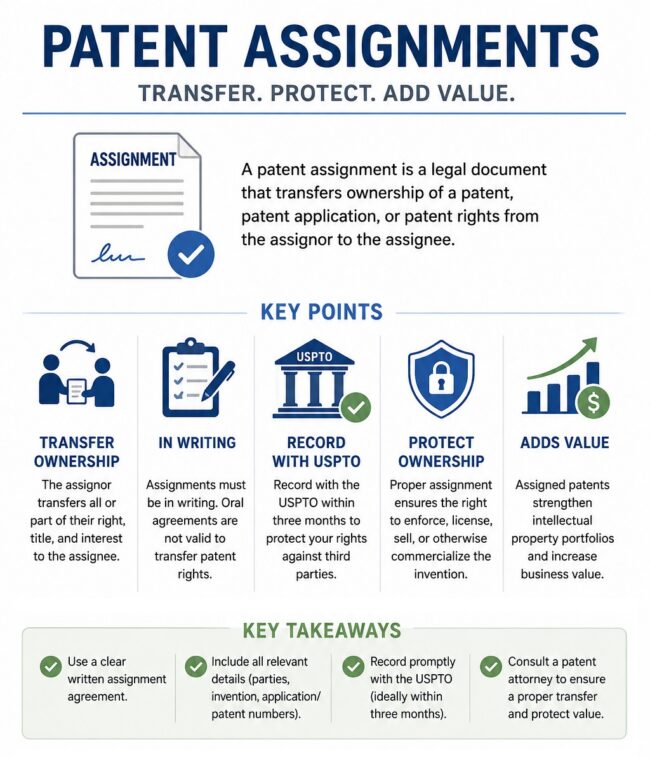
A patent assignment is a permanent transfer of ownership from one entity to another. The assignor gives up its right, title, and interest in the patent, patent application, or issued patent, and the assignee becomes the new patent owner. A licensing agreement is different from an assignment because the patent owner (the licensor) retains ownership but grants permission to a licensee to use the patented technology under agreed terms. In practical terms, licensing is like renting a house, while an assignment is like selling a house.
This distinction matters because ownership affects who may enforce the patent, license others, sell the asset, and control commercialization. The Supreme Court’s Waterman v. Mackenzie, 138 U.S. 252 (1891) decision remains a leading case distinguishing assignments that convey patent title from mere licenses. The Court held that an assignment exists where the transfer conveys: (1) the whole patent; (2) an undivided part or share of the patent; or (3) the exclusive right under the patent within a specified territory. By contrast, a transfer of fewer rights is generally a license rather than an assignment.
Upon assignment, the inventor or original owner relinquishes control over how the invention is developed, priced, commercialized, or utilized. Assignment often comes with compensation such as royalties, equity, or a lump-sum payment. Patent assignments can provide immediate financial benefit to the assignor, while the assignee can generate revenue through licensing patent rights and earning royalties.
To execute a patent assignment, the parties should create a written assignment document, obtain signatures from the assignor and assignee, and record the transfer with the USPTO. Recording does not create the transfer itself, the assignment agreement does that, but recording gives public notice that the assignee claims patent ownership. This is critical because failure to record an assignment within three months of its date, or before a later purchaser or mortgagee appears, can make the transfer void against a subsequent bona fide purchaser or mortgagee for value without notice. In practical terms, late recording can cloud title, delay financing or acquisition diligence, complicate patent enforcement, and create disputes over who owns the patent rights. A company that fails to record may also face problems if an original owner later signs conflicting documents. Prompt USPTO recordation helps preserve the assignee’s priority, confirms the chain of title, reduces ownership challenges, and ensures the assignment is enforceable against third parties.
The assignment should be recorded through the USPTO Assignment Center and the Assignment Recordation Branch by submitting a recordation cover sheet and a copy of the actual assignment. Assignments of applications and patents must be accompanied by a proper cover sheet that meets the requirements of 37 C.F.R. §§ 3.28 and 3.31, when submitted. The USPTO’s Assignment Center handles patent and trademark assignment submissions. The patent office also provides how-to guides for recording assignments for patents and trademarks. Once the assignment is properly recorded, it becomes a record in the USPTO assignment records public database and can be found through an assignment search in through the USPTO’s web-based application. The ownership of the patent can be found by third parties through a patent assignment search using the patent application number, patent number, inventor name(s), and other associated data as search criteria.
A patent assignment is more than a formality. It determines who owns, controls, licenses, and can enforce valuable patent rights. For a company, the right assignment document can ensure that the company owns inventions created by employees and contractors, protect patent ownership, support investment, and preserve patent protection. Before signing, recording, or relying on an assignment, businesses should consult a patent attorney to confirm that the agreement, USPTO record, and commercial provisions match the intended transfer.
© 2026 Sierra IP Law, PC. The information provided herein does not constitute legal advice, but merely conveys general information that may be beneficial to the public, and should not be viewed as a substitute for legal consultation in a particular case.

"Mark and William are stellar in the capabilities, work ethic, character, knowledge, responsiveness, and quality of work. Hubby and I are incredibly grateful for them as they've done a phenomenal job working tirelessly over a time span of at least five years on a series of patents for hubby. Grateful that Fresno has such amazing patent attorneys! They're second to none and they never disappoint. Thank you, Mark, William, and your entire team!!"
Linda Guzman


Sierra IP Law, PC - Patents, Trademarks & Copyrights
FRESNO
7030 N. Fruit Ave.
Suite 110
Fresno, CA 93711
(559) 436-3800 | phone
BAKERSFIELD
1925 G. Street
Bakersfield, CA 93301
(661) 200-7724 | phone
SAN LUIS OBISPO
956 Walnut Street, 2nd Floor
San Luis Obispo, CA 93401
(805) 275-0943 | phone

SACRAMENTO
180 Promenade Circle, Suite 300
Sacramento, CA 95834
(916) 209-8525 | phone
MODESTO
1300 10th St., Suite F.
Modesto, CA 95345
(209) 286-0069 | phone
SANTA BARBARA
414 Olive Street
Santa Barbara, CA 93101
(805) 275-0943 | phone
SAN MATEO
1650 Borel Place, Suite 216
San Mateo, CA, CA 94402
(650) 398-1644. | phone
STOCKTON
110 N. San Joaquin St., 2nd Floor
Stockton, CA 95202
(209) 286-0069 | phone
PORTLAND
425 NW 10th Ave., Suite 200
Portland, OR 97209
(503) 343-9983 | phone
TACOMA
1201 Pacific Avenue, Suite 600
Tacoma, WA 98402
(253) 345-1545 | phone
KENNEWICK
1030 N Center Pkwy Suite N196
Kennewick, WA 99336
(509) 255-3442 | phone
2023 Sierra IP Law, PC - Patents, Trademarks & Copyrights - All Rights Reserved - Sitemap Privacy Lawyer Fresno, CA - Trademark Lawyer Modesto CA - Patent Lawyer Bakersfield, CA - Trademark Lawyer Bakersfield, CA - Patent Lawyer San Luis Obispo, CA - Trademark Lawyer San Luis Obispo, CA - Trademark Infringement Lawyer Tacoma WA - Internet Lawyer Bakersfield, CA - Trademark Lawyer Sacramento, CA - Patent Lawyer Sacramento, CA - Trademark Infringement Lawyer Sacrament CA - Patent Lawyer Tacoma WA - Intellectual Property Lawyer Tacoma WA - Trademark lawyer Tacoma WA - Portland Patent Attorney - Santa Barbara Patent Attorney - Santa Barbara Trademark Attorney
